



- Automated contract drafting uses AI and pre-approved templates to generate contracts in minutes instead of hours, reducing manual drafting time by up to 80% according to CLM industry benchmarks.
- The core features that power automated drafting include template libraries, clause banks, conditional logic rules, intake forms, and AI-assisted language generation with human oversight for final review.
Automated contract drafting is the process of using software, typically powered by AI and machine learning, to generate contracts from pre-approved templates, clause libraries, and conditional rules. Instead of writing each agreement from scratch, legal and business teams use automated tools to assemble accurate contracts in minutes.
Organizations that adopt automated drafting report up to 80% reduction in contract creation time and significantly fewer errors in final agreements. This guide covers how automated contract drafting works, the key features to look for, the technology behind the process, and how to evaluate whether automation fits your contract approval workflow.
In this blog post, we’ll learn how automated contract drafting works and why it’s so helpful for legal teams.
What is automated contract drafting and how does it work?
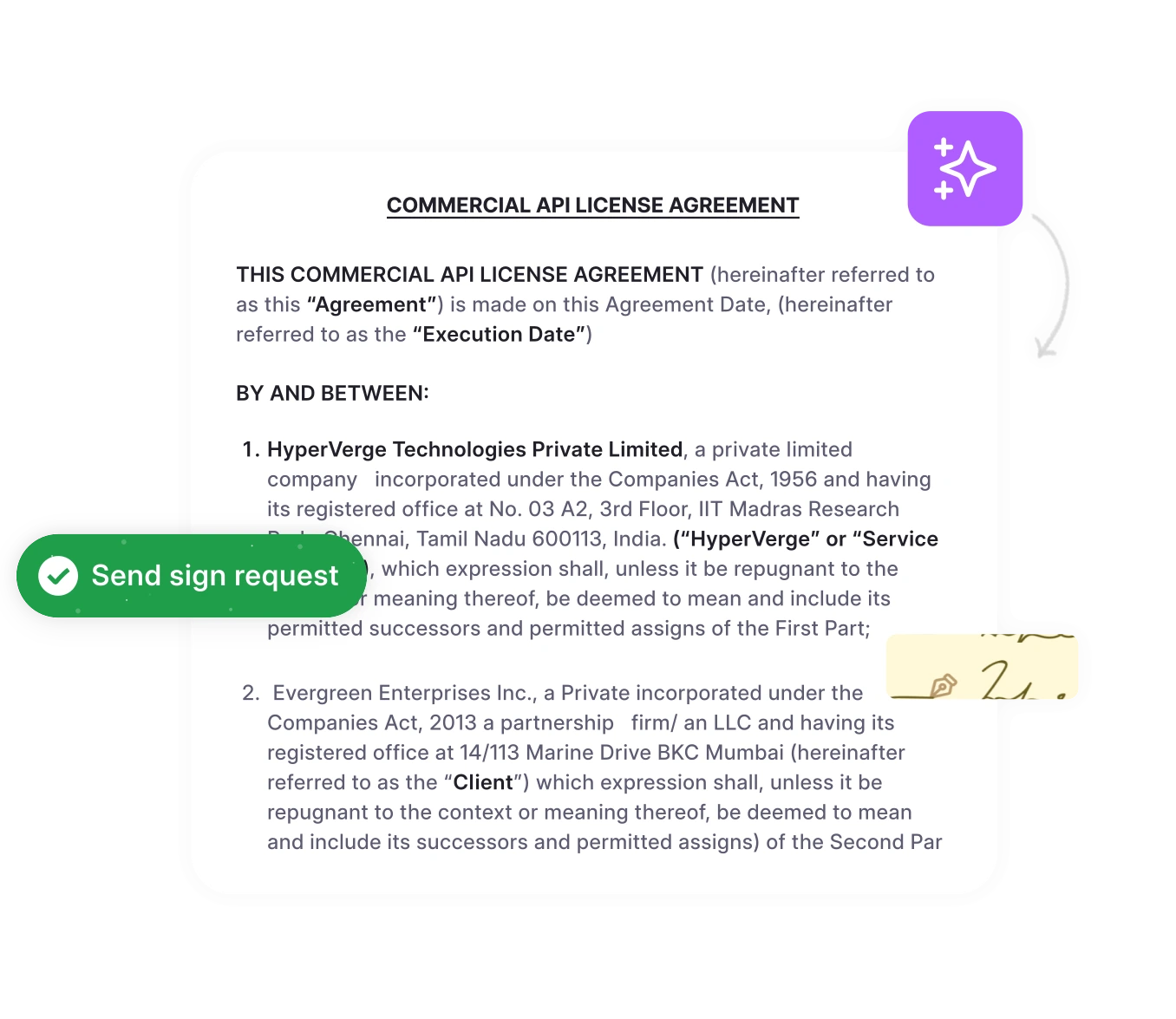
Automated contract drafting is the process of using software, powered by AI and machine learning, to generate legally accurate contracts from pre-approved templates, clause libraries, and conditional rules.
Rather than writing each agreement from scratch, legal and business teams configure templates with standard terms, and the software assembles complete contracts by pulling the correct clauses based on contract type, party details, and jurisdiction. The process reduces manual drafting time by up to 80%. An automated contract is generated in minutes rather than days, with consistent clause language across every agreement.
As per a report by Thomson Reuters Institute, one of the top uses of ChatGPT and Generative AI technologies in legal and corporate is in contract drafting (76%). Automated contracting encompasses the full range of software-driven contract processes, from initial drafting through execution and renewal tracking.
Instead of drafting each contract from scratch, legal and business teams can use automated tools to fill in standard clauses, terms, and variables, adapting the language based on factors like contract type, party details, or jurisdiction.
According to World Commerce & Contracting, poor contract management costs organizations an average of 9% of their annual revenue, with missed deadlines, inconsistent terms, and manual errors accounting for the largest share of that loss.
This approach minimizes human error, enhances consistency, and significantly reduces drafting time. Automated contracts (also called auto-generated contracts) are agreements assembled by software using pre-approved templates, reducing the need for manual drafting.
Why is traditional contract drafting slow and error-prone?
Traditional contract drafting is slow because legal teams manually create each agreement from scratch or from outdated templates, a process that takes an average of 1 to 3 weeks per contract for mid-complexity agreements. The manual approach introduces errors through copy-paste mistakes, inconsistent clause language, and version control failures. According to the Journal of Contract Management, 71% of companies cannot locate 10% or more of their active contracts, further compounding delays.
Traditional drafting processes often result in fragmented information, making it difficult to track contracts, identify risks, or ensure compliance across departments.
Traditional contract drafting faces numerous challenges that can hinder efficiency, compliance, and overall effectiveness in managing agreements. Here are the primary issues associated with this outdated approach:
1. Siloed data and lack of visibility
Contracts are often stored in various locations—paper files, emails, and personal drives—leading to information silos. This fragmentation makes it difficult to track obligations and deadlines, resulting in missed opportunities and potential legal risks. Many organizations struggle to locate all their contracts, complicating compliance and oversight.
2. Inflexible and time-consuming processes
The manual nature of traditional contract drafting is inherently slow and prone to errors. Processes such as drafting, negotiating, and approving contracts can take significant time, diverting resources from core business activities. Legal departments often find themselves bogged down by inefficient workflows that delay contract execution.
3. Non-compliance and risk management issues
Manual tracking of contractual obligations increases the risk of non-compliance with legal requirements. This lack of oversight can lead to costly penalties or disputes over contract terms. Additionally, the inability to effectively identify and mitigate risks associated with contracts can expose organizations to significant financial liabilities.
4. Inefficient search and analysis
Finding specific clauses or obligations within a large volume of contracts is cumbersome when using traditional methods. The absence of a centralized database means extracting insights from contracts is labor-intensive and often inaccurate. This inefficiency can delay decision-making processes and hinder strategic planning.
5. Limited scalability and collaboration
As businesses grow, the volume of contracts typically increases. Traditional systems struggle to manage this growth effectively, making it difficult for teams across departments to collaborate on contracts. Without streamlined communication channels, the approval process can become a bottleneck, further complicating contract management efforts.
6. Poor drafting practices
Traditional drafting often relies on outdated templates or inconsistent language, leading to misunderstandings and potential legal disputes. Many drafts are created without adherence to established guidelines, resulting in unclear or redundant clauses that complicate agreements unnecessarily. The reliance on “copy-and-paste” methods contributes to a lack of clarity in contracts, making them harder for all parties to understand.
7. Resistance to technological adoption
Despite the availability of advanced contract management solutions that could alleviate many of these challenges, many organizations remain hesitant to adopt new technologies. Factors such as budget constraints, resistance to change, and a lack of awareness about the benefits of automation hinder progress toward more efficient contract management practices.
Who benefits most from automated contract drafting?
Legal teams benefit most from automated contract drafting because contract assembly is their highest-volume repetitive task. Sales teams, HR departments, and procurement teams also benefit by generating NDAs, employment agreements, and vendor contracts without waiting for legal review on standard terms. Organizations with high contract volumes (100+ agreements per month) see the fastest return, often reclaiming 80% of the time previously spent on manual drafting. The AI legal drafting tools market reached $811.8 million in 2025 and is projected to grow at a 27.4% CAGR through 2034, according to Market.us research
Automated contract drafting provides significant advantages for enterprises, small businesses, startups, and solopreneurs, helping to boost productivity and save resources by streamlining the contract creation workflow. Automated contract creation is especially valuable for organizations generating 100+ agreements per month, where manual drafting creates bottlenecks in sales, procurement, and HR.
This is particularly transformative for various departments across organizations, each with specific KPIs and deliverables within their scope of work.
1. How legal teams benefit from automated drafting
Automated contract drafting is a game-changer for legal teams. AI-powered legal contract drafting software can generate contracts in minutes, incorporating chameleon clauses and automatic styling for consistency. With tools designed to enhance negotiation capabilities, in-house legal teams can utilize pre-approved clause libraries and templates that ensure compliance and efficiency. This approach can reclaim up to 80% of legal operations efficiency by:
Reducing time spent on drafting: Contracts are created quickly, eliminating the need to scroll through extensive paperwork to find definitions or errors.
Streamlining legal tasks: Contract management software automates not just contract drafting but also document review, compliance checks, and case management.
Enhancing strategic focus: Legal resources can be redirected toward more strategic tasks such as risk assessment, negotiations, and advisory roles, as compliance checks and approval workflows minimize errors and omissions.
Apart from contract drafting the CLM software can help to automate other legal tasks such as contract creation, document review, compliance checks, and case management.
2. How non-legal teams (sales, HR, procurement) benefit from automated drafting
Non-legal departments such as sales, HR, procurement, and finance also benefit immensely from automated contract drafting. The CLM process becomes more collaborative, guided, and intuitive, enabling different teams to take ownership of generating routine agreements without relying heavily on legal support. This not only reduces costs associated with legal operations but also enhances employee morale and productivity. Key benefits include:
Sales Teams: Automated contract drafting enables faster turnaround times (TAT) for contracts, allowing sales teams to close deals more quickly and improve customer satisfaction scores.
Procurement Teams: Automation ensures consistency and accuracy in vendor contracts, fostering better supplier relationships, which can lead to more favorable terms, reduced costs, and enhanced collaboration.
Human Resources Teams: HR can process standard employee contracts in bulk, streamlining recruitment and onboarding processes while minimizing paperwork.
Finance Teams: Automated drafting incorporates built-in compliance checks and mandated guardrails, leading to better contract risk management and improved cash flow.
Automate Your Contract Drafting Today
Reduce drafting time and focus on real opportunities instead of routine paperwork. Get started with HyperStart and see the difference.
Book a DemoWhat features should automated contract drafting software include?
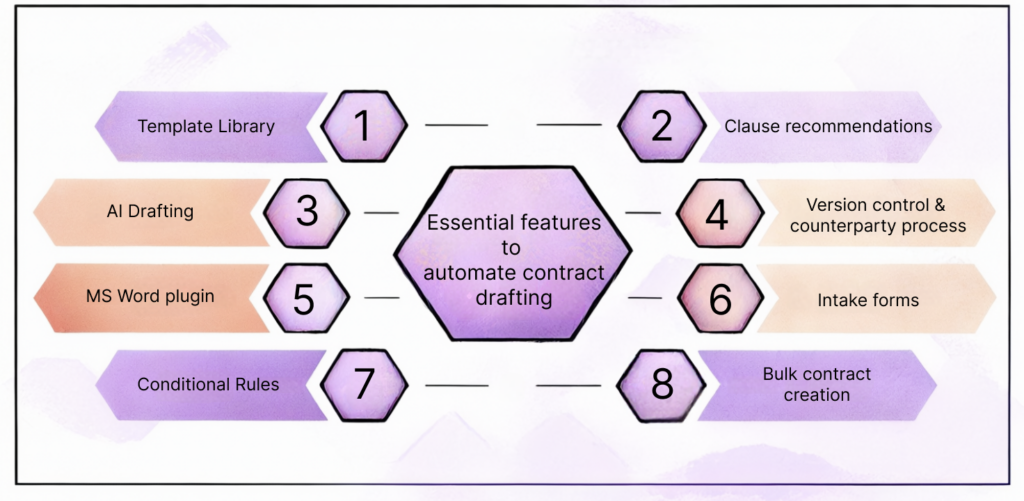
Automated contract drafting software should include eight core features: a template library with pre-approved formats, a clause bank for standard and custom language, AI-assisted drafting with human oversight, version control with audit trails, a Microsoft Word plugin for familiar editing, automated intake forms, conditional logic rules that adjust terms dynamically, and bulk contract creation for high-volume processing.
Contract drafting comprises crucial milestones that make sure an agreement is comprehensive, legally binding, compliant, and mutually beneficial for each party involved. Automating rote work along this process empowers the whole organization and counterparties with contracting structure and velocity. To automate contract creation at your organization, start by identifying the five to ten agreement types your team drafts most frequently, then configure templates for those high-volume contracts first. HyperStart AI-based contract management software offers a single comprehensive set of contract drafting tools to elevate your drafting experience through automation:
1. Template library
Pre-approved templates are dynamic digital assets that help you repurpose standard form agreements. There is no need to recreate the wheel for similar agreements, saving valuable time and resources.
2. Clause recommendations
Clauses function as legos to ensure consistency in terminology, grammar, style, cross-referencing, contracting policies, and other elements. They are designed to adapt to different environments and the library is built to be a shared brain of standardized clauses.
3. AI drafting
Assisted drafting allows users to draft and redraft clauses and documents with case-specific prompts and query contracts for key information. While AI-powered tweaking updates contractual language autonomously, it still requires human supervision.
4. Version control and counterparty access
A clear audit trail with version control features allows you to track changes and revisit previous versions if necessary while making sure each party involved is working with the current iteration of the agreement. HyperStart also offers secure counterparty access for faster review.
5. MS Word plugin
Eliminate switching between tabs and applications with automated templates directly from a browser-native MS Word plugin. This functionality is both familiar and simplified for automated contract generation.
6. Intake forms
The intake forms automate contract creation, making it much simpler and more efficient for employees, vendors, and suppliers to create a wide range of contracts like NDAs, MSAs, employee agreements, order forms, and so on. It empowers non-legal professionals to initiate routine contract requests and gather information.
7. Conditional rules
Conditional rules add another layer of automation. They dynamically adjust the contract based on the input, populating relevant clauses and sections based on specific form responses.
8. Bulk contract creation
High volumes of standard contracts can be initiated, processed, sent, and tracked with bulk actions. Bulk contract creation is a handy tool for HR and procurement teams that deal with multiple contracts, allowing them to pre-populate data and save significant time and effort.
What technology powers automated contract drafting?
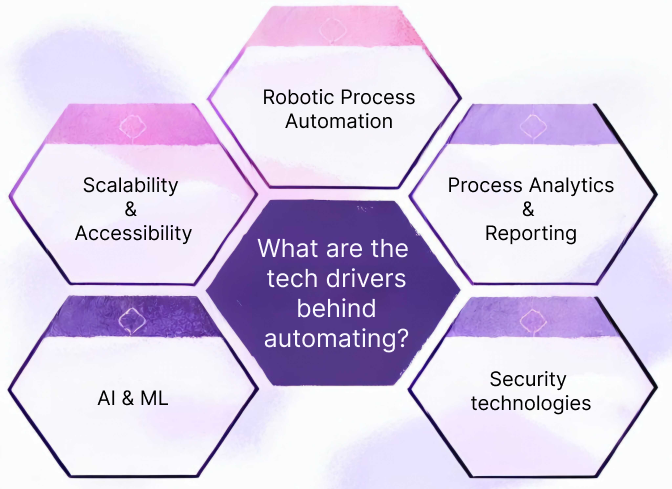
Five technologies power automated contract drafting: natural language processing (NLP) for understanding and generating contract language, machine learning for clause recommendations and risk identification, cloud computing for secure and scalable access, robotic process automation (RPA) for handling repetitive tasks like data entry and routing, and process analytics for tracking contract cycle times and bottleneck identification.
Artificial intelligence and machine learning
Natural language processing (NLP): NLP parses through complex legal texts, identifies key clauses, analyzes them, and suggests appropriate clauses based on pre-approved rules and standardized templates. Automated contract generation relies on these NLP models to understand contract language patterns and produce complete agreement drafts from structured inputs like intake forms and CRM data.
Predictive analytics: Machine learning models analyze a centralized repository to spot contract risks and predict outcomes and performance based on key clauses or non-compliance.
Intelligent document automation: This system automatically populates templates with key clauses, making them dynamic to fit specific contract requirements.
These elements together form a comprehensive contract intelligence system that enhances the efficiency, accuracy, and effectiveness of contract management.
Cloud solutions and integrations
Cloud computing: Cloud-based CLM platforms ensure that all contract data is securely stored and backed up. The systems can be accessed and scaled safely from anywhere for better collaboration among distributed or remote teams.
Integrations: Cloud-based CLM systems integrate with other business applications like CRM, ERP, and HRMS for frictionless data flow and alignment with other business processes.
Robotic process automation (RPA)
Automating repetitive tasks: This technology uses contract drafting software bots to automate duplicative, rule-based tasks, reducing the drafting time frame and manual errors. This is best for mundane work like data entry, contract formatting, and compliance audits so legal professionals can focus on more meaningful work.
Workflow automation: RPA also streamlines the workflow by automating routine contracts for review without delays or bottlenecks.
Process analytics and reporting
Dashboard insights: Key metrics like contract cycle times, approval times, time taken for review, and compliance rates can be tracked to continually optimize the contract process. A custom in-flight dashboard can offer real-time visibility into the contracting process and status to make sure KPIs are met.
Security technologies
Data encryption:Advanced encryption methods are crucial to keeping contract data safe in transit and at rest. Robust access controls, multi-factor authentication, and workflow mechanisms must reflect security measures for confidentiality and data integrity.
What is the difference between automated contract drafting and contract management?
Automated contract drafting focuses specifically on the creation phase of a contract, using templates, clause libraries, and AI to generate new agreements quickly and accurately. Contract management covers the entire contract lifecycle, from drafting through negotiation, execution, compliance monitoring, renewal tracking, and expiration management.
| Factor | Automated contract drafting | Contract management (CLM) |
|---|---|---|
| Scope | Contract creation phase only | Full lifecycle: creation through expiration |
| Core function | Assembles contracts from templates and clause libraries | Tracks, stores, monitors, and manages all contracts |
| Key tools | Template library, clause bank, AI drafting, conditional logic | Repository, dashboards, alerts, renewal tracking, compliance |
| Time savings | Up to 80% reduction in contract creation time | Varies. 5 to 15% annual cost reduction across contract portfolio |
| Primary users | Legal teams, sales, HR, procurement | Legal, operations, finance, compliance |
| ROI timeline | 30 days (immediate reduction in drafting time) | 3 to 6 months (requires full workflow migration) |
| HyperStart capability | Yes. AI-powered drafting with 94% accuracy | Yes. Full CLM with repository, dashboards, and alerts |
Drafting automation is one component within a broader contract lifecycle management (CLM) platform. Organizations often start with automated drafting because it delivers the fastest ROI, reducing contract creation time by up to 80%. From there, teams expand into full lifecycle management to handle approvals, compliance tracking, and renewal alerts.
A CLM platform like HyperStart combines both capabilities: AI-powered drafting for fast contract creation and full lifecycle management tools (repository, dashboards, alerts, integrations) to manage agreements from creation through expiration.
How does HyperStart automate contract drafting?
HyperStart automates contract drafting through AI-powered metadata extraction with 94% accuracy, a central repository with full-text search across all agreements, real-time dashboards for tracking contract status and cycle times, and pre-built integrations with existing business tools. HyperStart deploys in 4 weeks and has processed over 8 million documents across 190+ countries, helping organizations reduce contract-related costs by approximately 30% annually.
See how HyperStart works! 👇
1. AI-powered metadata extraction
As our extractive AI models lead the force of innovation, their 99% accuracy has proved incredibly lucrative and efficient. It performs tasks that would otherwise take weeks and months to manually enter, track, and follow up on in mere minutes. You can automatically track contract expiration dates, liability exposure, and other key obligations. You can also automate reminder alerts to necessary stakeholders about upcoming obligations.
Beyond metadata extraction, HyperStart allows you to redline contracts quickly using AI-powered review and version control. Its intuitive in-app editor or Microsoft Word plug-in helps comment and suggest changes. Recently, HyperStart helped LeadSquared streamline its contract review process. Here is the testimonial of their legal head.
We took demos of around 5 CLM vendors and chose to use HyperStart. They were the only CLM vendor who had SOC2 compliance and met the criteria of around 22 parameters which we had evaluated them on.

Om Prakash Pandey
Head of Legal at LeadSquared
2. Central repository with a powerful search
The repository stores, organizes, and retrieves contracts in one secure, unified space. Bulk import contracts from Gmail, OneDrive, Google Drive, Salesforce CRM, or your local storage. Find the contract data you’re looking for in seconds. These centralized systems of intelligence are meticulously organized, easily searchable with powerful AI, SSO integrated, and end-to-end encrypted. No more file hunts with digital contract repositories.
3. Dashboards and analytics
Visualizing contract data helps you decrease risk exposure with auto-generated reports. Understand your risk exposure with better contract visibility and avoid contract breach penalties. They help you manage obligations and avoid contractual risks like conflicts, penalties, and termination based on contract type, deadlines, recurrence, and criticality. Visual graphs help visualize critical data for easy consumption. Key functionalities include AI-powered extraction and analysis and proactive notification reminders. Proactive tracking prevents oversight, missed renewals, and contract risks.
4. Security
Legal tech adoption in AI across the world is seeing an uptake. The US and Canada lead the charge with larger conversations on data privacy and cybersecurity despite headwinds in pending regulatory policies, lack of trust, and budgets. HyperStart is hosted on AWS with ISO 27001:2013, and SOC Type 2 compliant standards. Furthermore, you can set granular access to the contracts and define who works on them at which stage. With access control, your contracts are searchable, trackable, and safe.
5. Affordable
HyperStart is a no-brainer choice for many scaling organizations as you save up to 30% on your annual subscription. It is accessible and scalable, offering superior value at a fraction of the cost. You get to save money on consultant fees for set-up and support. You pay for the modules you use with no hidden fees. We’re contour custom pricing to make sure we tailor the solution to your business needs. Besides, you get to realize ROI 75% faster.
How do you get started with automated contract drafting?
Getting started with automated contract drafting requires three steps: auditing your current contract workflow to identify the highest-volume, most repetitive agreement types (typically NDAs, sales contracts, and vendor agreements), selecting a CLM platform that integrates with your existing tools and supports your contract volume, and migrating your approved templates and clause libraries into the new system. Most organizations see measurable time savings within the first 30 days of deployment.
There is no lack of tech advances in contract drafting. The process can be fully automated with human intervention for a final review. AI automation and augmentation have proven incredibly efficient, performing hours and weeks of work in a few minutes. The landscape has never been this vibrant or crowded. With new product launches every week, it’s increasingly difficult for lawyers to assess which tools will work for them best.
As a product of HyperVerge, we build deep-learning AI engines that have processed 8+ million documents in the past 3 years in 190+ countries across 5 geographies. You can seamlessly import scanned or digital contracts from your inbox, CRM, or drive in minutes. Critical data is auto-extracted with AI and highlighted to repurpose so you can create contracts in 2 minutes.
Transform Your Contract Drafting Process With HyperStart
Generate accurate contracts in just 2 minutes using HyperStart’s dynamic templates and intuitive intake forms.
Book a Demo