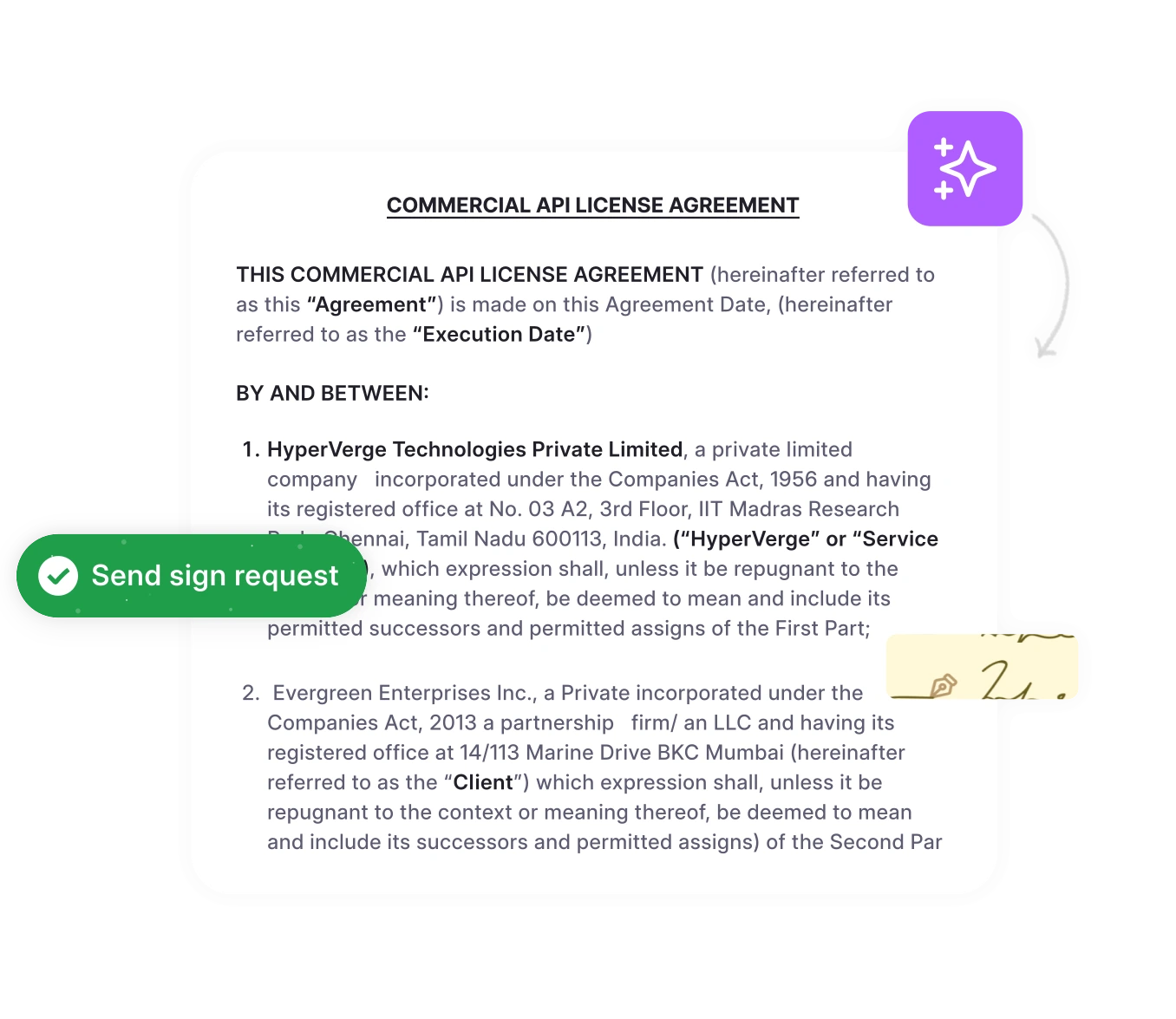


A clearly drafted Employment Agreement can set out the obligations and expectations of the company and the employee in a way to minimize future disputes.
Hiring the right talent is hard enough. According to AIHR’s HR research, permanent employee contracts make up around 60% of the workforce in the United States, encompassing both full-time and part-time positions. This represents the most prevalent employment arrangement in the American labor market.
Whether you’re scaling a startup or managing a distributed team, understanding the different types of contracts available isn’t just an HR checkbox. Automating boilerplate affects your strategic impact, compliance posture, and ability to attract top-tier talent.
In this guide, we’ll break down 12 types of employment contracts, decode the difference between employee and worker status in 2026, and show you how to future-proof your agreements.
Why one size doesn’t fit all: The modern contract landscape
Gone are the days when a single employment contract template could cover your entire workforce. Today’s hiring landscape demands flexibility, precision, and a deep understanding of statutory rights across jurisdictions.
From stability to scalability: Aligning business goals with contract types
Your contract strategy should mirror your business model. A venture-backed SaaS company scaling aggressively will have different needs than a bootstrapped agency managing seasonal projects. The key is matching contract types to specific roles, risk tolerance, and growth trajectory.
Think of it this way: full-time permanent contracts offer stability and retention, while fixed-term agreements give you the agility to pivot without long-term overhead. Getting this balance right can mean the difference between sustainable growth and a compliance nightmare.
While legally binding in some regions, verbal contracts are difficult to prove and create significant risk for both parties. In 2026, a written statement of particulars is a global best practice for risk mitigation. Verbal agreements lack the clarity needed to resolve disputes around compensation, duties, or termination terms.
7 Standard employment contract types
Let’s focus on the most common arrangements you’ll encounter when building your team.
1. Full-time permanent: The gold standard for talent retention
Papaya Global’s workforce data indicates that full-time employment consisting of 35-40 hours per week remains the most common type among 12 different employment classifications, though each impacts organizational operations, costs, and flexibility differently.
Full-time permanent contracts typically include:
- Comprehensive benefits packages (health insurance, retirement contributions, paid time off)
- Protection under employment law with stronger statutory rights
- Clear termination procedures and notice periods
- Opportunities for career advancement and skill development
These agreements work best for core team members who drive long-term value. Think product leads, senior engineers, and department heads where institutional knowledge is critical.
2. Part-time contracts: Balancing flexibility and prorated benefits
Part-time arrangements (typically under 35 hours per week) offer businesses a way to access specialized skills without full-time overhead. The trade-off? Prorated benefits and potentially lower employee engagement.
The key here is clarity. Your HR contractsshould explicitly outline:
- Weekly hour expectations
- Benefits eligibility thresholds
- Scheduling requirements and advance notice
- Rights regarding additional hours or transition to full-time status
3. Fixed-term & project-based: Managing seasonal peaks and specialized gigs
Fixed-term contracts have a defined end date, making them perfect for covering parental leave, seasonal demand spikes, or specific projects with clear deliverables. These agreements must specify the contract duration and conditions for renewal or conversion to permanent status.
Repeatedly renewing fixed-term contracts can trigger automatic conversion to permanent employment under certain labor laws. This is especially true in jurisdictions with strong worker protection frameworks.
4. Zero-hour & casual contracts: Maximum agility (with compliance warnings)
Zero-hour contracts offer maximum flexibility, employers aren’t obligated to provide minimum hours, and workers aren’t obligated to accept offered shifts. While this sounds ideal for businesses with unpredictable demand, there’s a catch.
These arrangements carry significant misclassification risk and have faced increased regulatory scrutiny. The duty of mutual trust and confidence can be difficult to establish when work availability is inconsistent, potentially exposing you to claims of unfair treatment or vicarious liability.
Zero-hour contracts can work for genuinely irregular needs (event staffing, seasonal hospitality roles), but using them to avoid providing statutory rights to regular workers is unsound legally and for the brand.
5. Freelance (1099) vs. worker status: Navigating the misclassification minefield
This is where things get complex. The difference between employee and worker status in 2026 has massive implications for tax obligations, benefits, and legal liability.
Independent contractors (1099s):
- Control their own work methods and schedules
- Provide their own tools and equipment
- Work for multiple clients simultaneously
- Invoice for services rendered
- Bear their own tax and insurance responsibilities
Workers/employees:
- Follow company processes and supervision
- Use employer-provided resources
- Work primarily or exclusively for one organization
- Receive regular wages with tax withholding
- Qualify for benefits and employment protections
Misclassifying employees as contractors to save on payroll taxes and benefits? That’s a fast track to audits, penalties, and back payments. The IRS and DOL have specific tests to determine proper classification, and AI-powered audit tools are making it easier than ever for regulators to spot violations.
6. At-will employment: Understanding the US standard
At-will employment means either party can terminate the relationship at any time, for any legal reason, without advance notice. It’s the default in most US states and provides maximum flexibility for both employers and employees.
However, “at-will” doesn’t mean “without consequences.” You still can’t fire someone for discriminatory reasons, retaliation, or in violation of public policy. Written employment agreements should clearly state at-will status while outlining expectations, compensation, and any exceptions to the at-will doctrine.
7. Apprenticeships & internships: Investing in the future pipeline
These agreements combine work with structured learning and skill development. Apprenticeships typically involve formal training programs with industry certifications, while internships offer shorter-term exposure to professional environments.
Critical compliance point: unpaid internships must meet strict criteria around educational benefit and must not displace regular employees. When in doubt, pay your interns, it’s a small investment in future talent and protects you from wage claims.
Stop Juggling Manually Contract Templates
Managing multiple types of employment contracts shouldn’t be a manual headache. Hyperstart automates drafting and compliance so you can hire in minutes.
Book a DemoKey terms that define your employment relationship
Every employment agreement should cover these fundamental elements, though the specifics will vary based on contract type and jurisdiction.
1. Compensation: More than just base salary
Compensation is the most obvious key issue, but there are multiple layers of negotiating points encompassed here, including:
- Does the base salary increase year on year?
- If an employee loses options and other benefits during a job switch, would there be a signing bonus?
- What is the quarterly or annual bonus? Is it dependent on achievement of milestones or wholly discretionary with the Board of Directors?
- Under what circumstances can the employee’s base salary be reduced? Some agreements give the company the right to reduce base salary up to a certain percentage if other similar situated employee salaries are similarly reduced (such as might occur when the company is in financial distress).
2. Equity: The startup compensation wildcard
For growth-stage companies, equity can be even more valuable than cash compensation. Your contracts should specify:
- Percentage ownership and number of shares
- Type of equity (incentive stock options, non-qualified stock options, stock appreciation rights, restricted stock units)
- Exercise price and vesting period
- Acceleration clauses upon acquisition or termination
- Time to exercise options post-termination
- Right of first refusal provisions
3. Scope of employment: Defining roles and responsibilities
Vague job descriptions lead to scope creep and frustration on both sides. Your contract should clearly outline:
- Official job title
- Primary responsibilities and deliverables
- Reporting structure
- Conditions under which role responsibilities might change
- Protections against demotion without cause
The “silent” terms: Express vs. implied contracts
Not everything binding in an employment relationship is written down explicitly. Understanding the interplay between express and implied terms is crucial for compliance and relationship management.
Express terms: What’s explicitly on the page
Express terms are the provisions you negotiate and document in the written agreement: salary, title, benefits, termination clauses, and restrictive covenants. These are enforceable in court and form the foundation of your employment relationship.When drafting standardized contracts, ensure your express terms are:
- Specific and measurable (avoid phrases like “competitive salary” or “reasonable notice”)
- Compliant with local employment law minimums
- Consistent across similar roles to avoid discrimination claims
- Reviewed by legal counsel before use
Implied terms: The duty of mutual trust and confidence
Beyond what’s written, employment law implies certain obligations even if they’re not stated in your contract:
Employer obligations:
- Provide a safe working environment (duty of care)
- Pay wages on time and accurately
- Not act in ways that destroy the employment relationship without cause
- Maintain confidentiality of employee personal data
Employee obligations:
- Perform duties with reasonable competence and skill
- Follow lawful and reasonable instructions
- Act in good faith and not compete while employed
- Maintain confidentiality of trade secrets and proprietary information
Industry-specific implied terms:
- Indemnification and risk: Under standard commercial principles, each party is typically expected to indemnify the other for employment matters brought by their own employees against the counterparty
- Non-solicitation provisions: These clauses are used to prevent one party from enticing away the employees of another, particularly those with unique or specialized skills. Industry principles recommend that these be narrowly crafted, limiting the scope to specific “key employees,” to increase the likelihood of enforceability.
- Non-compete waivers: To ensure seamless transitions, exit plans in these contracts may require suppliers to waive non-compete provisions for identified personnel being recruited by the customer or an alternate supplier
Remote & hybrid addendums: The new contractual essential
An Owl Labs study cited by Papaya Global reveals that 84% of employees express interest in working from wherever they want in the future, driving demand for unique contract structures that specify working hours across time zones, communication expectations, and remote work policy compliance.
Modern employment contracts need explicit remote work provisions covering:
- Location requirements: Can employees work from anywhere? Specific states/countries only? What approval is needed for location changes?
- Equipment and expenses: Who provides laptop, monitor, internet? What expense reimbursements are available?
- Working hours and availability: Core hours for meetings, timezone expectations, response time requirements
- Data security and confidentiality: VPN requirements, prohibited locations for sensitive work, device security standards
According to Kader Law,
- Employers must ensure AI systems comply with employment laws by preventing discriminatory outcomes in hiring and promotions through regular audits and human oversight.
- Privacy concerns require securing employee consent, protecting personal data, and complying with regulations like GDPR and CCPA.
- Intellectual property disputes may arise over AI-generated content, requiring clear ownership definitions in contracts.
- Contractual obligations need updating to address AI implementation, liability provisions, and vendor data sharing.
Beyond legal compliance, businesses should establish ethical AI guidelines covering transparency, fairness, and accountability to maintain public trust and corporate reputation.
Key clauses to future-proof your agreements
The employment contracts you draft today need to hold up in tomorrow’s business environment. Here’s how to build in appropriate protections without overreaching.
Intellectual property (IP) protection in the AI era
With AI tools increasingly integrated into daily workflows, your IP clauses need to address:
- Work product ownership: All materials created during employment (including AI-assisted work) belong to the company
- Invention assignment: Employees assign rights to inventions created using company resources or related to company business
- Third-party IP respect: Employees won’t bring proprietary information from previous employers or use unlicensed tools
- Post-termination obligations: Continued confidentiality and non-use of company IP after employment ends
Restrictive covenants: Non-competes and non-solicitation
Non-compete agreements are under increased scrutiny, with several states banning or severely limiting their enforcement. The FTC has proposed a nationwide ban on most non-competes (though this remains in legal limbo as of 2026).
Your best bet? Focus on narrow, reasonable restrictions:
- Non-solicitation of customers: Prevent former employees from targeting your client relationships (typically 6-12 months)
- Non-solicitation of employees: Protect against team raiding (typically 12 months)
- Confidentiality obligations: Protect trade secrets and proprietary information (can be indefinite for true trade secrets)
Overly broad non-competes that prevent someone from working in their field will likely be unenforceable and damage your reputation as an employer.
Airtight Contracts for a Modern Workforce
From 1099s to full-time permanent roles, ensure every agreement is legally sound and up to 2026 standards.
Book a DemoConclusion: Automating compliance with Hyperstart
Understanding the different types of employment contracts is the first step. The real challenge is implementing them consistently, staying compliant as regulations evolve, and scaling your hiring without getting buried in paperwork.
This is where contract lifecycle management makes the difference. Automated CLM tools help streamline Human Resources operations by facilitating timely signings and automating routine tasks such as contract compliance monitoring.
Whether you’re managing full-time permanent employees, navigating the complexities of fixed-term contracts, or ensuring your freelance agreements avoid misclassification risk, having the right tools and templates can transform your hiring process from a compliance headache into a competitive advantage.
Want to see how to write a contract that actually protects your business? Need help transitioning your team to evergreen contracts that automatically renew? Hyperstart’s AI-powered platform handles the heavy lifting so you can focus on building great teams.