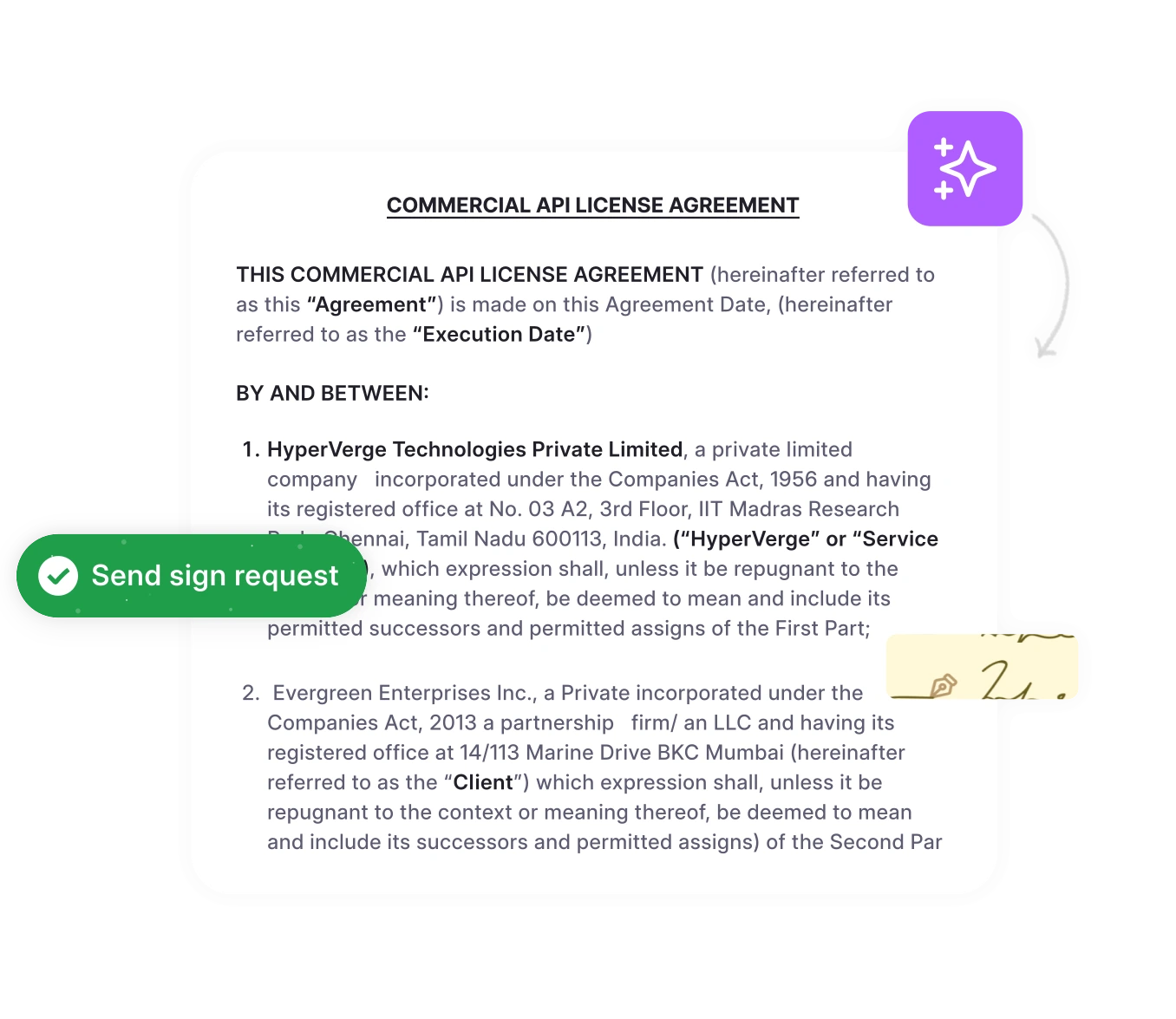




- An affiliate agreement template is not just a compliance document. It defines commission structure, tracking methodology, FTC disclosure obligations, and termination rights in one enforceable agreement before a single link goes live.
- The most common affiliate program failure is not a bad commission rate. It is an unsigned or improperly executed agreement that leaves payment disputes, brand misuse, and FTC violation liability unresolved between the company and its affiliates.
- Legal teams managing high-volume affiliate programs with contract management software reduce onboarding from 8 to 12 business days down to same-day, with legal review time dropping from 2 to 4 hours to under 15 minutes per agreement.
Setting up an affiliate program, whether you are formalizing your first affiliate relationship or scaling to hundreds of affiliate contracts, starts with the same document: a signed agreement that defines every commercial and legal term before a commission is paid or a promotional link goes live.
According to Grand View Research, the global affiliate marketing platform market size was valued at USD 22,577.9 million in 2025 and is projected to reach USD 35,703.2 million by 2033, growing at a CAGR of 5.9% from 2026 to 2033. According to Rakuten Advertising, more than 81% of advertisers and 84% of publishers now run affiliate programs. At that scale, a properly executed affiliate agreement is not optional. It is the only document standing between your business and uncontrolled brand exposure, unpaid commission disputes, and FTC disclosure violations.
This guide covers a complete affiliate agreement template, a free affiliate agreement sample you can customize immediately, every clause type your program needs, and how to move from a static document to a system that scales across hundreds of affiliate marketing agreements simultaneously.
What is an affiliate agreement?
An affiliate agreement is a contract between a company (the “merchant”) and a promotional partner (the “affiliate”) that sets out every term of their commercial relationship: how commissions are calculated and paid, what the affiliate may and may not do to promote the company’s products, how the commercial relationship must be disclosed under FTC guidelines, and how either party can end the arrangement.
“Affiliate agreement,” “affiliate contract,” “affiliate marketing agreement,” “affiliate marketing contract,” “affiliation agreement,” and “affiliate program agreement” all refer to the same category of document. The affiliate agreement’s meaning is consistent across these names: a bilateral contract governing a commission-based promotional relationship. The name on the title page does not affect enforceability. The signed content does.
A standard affiliate agreement is legally binding once signed by both parties. It is distinct from a referral agreement (which governs warm personal introductions rather than tracked promotional links), a reseller agreement (which governs product resale with a margin), and a co-marketing agreement (which governs joint promotional campaigns between two organizations with mutual obligations). If you are running a tracked-link, commission-based affiliate program with multiple affiliates, the affiliate marketing agreement is the correct document.
A business affiliate agreement follows the same structure whether the affiliate is an individual creator, a media company, a software publisher, or a nonprofit running a cause-related promotion. The provisions vary in complexity, not in category. An affiliate agreement is also a specific type of marketing agreement, which is the broader category covering all commercial arrangements that govern how one party promotes another’s products or services.
Free affiliate agreement template
The following affiliate agreement template is a free, complete sample you can copy, paste, and customize for your program. It covers the 10 core provisions required for a legally enforceable affiliate marketing arrangement. Replace all bracketed text with your actual terms. For programs with complex tiered commission structures, international affiliates, or agreements with annual commission value above $50,000, have qualified legal counsel review before execution.
This affiliate agreement sample works as a standard affiliate agreement template for most commercial programs, a simple affiliate agreement template for small or early-stage programs, a website affiliate agreement template for publisher-based programs (see the website-specific additions below), and an affiliate marketing contract template for creator and influencer arrangements. The affiliate agreement example below is not jurisdiction-specific legal advice. It is a starting framework.
AFFILIATE MARKETING AGREEMENT -- TEMPLATE v1.0
[FOR REVIEW -- NOT EXECUTED UNTIL SIGNED BY BOTH PARTIES]

This Affiliate Marketing Agreement ("Agreement") is entered into as of [Date]
by and between:

[Company Legal Name], a [State/Province] [corporation/LLC/Ltd.] ("Company")

and

[Affiliate Legal Name or Individual Name] ("Affiliate")

Collectively referred to as the "Parties."

-----------------------------------------------------------------------
1. APPOINTMENT AND SCOPE
-----------------------------------------------------------------------
Company appoints Affiliate as a non-exclusive, independent affiliate to
promote Company's products and services ("Products") using approved
marketing materials and unique tracking links provided by Company.
Affiliate accepts this appointment and agrees to promote Products in
compliance with the terms of this Agreement. This appointment does not
grant Affiliate the right to bind Company to any agreement, make
warranties on Company's behalf, or create any agency relationship.

-----------------------------------------------------------------------
2. COMMISSION AND PAYMENT
-----------------------------------------------------------------------
2.1 Commission Rate: Company will pay Affiliate [X%] of the net sale
    value of each Qualifying Sale, OR a flat fee of [$X] per Qualifying
    Sale, as specified in Exhibit A attached hereto.

2.2 Qualifying Sale: A Qualifying Sale is a completed, non-refunded
    purchase by a new customer who arrived via Affiliate's unique
    tracking link and whose purchase is credited within the
    [30/60/90]-day attribution window defined in Exhibit A.

2.3 Payment Schedule: Commissions are paid [monthly/bi-monthly] on
    the [day] of each month for the preceding period, subject to a
    minimum payout threshold of [$X]. Amounts below the threshold
    roll forward to the next payment period.

2.4 Chargebacks and Refunds: Commissions on refunded, charged-back,
    or reversed transactions will be deducted from future payment
    cycles. If total deductions exceed amounts due, Affiliate will
    reimburse Company within [30] days of written notice.

2.5 Taxes: Affiliate is solely responsible for all applicable taxes on
    commissions received. Company will provide tax documentation as
    required by applicable law (e.g., IRS Form 1099, T4A in Canada).

-----------------------------------------------------------------------
3. AFFILIATE OBLIGATIONS AND RESTRICTED ACTIVITIES
-----------------------------------------------------------------------
3.1 Affiliate must use only Company-approved promotional materials,
    creatives, and tracking links provided or authorized by Company
    in writing.

3.2 Affiliate must not:
    (a) Bid on Company's trademarked keywords or brand terms in paid
        search without prior written consent;
    (b) Represent that Products are discounted, on sale, or have
        special pricing unless Company explicitly authorizes such
        claims in writing;
    (c) Use spam, robocalls, unsolicited email, or deceptive
        promotional tactics in violation of CAN-SPAM, CASL, or
        equivalent anti-spam regulations;
    (d) Recruit sub-affiliates or operate a multi-tier affiliate
        structure without prior written consent;
    (e) Make false or misleading claims about Company's Products;
    (f) Place affiliate links on sites containing adult content,
        hate speech, or content that violates applicable law.

3.3 Affiliate must obtain prior written approval from Company for any
    promotional method not explicitly authorized in this Agreement or
    in Company's affiliate program guidelines.

-----------------------------------------------------------------------
4. FTC DISCLOSURE AND COMPLIANCE
-----------------------------------------------------------------------
4.1 Affiliate must clearly and conspicuously disclose the material
    connection with Company in all promotional content, in compliance
    with the FTC's Endorsement Guides (16 C.F.R. Part 255).

4.2 Disclosure must appear before or adjacent to any affiliate link or
    promotional claim, in plain language readable without scrolling
    (e.g., "I earn a commission if you purchase through this link at
    no extra cost to you").

4.3 Failure to maintain compliant disclosure in any content piece is
    a material breach of this Agreement, subject to immediate
    termination under Section 7.3.

4.4 Affiliate is solely responsible for compliance with all applicable
    advertising and privacy laws in the jurisdictions where promotional
    content is published, including the FTC Act, CAN-SPAM Act, CASL
    (Canada's Anti-Spam Legislation), PIPEDA (if applicable), and
    equivalent regulations in the Affiliate's operating jurisdiction.

-----------------------------------------------------------------------
5. INTELLECTUAL PROPERTY
-----------------------------------------------------------------------
Company grants Affiliate a limited, non-exclusive, non-sublicensable,
revocable license to use Company's trademarks, logos, product images,
and approved marketing materials solely for the purpose of promoting
Products under this Agreement and in accordance with Company's brand
guidelines. Affiliate acquires no ownership rights in any Company
intellectual property. All goodwill arising from Affiliate's use of
Company marks inures solely to the benefit of Company. Upon
termination, this license revokes immediately and Affiliate must remove
all Company marks from promotional content within [10] business days.

-----------------------------------------------------------------------
6. CONFIDENTIALITY
-----------------------------------------------------------------------
Each party agrees to keep strictly confidential any non-public
information received from the other party ("Confidential Information"),
including but not limited to commission rates, program performance data,
customer information, and business strategies. Each party will use
Confidential Information only in connection with performing obligations
under this Agreement and will not disclose it to any third party without
prior written consent. This obligation survives termination for [2]
years.

-----------------------------------------------------------------------
7. TERM AND TERMINATION
-----------------------------------------------------------------------
7.1 Term: This Agreement begins on the Effective Date and continues
    until terminated by either party under this Section.

7.2 Termination without cause: Either party may terminate this
    Agreement upon [30] days written notice to the other party.

7.3 Termination for cause: Either party may terminate immediately upon
    written notice if the other party:
    (a) Commits a material breach not cured within [10] business days
        of written notice (for first-time, non-material violations);
    (b) Violates FTC disclosure requirements (immediate termination,
        no cure period);
    (c) Commits fraud, misrepresents conversion data, or engages in
        click fraud or cookie stuffing;
    (d) Becomes insolvent or files for bankruptcy protection.

7.4 Effect of termination: All unpaid commissions for Qualifying Sales
    completed before the termination effective date will be paid on the
    next scheduled payment date. Affiliate's license to use Company
    marks terminates immediately upon the termination effective date.

-----------------------------------------------------------------------
8. INDEPENDENT CONTRACTOR
-----------------------------------------------------------------------
Affiliate is an independent contractor and not an employee, agent,
joint venturer, or partner of Company. Affiliate has no authority to
bind Company to any obligation. Affiliate is responsible for all
applicable taxes, insurance, and compliance obligations arising from
Affiliate's business operations. Nothing in this Agreement creates an
employment relationship or entitles Affiliate to employment benefits.

-----------------------------------------------------------------------
9. LIMITATION OF LIABILITY AND INDEMNIFICATION
-----------------------------------------------------------------------
9.1 In no event will Company be liable to Affiliate for any indirect,
    incidental, special, consequential, or punitive damages arising
    from or related to this Agreement, even if Company has been advised
    of the possibility of such damages. Company's total liability will
    not exceed the total commissions paid to Affiliate in the [3]
    months preceding the event giving rise to the claim.

9.2 Affiliate will defend, indemnify, and hold harmless Company and its
    officers, directors, employees, and agents from any claims, damages,
    losses, fines, and expenses (including reasonable legal fees)
    arising from: (a) Affiliate's breach of this Agreement; (b)
    Affiliate's violation of applicable law; (c) Affiliate's
    misrepresentation to end customers; or (d) Affiliate's failure to
    maintain compliant FTC disclosures.

-----------------------------------------------------------------------
10. GOVERNING LAW AND DISPUTE RESOLUTION
-----------------------------------------------------------------------
This Agreement is governed by the laws of [State/Province], without
regard to conflict-of-law principles. Any dispute arising from or
related to this Agreement will be resolved by binding arbitration in
[City, State/Province] under [AAA/JAMS/applicable arbitration rules],
with each party bearing its own costs unless the arbitrator determines
otherwise. Judgment on the arbitration award may be entered in any
court of competent jurisdiction.

-----------------------------------------------------------------------
SIGNATURES
-----------------------------------------------------------------------
By signing below, both parties represent that they have read,
understood, and agreed to the terms of this Agreement.

Company:
Authorized Name: ___________________________
Title: _____________________________________
Date: ______________________________________
Affiliate Agreement Signature: _____________
[E-signature confirmation timestamp if signed electronically]

Affiliate:
Full Legal Name: ___________________________
Entity Name (if applicable): _______________
Date: ______________________________________
Signature: _________________________________
[E-signature confirmation timestamp if signed electronically]

-----------------------------------------------------------------------
EXHIBIT A -- COMMISSION SCHEDULE
-----------------------------------------------------------------------
Commission type:    [ ] Percentage of net sale   [ ] Flat fee per sale
Commission rate:    [X%] or [$X]
Attribution window: [30 / 60 / 90] days
Minimum payout:     [$X]
Payment day:        [Day] of each month
Program tier:       [Bronze / Silver / Gold / N/A]
Simple affiliate agreement template
A simple affiliate agreement template covers five core provisions and is appropriate for individual creators, micro-influencers, and low-volume affiliate arrangements where a full 10-clause document is disproportionate to the commercial relationship.
A simple affiliate agreement should include: (1) who the affiliate is and what they are promoting; (2) the commission rate and payment schedule; (3) the FTC disclosure obligation in plain language; (4) permitted and prohibited promotional methods; (5) how either party can end the arrangement and what happens to earned commissions on exit. Keep the language direct. A simple affiliate agreement does not need arbitration clauses, geographic restriction provisions, sub-affiliate rules, or performance metric reporting requirements. Add those provisions only when affiliate volume or brand exposure justifies the added complexity.
Website affiliate agreement template
A website affiliate agreement template adds four website-specific provisions that a generic affiliate contract omits, and is the appropriate format for publisher networks, review sites, content blogs, and comparison platforms where traffic quality and attribution accuracy are central to program integrity.
- Cookie duration and attribution window. Define exactly how long the tracking cookie persists (commonly 30, 60, or 90 days) and what happens when a user clears cookies, switches devices, or completes a purchase through a different link within the window.
- Tracking pixel placement. If the affiliate must place a conversion pixel on a confirmation page, specify the technical requirements, whose tag management system governs implementation, and who is responsible if the pixel misfires or fires out of sequence.
- Content placement restrictions. Specify prohibited placements explicitly: adult content sites, coupon aggregator pages, competitor comparison pages designed to intercept branded traffic, and any site using deceptive redirects or forced clicks.
- UTM parameter requirements. Require the affiliate to use only Company-issued UTM parameters and prohibit self-referral, link manipulation, or any technique that inflates attributed traffic artificially.
A sample terms of use for a blog with affiliate links typically references the website affiliate agreement as the underlying legal document and adds a public-facing disclosure statement for readers. The affiliate terms and conditions template and the affiliate marketing terms and conditions template are publisher-facing versions of the same disclosure framework, formalized as a standalone document that the affiliate signs separately from the main commission agreement.
Affiliate program agreement template
An affiliate program agreement template governs the relationship between a company and its entire affiliate program structure, rather than a single affiliate. It typically accompanies an affiliate program terms and conditions template published on the affiliate portal and covers provisions that apply uniformly across all program participants.
- Program-level commission tiers. Define tier thresholds (Bronze: 0 to 10 sales/month; Silver: 11 to 50; Gold: 51 and above) and the commission rate or bonus applicable at each level.
- Program modification rights. Reserve the right to update commission rates, attribution windows, approved materials, and program terms with [30-day] advance written notice to all active affiliates.
- Mass termination provisions. Include the right to terminate the entire affiliate program with [60-day] advance notice, with commissions paid for all Qualifying Sales completed through the termination date.
- Sub-affiliate rules. Specify whether affiliates may recruit sub-affiliates and, if so, the tracking method, attribution split, and payment structure for multi-level arrangements.
An affiliate program contract template is substantively the same as an affiliate program agreement template. The difference is operational: the “contract” version is typically signed by each affiliate individually, while the “program agreement” version is incorporated by reference into each affiliate’s onboarding acceptance. If you are managing more than 50 active affiliates, use contract automation software to version-control your program agreement template and distribute amendments to all active agreements simultaneously, rather than manually re-executing individual contracts every time a program term changes.
Affiliate program manager contract template
An affiliate program manager contract template governs the relationship between a company and an external affiliate program manager (a contractor hired to recruit, manage, and optimize the affiliate program on behalf of the company). This is distinct from an affiliate agreement: the affiliate promotes products; the affiliate program manager manages the affiliates who promote products.
An affiliate program manager contract covers: scope of management services (recruitment targets, platform management, compliance auditing); fee structure (retainer, performance bonus, or hybrid); access rights to affiliate tracking platforms and payment systems; reporting obligations and frequency; and the handling of commission disputes between the company and individual affiliates. The independent contractor classification applies here as well, and should be reinforced with the same precision as in a standard affiliate agreement.
One-page affiliate agreement template
A one-page affiliate agreement template compresses the essential terms into a single page for fast execution. It is appropriate for short-term promotional partnerships, event-based affiliate arrangements, and low-risk brand ambassador programs where speed of onboarding matters more than comprehensive legal coverage. A one-page affiliate agreement covers: parties and their relationship, commission rate and attribution window, the FTC disclosure requirement, permitted promotional channels, and a mutual termination-at-will clause with [14-day] notice. For any arrangement with a projected commission value above $5,000 or a term longer than six months, use the full 10-clause template above.
Affiliate partnership agreement template
An affiliate partnership agreement template applies when the relationship is more collaborative than a standard unilateral affiliate arrangement. This includes co-marketing partnerships, revenue-sharing arrangements between two businesses, and joint promotional campaigns where both parties contribute content, audiences, or resources.
Unlike a standard affiliate agreement where one party promotes and the other pays commissions, an affiliate partnership agreement may include mutual promotional obligations, shared content creation rights, co-branded material ownership provisions, and revenue splits that extend beyond a simple referral percentage. A web content partnership agreement is a variant of this structure used specifically when both parties are content publishers who agree to cross-promote and share revenue from the traffic generated. If your partner also resells or bundles your product, use a channel partner agreement template structure instead, which adds reseller rights, territory exclusivity provisions, and product training obligations that a standard affiliate partnership agreement does not address.
Business affiliate agreement
A business affiliate agreement applies when the affiliate is a legal entity rather than an individual creator: a marketing agency, a media company, a software publisher, or a trade association promoting products to its membership. The substantive provisions are identical to an individual affiliate agreement, but the business affiliate agreement adds: entity-level representations and warranties (the signatory has authority to bind the company), business insurance requirements (general liability minimum, errors and omissions coverage), and a provision addressing what happens to the agreement if the affiliate entity is acquired or merges with a competitor. A corporate affiliate commitment template is a variant used internally by larger organizations to document which external affiliate programs their own teams are enrolled in, track the commercial terms, and manage renewal obligations across multiple programs simultaneously.
Stop managing affiliate agreements in spreadsheets
HyperStart CLM auto-generates affiliate agreement templates, routes them for e-signature, and tracks every renewal and compliance obligation in one place. Teams that move from manual templates to HyperStart reduce affiliate onboarding from 8 to 12 business days down to same-day
Book a DemoHow to write an affiliate agreement
Writing an affiliate agreement that is both legally sound and fair enough to attract quality affiliates requires balancing four competing interests: your brand protection, commission clarity for the affiliate, FTC compliance, and termination fairness for both parties.
Here is how to approach each element when writing an affiliate agreement from scratch:
- Start with the commission structure and define every term. “Qualifying sale” is the most litigated phrase in affiliate contracts. Define it precisely: new customers or repeat customers, first-click or last-click attribution, which products are eligible, and what the chargeback window is. An affiliate agreement that is fair to the affiliate includes a clear, auditable definition here, not a vague description.
- Make the FTC disclosure obligation explicit and specific. Do not write “Affiliate must comply with applicable law.” Write the exact disclosure language required, where it must appear, and what constitutes a violation. Affiliates who know exactly what is required can comply. Affiliates who receive vague obligations cannot.
- Include a cure period for first-time violations. An affiliate agreement that terminates immediately for any violation, including minor or inadvertent ones, will not attract serious affiliate partners. A fair affiliate agreement gives affiliates 10 business days to cure first-time, non-material violations before termination. Reserve immediate termination for FTC failures, fraud, and material misrepresentation.
- Define what happens on exit. Commissions earned before termination should be paid on the next scheduled cycle. Affiliates need this certainty before they commit to promoting. Leaving this undefined is one of the most common motivating reasons affiliates avoid programs without a clear contract.
- Set realistic affiliate rules. Affiliate rules covering prohibited promotional methods (brand keyword bidding, coupon aggregator placement, unsolicited email) should be specific and enforceable. Generic rules like “Affiliate must not engage in deceptive marketing” are unenforceable in practice because they require subjective interpretation. List the specific prohibited tactics by name.
- Cap your own liability. Limit Company liability to commissions paid in the preceding three months. Unlimited liability provisions in affiliate agreements expose you to disproportionate risk for a commission-based relationship.
The result of following these steps is an affiliate agreement that is fair and motivating because it gives affiliates what they need (clarity on payment, predictable enforcement, exit certainty) while protecting what the company needs (brand control, FTC compliance documentation, termination rights). Affiliates who read your agreement and find these elements present will sign faster than affiliates who encounter ambiguous terms.
Who manages affiliate agreements in a business?
In most organizations, affiliate agreement ownership sits at the intersection of legal, marketing, and finance. The lack of a clear owner is itself one of the most common program governance failures, and it is the primary reason affiliate agreements lapse, go unsigned, or carry outdated terms.
The legal team owns the template and the clause language. Legal is responsible for ensuring that FTC disclosure requirements are met, that the independent contractor classification is defensible, and that indemnification, limitation of liability, and governing law provisions protect the company. Legal should review and approve the master affiliate agreement template before any version goes live to an affiliate.
The marketing or sales team owns affiliate recruitment and day-to-day relationship management. Marketing selects affiliates, negotiates commission rates within parameters legal sets, and monitors promotional activity. In programs with more than 20 active affiliates, a dedicated affiliate program manager handles communication, compliance monitoring, and performance reporting. The affiliate program manager does not have authority to modify the standard affiliate agreement template without legal approval.
Finance owns commission reconciliation and payment processing. Finance teams managing large affiliate programs need clean attribution data, auditable chargeback rules, and a payment trail that supports tax reporting. Disputes between affiliates and the company almost always originate from payment calculation disagreements, making the commission and payment clause the most operationally important section of the agreement from finance’s perspective. Unresolved affiliate payment discrepancies are a documented source of revenue leakage that goes undetected in manual systems without systematic reconciliation.
Procurement teams managing supplier-affiliate hybrid relationships, where a vendor also promotes the company’s products to their own customer base, need to coordinate the affiliate agreement with the underlying vendor agreement to ensure the two documents do not create conflicting obligations around exclusivity, IP licensing, or payment terms.
Legal operations teams increasingly own the full affiliate agreement lifecycle: template management, execution routing, renewal tracking, amendment distribution, and compliance auditing. In organizations without a dedicated legal ops function, these responsibilities fall to whoever manages contracts day-to-day, often without the tooling needed to manage affiliate agreements at program scale. The HR team may be consulted when the independent contractor classification of an affiliate is being reviewed or challenged, as the documentation standard for contractor classification overlaps significantly with what affiliate agreements already provide.
Do you need a contract for affiliate marketing?
Yes. An affiliate agreement is not optional if you are paying commissions based on tracked performance.
Without a signed affiliate contract, there is no written definition of what constitutes a qualifying sale, how attribution disputes are resolved, what affiliate rules apply to promotional methods, or how either party can exit the arrangement. When an affiliate drives 200 conversions in a month and your tracking platform shows 140 because of cookie conflicts or browser privacy settings, the only document that determines what you owe is the one you signed. Without it, you are in a verbal agreement dispute with no written reference point.
FTC compliance is a separate, legally mandatory reason to have a written agreement. The FTC’s Endorsement Guides require affiliates to clearly disclose material connections. If an affiliate fails to disclose and the FTC investigates, your affiliate agreement is the evidence that you imposed and communicated the disclosure obligation. Without a signed agreement, you have no documentation that you required compliance.
The affiliate agreement also establishes independent contractor status. This classification determines whether you owe employment benefits, payroll taxes, or workers’ compensation. A signed agreement specifying that the affiliate is an independent contractor, combined with the operational reality of that arrangement, is the primary documentation you need if the classification is ever challenged by a tax authority or employment regulator.
For companies running affiliate programs in Canada, additional considerations apply. Canada’s Anti-Spam Legislation (CASL) imposes strict requirements on commercial electronic messages sent in connection with affiliate promotions, including consent documentation, sender identification, and unsubscribe mechanisms. PIPEDA (the Personal Information Protection and Electronic Documents Act) governs how affiliate program data is collected and used. A business affiliate agreement operating in Canadian jurisdictions should reference both CASL and PIPEDA compliance obligations explicitly, rather than relying on a generic “comply with applicable law” clause. Affiliate marketing in Canada is subject to these requirements regardless of where the merchant is headquartered, if the promotional content reaches Canadian consumers.
What should an affiliate agreement include? 10 critical clauses
Every affiliate agreement template, regardless of format, should cover these 10 provision categories. Missing any one creates a specific, predictable dispute risk.
The core commercials
Commission structure, payment schedule, attribution window, and minimum payout threshold are the commercial terms that govern the financial relationship. Define commission as a percentage of net sale value (after returns, refunds, and taxes) or as a flat fee per qualifying action. Define “qualifying” precisely: new customers only, or repeat customers too? First-click or last-click attribution? What is the cookie duration? Ambiguity in commercial terms is the single largest source of affiliate payment disputes and the primary reason affiliates lose confidence in a program.
Affiliate responsibilities and restricted activities
Permitted promotional channels, prohibited tactics, and pre-approval requirements for new methods. This clause is what gives you legal standing to terminate an affiliate who bids on your branded keywords in paid search, uses coupon aggregator sites without authorization, or sends unsolicited email blasts in violation of CAN-SPAM or CASL. Without an explicit restricted activities list, the affiliate can argue any promotional method was implied by the program’s general purpose. Specific affiliate rules in this clause are enforceable. Generic ones are not.
Intellectual property and limited license rights
Grant the affiliate a limited, non-exclusive, revocable license to use your marks for the specific purpose of promotion under this agreement. Specify that all goodwill accrues to you, not the affiliate. Include an obligation to cease using your marks within a defined period after termination. Without this clause, an affiliate who has built content around your brand name and logo may have an arguable license claim that survives termination.
Term, termination, and modification
Specify the agreement term (evergreen until terminated, or fixed duration), the notice period for termination without cause (commonly 30 days), and the conditions for immediate termination for cause. Include what happens to earned but unpaid commissions after termination. Without explicit termination mechanics, ending a non-performing or non-compliant affiliate relationship becomes legally complicated even when both parties want to exit.
Compliance and disclosures: the FTC minefield
The FTC’s Endorsement Guides require affiliates to “clearly and conspicuously” disclose material connections to the brands they promote. “Clearly and conspicuously” means the disclosure must be placed before or adjacent to any affiliate link or promotional claim, in plain language, and visible without scrolling. A disclosure buried in a footer or written in ambiguous language does not meet the standard.
Many legal teams formalize this requirement as a standalone affiliate terms and conditions template or affiliate compliance policy template that affiliates sign separately from the main commission agreement. This makes FTC compliance auditable as its own signed document and eliminates the argument that the affiliate was unaware of the obligation. The affiliate compliance policy template should specify the exact disclosure language required, where it must appear, and the consequence of non-compliance. For affiliate programs operating in the UK, the ASA’s CAP Code imposes equivalent requirements and should be referenced explicitly for UK-based affiliates.
Confidentiality, indemnification, and limitation of liability
Protect non-public program data, commission rates, and customer information from disclosure. Include mutual confidentiality obligations if you share business information with the affiliate. The indemnification clause should require the affiliate to cover your legal costs if their promotional activity generates regulatory action, customer complaints, or third-party claims. Cap your total liability to the commissions paid in the preceding three months. Unlimited liability in an affiliate agreement exposes the company to risk that is disproportionate to the commercial relationship. When an affiliate program is being wound down or a high-value affiliate relationship is ending, consider pairing the termination clause with a general release of liability to extinguish all mutual claims arising from the program before the final commission payment is made.
Performance metrics and reporting
Define what performance data both parties have access to, how often it is reconciled, and what discrepancy threshold triggers a formal review. Affiliate agreement monitoring provisions should specify what triggers a compliance review, how affiliate contract violations are documented, and what remedy the company has before termination. Affiliate agreement violation clauses without a defined cure period are routinely challenged in disputes. Include a minimum 10-business-day written cure period for first-time, non-material violations and immediate termination rights for FTC non-compliance, click fraud, and cookie stuffing. Contract tracking software eliminates the manual effort of monitoring compliance dates, renewal windows, and performance review triggers across large affiliate programs.
Geographic and channel restrictions
Specify which countries, regions, or sales channels the affiliate is authorized to operate in, especially if you have exclusive distribution agreements in certain markets or if your product is not legally available in all jurisdictions. Without geographic restrictions, an affiliate can legally promote your product in a market where you have an exclusive distributor, creating channel conflict and potentially voiding a more valuable commercial agreement.
Payment terms and dispute resolution
Include payment mechanics (currency, transfer method, processing fees), the minimum payout threshold, and what happens when the affiliate disputes a payment calculation. Define a formal dispute resolution process: written notice within [30] days of the disputed payment, a [10-business-day] internal review period, and then binding arbitration if unresolved. Without a defined process, payment disputes escalate directly to litigation because no contractual off-ramp exists.
Relationship and representations
Explicitly state that the affiliate is an independent contractor, not an employee, agent, or partner. Require the affiliate to represent that they have the right to enter this agreement, that their promotional activities comply with applicable law, and that they will notify you of any conflict of interest. This clause is the first line of defense in misclassification claims and in disputes where an affiliate acts outside the scope of what was authorized.
Affiliate agreement addendum and amendments
An affiliate agreement addendum is a supplemental document that modifies specific terms of an existing affiliate agreement without replacing the entire contract. It is the correct mechanism for changes that occur after execution: updating commission rates, adding new product categories to the scope of promotion, adding a geographic restriction when a new exclusive distribution deal is signed, or incorporating updated FTC disclosure language following a regulatory guidance change.
An affiliate addendum should reference the original agreement by name and effective date, specify exactly which provisions it modifies (by section number), state the new language replacing the old, and be signed by both parties to be enforceable. An unsigned affiliate addendum distributed as a “policy update” email is not a legally binding amendment, because it lacks counter-signature and mutual assent. This is one of the most common legal vulnerabilities in large affiliate programs: commission rate changes are communicated by email to hundreds of affiliates, but the underlying agreements remain unmodified and the email communication does not constitute a signed amendment.
When managing affiliate agreements at scale, contract collaboration software handles amendment routing automatically: it identifies all active agreements affected by a clause change, generates the affiliate addendum, routes it for counter-signature from each affected affiliate, and tracks completion status until all amendments are executed. This converts a process that would take weeks manually into one that runs in parallel across hundreds of agreements simultaneously.
Affiliate marketing agreement vs. referral agreement
An affiliate marketing agreement and a referral agreement are not interchangeable documents, and using the wrong template for your arrangement creates legal and operational problems that only become visible when something goes wrong.
| Dimension | Affiliate marketing agreement | Referral agreement |
|---|---|---|
| Who the partner is | External publisher, creator, or website with an existing audience | Existing customer, employee, or trusted contact making a personal introduction |
| How promotion happens | Tracked links, published content, paid placements, social posts | Direct introduction, personal recommendation, forwarded email |
| Attribution mechanism | Cookie-based tracking link with defined attribution window | Named referral code, direct email introduction, or CRM-tracked referral |
| FTC disclosure required? | Yes, conspicuous disclosure mandatory in all promotional content | Often yes, depends on whether compensation is paid for the recommendation |
| Commission structure | Revenue percentage or flat fee per qualifying conversion | Fixed bounty, account credit, or one-time referral fee |
| Scale potential | Unlimited, open program with many parallel affiliates | Limited, typically a closed and invitation-only group |
| Typical partner volume | Dozens to thousands of partners simultaneously | Fewer than 50 active referrers in most programs |
| Channel partner agreement format | Not applicable, affiliates are not resellers | Applicable when the partner also resells or bundles the product |
Use an affiliate marketing agreement when you want a trackable, scalable partner network where promotional activity is systematic and tracked by link. Use a referral agreement when you want warm personal introductions from a defined group of trusted contacts. If your program involves elements of both (a loyal customer who also publishes detailed product reviews with tracked links), the primary activity determines the document type: tracked promotion means an affiliate marketing agreement; personal introduction means a referral agreement. Using the wrong template means your termination provisions, attribution rules, and FTC disclosure requirements may not fit the actual commercial arrangement.
Why manual affiliate agreement templates fail at scale
A static affiliate agreement template stored in a shared drive works adequately for programs with fewer than 10 affiliates. Beyond that, manual management creates three compounding problems that grow proportionally with program size.
The onboarding bottleneck
Without a structured affiliate agreement workflow, legal teams spend 2 to 4 hours reviewing and customizing each affiliate agreement before it is sent for signature. Affiliates wait 8 to 12 business days from application to activation. During that window, motivated affiliates lose interest, accept competitor programs, or begin promoting without a signed agreement because the process takes too long. Every day of delay is a direct revenue cost in a commission-based model. A contract repository that stores all affiliate agreements in one searchable system, combined with automated template generation, reduces this window to same-day for standard agreements without any additional legal review for pre-approved templates.
The compliance gap
Manual affiliate programs cannot reliably track which affiliates have current signed agreements, which agreements are approaching renewal or auto-termination, and which affiliates have acknowledged recent program term updates. When FTC compliance obligations change, or when commission structures evolve, there is no scalable mechanism to push an amendment to 200 active affiliates and confirm counter-signature across all of them. The result is a program where some affiliates operate under outdated terms, some operate under the old commission structure, and some have not acknowledged updated affiliate rules, creating simultaneous legal and financial exposure. Using contract risk management software to flag non-compliant clauses, expired agreements, and affiliates without current FTC acknowledgments converts a reactive compliance process into a proactive one.
The renewal drag
Fixed-term affiliate agreements that renew annually require active tracking. In a manual system, renewal dates are buried in a spreadsheet that is nobody’s primary responsibility. Agreements lapse, affiliates continue promoting without a current signed contract, and the company has no enforceable agreement governing an active commercial relationship. This is both a legal and a financial risk: if an affiliate drives $50,000 in commissions in a month when no current signed agreement is in place, recovering an overpayment or disputing a commission calculation has no contractual basis. Contract reminder software eliminates this by generating automated alerts 60 and 30 days before any affiliate agreement renewal or expiration date, with the option to auto-route a renewal agreement for signature before the expiration date passes.
Manage hundreds of affiliate agreements without a single spreadsheet
From template generation to FTC compliance tracking to automated renewal alerts, HyperStart gives your legal and marketing teams one system for the full affiliate agreement lifecycle
Book a DemoHow CLM software manages affiliate agreements at scale
Contract lifecycle management software addresses each of the three manual failure modes above through a structured workflow that scales without adding legal headcount.
AI-powered drafting and accelerated onboarding
A CLM platform stores your approved affiliate agreement template with locked standard clauses and defined variable fields. When a new affiliate is approved, the system auto-generates a customized agreement by pulling the affiliate’s entity name, commission tier, and attribution window from the onboarding form into the template. The agreement is then routed for e-signature automatically using contract signing software that creates a timestamped audit trail for every execution. Using contract creation software with pre-approved clause libraries, legal review time drops from 2 to 4 hours per agreement to under 15 minutes. Same-day affiliate onboarding becomes operationally achievable at any program volume.
HyperStart’s AI drafts and reviews affiliate agreements with 94% accuracy, flagging non-standard clauses and missing provisions before the agreement reaches the affiliate. The review that previously occupied a senior contracts attorney for an afternoon runs in 26 seconds.
Proactive compliance tracking across all affiliate agreements
Every affiliate agreement in HyperStart is automatically indexed for key dates: execution date, attribution window, renewal date, and FTC compliance acknowledgment requirements. When your affiliate compliance policy template is updated, HyperStart identifies every active agreement that requires an amendment, generates the affiliate addendum, and routes it for counter-signature without manual intervention. The contract management dashboard shows real-time status: which affiliates have current signed agreements, which renewals are approaching, and which FTC acknowledgments are pending.
AI contract review software surfaces high-risk clause combinations, such as uncapped indemnification paired with an unusually long attribution window, before agreements are executed rather than after a dispute makes them visible. For a broader view of what to look for when evaluating CLM platforms for affiliate agreement management, see the contract management best practices guide and the step-by-step contract management workflow reference. For legal teams comparing CLM platforms specifically, HyperStart vs Juro covers how the two platforms handle template management, compliance tracking, and affiliate onboarding volume.
Affiliate agreement negotiation and redlining
For high-value affiliate relationships where the affiliate negotiates commission rates, attribution windows, or exclusivity provisions, contract negotiation software tracks every redline, records the negotiation history in a single version-controlled thread, and ensures the executed agreement reflects the final agreed terms rather than a version sent early in the process. Legal AI tools extend this workflow across every agreement type in the legal team’s portfolio, from affiliate contracts to vendor agreements to partnership arrangements.
Why legal teams use HyperStart for affiliate agreement management
Managing affiliate agreements at scale requires more than a well-drafted template. It requires a system that keeps every agreement current, compliant, and visible without manual tracking across spreadsheets and shared drives.
- Pre-approved clause libraries. Lock the FTC disclosure clause, independent contractor language, and limitation of liability provision so no version goes out without them, regardless of who generates the agreement or how quickly the program is growing.
- 94% AI accuracy in 26 seconds. HyperStart reviews each affiliate agreement for missing provisions, non-standard language, and clause-level risk before the affiliate receives it, with no attorney time required for standard agreements.
- Same-day onboarding. Automated template generation, e-signature routing via contract signing software, and CRM integration compress affiliate activation from 8 to 12 business days down to same-day for standard agreements.
- Full compliance visibility. Track FTC acknowledgment status, renewal dates, and amendment counter-signature rates across every active affiliate in one contract management dashboard, not across 14 spreadsheets managed by different teams.
- Deploys in 4 weeks. HyperStart integrates with your existing affiliate tracking platform, CRM, and e-signature tool in a standard 4-week implementation, without a multi-month enterprise deployment project.
Legal teams that manage affiliate programs on HyperStart’s contract management platform reduce the per-agreement cost of affiliate onboarding, eliminate renewal lapses, and maintain complete audit-ready documentation of FTC compliance obligations for every active affiliate in the program