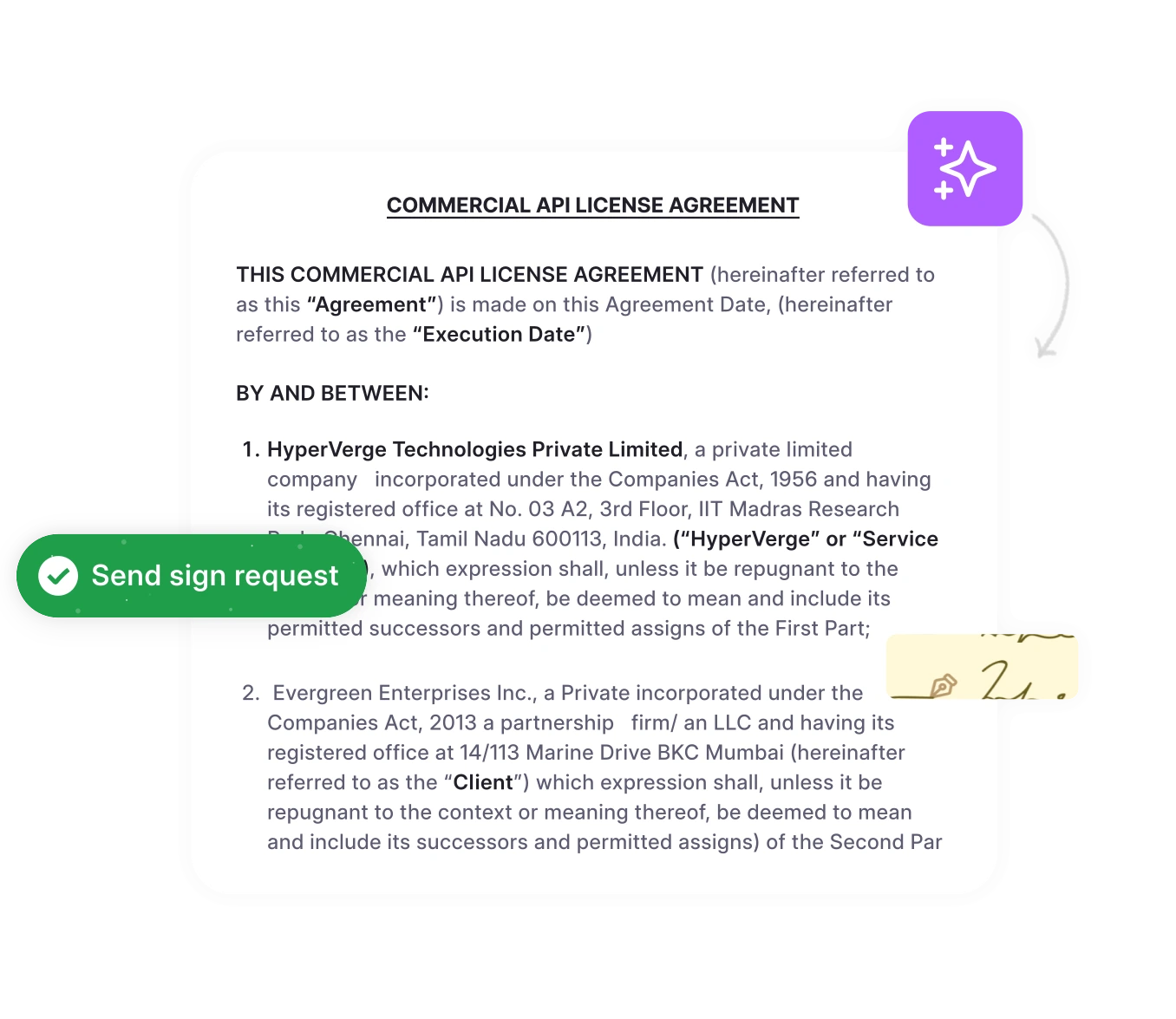



When your acquisition team receives a 120-page asset purchase agreement from the seller’s counsel, you need visibility into every transferred asset, assumed liability, and post-closing obligation.
Manual tracking across email threads and shared drives creates risk during due diligence and post-transaction compliance.
Read this guide to learn what asset purchase agreements are, how to structure them effectively, and why contract management software helps M&A teams maintain control throughout the deal lifecycle.
What is an asset purchase agreement?
An asset purchase agreement is a legal contract where a buyer acquires specific assets and assumes selected liabilities from a seller, without purchasing the entire company.
The buyer chooses which assets to acquire, such as equipment, inventory, intellectual property, customer contracts, and real estate, while leaving behind unwanted liabilities like pending lawsuits or environmental obligations.
Unlike a stock purchase, where the buyer inherits everything, including hidden liabilities, an asset purchase allows selective acquisition.
For example, a software company might purchase another firm’s product code and customer contracts while excluding legacy debt and litigation exposure.
Such a selective approach makes asset purchase agreements the preferred structure when buyers want to minimize risk exposure or acquire only specific business lines or divisions.
Streamline M&A contract tracking with centralized visibility
HyperStart’s AI-powered CLM platform tracks asset transfers, liabilities, and post-closing obligations across every transaction.
Book a DemoWhat are the key elements of an asset purchase agreement?
Understanding the structure of an asset purchase agreement matters because missing or ambiguous terms create post-closing disputes, compliance gaps, and liability exposure. A comprehensive APA protects both parties by explicitly defining what transfers and what stays behind.
Here’s a quick reference to the core components:
| APA Component | Primary Purpose | Critical for |
| Purchased/Excluded Assets | Define what transfers and what stays | Asset clarity, title transfer |
| Assumed Liabilities | Allocate obligations between parties | Risk management, exposure limits |
| Purchase Price Allocation | Assign value to asset categories | Tax reporting, IRS compliance |
| Representations & Warranties | Create legal promises and protections | Indemnification, breach claims |
| Covenants & Conditions | Set pre/post-closing obligations | Deal protection, compliance |
| Indemnification | Establish remedy mechanisms | Loss recovery, dispute resolution |
| Closing Conditions | Define requirements to finalize | Deal certainty, regulatory approval |
Now, let’s understand each key element of an asset purchase agreement in detail.
1. Purchased and excluded assets
The foundation of any asset purchase agreement starts with precisely defining what transfers and what stays behind. Purchased assets typically include tangible items like equipment, inventory, and real estate, as well as intangible assets such as intellectual property, customer lists, and brand names.
Excluded assets are listed separately to avoid ambiguity, commonly covering cash, accounts receivable, and any property unrelated to the acquired operations. Such a granular approach prevents disputes over whether specific items were included in the transaction.
2. Assumed liabilities
The buyer specifies which obligations to assume, such as customer warranties, supplier contracts, and employee benefits for transferred workers.
Unlike a stock purchase, where all liabilities transfer automatically, asset purchase agreements let buyers leave behind unwanted obligations like pending litigation or legacy debt.
Sellers remain responsible for any liabilities not explicitly assumed, creating a clean separation that protects both parties.
3. Purchase price allocation
Both parties must agree on how the total consideration gets assigned across asset categories for tax reporting and depreciation purposes. The IRS requires consistency between buyer and seller reporting, making this a heavily negotiated provision.
The agreement may also include working capital adjustments to account for changes in inventory, receivables, and payables between signing and closing.
4. Representations and warranties
These legal promises from both parties cover asset ownership and clear title, legal compliance and regulatory standing, financial accuracy of disclosed information, and absence of undisclosed liabilities or litigation.
The strength and scope of these representations directly impact indemnification exposure, with sellers typically negotiating survival period limits and materiality thresholds to cap their long-term risk.
5. Covenants and conditions
Pre-closing covenants require the seller to maintain business operations normally without material changes that could degrade asset value. Post-closing restrictions typically include non-compete agreements, employee non-solicitation provisions, and confidentiality obligations.
Such covenants protect the buyer’s investment by preventing the seller from competing or poaching key personnel.
6. Indemnification
The agreement establishes how parties compensate each other for breaches, undisclosed liabilities, and third-party claims.
Key mechanics include claim notification procedures, baskets that must be exceeded before indemnification triggers, caps on total exposure, and escrow arrangements that hold back a portion of the purchase price.
According to Morgan & Westfield’s M&A analysis, the majority of M&A transactions include escrow arrangements holding 10-20% of the purchase price for 12-24 months to secure indemnification obligations and address post-closing claims.
Without clear indemnification terms, parties lack enforceable remedies when problems surface post-closing.
7. Closing conditions
The transaction cannot finalize until specific requirements are met, including regulatory approvals, third-party consents for contract assignments, and satisfactory completion of due diligence.
The transfer of physical assets typically requires bills of sale as legal proof of ownership transfer from seller to buyer. Missing even one material asset or liability in the documentation can trigger renegotiation or post-closing litigation.
How asset purchase agreements impact legal, GC, and ops teams
Asset purchase agreements sit at the intersection of legal risk, financial exposure, and operational complexity. According to CFA Institute research, M&A transactions face a failure rate of 70-90% when due diligence is inadequate, with flawed due diligence processes cited as the primary cause of post-closing disputes and value destruction.
For in-house legal teams managing multiple transactions, these agreements create long-term obligations that extend well beyond closing day.
1. Impact on legal, finance, operations, and compliance teams
The business impact shows up across departments:
| Department/Function | Primary Impact | Common Risk if Mismanaged |
| Legal | Representations and warranties create liability lasting 12-36+ months post-closing | Untracked survival periods, missed indemnification claims |
| Finance & Tax | Purchase price allocation affects depreciation and tax reporting | IRS penalties, incorrect financial statements |
| Operations | Transferred contracts require consent and integration workflows | Business disruption, lost customer/supplier relationships |
| Compliance | Permits and licenses must transfer correctly | Regulatory violations, operational shutdown |
| Corporate Development | Due diligence across hundreds of assets and contracts | Acquisition of undisclosed liabilities, valuation errors |
2. Impact of fragmented APA tracking and management
Common failure modes compound these cross-departmental challenges:
Post-closing obligation failures:
- Missed earnout calculations and payment deadlines
- Forgotten escrow release triggers
- Untracked representation survival period expirations
Documentation and visibility problems:
- Fragmented storage across email, data rooms, and shared drives
- Inability to locate specific schedules or amendments during audits
- No centralized view of obligations across multiple transactions
Manual tracking breakdowns:
- Inadvertent breaches of non-compete or non-solicitation covenants
- Missed indemnification claim deadlines
- Lost opportunities to enforce seller obligations
“Almost 85% of respondents indicate that they expect to see an increase in M&A disputes. Inflation and recession are the top dispute drivers identified, with over 84% of respondents indicating these are significant factors.”
Read
For corporate development teams handling multiple transactions annually, systematic contract risk management becomes essential. The alternative is scattered documentation, missed deadlines, and concentrated legal exposure that surfaces during board audits or future M&A activity.
How to draft and negotiate an asset purchase agreement?
Drafting an asset purchase agreement requires balancing buyer protection with seller cooperation. The process involves extensive due diligence, precise legal drafting, and often months of negotiation between counsel on both sides.
Step 1: Conduct thorough due diligence
Review financial records, asset titles, contracts, intellectual property registrations, employee agreements, litigation history, and regulatory compliance before drafting. Comprehensive due diligence reveals which assets are transferable and which liabilities must be addressed.
“[Baruch] Lev and [Feng] Gu define failure in terms of post-acquisition sales and gross margin trends, stock performance, and goodwill write-offs. Based on a sample of 40,000 transactions over 40 years, they find that 70% to 75% of M&A deals fail.”
Read
Step 2: Define assets with specificity
List every asset being purchased with enough detail to avoid ambiguity. Include serial numbers for equipment, legal descriptions for real estate, and schedule attachments for customer contracts and intellectual property.
Step 3: Identify and allocate liabilities
Explicitly state which liabilities the buyer assumes and which the seller retains. Address contingent liabilities like pending litigation, product warranty claims, and environmental remediation obligations.
Step 4: Structure purchase price allocation
Work with tax advisors to assign the purchase price across asset categories in a manner advantageous for both parties. Document this allocation clearly, as the IRS requires consistency between buyer and seller reporting.
Step 5: Negotiate representations and warranties
Sellers typically provide representations about asset ownership, financial accuracy, compliance with laws, and the absence of undisclosed liabilities. Buyers seek broad protections while sellers negotiate limitations through survival periods, materiality qualifiers, and indemnification caps.
Step 6: Define closing conditions
Specify what must occur before closing, including required regulatory approvals, third-party consents for contract assignments, and satisfactory completion of due diligence.
Step 7: Establish indemnification mechanics
Agree on how claims are made, baskets that must be exceeded before indemnification applies, caps on total exposure, and escrow arrangements to secure indemnification obligations.
Jurisdiction-specific requirements vary significantly. Some states require bulk sale notices to creditors, others mandate specific disclosure timelines for environmental issues, and international transactions add cross-border tax and regulatory complexity. Experienced M&A counsel familiar with the relevant jurisdictions should review every contract negotiation before execution.
How to manage asset purchase agreements at scale with workflows and tooling?
When asset purchase agreements live in email threads, shared drives, and ad hoc spreadsheets, corporate development teams lose visibility into critical obligations and deadlines. Such fragmentation creates risk as transaction volume increases.
Key APA management capabilities for M&A teams
A systematic approach to managing asset purchase agreements includes centralized storage, standardized workflows, and automated tracking. Contract automation software addresses the specific challenges M&A teams face.
Here are the 5 key capabilities that support asset purchase agreement management:
- Centralized repository: Single source of truth for all transaction documents, including the main agreement, schedules, amendments, and closing deliverables. It eliminates time spent searching across systems during audits or integration planning.
- Metadata extraction: AI-powered extraction of key terms like purchased assets, assumed liabilities, indemnification caps, and survival periods enables quick reporting and comparison across transactions.
- Obligation tracking: Automated alerts for post-closing deadlines including earnout calculation dates, escrow release conditions, non-compete expiration, and representation survival periods ensure nothing falls through gaps.
- Integration workflow: Linking asset purchase agreements to related documents like employment offer letters, supplier notifications, and customer transition communications creates complete transaction records.
- Portfolio reporting: Dashboard views showing all active transactions, pending obligations, and indemnification exposure across the corporate development function give leadership visibility into aggregate risk.
From manual tracking to automated systems
The cost of manual management:
How modern CLM platforms help:
Modern contract repository software treats asset purchase agreements as structured data rather than static PDFs, enabling teams to:
Track obligations without doing a thing
See how HyperStart helps teams centralize transaction documents and automate deadline tracking.
Book a DemoBring order to asset purchase agreement management with HyperStart
Asset purchase agreements create long-term legal and operational obligations that extend well beyond the closing date. The key levers are precise drafting that eliminates ambiguity, thorough due diligence that surfaces hidden liabilities, and systematic tracking of post-closing commitments.
HyperStart’s contract management software for legal departments provides corporate development and in-house legal teams with centralized visibility into every asset transfer, assumed liability, and indemnification provision across their M&A portfolio. With AI-powered metadata extraction and automated obligation tracking, teams maintain control throughout the deal lifecycle without manual spreadsheet updates. Book a demo to see how HyperStart helps M&A teams bring order to transaction management.