


Choosing the right contract management software for healthcare can feel overwhelming, especially when most tools promise compliance readiness and faster contracting. For healthcare legal and operations teams, the margin for error remains narrow.
Healthcare organizations manage complex provider agreements, payer contracts, vendor relationships, and Business Associate Agreements (BAAs) under strict regulatory oversight, making disciplined contract administration a critical task for day-to-day operations. Fragmented contract processes increase compliance risk, slow down approvals, and limit visibility across obligations.
This guide presents a curated list of the 9 best contract management software solutions for healthcare. Each platform was evaluated for healthcare relevance, compliance support, and practical usability. The guide starts by explaining what healthcare contract management software is and then outlines how the shortlist was created.
What is healthcare contract management software?
Healthcare contract management software is a digital system designed to manage the full lifecycle of healthcare-related agreements. Covered agreements typically include provider contracts, payer agreements, vendor contracts, research agreements, and BAAs.
Healthcare teams use these platforms to centralize contracts, standardize workflows, manage approvals, track obligations, and maintain audit trails across the full contract lifecycle. Many solutions support automation and AI-assisted features to reduce manual effort while aligning workflows with healthcare compliance requirements.
Selecting the right platform requires more than feature comparison. Healthcare organizations must consider regulatory alignment, stakeholder complexity, and integration with existing healthcare systems. The following section explains how the shortlisted tools were evaluated.
How we analyzed and selected the best healthcare contract management software
The evaluation process reviewed more than 25 contract management platforms relevant to healthcare organizations. Each solution was assessed using publicly available product documentation, verified vendor information, and feedback from platforms such as G2 and Capterra.
Shortlisting focused on healthcare-specific considerations, including support for regulated contract types, alignment with HIPAA-related workflows, usability for legal and operational teams, scalability, and integration flexibility. Platforms with documented healthcare use cases or clear applicability to regulated environments received additional weight.
The final list reflects a mix of healthcare-explicit, healthcare-adjacent, and general-purpose solutions that healthcare organizations commonly evaluate based on size, complexity, and compliance needs.
9 best contract management software for healthcare (at a glance)
The table below provides a quick comparison of leading contract management platforms evaluated for healthcare use. Each tool differs in healthcare alignment, core strengths, and pricing transparency, making this overview useful for shortlisting before deeper evaluation.
| Software | Standout feature | Healthcare focus |
| HyperStart CLM | AI-driven contract automation with HIPAA-compliant workflows and fast implementation | Healthcare-specific (providers, payers, life sciences) |
| Lexagle | AI-powered contract analysis with high configurability | Healthcare-configurable, not healthcare-specific |
| Contract Logix | Purpose-built CLM with explicit healthcare compliance support | Healthcare-specific |
| Icertis | Enterprise-grade contract intelligence for regulated industries | Healthcare and life sciences–specific (enterprise-focused) |
| CobbleStone Software | Compliance-first CLM with HIPAA templates and vendor management | Healthcare-specific |
| DocuSign CLM | Native integration with DocuSign eSignature ecosystem | General-purpose, healthcare-configurable |
| Evisort | AI-based contract analytics and metadata extraction | General-purpose, healthcare-adjacent |
| Gatekeeper | Vendor lifecycle management with contract controls | General-purpose, vendor-focused |
| Juro | Browser-native CLM for lean legal teams | General-purpose |
Each platform approaches healthcare contract management differently. The sections below examine each solution in detail, including capabilities, limitations, and ideal use cases for healthcare organizations.
In-depth review of the 9 best healthcare contract management tools
Now that you’ve seen the comparison overview, let’s dive deep into each healthcare contract management solution. We’ll explore their features, strengths, limitations, and ideal use cases to help you make an informed decision for your healthcare organization.
1. HyperStart CLM – best overall healthcare contract management software
See HyperStart in action 👇
About HyperStart CLM
HyperStart CLM is an end-to-end healthcare contract management software that empowers healthcare providers, payers, and life sciences organizations to manage contracts more efficiently. The platform offers a 4-6 week implementation, allowing healthcare teams to centralize their contract operations.
Powered by HyperVerge AI technology that has processed 1B+ documents, HyperStart CLM automates critical healthcare contract processes. The AI handles contract metadata extraction, clause identification, and obligation tracking. The platform manages everything from HIPAA-compliant contract creation to automated BAA tracking, helping healthcare organizations maintain compliance while managing contract operations.
Healthcare organizations face unique contract management challenges, including managing physician agreements, payer contracts, vendor risk assessments, and maintaining strict HIPAA compliance. HyperStart CLM addresses these needs with purpose-built features for healthcare compliance, revenue cycle optimization, and audit-ready documentation.
The platform’s AI extracts contract metadata and identifies key terms such as reimbursement rates, compliance obligations, and renewal dates, helping prevent missed deadlines.
Using HyperStart CLM, healthcare organizations can streamline contract review and execution processes while maintaining enterprise-grade security. The platform is SOC 2 Type 2 certified and fully HIPAA compliant, making it suitable for healthcare providers, health systems, payers, and pharmaceutical companies requiring both operational efficiency and regulatory compliance.
Key healthcare-focused features of HyperStart CLM
Create: Generate HIPAA-compliant contracts within minutes using pre-approved healthcare templates for physician agreements, BAAs, payer contracts, and vendor agreements. Dynamic intake forms with conditional logic ensure all required compliance fields are captured.
Approve: Configure automated approval workflows tailored to healthcare compliance requirements without coding expertise. Route contracts through legal, compliance, finance, and clinical leadership based on contract type, value, or risk level.
Negotiate: Streamline contract negotiation by redlining all healthcare contracts in one secure, HIPAA-compliant platform. Track changes, manage versions, and collaborate with internal teams and external parties while maintaining complete audit trails for compliance purposes.
Sign: Collect legally binding signatures through multiple compliant methods, including hand-drawn signatures, OTP-based eSign, or integrations with DocuSign and Adobe Sign. All signature processes maintain HIPAA compliance and provide complete audit documentation.
Store: Centralize all healthcare contracts in a secure, HIPAA-compliant repository with AI-powered search. Bulk imports contracts from Gmail, OneDrive, Google Drive, Salesforce, or local storage, and finds any agreement or clause in seconds using natural language search.
Track: Automated tracking of expiration dates, reimbursement terms, compliance obligations, and renewal windows helps teams stay informed about critical contract deadlines. Proactive reminders support management of payer contract renewals, physician credentialing deadlines, and vendor agreement expirations.
Pros of using HyperStart CLM for healthcare
Purpose-built for healthcare compliance: HyperStart CLM is HIPAA compliant and SOC 2 Type 2 certified, with specific features for managing BAAs, tracking PHI-related obligations, and maintaining audit-ready documentation. Healthcare organizations can manage sensitive contracts while meeting regulatory requirements.
Fast implementation timeline: The platform implements in 4-6 weeks, allowing healthcare organizations to centralize their provider contracts, payer agreements, and vendor relationships without extended deployment periods.
Comprehensive healthcare integrations: HyperStart CLM offers 100+ integrations, including CRMs such as Salesforce and HubSpot, document systems like SharePoint and Google Drive, and SSO capabilities. Healthcare teams can maintain their existing technology stack while centralizing contract management.
Scalable for healthcare organizations: The platform provides enterprise-grade features with pricing designed for growing healthcare organizations, offering contract automation and compliance features without prohibitive costs.
Cons of using HyperStart CLM
Newer market presence compared to established players: While HyperStart CLM offers robust healthcare contract management capabilities, it has less market recognition than some established competitors in the healthcare CLM space.
Key Takeaway
HyperStart CLM offers AI-powered contract automation with healthcare-specific compliance features built in. Its 4-6 week implementation timeline and comprehensive integrations make it suitable for healthcare organizations seeking to streamline contract operations while maintaining HIPAA compliance.
Customer feedback on HyperStart CLM
While not healthcare-specific organizations, recent customer implementations across industries highlight ease of implementation and platform capabilities:
We took demos of around 5 CLM vendors and chose to use HyperStart. They were the only CLM vendor who had SOC2 compliance and met the criteria of around 22 parameters which we had evaluated them on.

Om Prakash Pandey
Head of Legal at LeadSquared
Implementation was very smooth. Using the bulk upload feature, all contracts were integrated into the system within minutes. I could also see the AI-extracted metadata on the tool immediately, which was impressive.

Mayuri Jaltare
Company Secretary at Qapita
Implementation details
| Metric | Value |
| Implementation Timeline | 4-6 weeks |
| Compliance | HIPAA compliant, SOC 2 Type 2 certified |
Learn more: HyperStart CLM offers HIPAA-compliant contract lifecycle management for healthcare organizations.
Book a demo to see the platform in action.
Who HyperStart CLM is best suited for
HyperStart CLM is ideal for healthcare providers (hospitals, health systems, clinics), healthcare payers (insurance companies, MCOs), pharmaceutical and life sciences companies, and healthcare vendors managing complex contract portfolios.
The platform serves organizations ranging from growing healthcare startups to established healthcare enterprises requiring HIPAA-compliant contract automation with fast time-to-value.
2. Lexagle – AI-powered CLM with customization capabilities
About Lexagle
Lexagle is an AI-powered contract management platform founded in 2019 and headquartered in Singapore. The cloud-based solution offers contract drafting, review, clause extraction, analytics, and risk assessment capabilities suitable for healthcare organizations managing diverse contract portfolios.
While not exclusively healthcare-focused, Lexagle provides customizable templates that can address compliance needs and offers educational content discussing HIPAA compliance and healthcare contract management.
Healthcare teams should note that compliance workflows and templates require configuration rather than being pre-built for healthcare use. The platform’s AI handles auto-tagging and structured data extraction from contracts, streamlining contract review processes.
Lexagle’s configurable workflows and approval routing allow healthcare organizations to design contract processes that align with their specific requirements. The platform’s secure, cloud-based repository with audit trails supports healthcare organizations in maintaining documentation standards, though it does not claim HIPAA compliance certification.
Key healthcare-focused features
- AI contract analysis: Automated clause extraction, risk assessment, and analytics help healthcare legal teams quickly review complex provider and vendor agreements.
- Customizable compliance templates: Build healthcare-specific contract templates with custom compliance fields, though pre-built HIPAA templates are not explicitly listed.
- Workflow automation: Configurable approval routing allows healthcare organizations to design contract workflows matching their compliance review requirements.
- Multi-language support: International healthcare organizations can manage contracts across different languages and regions.
- Integration ecosystem: Connect with eSignature platforms, CRM systems, document management tools, and accounting systems to maintain existing healthcare technology stacks.
Pros of using Lexagle
Intuitive interface reduces training time: Healthcare users frequently mention ease of use in marketplace reviews, allowing legal, finance, and operations teams to adopt the platform quickly without extensive training.
AI capabilities for contract intelligence: The platform’s AI assists with contract review, clause extraction, and risk identification, helping healthcare organizations manage large contract volumes more efficiently.
ISO and security certifications: ISO 27001, SOC 2, and CSA STAR Level 2 certifications demonstrate commitment to information security, important for healthcare organizations handling sensitive contract data.
Cons or limitations to consider
Limited healthcare-specific positioning: Lexagle does not market a dedicated healthcare contract management solution or claim HIPAA certification, though compliance features can be configured based on organizational needs.
Implementation timeline unclear: The platform does not publicly disclose implementation timelines, making it difficult for healthcare organizations to plan deployment and evaluate against alternatives with faster go-live commitments.
Who Lexagle is best suited for
Lexagle works well for healthcare organizations seeking a flexible, AI-powered contract management platform with customization capabilities. It’s most appropriate for healthcare companies comfortable configuring their own compliance workflows and templates, rather than those requiring out-of-the-box HIPAA-certified solutions with healthcare-specific features.
3. Contract Logix – configurable CLM for healthcare providers
About Contract Logix
Contract Logix is a healthcare-specific contract management solution founded in 2006 and based in Lowell, Massachusetts. With over 15 years serving healthcare organizations and a user base of 60,000+ professionals across legal, procurement, finance, and sales, the platform offers proven expertise in healthcare contract management.
The platform is HIPAA compliant, SOC 2 Type II certified, and meets additional healthcare compliance standards, including HITECH, HCQIA, JCAHO, and FISMA requirements. Contract Logix specifically targets healthcare providers, health systems, hospitals, and mental health facilities with purpose-built features for physician agreements, service agreements, vendor contracts, insurance contracts, and pharmaceutical partnerships.
Contract Logix’s no-code drag-and-drop workflow configuration allows healthcare organizations to customize contract processes without IT resources. The platform offers EHR system integrations, procurement system connections, and billing system integrations, recognizing the complex technology environments healthcare organizations manage.
Key healthcare-focused features
- Healthcare compliance certifications: HIPAA compliant with SOC 2 Type II certification, plus compliance with HITECH, HCQIA, JCAHO, and state/federal healthcare regulations.
- Visual workflow automation: No-code drag-and-drop workflow builder with automated alerts for dates, obligations, and compliance milestones specific to healthcare contract requirements.
- Healthcare system integrations: Direct integrations with EHR systems, procurement platforms, and billing systems that are commonly used in healthcare organizations.
- Centralized healthcare contract repository: Full-text search across physician agreements, payer contracts, vendor agreements, and insurance contracts with role-based access controls.
- Healthcare-specific use cases: Pre-built workflows and templates for physician credentialing, service line contracts, vendor management, and pharmaceutical partnerships.
Pros of using Contract Logix
Proven healthcare track record: With 15+ years serving healthcare organizations and documented case studies, including Bayshore HealthCare (60% reduction in contract-related emails) and North American MCO implementations, Contract Logix demonstrates deep healthcare expertise.
Extensive configurability for complex needs: Healthcare users note the platform’s customization capabilities, allowing organizations to match the system to their specific compliance requirements, approval hierarchies, and workflow complexities.
Strong customer support: Reviews consistently mention dedicated Customer Success Managers who understand healthcare contract management needs and provide ongoing implementation support.

Cons or limitations to consider
Learning curve for advanced features: Some healthcare users report that the platform’s extensive configuration options require time to master, particularly when setting up complex compliance workflows.
Configuration time investment: While the no-code workflow builder is powerful, healthcare organizations should plan for adequate time to configure the system to match their specific compliance and operational requirements.
Our workflow is quite unique and CLX helped us implement it with the assistance of a very skilled individual. Since then, however, the support we have received from the current staff has not met our expectations.
Who Contract Logix is best suited for
Contract Logix is ideal for healthcare providers, health systems, hospitals, and mental health facilities requiring a healthcare-explicit CLM solution with proven compliance credentials. The platform particularly suits mid-sized to large healthcare organizations with complex contract portfolios who need extensive customization capabilities and are willing to invest time in proper configuration.
4. Icertis – enterprise-grade contract intelligence for healthcare
About Icertis
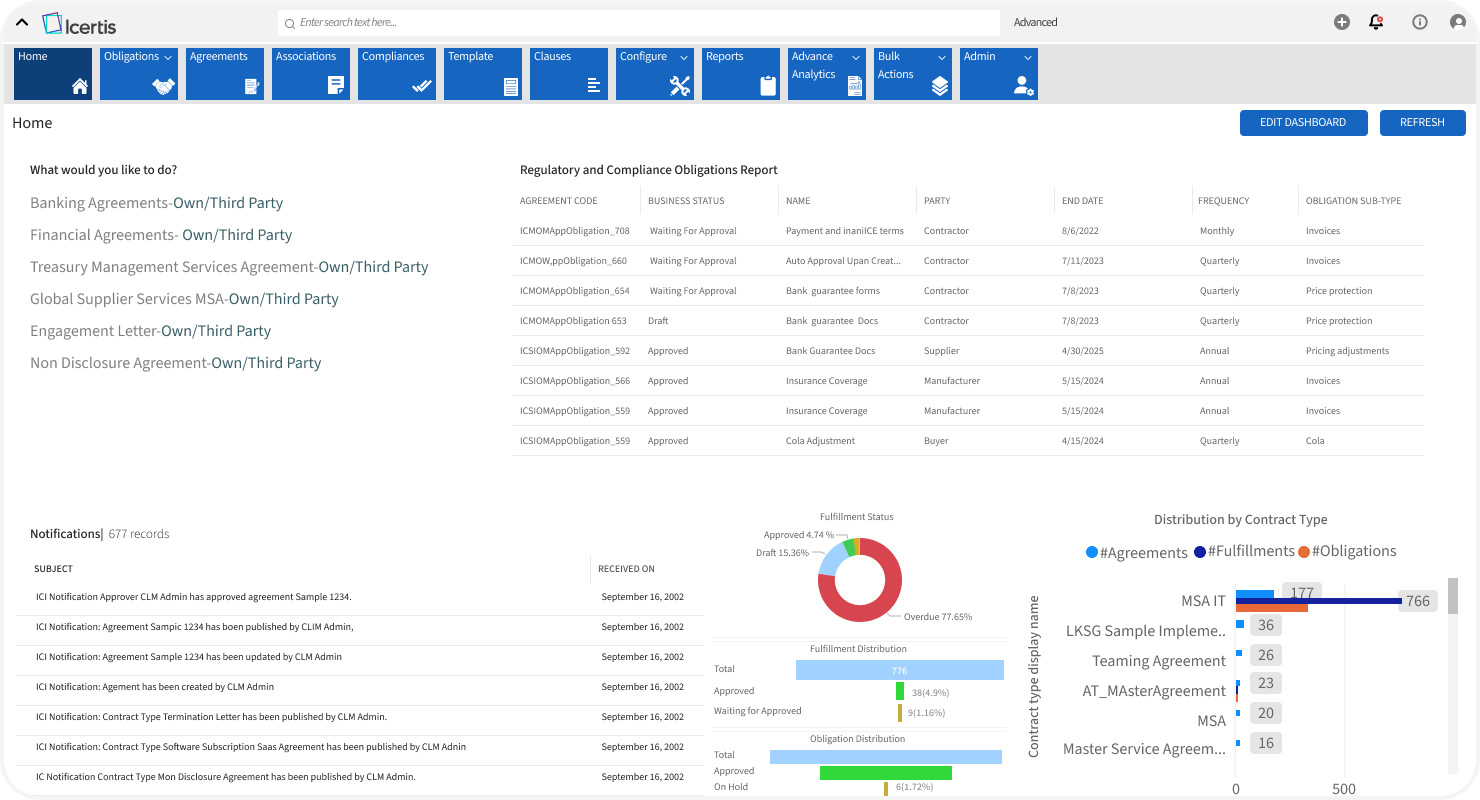
Icertis is an enterprise-grade contract intelligence platform headquartered in Bellevue, Washington, offering a dedicated “Icertis Contract Intelligence for Healthcare and Life Sciences” solution. The company has served healthcare and life sciences organizations for over a decade, providing specialized capabilities for healthcare providers, payers, pharmaceutical companies, biotechnology organizations, and life sciences firms.
The platform positions itself as a contract intelligence solution rather than just contract management, using AI to analyze contract data, monitor obligations, and provide strategic insights. Icertis explicitly targets large healthcare enterprises managing complex global contracts across research partnerships, manufacturing agreements, and commercialization deals.
For healthcare providers, Icertis aims to simplify and accelerate contract management with AI-driven CLM that centralizes contracts, automates workflows, and uses industry-specific AI to reduce risk and improve compliance. For healthcare payers, the platform automates provider agreement assembly and compliance management, supporting provider network expansion with structured contract workflows.
Key healthcare-focused features
- Dedicated healthcare and life sciences solution: Purpose-built “Icertis Contract Intelligence for Healthcare and Life Sciences” with over a decade of healthcare industry experience.
- AI contract intelligence: The AI analyzes healthcare contract data, identifies risks, monitors compliance obligations, and provides strategic insights for decision-making based on industry-specific training.
- Healthcare provider capabilities: Centralizes physician agreements, vendor contracts, and service agreements with automated workflows designed for healthcare compliance and patient outcome optimization.
- Healthcare payer features: Automates provider agreement assembly, compliance tracking, and risk detection, supporting provider network expansion with structured contract workflows.
- Pharmaceutical and biotech support: Manages complex global contracts across R&D partnerships, manufacturing relationships, and commercialization agreements with regulatory adherence tracking.
Pros of using Icertis
Deep healthcare and life sciences expertise: Over a decade serving healthcare organizations demonstrates the platform’s understanding of healthcare contract complexity, regulatory requirements, and industry-specific needs.
Enterprise scalability for large health systems: Icertis handles complex, high-volume contract portfolios across multiple facilities, regions, and business units, making it suitable for large healthcare enterprises and health systems.
Contract intelligence capabilities: The platform goes beyond basic contract management to provide strategic insights, risk analysis, and obligation monitoring powered by healthcare-specific AI models.
ICertis is customer focus and ensures success by making sure they met customers needs. Their API’s are easy to work with and integrate with systems
Cons or limitations to consider
Enterprise-only pricing not disclosed: Icertis does not publicly disclose pricing, and the platform typically targets large healthcare enterprises, potentially making it less accessible for mid-sized healthcare organizations.
Implementation complexity for enterprise systems: Enterprise-grade platforms often require longer implementation timelines and more extensive change management compared to more streamlined healthcare CLM solutions.
Limited public user reviews: Fewer publicly available healthcare user reviews make it harder to validate real-world performance and user satisfaction compared to platforms with more transparent review ecosystems.
iCertis need to work on the implementation side. Not very pleasant experience working with iCertis implementation partner.
Who Icertis is best suited for
Icertis is best suited for large healthcare enterprises, major health systems, national or international healthcare payers, and pharmaceutical or biotechnology companies with complex, high-volume contract portfolios. The platform serves organizations requiring advanced contract intelligence, enterprise scalability, and industry-specific AI capabilities, particularly those operating across multiple regions or business units.
5. CobbleStone Software – compliance-first healthcare contract management
About CobbleStone Software
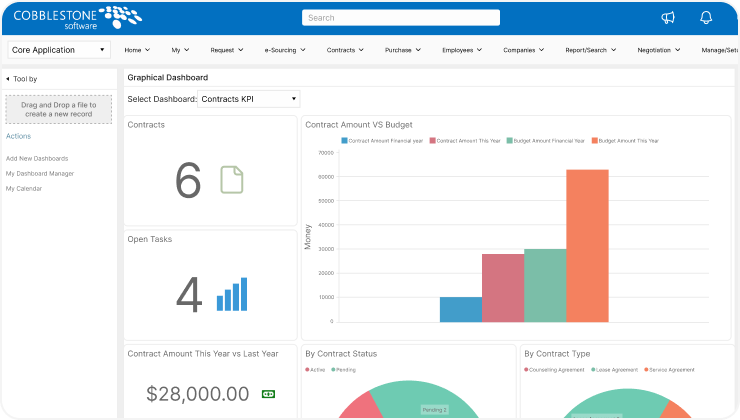
CobbleStone Contract Insight is a healthcare-explicit contract management platform that markets itself as “healthcare contract management software” and “medical contract management software.” The cloud-based platform offers contract and vendor tracking, compliance features, alerts, and e-signatures specifically designed for healthcare contract requirements.
CobbleStone is SOC 1 and SOC 2 compliant and provides a secure environment meeting compliance standards in hospitals and healthcare organizations. The platform offers HIPAA contract templates for BAA tracking and includes contract data merge capabilities to simplify managing business associate agreements and provider contracts.
The platform explicitly targets healthcare compliance needs with features supporting the full range of healthcare agreements, including physician contracts, vendor relationships, payer agreements, and pharmaceutical partnerships. CobbleStone’s secure vendor management module helps healthcare organizations assess and monitor vendor risk, a critical capability for HIPAA compliance and patient data protection.
Key healthcare-focused features
- HIPAA contract templates: Pre-built templates for business associate agreements, provider contracts, and other HIPAA-compliant healthcare documents with automated data merge capabilities.
- Healthcare compliance tracking: Automated alerts and compliance monitoring specifically designed for healthcare regulatory requirements, including BAA management and vendor risk assessment.
- Secure vendor management: Dedicated vendor management module with security assessments, risk monitoring, and compliance verification to support HIPAA vendor requirements.
- Healthcare contract repository: Centralized storage for physician agreements, payer contracts, vendor relationships, and pharmaceutical partnerships with role-based access controls.
- SOC compliance certification: SOC 1 and SOC 2 compliant environment specifically validated for use in hospitals and healthcare organizations.
Pros of using CobbleStone
Healthcare-specific compliance focus: The platform explicitly positions itself for healthcare organizations with HIPAA templates, BAA tracking, and compliance features designed for healthcare regulatory requirements.
Secure vendor management capabilities: Healthcare organizations can centrally manage vendor relationships, assess security risks, and maintain HIPAA vendor documentation in one platform.
Healthcare contract template library: Pre-built HIPAA-compliant templates for common healthcare agreements reduce time spent creating compliant contract documents from scratch.
Good sales and legal staff, and they are willing to get on a call and work on the issue.
Cons or limitations to consider
Implementation details not publicly available: CobbleStone does not disclose typical implementation timelines, making it difficult for healthcare organizations to plan deployment and compare against alternatives with clear implementation commitments.
Limited user interface modernization: Some users report that the interface could benefit from modernization, particularly compared to newer healthcare CLM platforms with more contemporary user experiences.
The only downside I am noticing right now, is the amount of information this system holds.
Who CobbleStone is best suited for
CobbleStone Software is ideal for healthcare providers, hospitals, and health systems prioritizing HIPAA compliance and vendor risk management. The platform particularly suits healthcare organizations needing pre-built compliance templates, BAA tracking capabilities, and secure vendor management features, with less emphasis on modern user experience or fast implementation timelines.
6. DocuSign CLM – CLM for health systems already using DocuSign
About DocuSign CLM
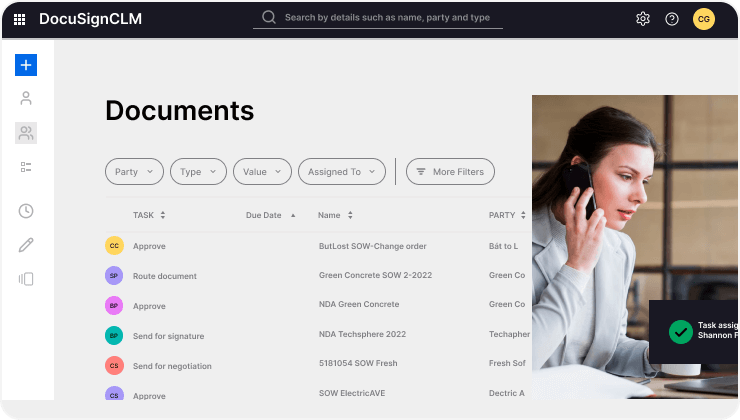
DocuSign CLM is a cloud-based contract lifecycle management platform from DocuSign, the widely recognized leader in electronic signature solutions. The platform extends DocuSign’s signature capabilities with full contract lifecycle automation and includes AI for contract review, though it lacks healthcare-specific positioning.
DocuSign CLM offers AI-powered contract review, automated workflows with a drag-and-drop editor, and integration with DocuSign’s core eSignature platform. Healthcare organizations already using DocuSign for signatures may find value in adopting the full CLM platform to manage contracts end-to-end while maintaining their existing signature workflows.
The platform is recognized in the Gartner Magic Quadrant for CLM and offers 100+ pre-trained AI models to analyze contract data, assess risks, and extract key terms. While not healthcare-specific, DocuSign CLM’s broad feature set can support healthcare contract management when configured appropriately.
Key healthcare-focused features
- Seamless eSignature integration: Native integration with DocuSign eSignature maintains healthcare organizations’ existing signature workflows while adding full contract lifecycle capabilities.
- AI contract analysis: 100+ pre-trained AI models analyze contract data and identify risks, though not specifically trained on healthcare contract types or compliance requirements.
- Workflow automation: Drag-and-drop workflow editor with 100+ pre-defined steps allows healthcare teams to build approval processes matching their requirements.
- Contract template library: Pre-defined contract templates and clause libraries that healthcare organizations can customize for provider agreements, vendor contracts, and payer relationships.
- Analytics and reporting: Contract analytics, risk scores, and reporting dashboards help healthcare organizations monitor contract portfolios and identify trends.
Pros of using DocuSign CLM
Familiar DocuSign ecosystem: Healthcare organizations already using DocuSign eSignature can extend their investment with full contract lifecycle management while maintaining familiar workflows and user experience.
Broad recognition and market presence: As a Gartner Magic Quadrant leader, DocuSign CLM offers enterprise stability and widespread adoption, important factors for risk-averse healthcare organizations.
Pre-trained AI models: 100+ AI models provide contract intelligence capabilities out of the box, though healthcare organizations may need to supplement with healthcare-specific training.
You can seamlessly connect documents across systems making it easier than ever to connect on agreements
Cons or limitations to consider
No healthcare-specific positioning: DocuSign CLM does not offer dedicated healthcare contract management features, HIPAA-specific templates, or healthcare compliance certifications beyond general security standards.
Higher pricing for small to mid-sized organizations: DocuSign CLM pricing is positioned at the higher end of the market and may not be affordable for smaller healthcare practices or growing healthcare organizations.
Platform performance issues: Some users report the platform can be buggy with suboptimal performance, and pages occasionally take longer to load than expected, which can impact user productivity.
Sometimes when I’m trying to test the changes in the flow I made, it doesn’t behave like I thought it would.
Who DocuSign CLM is best suited for
DocuSign CLM works best for healthcare organizations already using DocuSign eSignature who want to extend into full contract lifecycle management. The platform suits larger health systems and healthcare enterprises with budgets for premium pricing, but may be less appropriate for healthcare organizations seeking purpose-built healthcare compliance features or those requiring more affordable solutions.
7. Evisort – CLM with contract analytics capabilities
About Evisort
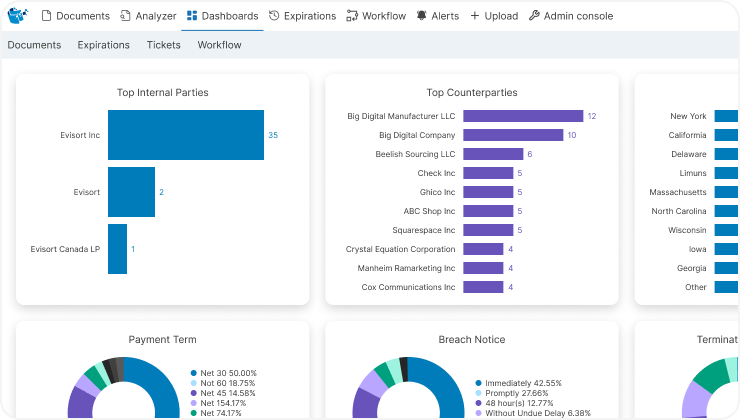
Evisort is a contract lifecycle management platform that focuses on AI for contract intelligence and analytics. Headquartered in San Francisco, Evisort offers a cloud-based solution with AI for document analysis, workflow automation, and contract analytics.
While Evisort has been used by healthcare and life sciences organizations, according to their materials, the platform lacks dedicated healthcare-specific positioning. The general-purpose CLM capabilities can be applied to healthcare contract management, but without built-in healthcare templates, compliance certifications, or industry-specific features.
Evisort’s AI focuses on extracting contract data, identifying obligations, and providing analytics across contract portfolios. Healthcare organizations seeking AI capabilities for contract intelligence may find value in the platform, though healthcare-specific requirements will require configuration.
Key healthcare-focused features
- AI contract intelligence: The AI analyzes contracts to extract key terms, identify obligations, and flag potential risks, though not specifically trained on healthcare contract types.
- Contract analytics and reporting: Comprehensive analytics dashboards provide visibility into contract portfolios, helping healthcare organizations identify trends and manage risks.
- Automated data extraction: AI automatically extracts contract metadata, including dates, parties, financial terms, and obligations, reducing manual data entry for healthcare contract administrators.
- Workflow automation: Configurable workflows automate contract reviews, approvals, and renewals based on rules that healthcare organizations define.
- File and folder synchronization: Integration with document storage systems allows healthcare teams to maintain existing file structures while adding CLM capabilities.
Pros of using Evisort
AI capabilities for contract intelligence: Evisort’s AI provides contract analysis and data extraction, helping healthcare organizations gain insights from large contract portfolios.
Advanced analytics for portfolio visibility: Healthcare leadership can access comprehensive contract analytics and reporting to understand risk exposure, obligation timelines, and portfolio trends.
Document synchronization capabilities: The platform’s file and folder sync features allow healthcare organizations to maintain their existing document management practices while adding CLM functionality.
We started using Evisort in August 2023. The implementation process and integrations were easy; we could roll out the software by September. We particularly liked the workflow builder and AI features. The AI tool has helped us easily capture important clauses and reduce our manual work. The Eversort team is constantly improving and adding new features, another bonus point.
Cons or limitations to consider
No healthcare-specific positioning: Evisort does not offer dedicated healthcare solutions, HIPAA compliance certifications, or healthcare contract templates. Organizations will need to configure compliance workflows and build healthcare-specific capabilities themselves.
Implementation details not disclosed: The platform does not publicly share implementation timelines, making it difficult for healthcare organizations to plan deployment and evaluate against alternatives.
Limited healthcare-specific use cases: While the platform has been used in healthcare settings, there are few publicly available healthcare-specific case studies or testimonials to validate effectiveness for healthcare contract management.
Although Evisort has pretty solid instructional materials, the learning curve for administrators can be steep. The UI takes a bit of time to get used to and some of the names for user permission profiles are idiosyncratic.
Who Evisort is best suited for
Evisort is appropriate for healthcare organizations that prioritize AI-powered contract intelligence and analytics capabilities and are comfortable configuring healthcare-specific compliance requirements themselves. The platform suits healthcare companies with technical resources to customize workflows and templates, rather than those requiring out-of-the-box healthcare compliance features.
8. Gatekeeper – vendor lifecycle management with contract capabilities
About Gatekeeper
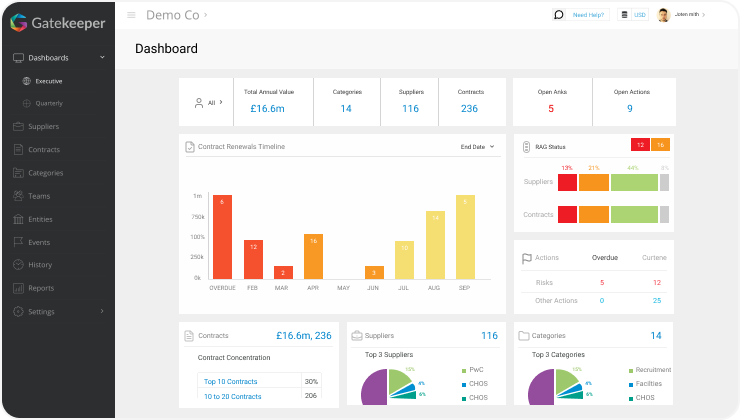
Gatekeeper is a cloud-based contract and vendor management platform headquartered in Cheltenham, United Kingdom. The platform positions itself as a vendor lifecycle management (VCLM) solution with a strong emphasis on vendor management, third-party risk, and supplier relationship management alongside contract capabilities.
Gatekeeper is ISO 27001:2013 certified for Information Security Management and ISO 9001:2015 certified for Quality Management, demonstrating commitment to security and quality standards. The platform offers automated compliance checks and audit trails that support HIPAA-aligned workflows and GDPR requirements, though it does not market itself as a healthcare-dedicated solution.
The platform’s Kanban Workflow Engine visualizes contract processes and automates contract lifecycle stages, with configurable permissions and unlimited integrated e-signatures. Gatekeeper integrates with 220+ third-party solutions, including SSO, ERP/finance, and document management systems.
Key healthcare-focused features
- Vendor lifecycle management: Comprehensive vendor and supplier management capabilities help healthcare organizations assess vendor risk, manage vendor contracts, and maintain vendor documentation for HIPAA compliance.
- Kanban workflow visualization: Visual Kanban boards show contract stages and automate processes, making it easy for healthcare teams to see where contracts are in the approval pipeline.
- Compliance audit trails: Automated compliance checks and complete audit trails support HIPAA-aligned workflows and GDPR requirements, though the platform does not claim HIPAA compliance certification.
- Enterprise security standards: ISO 27001:2013 and ISO 9001:2015 certifications plus industry-leading encryption for data at rest and in transit support healthcare security requirements.
- Extensive integration ecosystem: 220+ third-party integrations, including SSO, ERP/finance, and document management systems, allow healthcare organizations to maintain existing technology investments.
Pros of using Gatekeeper
Strong vendor and supplier management: Healthcare organizations managing complex vendor relationships benefit from Gatekeeper’s comprehensive vendor lifecycle capabilities, particularly important for vendor risk assessments in regulated environments.
Visual workflow management: The Kanban Workflow Engine provides clear visibility into contract status and progression, making it easier for healthcare teams to track contracts through approval processes.
Robust security certifications: ISO 27001:2013 and ISO 9001:2015 certifications demonstrate a commitment to security and quality standards important to healthcare organizations.
I like how Gatekeeper keeps everything in one place. It helps me manage all my contracts and vendors without needing ten different tools or reminders. What I found especially helpful is how it sends alerts before a contract ends or needs to be renewed.
Cons or limitations to consider
Not marketed as healthcare-specific: Gatekeeper does not market a dedicated healthcare contract management solution and lacks healthcare-specific templates, workflows, or compliance certifications beyond general security standards. Teams will need to configure compliance workflows rather than relying on pre-built healthcare features.
Limited healthcare use case evidence: The platform does not prominently feature healthcare customers or healthcare-specific case studies, making it harder to validate effectiveness for healthcare contract management needs.
Implementation and pricing not disclosed: Gatekeeper does not publicly share implementation timelines or pricing details, requiring healthcare organizations to engage in sales conversations before evaluating fit.
The main downside of Gatekeeper is the setup for more complex workflows, which can be a bit tricky without extra help. Some users also find the reporting features not as flexible as they’d like, especially when it comes to pulling specific data.
Who Gatekeeper is best suited for
Gatekeeper works well for healthcare organizations whose primary contract management challenge is vendor and supplier relationship management. The platform suits healthcare companies managing numerous vendor contracts, assessing third-party risk, and requiring strong vendor lifecycle capabilities, but may be less appropriate for organizations needing healthcare-specific compliance features or provider/payer contract management.
9. Juro – modern CLM for lean healthcare legal teams
About Juro
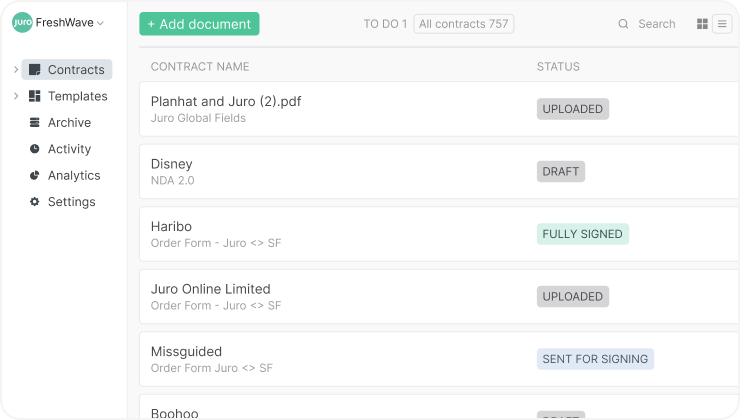
Juro is a cloud-based contract automation platform headquartered in London, United Kingdom. The browser-native solution enables business teams to negotiate and manage contracts end-to-end while legal retains oversight, positioning itself for lean legal teams supporting multiple business functions.
Juro’s AI assistant helps with drafting, reviewing, summarizing, and extracting data from contracts. The AI extract feature handles tagging metadata and digitizing PDF contracts. The platform is SOC 2 and ISO 27001 compliant with 256-bit encryption for data security, meeting general enterprise security standards.
While Juro does not claim healthcare-specific positioning, templates, or certifications, the platform’s contract automation features can be adapted to healthcare contract management. The platform targets Sales, HR, Procurement, and Finance teams working with legal departments rather than healthcare-specific use cases.
Key healthcare-focused features
- AI for contract assistance: AI helps healthcare teams draft, review, and summarize contracts, though not specifically trained on healthcare contract types or compliance requirements.
- Browser-native workflow: Healthcare teams can negotiate and manage contracts entirely in the browser without switching between multiple tools or downloading software.
- Deep system integrations: Integration with CRM, HR, and other business systems allows healthcare teams to initiate and manage contracts from existing tools they use daily.
- AI metadata extraction: Automatically tags contract metadata and digitizes PDF contracts, helping healthcare organizations centralize and organize existing contract documents.
- Security and compliance: SOC 2 and ISO 27001 compliance with 256-bit encryption provides enterprise-grade security, though not healthcare-specific certifications.
Pros of using Juro
Modern, user-friendly interface: The browser-native platform offers a contemporary user experience that healthcare business teams can adopt without extensive training or complex software installations.
Designed for lean legal teams: Healthcare organizations with small legal departments supporting multiple business units may benefit from Juro’s approach of empowering business teams while maintaining legal oversight.
Quick adoption for business teams: The platform’s focus on enabling Sales, HR, Procurement, and Finance teams to self-serve on routine contracts can reduce legal bottlenecks for standard healthcare vendor agreements.
What I like about Juro is the contract creation and workflow capabilities. The template builder is genuinely robust, making it easy to standardise documents and roll them out across different teams. The approval workflow is also well-designed and the signing flow works smoothly end-to-end.
Cons or limitations to consider
No healthcare-specific capabilities: Juro does not offer healthcare contract templates, HIPAA compliance features, or healthcare-specific positioning. Organizations must build compliance workflows and templates from scratch rather than using pre-configured healthcare features.
Limited healthcare validation: With no publicly available healthcare customers, case studies, or healthcare use cases, it’s difficult to validate the platform’s effectiveness for complex healthcare contract management needs.
General-purpose positioning: The platform targets general business contracting rather than healthcare compliance requirements, potentially missing critical healthcare-specific features such as BAA management and provider contract workflows.
The search and data extraction may at times be a bit basic and does not offer the best insights.
Who Juro is best suited for
Juro is appropriate for smaller healthcare organizations or healthcare technology companies with lean legal teams managing primarily business contracts such as vendor agreements, employment contracts, and commercial partnerships. The platform is less suitable for healthcare providers managing complex physician agreements, payer contracts, or organizations requiring healthcare-specific compliance features and templates.
Key benefits of healthcare contract management software
Healthcare contract management software delivers measurable improvements across compliance, revenue protection, operational speed, and organizational visibility. These benefits address the unique challenges healthcare organizations face when managing complex agreements with providers, payers, vendors, and regulatory bodies.
1. Reduce compliance risk and audit headaches:
Healthcare organizations operate under strict regulatory requirements. HIPAA violations, missing Business Associate Agreements (BAAs), and incomplete audit trails create significant legal and financial exposure.
Contract management software maintains complete contract audit trails of all contract actions. Every approval, revision, and access event is tracked with timestamps and user attribution.
The software automatically flags contracts approaching compliance deadlines, preventing gaps in regulatory coverage.
2. Prevent revenue leakage in payer and provider contracts:
Healthcare reimbursement is complex. Rate schedules, discount structures, and performance incentives vary across payer contracts. Contract management software extracts and tracks financial terms automatically.
Reimbursement rates, bundled payment structures, and value-based care metrics are stored in searchable formats. Renewal tracking prevents automatic extensions at unfavorable terms by identifying evergreen contracts early, ensuring negotiations begin with adequate lead time.
3. Accelerate contracting for physicians, vendors, and payers:
Healthcare organizations manage diverse contract types across multiple stakeholders. Standardized templates reduce drafting time from weeks to hours.
Pre-approved language for common contract types enables non-legal staff to initiate contracts without starting from scratch.
Automated workflows route contracts to appropriate reviewers based on contract type, value, and risk level, enforcing approval sequences without manual intervention.
4. Improve visibility into obligations and performance:
Healthcare contracts contain numerous ongoing obligations that fall under post-signature contract administration and require continuous monitoring. Centralized repositories make every contract searchable by any term or party.
Legal teams can instantly locate all agreements with a specific vendor, all contracts containing indemnification language, or all payer agreements expiring within a defined period.
Executive dashboards provide real-time contract status across the organization, enabling proactive decision-making.
Contract management software features for healthcare organizations
Healthcare contract management software must address industry-specific requirements while providing core CLM capabilities. Here are essential features for healthcare providers, payers, and life sciences organizations:
- Security, access controls, and audit trails: Role-based access controls ensure only authorized personnel can view sensitive agreements. Audit trails track every user action—viewing, editing, downloading, sharing—creating comprehensive records for compliance reviews and security investigations.
- Compliance tracking for healthcare regulations: Tag contracts with applicable regulations and monitor compliance status. Automated alerts notify teams when contracts lack required language or approach compliance deadlines. Policy libraries store standard clauses for BAAs, HIPAA provisions, and state-mandated terms.
- Centralized repository and advanced search: Organize thousands of contracts with consistent metadata tagging. Full-text search locates specific language within contract documents, supported by structured metadata and strong legal document version control. Metadata search filters by contract type, party, value, dates, or custom tags.
- Workflow automation and AI review: Automated workflows send contracts to appropriate reviewers based on predefined rules. AI review capabilities scan contracts for missing clauses, non-standard language, and potential risks. Clause libraries enable AI to compare draft language against approved standards.
- Integrations with core healthcare systems: Integration with EMR/EHR systems ensures provider agreements align with credentialing data. CRM integration connects payer contracts with membership information. The ticketing system integration routes contract requests from departments. eSignature integration enables digital execution. Finance and ERP system integration links contract terms with billing.
How to select the right healthcare contract management software solution
Healthcare organizations benefit from structured evaluation frameworks that involve key stakeholders and prioritize essential capabilities. Here are factors to consider when selecting contract management software:
- Consult stakeholders across legal, finance, compliance, and operations: Provider organizations prioritize physician contracts, payer agreements, and vendor management. Payers focus on provider network agreements and reinsurance contracts. Life sciences companies manage clinical trial agreements and research collaborations. Identify which contract types consume the most resources.
- Evaluate features and integrations: Distinguish between must-have capabilities and desirable features. Must-have features typically include repository management, search, workflow automation, and compliance tracking. Assess integration requirements based on your existing technology stack, including EHR systems, CRM platforms, and finance systems.
- Run pilots and track relevant metrics: Request pilot programs with finalist vendors using real contracts and actual workflows. Track contract cycle time, legal hours per contract, approval bottlenecks, and search time to build a defensible business case for a contract management system. Ask vendors about implementation timelines, configuration requirements, training, support, contract migration, and pricing for volume or user overages.
How much does healthcare contract management software cost?
There is no fixed cost for healthcare contract management software. Pricing varies based on several factors, including:
- Exact features and functionalities
- Modules required
- Number of contracts managed
- Number of users
- Integration capabilities
A basic contract management solution typically costs less than an advanced platform with automation, analytics, and compliance capabilities. Vendors usually provide pricing details based on your specific requirements. For a deeper breakdown, you can review the factors affecting the cost of contract management software.
HyperStart offers custom pricing models designed to fit different healthcare business needs. Organizations can request a tailored quote based on contract volume, user count, and required features.
With this information, you are well-positioned to evaluate and select the right healthcare contract management software to streamline contract operations and maintain compliance.
Ready to streamline your contract management process?
Healthcare organizations need contract management solutions that address HIPAA compliance, payer relationships, provider credentialing, and regulatory requirements. HyperStart CLM provides healthcare-focused contract management for providers, payers, and life sciences organizations.
The HyperStart AI contract management platform handles diverse healthcare agreement types with workflows tailored to operational realities. Healthcare customers report faster contract processing, improved renewal capture, and reduced legal bottlenecks. Implementation typically completes within weeks, with dedicated support during migration and configuration.
Book a personalized demo to see how HyperStart CLM addresses your contract challenges. Our team will review your processes, demonstrate platform capabilities, and outline an implementation timeline.