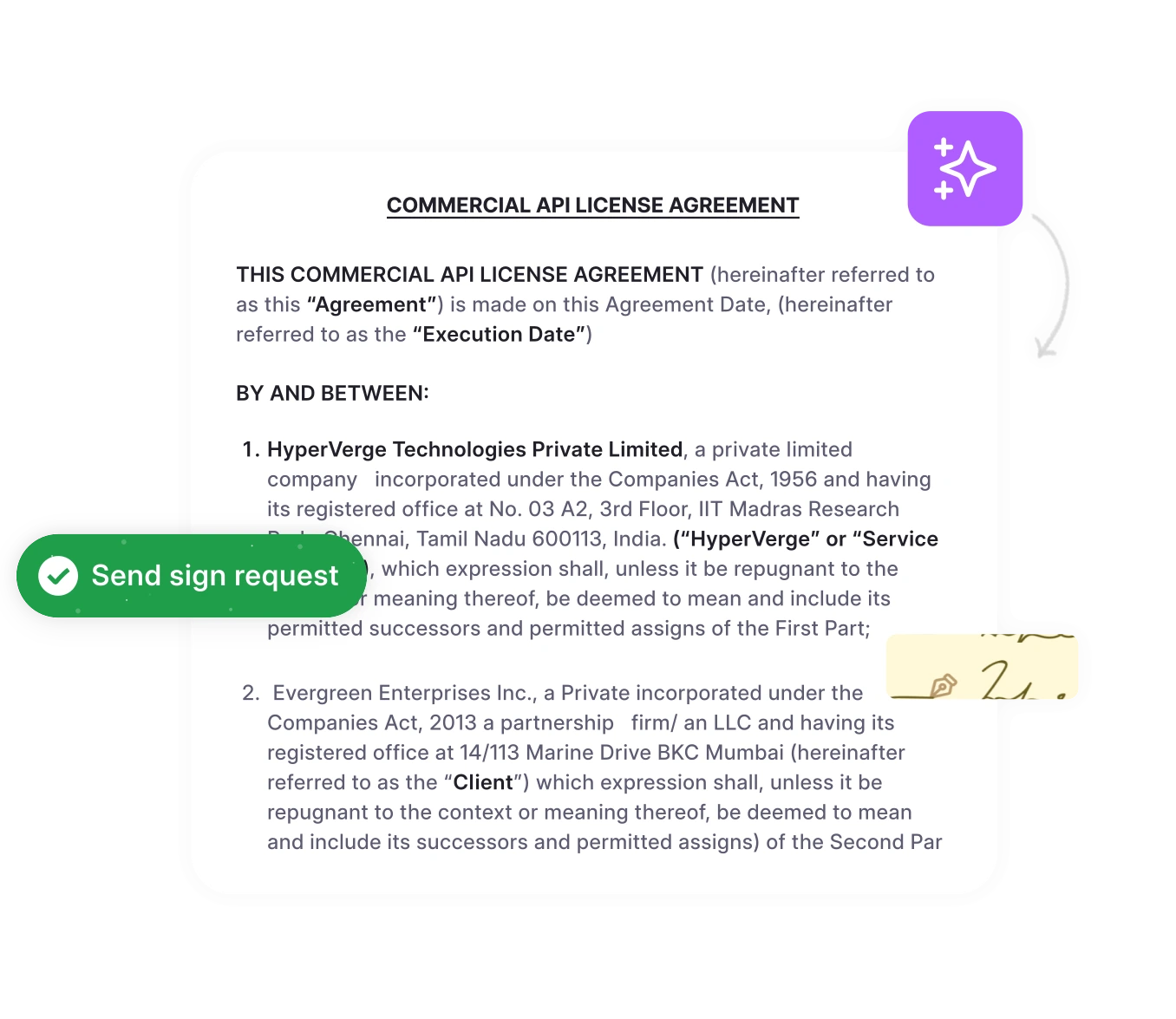




Most legal teams spend more time negotiating indemnification clauses than any other contract provision. The reason is straightforward: a poorly drafted indemnification clause can expose your company to unlimited financial liability, and the standard contract-wide liability cap may not protect you.
This guide covers the indemnification clause definition, the five components that determine whether a clause protects or exposes you, and three copy-ready sample clause templates for the most common contract scenarios. It also covers how in-house legal teams manage indemnification obligations at scale using HyperStart contract lifecycle management software.
What is an indemnification clause?
Indemnification clause definition: An indemnification clause is a contractual provision that transfers financial risk from one party to another. The indemnifying party agrees to compensate the indemnified party for specified losses, damages, legal defense costs, and third-party claims that arise from covered events defined in the clause.
Indemnity meaning: Indemnity is the legal obligation to make another party whole against a specified loss. The word comes from the Latin indemnis, meaning free from loss. In a contract, an indemnity provision is a promise: if a triggering event causes the other party a loss, you will cover the resulting costs.
An indemnification clause defines who is responsible when something goes wrong. It does not prevent a lawsuit from being filed. It determines who bears the financial cost when one is.
In a vendor agreement, the vendor typically indemnifies the client against claims arising from the vendor’s services, products, or intellectual property. In a construction contract, the subcontractor typically indemnifies the general contractor against claims arising from the subcontractor’s work on site. In a licensing agreement, the licensor typically indemnifies the licensee against third-party IP infringement claims related to the licensed technology.
The clause answers three questions: who pays (the indemnitor), what they pay for (covered events), and how much they pay (the scope of recoverable damages, including any indemnification cap). Understanding each of these components is the difference between a clause that protects you and one that creates surprise exposure at the worst possible time.
What does an indemnification clause look like? Sample language and examples
The following are standard indemnification clause templates for three common scenarios in commercial contracts. These are starting points — every clause should be reviewed by legal counsel before use in a binding agreement.
Standard one-sided indemnification clause
Used when one party bears the indemnification obligation. This is the standard structure in vendor agreements, SaaS contracts, and professional services agreements where the vendor or service provider creates the primary risk.
[Vendor] shall indemnify, defend, and hold harmless [Client] and its officers,
directors, employees, agents, and permitted successors and assigns from and
against any and all third-party claims, damages, losses, liabilities, costs,
and expenses (including reasonable attorneys' fees) arising out of or relating
to: (a) any material breach by [Vendor] of its representations, warranties, or
obligations under this Agreement; or (b) the negligence or willful misconduct
of [Vendor] or its personnel.
Mutual indemnification clause
Used in balanced agreements where both parties create risk exposure for the other. Each party indemnifies the other on identical terms. Standard in partnerships, licensing agreements, and commercial contracts between parties with comparable risk profiles.
Each party (as "Indemnifying Party") shall indemnify, defend, and hold harmless
the other party and its officers, directors, and employees (collectively,
"Indemnified Parties") from and against any third-party claims, losses, and
expenses (including reasonable attorneys' fees) arising out of or related to:
(a) the Indemnifying Party's material breach of this Agreement; or (b) the
gross negligence or willful misconduct of the Indemnifying Party.
Important drafting check: Mutual indemnification clauses can look balanced but be asymmetric if the covered events for each party are defined differently. If one party’s obligation triggers on “negligence” and the other’s only on “gross negligence,” the clause is not truly mutual. Always compare both obligations side by side before signing.
Standard indemnification clause with liability cap
Used when the indemnifying party needs to limit total exposure. Without an explicit indemnification cap written directly into this clause, the general contract liability cap may not apply to indemnification obligations.
[Party A] shall indemnify [Party B] for any third-party claims arising from
[Party A]'s breach of this Agreement; provided, however, that [Party A]'s
total indemnification obligations under this Section shall not exceed the
greater of: (i) $[AMOUNT]; or (ii) the total fees paid by [Party B] to
[Party A] in the twelve (12) months immediately preceding the claim giving
rise to the indemnification obligation.
Key drafting note: Standard liability caps in the contract body do not automatically apply to indemnification obligations. Courts in most US jurisdictions treat indemnity for third-party claims as a performance obligation. A $500,000 liability cap can leave the indemnitor exposed to indemnification costs well beyond that amount unless an explicit indemnification cap is included in the clause itself.
Review Indemnification Clauses 210x Faster
HyperStart’s AI reviews an indemnification clause in 26 seconds. Flag uncapped obligations, identify one-sided terms, and extract indemnity scope across your full contract portfolio without manual review.
Book a DemoWhat are the key components of an indemnification clause?
Every indemnification clause has five core components. Missing or misdefining any one of them creates disputes that outlast the original contract.
Obligation to indemnify: who pays what
Every indemnification clause names two parties: the indemnitor (the party giving the protection) and the indemnitee (the party receiving it). In vendor agreements, the vendor is almost always the indemnitor. In construction contracts, subcontractors indemnify the general contractor. In licensing agreements, the licensor indemnifies the licensee against IP infringement claims.
The obligation to indemnify is a financial obligation. When a covered event occurs, the indemnitor pays. This includes third-party claims filed against the indemnitee, settlements the indemnitee reaches with a third party, judgments entered against the indemnitee, and all associated legal costs. The right of indemnification only applies to losses that fall within the clause’s defined trigger events, which is why the covered events language is the most heavily negotiated part of any indemnification provision.
One drafting detail that creates disputes: whether the indemnification obligation survives termination of the contract. If the clause does not specify, courts apply the governing law default, which varies by state. Always include an explicit survival clause for indemnification obligations.
Covered events and scope of indemnification obligations
Covered events define exactly when the indemnification obligation is triggered. Most commercial contracts use one or more of the following trigger categories:
- Material breach of the agreement — the most common trigger. The indemnitor covers losses caused by their own breach of the contract’s representations, warranties, or obligations.
- Negligence or willful misconduct — covers third-party bodily injury, property damage, and related claims arising from the indemnitor’s actions or omissions.
- IP infringement — the indemnitor’s products, services, or deliverables infringe a third party’s patent, copyright, trademark, or trade secret.
- Data breach or security incident — common in SaaS and technology contracts. The vendor indemnifies the client if a breach of the vendor’s systems exposes the client’s data to a third-party claim.
- Regulatory violations — the indemnitor’s failure to comply with applicable laws triggers the obligation. Common in healthcare contract management, financial services, and government contracts.
The scope of covered events is where indemnification clause language gets contested most often. Vendors push to limit triggers to “gross negligence or willful misconduct.” Clients push for “negligence.” The difference is significant: standard negligence includes ordinary mistakes; gross negligence requires a reckless disregard of risk. Always negotiate the negligence standard before signing.
Obligation to defend: procedures, control, and limitations
The obligation to defend is legally distinct from the obligation to indemnify. Indemnification reimburses losses after they occur. Defense requires the indemnitor to actively fund and manage the legal defense as the claim is ongoing — before any finding of liability.
This distinction matters in practice. A clause that says “indemnify against losses” may not require the indemnitor to fund a defense while litigation is active. A clause that says “indemnify, defend, and hold harmless” creates three separate obligations: paying defense costs in real time, covering final losses, and preventing the indemnitee from being held liable.
Three provisions that must accompany any defense obligation:
- Control of defense — which party controls the defense strategy and selects legal counsel. Indemnitors typically insist on controlling the defense to manage costs. Indemnitees typically insist on approval rights over counsel selection.
- Settlement consent — the indemnitor cannot settle a claim that affects the indemnitee’s rights, reputation, or future obligations without the indemnitee’s written consent. This prevents the indemnitor from accepting a settlement that includes non-monetary terms binding on the indemnitee.
- Notice obligation — the indemnitee must notify the indemnitor promptly when a covered claim arises. Failure to provide timely notice can reduce or eliminate the indemnitor’s defense obligation if the delay prejudiced their ability to manage the claim.
Recoverable damages: what costs are covered
A well-drafted indemnification clause defines exactly which costs the indemnitor must cover. The most common formulation covers: third-party judgments, court-approved settlements, attorneys’ fees, court filing costs, expert witness fees, and reasonable legal expenses incurred during the defense.
The critical drafting question is whether defense costs are included before a judgment is entered. Clauses that only reference “damages” without specifying defense costs create disputes over whether the indemnitor must fund an ongoing legal defense during litigation. Standard commercial drafting practice lists both defense costs and final damages explicitly:
“…from and against any and all third-party claims, damages, losses, liabilities, costs, and expenses (including reasonable attorneys’ fees)…”
What is typically not recoverable under a standard indemnification clause: internally calculated lost profits, consequential damages unless explicitly included, and punitive damages unless the governing jurisdiction permits contractual indemnification of punitive awards. Always confirm what damages are explicitly included and excluded in the indemnification clause language — not in a separate limitation of liability section that may or may not apply.
Indemnification cap: limiting total exposure
Without an explicit indemnification cap, the indemnifying party faces potentially unlimited financial exposure. This is the most common drafting gap in commercial contracts.
Standard limitation of liability clauses do not automatically apply to indemnification obligations. Courts in most US jurisdictions treat indemnification as a performance obligation. A general cap on “liability for breach” does not limit that promise unless the contract explicitly states it does. A vendor with a $500,000 liability cap can face indemnification obligations well beyond that amount if a third-party IP claim arises — unless the indemnification clause contains its own explicit cap.
Common indemnification cap structures by contract type:
| Contract type | Typical indemnification cap | Notes |
|---|---|---|
| Low-risk vendor agreement | 1x annual contract value (ACV) | Standard for services with limited data or IP exposure |
| SaaS / technology agreement | 2x to 3x ACV | Higher cap reflects data handling and IP risk |
| IP infringement (buyer requirement) | Often uncapped | Vendors should push for a separate, higher cap rather than fully uncapped exposure |
| Data breach indemnification | Negotiated separately | Regulatory fines in healthcare and financial services can exceed standard ACV multiples |
Note on uncapped indemnity meaning: an uncapped indemnification clause is not the same as unlimited indemnity. Even without a cap, indemnification is limited to actual, documented third-party losses. An uncapped clause means the general contract liability cap does not apply to that specific obligation. For guidance on tracking which of your contracts contain uncapped obligations, see contract management best practices.
One-sided vs. mutual indemnification clause: which protects whom?
Indemnification clauses in commercial contracts run in one of two directions. The structure you use determines how risk is distributed between the parties.
One-sided (unilateral) indemnification clause
In a unilateral indemnification agreement, one party bears the entire indemnification obligation. This is standard when one party — typically a vendor, contractor, or service provider — creates the primary risk in the relationship.
One-sided indemnification is appropriate when:
- A vendor’s product or service creates the majority of risk exposure for the client
- One party handles data or intellectual property belonging to the other
- The parties’ risk profiles are clearly asymmetric — for example, a construction subcontractor working on a general contractor’s project site
One-sided clauses are standard in SaaS agreements, professional services contracts, software development agreements, and staffing contracts. They are not inherently unfair — they reflect the actual distribution of risk in the relationship.
Mutual indemnification clause
A mutual indemnification clause requires both parties to indemnify each other for losses arising from their own breach, negligence, or IP infringement. It is standard in partnerships, licensing agreements, and commercial contracts where both parties create meaningful risk exposure for the other.
Sample mutual indemnification clause language:
Each party ("Indemnifying Party") shall indemnify, defend, and hold harmless
the other party ("Indemnified Party") from and against any third-party claims
arising out of or related to: (a) the Indemnifying Party's material breach of
its obligations under this Agreement; (b) the Indemnifying Party's gross
negligence or willful misconduct; or (c) any infringement of a third party's
intellectual property rights by the Indemnifying Party. Neither party's
indemnification obligation shall exceed the total fees paid or payable under
this Agreement in the twelve (12) months preceding the applicable claim.
Mutual clauses require careful drafting. If the scope of covered events differs between the two indemnification obligations, the clause is unilateral in practice despite the mutual label. Always compare the trigger language for both sides before accepting “mutual indemnification” language.
For a broader understanding of how indemnification clauses fit into the overall structure of a contract, see our guide to indemnity agreements.
Indemnification clauses in commercial contracts: industry-specific applications
Indemnification clauses appear in virtually every commercial contract. The obligation, covered events, and cap vary significantly by contract type and the applicable law of the governing jurisdiction.
In construction contracts
Construction indemnification clauses typically run between the general contractor and subcontractors. The subcontractor indemnifies the GC against claims arising from the subcontractor’s work on site: injuries to the subcontractor’s employees, property damage caused by the subcontractor’s crew, and third-party claims arising from the subcontractor’s negligence.
Anti-indemnity statutes in most US states — including California, Texas, and New York — prohibit clauses that require a subcontractor to indemnify a general contractor for the GC’s own negligence. A construction indemnification clause example that does not account for the relevant anti-indemnity statute may be partially or fully unenforceable. Always confirm applicable state law before finalizing construction indemnification language. See how teams handle construction contract management at scale.
In employment agreements
Indemnification clauses in employment agreements typically protect employees from personal liability for actions taken within the scope of their employment. A director and officer (D&O) indemnification clause requires the employer to defend and indemnify the employee against shareholder suits, regulatory claims, and other actions arising from the employee’s good-faith performance of their duties.
The clause should specify whether indemnification covers legal defense costs before a final determination — not just after a favorable verdict. LLC operating agreements also commonly include D&O indemnification provisions protecting managing members from personal liability for LLC business decisions made in good faith.
In consulting agreements
A consultant indemnification clause almost always runs one way: the consultant indemnifies the client. The scope typically covers claims arising from the consultant’s services, IP infringement from the consultant’s deliverables, and the consultant’s breach of confidentiality obligations.
Consultants should negotiate to limit indemnification to claims arising from their own negligence or willful misconduct — not the client’s use of the deliverables for purposes outside the original engagement scope. An independent contractor indemnification clause should also address which party owns the IP in the deliverables, since IP ownership determines who bears the infringement indemnification obligation if a third party files a claim.
In intellectual property and licensing agreements
IP indemnification clauses protect the licensee against infringement claims from third parties who allege that the licensed technology violates their patents, copyrights, or trademarks. The licensor indemnifies the licensee if a third party sues over the licensed IP.
An intellectual property indemnification clause in a software license or SaaS agreement should specify: which categories of IP claims trigger the obligation, whether the licensor controls the defense or just funds it, and whether the licensor can choose to modify or replace the allegedly infringing component rather than pay damages. The right to “step in” with a workaround instead of paying damages is a standard licensor protection that licensees should watch for and negotiate where appropriate.
In software and SaaS agreements
SaaS indemnification clauses typically cover three categories: IP infringement (the vendor’s software infringes a third party’s intellectual property), data security incidents (a breach of the vendor’s systems exposes the customer’s data to a third-party claim), and service-related claims (third-party claims arising directly from the customer’s use of the platform in violation of the terms of service).
Vendors resist broad data breach indemnification language because it creates significant exposure in regulated industries where regulatory fines can exceed standard contract value multiples. Customers should push for explicit IP infringement indemnification and specific coverage for regulatory fines arising from a vendor-caused security incident. For SaaS vendors managing high-volume agreements, see SaaS contract management software.
In real estate contracts
Indemnification clauses in real estate lease agreements typically require the tenant to indemnify the landlord against claims arising from the tenant’s use of the premises — injuries to the tenant’s customers or employees, property damage caused by the tenant’s operations, and regulatory violations by the tenant. Landlords typically indemnify tenants against claims arising from the landlord’s negligence in maintaining the property structure or common areas.
Real estate indemnification clause language often overlaps significantly with the insurance requirements in the same contract. Review both sections together: the indemnification clause determines who is legally obligated to pay; the insurance requirements determine who must have the financial capacity to cover that obligation. For teams managing high volumes of lease agreements, see real estate contract management.
How to negotiate an indemnification clause
Five provisions in-house counsel should always negotiate before signing any contract with indemnification obligations:
- Negligence standard. “Gross negligence or willful misconduct” versus “negligence” is the most consequential drafting decision in any indemnification clause. Gross negligence is a high bar — ordinary errors and misjudgments do not meet it. Push for “negligence” if you are the indemnitee. Push for “gross negligence” if you are the indemnitor.
- IP indemnification cap. Many buyers require uncapped IP indemnification. If you are the vendor, resist leaving IP indemnification fully uncapped. Negotiate a separate, higher cap specifically for IP claims — typically 3x to 5x ACV — rather than agreeing to unlimited exposure. Unlimited IP indemnification is the single largest source of surprise contract liability for technology vendors.
- Defense control. Define clearly who selects legal counsel, who controls the defense strategy, and what approval rights the indemnitee retains over settlement decisions. Ambiguity here leads to expensive disputes during active litigation when both parties are under pressure and incentives are misaligned.
- Survival clause. Confirm that indemnification obligations survive contract termination. A clause that does not address survival may become unenforceable after the agreement ends — even if the triggering event occurred during the active contract term.
- Explicit indemnification cap inside the clause. If the contract has a general limitation of liability clause, do not assume it applies to indemnification. Add an explicit cap inside the indemnification clause itself. See the sample capped clause earlier in this guide for the standard drafting approach.
For teams managing multiple active negotiations simultaneously, contract negotiation software tracks redline history and clause-level risk across every open deal — so no indemnification obligation slips through unreviewed.
Indemnification clause vs. hold harmless clause: what is the difference?
The terms are often used interchangeably in US commercial contracts. Courts in Colorado, Delaware, Ohio, and Louisiana treat them as synonyms. California and several other states treat them as legally distinct.
“Hold harmless” is a promise not to hold the other party liable — it prevents claims from arising against the other party in the first place. “Indemnification” is a promise to compensate after a loss has already occurred.
Most well-drafted commercial contracts combine both: “indemnify, defend, and hold harmless.” This three-part formulation covers:
- Defense costs — ongoing legal fees during active litigation
- Final damages — judgments or settlements after litigation ends
- Liability prevention — blocking third-party claims from reaching the indemnitee directly
If a contract uses only “indemnify” without “hold harmless,” the indemnified party may still face claims that they must pass through to the indemnitor — rather than having the indemnitor block those claims directly. The practical difference matters most in litigation: “indemnification and hold harmless clause” language with all three elements gives the indemnitee the strongest protection at every stage of a claim.
How do legal teams manage indemnification clauses at scale?
For legal operations teams reviewing dozens of contracts per month, manually identifying and evaluating indemnification clauses in every agreement is not sustainable. A single review cycle for one complex indemnification clause takes 92 minutes on average, per IBM and CLOC research. Across a 200-contract monthly volume, that is 300+ hours per month on clause review alone.
AI-powered contract review changes this. HyperStart’s AI reviews a full contract — including all indemnification obligations — in 26 seconds. Across a contract portfolio, the system:
- Flags uncapped indemnification clauses automatically — identifies every agreement where indemnification obligations are not capped or where the standard liability cap explicitly does not apply to indemnification
- Extracts indemnification obligation data at scale — counterparty, covered events, cap amount, and whether defense costs are included — across thousands of contracts simultaneously
- Surfaces one-sided clauses for renegotiation — identifies contracts where indemnification runs only one direction so legal teams can prioritize mutual-clause renegotiations at renewal
- Alerts on renewal dates tied to indemnification terms — contract reminder software notifies contract owners 60 to 90 days before renewal so material indemnification obligations can be renegotiated rather than auto-renewed unchanged
LeadSquared used HyperStart to surface all uncapped indemnification obligations across their contract portfolio — a review that previously required weeks of manual effort — in a single automated scan. For more on how AI handles clause-level extraction at portfolio scale, see AI contract management.
Best tools for drafting and reviewing indemnification clauses
For drafting, most in-house legal teams use a combination of a pre-approved clause library and a contract management system. The clause library stores approved indemnification language by contract type. Contract drafting software enforces that only approved indemnification language is used in new agreements — preventing individual negotiators from accepting non-standard clause language without legal review.
For reviewing existing contracts, contract risk management software automatically extracts indemnification clauses from uploaded documents, flags uncapped obligations, and identifies one-sided terms across the full contract portfolio. HyperStart reviews a full contract — including all indemnification provisions — in 26 seconds, with 94% AI accuracy.
Stop Missing Uncapped Indemnity Obligations
94% AI accuracy. HyperStart automatically surfaces every contract where indemnification obligations exceed your liability cap — across thousands of agreements simultaneously. See it in action.
Book a Demo