



- A legal signature is any mark applied to a document with the intent to agree to its terms. Courts do not require a specific appearance or format.
- Three conditions make a signature legally binding: intent to sign, attribution to a specific person, and retention of the signed record.
- Digital signatures are legally binding in the US under the ESIGN Act and in the EU under eIDAS. They carry stronger evidential weight than wet signatures in disputes.
A signature on a contract is not just a formality. It is the primary evidence courts use to determine whether an agreement was reached, who agreed to it, and whether that party had the authority and capacity to be bound. Get any one of those elements wrong, and a validly signed contract can be challenged, delayed, or voided in litigation.
When signature validity is disputed, three questions decide the outcome: Did the signer intend to be bound? Can the signature be attributed to that specific person? Was the signed document retained in an accessible, unaltered form? Legal teams, procurement managers, and compliance officers managing contracts at scale face this challenge across vendor agreements, employment contracts, NDAs, and regulatory filings, each carrying different authentication requirements and jurisdictional standards. A signing process that is sufficient for ten contracts a month creates legal exposure when applied to hundreds.
This guide covers what constitutes a legal signature under US and international law, the requirements that make one binding and enforceable, the types courts recognize, the enforceability risks that invalidate even properly executed signatures, and how contract management software from HyperStart automates signature compliance across every contract type and jurisdiction your team manages.
What is a legal signature?
A legal signature is any mark, symbol, or process applied to a document with the intent to agree to its terms. Courts do not require a specific appearance. A handwritten name, initials, a typed name, a stamp, or a click on “I agree” all qualify as legal signatures when the surrounding context confirms intent, identity, and consent.
Legal signatures serve as proof of agreement. They create enforceable obligations, establish accountability, and provide the evidentiary record courts rely on when disputes arise. Under frameworks like the ESIGN Act, UETA, and eIDAS, legal signatures in electronic and digital form carry the same weight as handwritten ones.
For example:
- A startup founder signing a client NDA to protect confidential information.
- An HR manager is completing an employment contract for a new hire.
- A freelancer signing a project agreement or proposal digitally.
- A business owner is finalizing a vendor or supplier contract.
Laws such as the ESIGN Act (U.S.) and eIDAS (EU) recognize electronic and digital signatures as legally binding if they meet requirements like intent, authentication, attribution, and record retention.
Ensuring signatures meet these legal standards protects individuals and organizations from disputes, enforces contractual obligations, and guarantees that agreements – whether domestic or international – hold up in court.
Streamline your signature workflow today
HyperStart helps you create legally enforceable signatures quickly and securely. Save time, reduce errors, and keep all your contracts organized in one platform.
Book a DemoWhat is considered a legal signature?
A signature is considered legal when it meets three conditions: the signer had the intent to sign, the signature can be attributed to that specific person, and the signed record is retained and accessible to all parties.
Courts do not require a signature to be legible, a full name, or a recognizable word. A mark, initials, a stamp, or a typed name all qualify, provided intent and attribution are present. What makes a signature legal is not how it looks but what it proves.
The legal definition of a signature under the ESIGN Act: “an electronic sound, symbol, or process, attached to or logically associated with a contract or other record and executed or adopted by a person with the intent to sign the record.” Your full cursive name is not required. What the law requires is proof that you intended to be bound by the document you marked.
Who needs legal signatures?
Legal signatures are crucial for anyone involved in agreements, contracts, or official documents where enforceability is a key consideration. Different professionals rely on them in specific ways:
- Business Owners & Startups: Use legal signatures to finalize client contracts, partnership agreements, and vendor or supplier contracts. For example, a startup founder signing an NDA with a new client ensures confidential information remains protected.
- HR Professionals & Recruiters: Secure employment contracts, offer letters, and onboarding documents. A legally binding signature ensures that employees understand and agree to the company’s policies, benefits, and responsibilities.
- Freelancers & Consultants: Formalize project agreements, proposals, and invoices. Signing electronically ensures clients acknowledge the scope, deliverables, and payment terms, minimizing disputes.
- Legal Professionals: Verify and enforce contracts, settlements, and other legal documents. Legal signatures provide proof of intent and compliance, essential in litigation or arbitration.
- Enterprises & Remote Teams: Manage vendor agreements, cross-border contracts, and team approvals efficiently. Electronic and digital signatures allow large teams to execute documents securely from anywhere, while maintaining legal enforceability.
Understanding who needs legal signatures and for what types of documents ensures that agreements are enforceable, disputes are minimized, and all parties’ rights are protected.
Electronic signatures have the same legal validity as handwritten signatures under laws like the Uniform Electronic Transactions Act (UETA). They must show clear intent to sign, consent to conduct business electronically, be associated with the signed record, and have proper record retention.
Electronic signatures cannot be denied legal effect solely because they are in electronic form, and parties must agree to transact electronically. Security measures such as verification processes help ensure authenticity and enforceability.
What makes a signature legally enforceable?
Three elements make a signature legally enforceable: authentication (proof of the signer’s identity), intent (knowing, voluntary agreement to be bound), and integrity (protection against post-signing alteration). Courts examine all three when signature validity is challenged.
Most legal signature failures do not happen because a signature was illegible or missing a middle name. They fail when one of these three pillars is weak or absent.
1. Authentication
Authentication proves the signature belongs to the person named. Handwritten signatures achieve this through motor-memory patterns that forensic experts analyze. Electronic signatures accomplish it through identity verification: email confirmation, two-factor authentication, or biometric checks. Digital signatures use cryptographic encryption that mathematically proves the signer’s identity. The law does not prefer one method. It accepts all three if they demonstrate who signed.
2. Intent
Intent requires clear evidence that the signer knowingly agreed to the document’s terms. This is why contracts include signature blocks stating “I have read and agree to the terms” and why eSignature platforms display the full document before requesting a signature. A signature in an email chain without explicit agreement language may not establish intent under scrutiny. The platform or process must create a documented record that the signer saw the terms and chose to be bound.
3. Integrity
Integrity ensures the document was not altered after signing. Handwritten signatures on paper provide this through physical ink and paper examination. Electronic signatures create audit trails logging timestamp, IP address, and device data. Digital signatures embed cryptographic seals that break if anyone modifies even a single character after signing. Without integrity protection, a signed document can be disputed on the grounds that the version the signer approved is not the version being enforced.
The ESIGN Act and UETA established that electronic signatures carry equal legal weight to handwritten ones when they satisfy these three pillars. The EU eIDAS Regulation goes further, recognizing qualified digital signatures as legally equivalent to handwritten signatures for nearly all document types.
What are the requirements for a legally binding signature?
For a signature to be legally binding, five conditions must be satisfied. These requirements apply to both handwritten and electronic signatures.
1. Intent to sign
The signer must demonstrate a clear, voluntary intention to agree to the document’s terms. Intent is the single most important requirement. A signature obtained through fraud, coercion, or misrepresentation does not satisfy this requirement and is void regardless of its form. Courts assess intent by looking at the circumstances surrounding the signing, not just the mark itself.
2. Consent and understanding
The signer must have the legal capacity to enter into an agreement. Minors, individuals under the influence, and those declared mentally incapacitated cannot create a binding signature. For electronic documents, signers must also consent to receiving and signing documents electronically. The platform must give them the option to opt out and receive a paper copy.
3. Signature attribution
The signature must be traceable to the specific individual who signed. For electronic signatures, attribution is established through contract audit trails, IP address logging, email confirmation, and timestamp records. Without attribution, the signature can be challenged and the document may be unenforceable in court.
4. Record retention
The signed document must be stored in a format that all parties can access and reproduce. This applies to both paper and electronic contracts. Loss of the signed record weakens enforceability, particularly in disputes where the opposing party denies signing. Dedicated contract storage systems ensure signed documents are encrypted, version-controlled, and retrievable on demand.
5. Security and protection
The document must be protected against tampering after signing. For electronic signatures, this means encryption and audit logs that detect any post-signature changes. For paper contracts, this means secure storage that prevents alteration of the signed version.
6. Contract law signature rules
Contract law does not prescribe a single signature format. It sets outcome-based rules that any signature method must satisfy to be enforceable. The core signature rules and guidelines under US contract law:
- The signature must be voluntary. A signature obtained through fraud, duress, or misrepresentation is void regardless of its form.
- The signer must have legal capacity. Minors, individuals under the influence, or those declared mentally incapacitated cannot create a binding signature.
- The signature must be connected to the document. A signature on a blank page or one that cannot be logically linked to a specific contract does not satisfy attribution requirements.
- Both parties must sign. A document signed by only one party is not a binding agreement. All parties listed must execute the document.
- Witnesses or notarization may be required. Certain documents, including wills, deeds, and powers of attorney, require a witness or notary to validate the signature under state law.
Legal document signature requirements vary by document type. A standard vendor contract needs only intent, attribution, and retention. A real estate deed requires notarization. A will typically requires two witnesses. Always verify the requirements specific to the document type and jurisdiction before signing.
Electronic signatures are legally valid when the signer intends to authenticate the document and the signature is securely linked to the record. Compliance with laws like the ESIGN Act (U.S.) and eIDAS (EU) ensures enforceability, provided there is consent, authentication, and audit trails. These measures reduce disputes and facilitate faster, cost-effective transactions globally.
Read
What are the different types of legal signatures?
Legal signatures come in several forms, each suitable for different documents and purposes.
1. Physical or wet signatures
Physical or wet signatures are handwritten signatures made in person. They are commonly used for high-value agreements, government documents, or notarized contracts. For example, signing a property sale or a mortgage agreement usually requires a wet signature along with witness verification.
2. Electronic signatures (eSignatures)
Electronic signatures (eSignatures) are created digitally, such as typing a name, drawing it on a touchscreen, or uploading an image of a handwritten signature. Laws such as the ESIGN Act, eIDAS, and India’s IT Act recognize e-signatures as legally binding when intent, consent, and record retention are ensured. Businesses, HR teams, and freelancers often use eSignatures to quickly sign contracts, NDAs, or proposals while maintaining their enforceability.
3. Digital signatures
Digital signatures are a type of electronic signature that adds encryption and authentication, ensuring the authenticity of the signature and the integrity of the document. They are often used in vendor agreements, financial approvals, and software licensing contracts where tamper-proof security is essential. While all electronic signatures are digital signatures, digital signatures offer stronger security through encryption and authentication, making them ideal for high-risk or sensitive contracts.
4. Faxed or scanned signatures
Faxed or scanned signatures involve sending an electronic image of a handwritten signature. While legally acceptable in many situations, they are less secure than digital signatures and are usually used when other signing tools are unavailable.
Understanding these types helps organizations, freelancers, and professionals select the right method for each document, ensuring enforceability, security, and contract compliance.
Are digital signatures legally binding?
Yes. Digital signatures are legally binding in the United States under the ESIGN Act and in the European Union under eIDAS. A digital signature uses cryptographic encryption to verify the signer’s identity and detect any tampering after signing. This makes digital signatures the most legally robust signature type, carrying stronger evidential weight than a wet signature or a basic electronic signature in disputes.
A digital signature is legally binding when it satisfies the same conditions as any other signature: the signer intended to sign, the signature is attributable to them, and the record is retained. The difference is that digital signatures provide automated, tamper-evident proof of all three conditions through the certificate authority, timestamp, and audit log.
1. Is a typed name a legal signature? Yes. Under the ESIGN Act, a typed name satisfies the definition of an electronic signature as long as it is executed with intent to sign. Typing your name at the bottom of a contract, clicking “I agree,” or using a name-entry field in a signing workflow all constitute legally binding signatures when the system captures attribution data such as IP address, timestamp, and email confirmation.
2. Is a signature legally binding on its own? A signature alone does not make a document enforceable. The underlying contract must also have offer, acceptance, consideration, and mutual assent. A signature is evidence that those conditions were met, not a substitute for them. If the contract itself is void, no signature makes it enforceable.
What are the use cases of legal signatures?
Legal signatures are essential across various roles and industries, ensuring agreements are enforceable, protecting rights, and streamlining operations. The following table highlights key use cases and their practical benefits:
| Audience / Role | Use Case | Example | Benefit / Context |
| Business owners & startups | Client contracts, vendor agreements, partnership deals | A startup founder signing a non-disclosure agreement (NDA) with a new client | Protects sensitive business information, ensures enforceability of agreements, and minimizes the risk of disputes with partners or clients. They make business operations more secure and trustworthy. |
| HR professionals & recruiters | Employment contracts, offer letters, and onboarding documents | HR manager securing an employment agreement for a new hire | Confirms that employees understand company policies, benefits, and responsibilities. They help HR prevent misunderstandings, non-compliance, or legal challenges related to employment terms. |
| Freelancers & consultants | Project agreements, proposals, and invoices | Freelancer signing a project proposal digitally | Provides a legally enforceable record that clearly defines project scope, deliverables, and payment terms. Protects freelancers from non-payment or disputes and ensures clarity with clients. |
| Legal professionals | Contracts, settlements, legal documents | Lawyer verifying a settlement agreement | Serves as proof of intent and compliance, which is essential in court, arbitration, or legal audits. They help maintain the integrity of agreements and evidence. |
| Enterprises & remote teams | Vendor agreements, cross-border contracts, and team approvals | Remote teams signing contracts digitally across multiple locations | Enables multiple parties to sign securely from anywhere while ensuring the agreement is legally binding. Streamlines workflows, reduces delays, and maintains compliance across borders. |
Never worry about compliance again
HyperStart ensures every signature meets legal requirements and is fully auditable. Stay compliant while giving your team and clients a signing experience.
Book a DemoLegal signature vs regular signature: what is the difference?
Every legal signature is a signature, but not every signature is a legal signature. The distinction comes down to context and enforceability. A signature on a birthday card is a signature. A signature on a vendor contract that carries an audit trail, attribution data, and a retention record is a legal signature.
| Factor | Regular Signature | Legal Signature |
| Purpose | Identifies the signer informally. Used on personal correspondence or acknowledgments that carry no legal obligation. | Creates a legally enforceable obligation. Used on contracts, deeds, and affidavits where the signer intends to be legally bound. |
| Intent requirement | No formal intent required. A signature on a greeting card carries no contractual weight even if it is the signer’s full legal name. | Intent to sign is mandatory. The signer must knowingly agree to be bound. Without demonstrated intent, the signature is not enforceable. |
| Attribution | No attribution requirements. The mark does not need to be traceable to a verified identity in a dispute. | Attribution is required. The signature must be traceable to the specific signer through an audit trail, IP address, timestamp, or certificate. |
| Record retention | No retention obligation. The signed document may be discarded without legal consequence. | The signed document must be retained and accessible to all parties. Loss of the signed record weakens enforceability. |
| Court enforceability | Not enforceable. A casual signature creates no legal obligation a court will uphold. | Enforceable. A legal signature on a valid contract is admissible as evidence and can be used to compel performance. |
What are some examples of a legal signature?
Legal signature examples include handwritten marks, typed names, initials, electronic clicks, stamps, and cryptographic digital certificates. Any of these qualifies as a legally binding signature when the signer had intent to be bound, the signature can be attributed to them, and the signed record is retained.
Courts do not require a specific appearance. A wide range of marks are legally binding when intent, attribution, and record retention are present.
- Handwritten signature: A handwritten mark on a paper contract, even if illegible, is a legal signature when the signer had capacity and intent. Used for high-value transactions, real estate deeds, and government documents.
- Typed name: Typing your name in a signature field on a digital document, PDF, or email contract qualifies as a legal signature under the ESIGN Act. Common in SaaS agreements, freelance contracts, and employment offer letters.
- Initials: Initialing each page of a contract or using initials in a designated signature field is a legal signature. Used in real estate contracts, multi-page agreements, and amendment acknowledgments.
- Electronic signature via platform: A DocuSign, Adobe Sign, or HyperStart signature captures the signer’s name, email, IP address, and timestamp in an audit log. This is a legally binding electronic signature under the ESIGN Act and UETA.
- “I agree” checkbox or button click: Clicking “I agree” on a terms of service, privacy policy, or software license constitutes a legal signature when the platform logs the action and the user had a genuine opportunity to review the terms. This is called a clickwrap agreement and is enforceable in US courts.
- Stamp or mark: A company stamp, chop, or official seal used in place of a handwritten signature is legally binding in jurisdictions that recognize it. Used on corporate agreements, purchase orders, and government filings.
- Digital signature with certificate: An Aadhaar eSign, DocuSign qualified signature, or PKI-based digital signature uses a cryptographic certificate from a trusted authority. It is the strongest form of legal signature, required for government filings, regulated industries, and cross-border contracts under eIDAS.
What qualifies as a signature on a note or draft? Under the Uniform Commercial Code (UCC), any symbol executed with the intent to authenticate a negotiable instrument qualifies as a signature. This includes a handwritten name, initials, a thumbprint, or a trade name. The UCC does not require a wet signature on notes or drafts. Typed or electronic marks satisfy the requirement when intent is clear.
Does “all rights reserved” in a signature have legal effect? No. Adding “all rights reserved” to a signature line on a contract does not modify the terms of the agreement or reserve any rights not already addressed in the contract. Courts treat a signature as acceptance of the document’s terms as written. Notations added unilaterally next to a signature that contradict or attempt to limit the contract’s terms are generally unenforceable unless both parties agreed to include them.
What are the benefits of legally binding signatures?
Legally binding signatures do more than formalize agreements—they protect parties, streamline operations, and provide legal certainty for businesses, HR teams, freelancers, and legal professionals. Here’s why they matter:
1. Ensure enforceability in court
A legally binding signature provides clear evidence that all parties agreed to the terms of a contract. This applies to NDAs, client contracts, partnership agreements, and vendor deals. Having proper signatures ensures that if a dispute arises, the agreement can be presented as valid proof in court, safeguarding your business or freelance interests.
2. Reduce disputes and legal risks
By creating a documented record of consent, misunderstandings and conflicts are minimized. This is particularly important for HR agreements, employment contracts, and project scopes. Tools like Hyperstart enhance this by providing audit trails, timestamped records, and compliance features, giving both parties confidence that the document cannot be tampered with.
3. Streamline operational efficiency and workflow
Digitally signing agreements speeds up approvals and reduces administrative bottlenecks. Whether onboarding a new employee, approving vendor contracts, or finalizing client agreements, teams no longer need to wait for in-person signatures, allowing business processes to move faster and teams to focus on productive work.
4. Save costs and time
Traditional paper-based workflows require printing, mailing, and storing documents, which can be expensive and time-consuming. Legal electronic signatures eliminate these steps, reducing operational costs while accelerating project timelines. This is especially useful for businesses handling large volumes of contracts or freelancers managing multiple client agreements.
5. Increase accessibility
Electronic and digital signatures allow documents to be signed from anywhere, at any time, and on any device. This makes collaboration easier for remote teams, international clients, and freelancers. Legal validity is maintained while providing the convenience of signing on the go.
How to make signatures legally binding using HyperStart
Ensuring that a signature is legally valid requires following clear steps. While traditional methods focus on physical signatures, modern platforms like HyperStart make it easy to execute legally binding contracts digitally. Here’s a detailed guide:
1: Review the document thoroughly
Before signing, carefully read every clause, term, and condition. Ensure you understand your obligations, rights, deadlines, and penalties. For example, employment agreements, client contracts, and vendor deals often contain clauses that can affect payments, confidentiality, and responsibilities. Reviewing the document ensures informed consent and reduces the risk of disputes.
2: Prepare the contract in HyperStart
Once all internal approvals are complete in HyperStart, the workflow will show the contract as Ready for Signature. At this stage, you can:
- Add stamp paper if required.
- Upload a pre-signed PDF if the document was signed externally.
- Proceed to send it for signature using HyperStart’s integrated eSignature options.
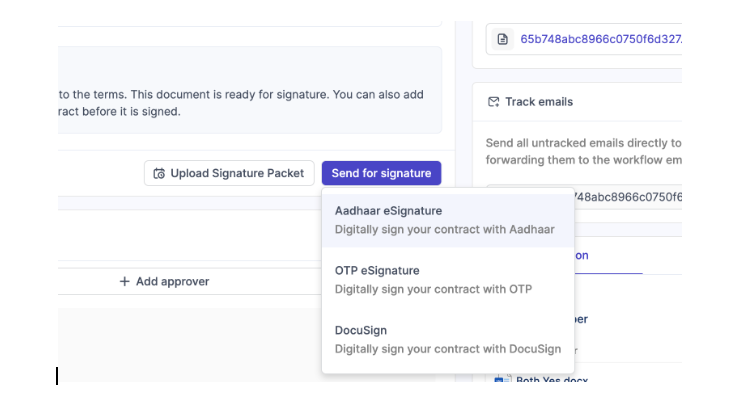
3: Select the type of signature
HyperStart supports multiple signature providers:
- DocuSign or Adobe eSignature – redirects you to DocuSign for the signing process.
- OTP-based eSignature – uses mobile/email verification to confirm signer identity.
- Aadhaar eSignature – a secure Aadhaar-based signing option.
4: Add participants and assign roles
- Enter the name and email of each signer.
- For multiple signers, click Add signer to create individual signer cards.
- You can also add recipients who should receive a copy of the signed contract for review or record-keeping. HyperStart even suggests recipients based on activity logs, ensuring key stakeholders stay informed.
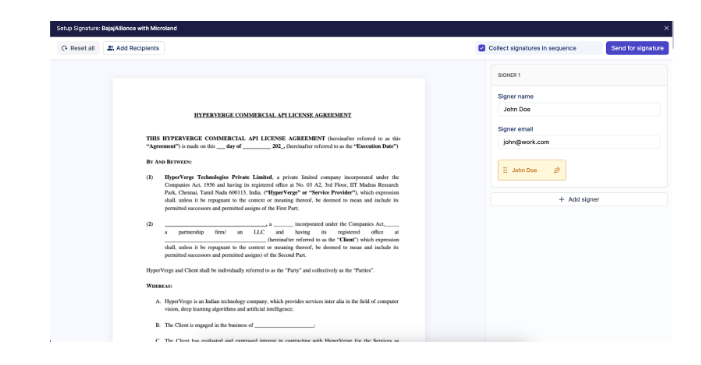
5: Place signature fields on the document
- Drag and drop signature fields onto the document at the locations where each signer needs to sign.
- Fields can be resized, and multiple instances can be assigned to the same signer if necessary.
- This ensures that each signature is clearly linked to the correct party, maintaining enforceability and traceability.
6: Decide the signing sequence
- Choose Collect signatures in sequence if signatures must follow a specific order. This is best for hierarchical approvals or sequential client-vendor agreements.
- Leave unchecked for parallel signing, where all signers receive requests simultaneously, speeding up the process for documents requiring multiple approvals at once.
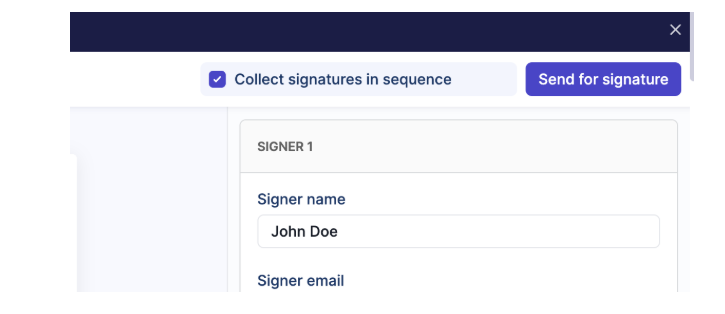
7: Verify settings and send for signature
- Review all participant details, signature placements, and sequence settings.
- Click Send for signature.
- Signers will receive an email with instructions to complete the signing process.
8: Track and finalize the signed contract
- HyperStart maintains an activity log, allowing you to monitor which participants have signed and who is pending.
- Once all signatures are collected, the contract is legally binding and securely stored in HyperStart.
- Any recipients you added receive a copy of the finalized contract, ensuring transparency and proper record-keeping.
9: Maintain records for legal compliance
- Legally binding contracts must be retrievable for audits, disputes, or compliance purposes.
- HyperStart automatically keeps signed contracts securely stored, maintaining encryption and audit trails for maximum legal protection.
What enforceability risks can invalidate a legally binding signature?
Three enforceability risks invalidate otherwise valid signatures: consent ambiguity (unclear whether the signer understood what they agreed to), authority gaps (the signer lacked organizational authority to execute that contract), and regulatory non-compliance (the signature method did not meet industry-specific standards for that document type). Legal validity and practical enforceability are different challenges: a signature can be technically valid and still fail in court.
1. Consent ambiguity
Consent ambiguity occurs when the signer claims they did not understand what they were agreeing to. An email reply saying “I approve the attached contract” might satisfy minimal intent requirements but fail if the signer argues they only approved the email, not the contract itself. This is why signing platforms require signers to acknowledge they have read the full document before the signature field is activated. Without that explicit acknowledgment, the consent record is weak.
2. Authority gaps
Authority gaps emerge when someone signs on behalf of an organization without the proper delegation to do so. An authorised signatory is a person formally designated by the organization with explicit authority to execute contracts up to a defined value or for a specific contract category. An employee signing a $500,000 vendor agreement when their approval limit is $100,000 creates an unenforceable signature regardless of the signature type used. Organizations must document who qualifies as an authorised signatory, at what contract values, and for which document types. If the signer lacked authority, the contract is voidable by the organization.
3. Regulatory non-compliance
Certain industries require signatures that meet specific regulatory standards beyond the ESIGN Act. Healthcare organizations cannot use basic electronic signatures for patient consent under HIPAA without documenting compliance. They need HIPAA-compliant electronic signatures with specific audit trail requirements. Financial institutions must verify signer identity through regulated KYC processes before accepting digital signatures on certain agreements. A signature that does not meet the applicable regulatory standard for that document type is invalid regardless of how it was executed.
How do legal signature requirements vary by jurisdiction?
Legal signature requirements vary significantly by country and document type. The US ESIGN Act accepts electronic signatures broadly for commercial transactions. The EU eIDAS Regulation defines three tiers of electronic signatures: simple, advanced, and qualified, with different legal weights. Many emerging markets lack equivalent legislation, requiring paper-based fallback processes to ensure enforceability. Global organizations that apply a single signature standard across all jurisdictions create compliance gaps that can invalidate agreements.
- United States: The ESIGN Act and UETA accept electronic and digital signatures broadly for commercial transactions. However, certain document types, including wills, powers of attorney, and some real estate transfers, still require wet-ink signatures in many states. Requirements are changing but are not yet uniform.
- European Union: The eIDAS Regulation recognizes three levels of electronic signature: simple, advanced, and qualified. Qualified digital signatures are legally equivalent to handwritten signatures across all EU member states. However, individual countries maintain specific requirements for regulated document types such as notarized deeds and court filings.
- Emerging markets: Many jurisdictions outside the US and EU lack clear electronic signature legislation. Organizations executing agreements in these regions may need to maintain parallel paper-based signature processes to ensure enforceability. A digital signature executed in a jurisdiction with no equivalent to ESIGN may have uncertain legal standing.
The practical implication for enterprises: a platform that captures the signatory’s location, applies the appropriate signature standard for that jurisdiction, and maintains a jurisdiction-specific audit trail is essential for cross-border contract compliance. This is why organizations increasingly standardize on digital signatures for international agreements. The cryptographic proof reduces jurisdictional disputes over signature validity.
Make every signature legally enforceable with HyperStart
HyperStart integrates trusted eSignature options, including DocuSign, Adobe Sign, OTP-based, and Aadhaar, within a single contract workflow. Drag-and-drop signature fields, sequential and parallel signing sequences, real-time tracking, and encrypted storage ensure every signature meets the legal standards for intent, attribution, and record retention.
Contract signing software from HyperStart handles the compliance requirements automatically so legal teams, HR, and procurement managers can focus on the agreement itself rather than the execution mechanics.