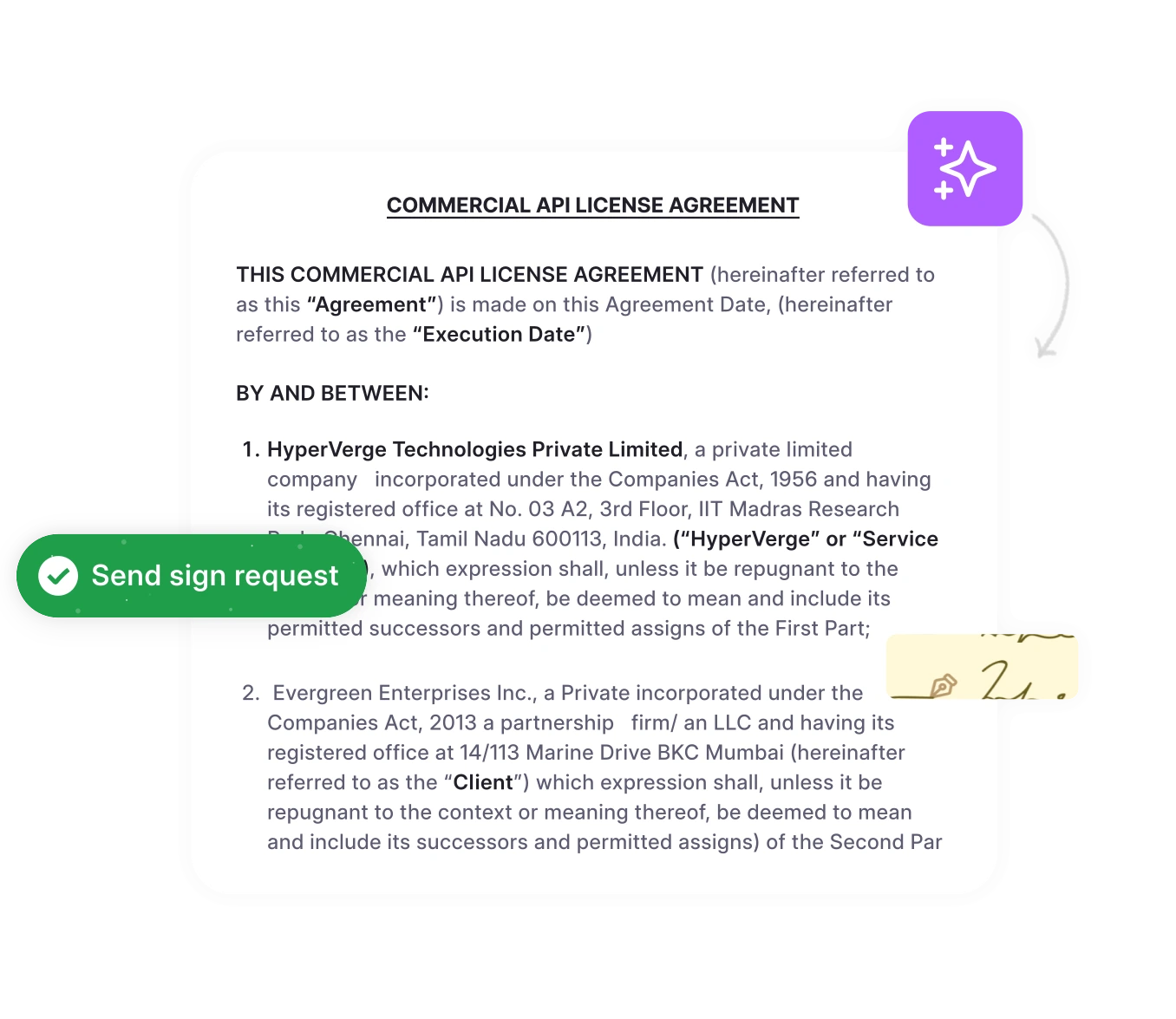



Reading a contract shouldn’t feel like translating a lost language. Terms like heretofore, inter alia, and mutatis mutandis are scattered across agreements as though plain English simply doesn’t exist. The result? Deals slow down, stakeholders check out, and misunderstood clauses quietly erode your bottom line.
Here are the most common legalese examples you’ll encounter in business contracts, why they exist, and — more importantly — what you can replace them with. If your team is spending more time decoding language than managing deals, this one’s for you.
What is legalese? (And why do lawyers use it?)
Legalese is the formal, technical language used in legal documents — a mix of Latin phrases, archaic English, and industry-specific terminology that has accumulated over centuries of legal drafting. It goes well beyond using complicated words. It’s an entire register of writing that prioritizes legal precision (in theory) over human readability (in practice).
The classic legalese examples you’ll spot immediately: notwithstanding, whereas, hereinafter, null and void, force majeure. These terms aren’t random — they each have a legal history. But their necessity in modern contracts? That’s debatable.
The origins: Why your contract sounds like it’s from 1750
Here’s a quick history lesson. Early English law was conducted in Latin and then Norman French, which is why so many legal phrases still carry that flavour today. When English eventually became the official language of legal proceedings in the 18th century, lawyers didn’t discard the Latin and French vocabulary; they folded it into their English drafting. And so the tradition of complex legal writing became self-perpetuating.
Fast forward to today, and you’re still reading contracts that say in witness whereof when “signed by” works just fine. The problem isn’t just aesthetic. According to research on contract negotiation, 72% of professionals believe that contract simplification would improve understanding, reduce negotiation time, and boost the confidence of negotiators. That’s nearly three-quarters of the people inside the legal process saying the language isn’t working.
Legalese didn’t develop because it was the clearest way to write — it developed because of historical linguistic layering. That history doesn’t make it necessary today.
What modern contracting research recommends instead:
- Efficiency first: Simplification reduces negotiation time and improves cross-functional understanding.
- Market norms over aggression: In one documented case study, a manufacturing company that adopted “market norm” terms — rather than aggressive, one-sided legal language — saw its negotiation time fall by 68%.
- Visual aids: Modern best practices suggest using graphics, flowcharts, and timelines alongside text so all parties share a clear understanding of responsibilities.
- Focus on business terms: Negotiators are urged to prioritise scope, responsibilities, and delivery over over-engineered legal risk clauses like indemnities and limitations of liability.
Turn Jargon into Action
Don’t let legalese examples slow your team down. Use HyperStart to automatically translate complex clauses into clear business terms.
Book a DemoCommon legalese examples you’ll find in every contract
Archaic adverbs: herewith, whereof, and heretofore
These are arguably the most dated examples in the legalese playbook. Words like herewith, whereof, heretofore, hereinabove, and hereinafter are compound adverbs that were once used to avoid repeating the name of the document. Today, they’re mostly just confusing.
| Legalese | Plain English |
| Herewith | Enclosed / with this |
| Heretofore | Until now / previously |
| Hereinafter | From this point on / below |
| Whereof | Of which |
| Whereas | Given that / because |
None of these words adds precision. They add distance. And in commercial contracts where speed matters, distance is expensive.
Legal doublets: Null and void, terms and conditions
Legal doublets are pairs of words used together that essentially mean the same thing. They’re a direct legacy of the Norman French and Latin period — lawyers would write the same concept in two languages side-by-side to ensure both audiences understood. That habit stuck long after it stopped being necessary.
Common examples:
- Null and void → void alone is sufficient
- Terms and conditions → terms cover it
- Cease and desist → stop works perfectly well
- Final and conclusive → final is final
- Made and entered into → made or entered into — pick one
The redundancy isn’t just a style issue. In contracts where ambiguity matters, doubling up can actually create interpretive problems. If “null and void” means the same thing twice, what does a court do when the two terms could theoretically diverge?
The “witness” clauses: In Witness Whereof
In Witness Whereof is one of the most recognisable legalese examples in any formal agreement. It traditionally appears at the end of a contract, just before the signature block, signalling that the parties are formally executing the document.
It means: “to confirm what we’ve agreed, we’re signing here.”
That’s it. A simple “The parties agree to the following,” or even just a labelled signature block does the same job. In most modern contracts, the phrase is considered a stylistic relic — retained out of habit.
The problem with traditional legalese
The proliferation of complexity
Since the 1970s, contracts have undergone a fundamental shift. What were once “handshake deals” grounded in social norms and mutual trust have become sprawling, formalized documents written to account for every conceivable risk.
The problem? It doesn’t actually work.
This trend is driven by what some researchers call the “contracting paradox” — the belief that businesses can write contracts detailed enough to plan for every future contingency, even though accurate forecasting in a volatile market is essentially impossible. The result is complexity without clarity.
The scale of this problem is almost absurd. It’s not uncommon for modern contracts to run to hundreds of pages.
And when legal teams are handed a deal to “just formalize,” the resulting document is often so laden with technical legal language that the very people responsible for executing it — procurement managers, account managers, operations leads — can’t actually use it to manage the vendor relationship.
The “agreement trap”: ambiguity hidden in complexity
Here’s the irony at the heart of legalese: it’s supposed to eliminate ambiguity. In practice, it often creates it.
Dense, clause-heavy contracts are harder to interpret consistently. When a dispute arises, both parties can find sections to support their position, especially when the language is archaic or overly abstract. Mutatis mutandis (“with the necessary changes having been made”) sounds precise, but its actual application in a specific scenario is anything but clear.
Boilerplate — those standard, copy-pasted clauses that appear in every contract without much thought — is a particular culprit. Teams paste in language they don’t fully understand, and that language sits quietly in the agreement until something goes wrong.
How jargon slows down sales cycles
Every day a contract spends being redlined is a day revenue isn’t closing. And complex legal language is one of the single biggest contributors to contract cycle drag.
When non-legal stakeholders — the sales rep, the procurement manager, the CFO — can’t quickly parse what a contract says, they escalate. That escalation goes to legal. Legal is already stretched. The deal stalls.
Only 16% of contract negotiators believe they are actually negotiating the “right things” for the business — the scope, delivery, and commercial terms that actually drive value. The rest of their time is spent on boilerplate legal clauses that rarely change the outcome of a deal but reliably slow it down.
Legal risks of misunderstood terms
Misunderstood contract language isn’t just a process problem — it’s a liability. When stakeholders don’t understand what they’ve agreed to, they can’t manage it. And when they can’t manage to do it, the contract underperforms.
The numbers here are stark. On average, contracts underperform against expectations by 27%, partly because they prioritise transactional legal rules over the kind of relationship management that actually drives long-term value. And poor contracting practices more broadly cause an average value erosion of 8.6% to 9.15% of annual revenue.
That’s not a legal problem. That’s a business problem with legal roots.
Complexity doesn’t protect you — it slows you down and exposes you to risks that clearer language would have avoided.
Translation guide: Legalese examples vs. plain language
Swapping “notwithstanding” for “even so” or “despite.”
Notwithstanding is one of the most overused legalese examples in commercial contracts. It’s typically used to introduce an exception — “notwithstanding the above, Party A retains the right to…” — but it consistently confuses non-legal readers.
Simple swaps:
- Notwithstanding → “Despite,” “Even if,” “Regardless of,” “Even so.”
- Notwithstanding the foregoing → “Despite what was said above”
- Notwithstanding any other provision → “Even if the rest of this agreement says otherwise.”
The meaning is identical. The readability is night and day.
Redefining “Force Majeure” for modern business
Force Majeure is a French term meaning “superior force.” In contracts, it refers to extraordinary events beyond a party’s control — natural disasters, wars, pandemics — that excuse performance under the agreement.
It’s one of the few Latin/French legalese examples that has genuine technical meaning without a perfect single-word English substitute. But that doesn’t mean it can’t be made clearer.
Best practice: keep the term where necessary for legal precision, but include a plain-language definition clause immediately after. Something like: “Force Majeure Event means an event outside a party’s reasonable control, including [specific examples relevant to your industry].”
A well-drafted force majeure clause actually specifies what qualifies — COVID-19 brought this into sharp focus when contracts written with vague force majeure language created enormous dispute and litigation.
Statistical impact of legal complexity
The reliance on dense legalese and rigid transactional structures creates measurable, quantifiable damage:
| Metric | Data |
| Average value erosion from poor contracting | 8.6% – 9.15% of annual revenue |
| Contracts underperforming against expectations | 27% on average |
| Negotiators focused on the “right things” for business | Only 16% |
| Big businesses emphasising clarity in agreements | 69% |
| Big businesses that have actually simplified contracts | Less than 20% |
| Reduction in negotiation time (plain language adoption) | Up to 20% |
The gap between the 69% who say clarity matters and the fewer than 20% who’ve done anything about it tells you everything. Most businesses know the problem. Few have built the process to fix it.
Simplify Your Contracts Today
Build a plain-language clause library with HyperStart’s AI and close deals faster than ever.
Book a DemoMoving toward plain language contracts
The benefits of readability in business
- Faster review and sign-off — fewer escalations to legal when stakeholders can self-serve understanding
- Reduced negotiation time — clear terms leave less room for back-and-forth interpretation
- Better execution — teams that understand their obligations are more likely to meet them
- Lower dispute risk — unambiguous language means fewer “but I thought it said…” moments
- Stronger relationships — contracts that feel fair and readable build trust between counterparties
The plain language movement in legal drafting has been gaining serious traction — particularly in regulated industries, government procurement, and high-volume commercial contracting. The core argument is simple: if the people bound by a contract can’t understand it, the contract isn’t doing its job.
Benefits of plain language contracts include:
The shift isn’t about removing rigour. It’s about making rigour accessible.
Using AI to standardise and simplify your clause library
This is where modern contract lifecycle management tools change the game entirely. AI-powered platforms like HyperStart can do at scale what would take a team of lawyers weeks to do manually.
Here’s how AI is transforming the way teams handle legalese:
- Translation: Modern AI tools can recap contracts and clauses in plain-language summaries for non-legal stakeholders — no more “I’ll need to run this by legal” for every standard clause.
- Standardisation: AI can automatically scan documents to identify deviations from your company’s standard position or playbook. Teams stop wasting time on repetitive formatting checks and focus on substantive changes that actually matter.
- Extraction and risk flagging: Legal professionals trust AI most for tasks like tagging metadata (34%) and flagging risky clauses (33%), helping teams manage the mountains of data buried in legacy contracts.
Read also: Contract Redlining for Legal and A Buyer’s Guide to Contract Review Automation Software
The clause library is where it all comes together. Instead of every contract being a bespoke, one-off exercise in drafting — with all the legalese baggage that implies — a standardised clause library gives your team pre-approved, plain-language alternatives for every common scenario. Legal reviews the library once. Execution happens faster every time after that.
Should I use this legal term?” → Is there a simpler word? → Yes → Use it.
No → Is it a defined technical term? → Yes → Define it clearly.
No → Simplify.
Conclusion: Making legal language a business asset, not a barrier
Legalese didn’t develop because it was the best way to write. It developed because of history, habit, and a legal culture that conflated complexity with rigour. But as the data shows clearly — from IACCM research to plain-language studies — complexity without clarity costs real money.
The good news? You don’t need to overhaul your entire contract function to start seeing results. Swapping notwithstanding for “despite,” retiring in witness whereof, and building a clean clause library are practical, achievable steps. And with AI tools purpose-built for contract management, the process of standardising and simplifying your legal language has never been more accessible.
The legal teams winning right now aren’t the ones with the most complex contracts. They’re the ones whose contracts actually get read, understood, and executed.
Ready to simplify your clause library and close deals faster?
👉Book a Demo with HyperStart →




![A Guide to Contract Redlining [Challenges + Solutions + Top Software Tools]](https://www.hyperstart.com/wp-content/uploads/2024/07/Blog-82-purple-scaled.webp)