


- Contract management software (CLM) automates the full contract lifecycle — from drafting and redlining through approval, execution, and post-signature obligation tracking — replacing manual processes across email, shared drives, and spreadsheets.
- The 15 essential CLM features split across three phases: pre-signature (drafting, clause library, intake, redlining, approval workflows, e-signature, AI review), both phases (version control, audit trail, role-based access, integrations), and post-signature (repository, obligation tracking, renewal management, reporting).
Contract management software handles every phase of a contract’s life — from the first draft to renewal or expiration. For legal operations teams managing hundreds of agreements simultaneously, for procurement managers tracking vendor commitments, and for general counsel responsible for compliance across business units, the right platform eliminates the manual overhead that consumes time and creates risk.
This guide covers the 15 features that define a complete contract management software platform, explains which phase of the contract lifecycle each one serves, and includes an evaluation framework for choosing between platforms.
15 Important features of contract management software
The 15 essential contract management software features are: contract drafting with template library, clause library, contract intake and request forms, redlining and markup tools, approval workflow automation, e-signature integration, AI-powered contract review, version control and audit trail, centralized contract repository, obligation and milestone tracking, renewal management, role-based access controls, data visualization and reporting, integrations (CRM, ERP, e-signature), and data security and compliance.
The table below maps each feature to its contract lifecycle phase and primary user:
| Feature | Pre-signature | Post-signature | Primary users |
|---|---|---|---|
| 1. Contract drafting & template library | ✓ | — | Legal, Sales, Procurement |
| 2. Clause library | ✓ | — | Legal |
| 3. Contract intake & request forms | ✓ | — | All departments |
| 4. Redlining & markup tools | ✓ | — | Legal, Procurement |
| 5. Approval workflow automation | ✓ | ✓ | All departments |
| 6. E-signature integration | ✓ | — | All departments |
| 7. AI-powered contract review | ✓ | ✓ | Legal, Compliance |
| 8. Version control & audit trail | ✓ | ✓ | Legal, Compliance |
| 9. Centralized contract repository | — | ✓ | All departments |
| 10. Obligation & milestone tracking | — | ✓ | Legal, Finance, Ops |
| 11. Renewal management | — | ✓ | Legal, Procurement |
| 12. Role-based access controls | ✓ | ✓ | IT, Legal |
| 13. Data visualization & reporting | — | ✓ | Management, Legal Ops |
| 14. Integrations (CRM, ERP, e-sig) | ✓ | ✓ | IT, Sales, Finance |
| 15. Data security & compliance | ✓ | ✓ | IT, Legal, Compliance |
1 Contract drafting and template library
A CLM platform’s contract drafting environment lets teams create contracts from pre-approved templates rather than starting from blank documents or copying old agreements. Templates lock in approved language for standard contract types such as NDAs, MSAs, vendor agreements, and employment contracts, while allowing customization within defined parameters. Business units can self-serve on routine agreements without legal review, freeing legal teams to focus on complex, high-value contracts. AI-assisted drafting further accelerates creation by suggesting clauses based on contract type, counterparty profile, and historical precedent.
2 Clause library
A clause library is a searchable repository of pre-approved, legally vetted contract language organized by clause type, including indemnification, limitation of liability, confidentiality, governing law, and more. When a counterparty rejects standard language, the clause library surfaces approved fallback positions immediately, eliminating the need for legal escalation on routine clause negotiations. Teams using a clause library reduce negotiation cycles because approved alternatives are ready at the point of need, not after a legal queue. The library should update automatically as policies change, ensuring every team member drafts from current-approved language.
3 Contract intake and request forms
Contract intake forms allow any employee in sales, HR, procurement, or finance to submit a contract request without emailing the legal team directly. The requester fills in a structured form capturing the contract type, counterparty, key terms, and business justification. The CLM platform then routes the request to the appropriate template and approval path automatically. Intake forms eliminate the back-and-forth of incomplete requests, ensure all required information is captured upfront, and give legal operations a single queue for all incoming contract work rather than an unmanageable inbox.
4 Redlining and markup tools
Redlining allows multiple stakeholders, including internal legal, outside counsel, and counterparties, to propose changes, add comments, and track revisions directly within the CLM platform rather than exchanging marked-up Word documents over email. Every change is attributed to a specific user with a timestamp, creating a complete negotiation history. Advanced redlining tools show clause-level favorability, indicating whether proposed language benefits your organization, the counterparty, or is neutral, giving negotiators a data-driven view of where to push back. The result is shorter negotiation cycles and a permanent audit record of how each provision evolved.
5 Approval workflow automation
Approval workflows route contracts to the right stakeholders automatically based on pre-configured rules, including contract type, value threshold, counterparty risk, or specific clause triggers. A vendor agreement above $500,000 routes to procurement, legal, and CFO. An NDA below $50,000 routes to a single legal reviewer. No manual hand-offs, no email chains, no “who has this?” questions. Conditional logic handles escalations: if legal rejects a clause, the contract returns to the drafter with comments rather than stalling in a queue. Automated workflows reduce contract cycle times and eliminate the risk of contracts being signed without appropriate oversight.
6 E-signature integration
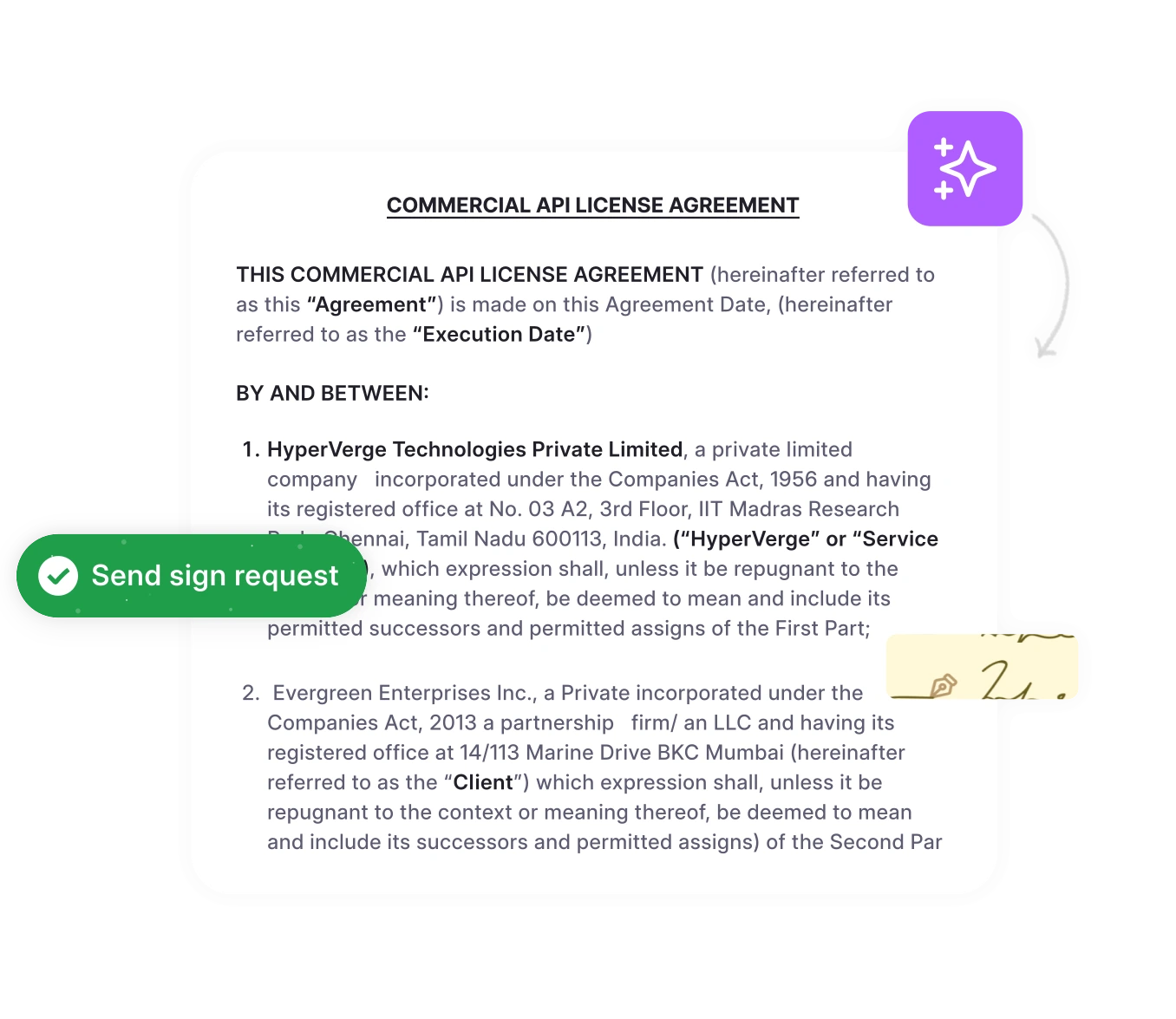
E-signature integration allows contracts to move from final approval to binding execution without leaving the CLM platform or printing a single page. The platform triggers the signature request, tracks who has signed and who is pending, sends reminders for outstanding signatures, and stores the fully executed document back in the repository automatically. Most CLM platforms integrate with DocuSign and Adobe Sign; some offer native e-signature capabilities. Electronic execution eliminates the days-long delays of print-sign-scan workflows and is legally equivalent to wet signatures in over 60 countries under frameworks including ESIGN, UETA, and eIDAS.
7 AI-powered contract review and analysis
AI contract review automatically scans contract documents, including third-party paper, to identify clause risks, flag non-standard language, extract key terms, and compare provisions against internal policy playbooks. The system surfaces problematic clauses such as unlimited liability, auto-renewal without notice, and jurisdiction mismatches, and suggests pre-approved fallback positions from the clause library. For post-execution contracts imported in bulk, AI extraction pulls metadata including effective dates, expiration dates, payment terms, party names, and governing law into structured fields without manual data entry. Teams that implement AI contract management reduce first-pass review time by 70-80% and consistently enforce clause standards that manual review misses under volume pressure.
Managing contracts across teams without a CLM?
HyperStart’s AI-powered CLM gives legal, finance, and procurement teams one platform to draft, review, approve, and track every contract. 94% AI extraction accuracy. Go live in 4 weeks.
Book a Demo8 Version control and audit trail
Version control ensures every change to a contract document is saved as a distinct version, with no overwriting or version confusion between “NDA_final_v3” and “NDA_FINAL_FINAL”. Any user can view a previous version, compare it to the current draft, or restore it if needed. The audit trail records who made each change, when, and from what IP address or device, creating a tamper-evident history of the entire contract lifecycle. For compliance and litigation purposes, the audit trail proves that proper approval procedures were followed, that specific language was reviewed and approved by appropriate stakeholders, and that no unauthorized edits occurred after execution. See contract management best practices for guidance on audit trail configuration.
9 Centralized contract repository
A centralized contract repository stores all contracts, including executed agreements, amendments, SOWs, and addenda, in a single searchable location with consistent metadata tagging. Full-text search allows users to find a contract by keyword, clause, counterparty name, date, or business unit in seconds. Role-based access ensures each user sees only the contracts relevant to their function. Without a centralized repository, organizations rely on email attachments, shared drives, and individual file systems, making it impossible to answer basic questions like “what are all the contracts expiring in Q3?” or “which vendor agreements include auto-renewal clauses?” with any confidence.
10 Obligation and milestone tracking
Obligation tracking monitors the commitments embedded in executed contracts, including payment schedules, delivery milestones, SLA metrics, compliance certifications, and notice periods, and alerts responsible teams when deadlines are approaching or overdue. A contract is not managed when it is stored; it is managed when its obligations are tracked. Unmonitored obligations are the primary driver of contract value leakage: missed SLA credits, unpaid volume discounts, overlooked price adjustment windows, and compliance failures that trigger penalty clauses. Contract tracking software with obligation management converts static signed documents into live operational checklists tied to responsible owners and escalation paths.
11 Renewal management
Renewal management tracks contract end dates, notice periods, and auto-renewal triggers across the entire contract portfolio, sending configurable alerts well in advance of critical windows, typically 90, 60, and 30 days before a notice deadline. Without renewal alerts, auto-renewals lock organizations into multi-year commitments with vendors they no longer use or at prices they would have renegotiated. Renewal management goes beyond simple date alerts: it surfaces renewal terms, identifies contracts where leverage exists for renegotiation, and tracks whether renewal conversations have been initiated, allowing procurement and legal to manage the portfolio proactively rather than reactively.
12 Role-based access controls
Role-based access controls (RBAC) define precisely which users can view, edit, approve, or execute which contracts based on their role, department, geography, or seniority level. A sales representative can view their own customer agreements but not a competitor’s vendor terms stored in the same repository. A legal reviewer can edit any contract in draft but not modify an executed agreement. RBAC protects commercially sensitive information, ensures GDPR and data privacy compliance, and prevents unauthorized modifications. Granular permission settings, down to individual clause visibility in some platforms, are essential for organizations managing contracts that contain confidential pricing, proprietary IP, or regulated personal data. Contract risk management software extends RBAC with risk-scoring and compliance controls.
13 Data visualization and reporting
CLM reporting provides contract management dashboards and analytics across the contract portfolio: contracts by status, average cycle time, bottlenecks by approval stage, renewal exposure by month, risk concentration by counterparty, and spend against contracted commitments. These dashboards replace static spreadsheet reports updated manually each week with live views updated in real time. Legal operations leaders use CLM analytics to identify which contract types take longest to execute, which clauses generate the most negotiation friction, and which business units generate the most contract volume, providing insights that drive process improvement and support resource allocation decisions for the legal team.
14 Integrations (CRM, ERP, and beyond)
A CLM platform that operates in isolation from the rest of your technology stack creates manual data-entry work and breaks workflows across departments. Sales teams need CLM integrated with Salesforce or HubSpot so they can trigger contract requests from within the CRM without switching systems. Finance teams need CLM connected to ERP systems for automated invoice matching and spend verification against contract terms. HR platforms, procurement tools, e-signature providers, and identity management systems (SSO) all need clean integrations. The most important integrations for most organizations are: CRM (Salesforce, HubSpot), ERP (SAP, NetSuite, Oracle), e-signature (DocuSign, Adobe Sign), and Microsoft 365 or Google Workspace for document collaboration.
15 Data security and compliance
Contracts contain some of the most commercially sensitive information an organization holds: pricing, IP ownership, liability caps, M&A terms, and employee compensation. CLM platforms must provide: encryption at rest and in transit; SOC 2 Type II certification; ISO/IEC 27001 compliance for enterprise deployments; GDPR-compliant data residency options; two-factor authentication; and comprehensive access logging. For regulated industries such as healthcare (HIPAA), financial services, and government contracting, additional certifications may be required. Review contract compliance requirements for your industry before shortlisting vendors. Security certifications should be verified directly; marketing claims about “enterprise-grade security” without documented certifications are insufficient for procurement due diligence.
Stop tracking contract obligations in spreadsheets
Legal teams using HyperStart reduce contract admin time by 93% and turn contracts around 70% faster. HyperStart covers all 15 features in this guide, from AI review to renewal management. Setup in 4 weeks, not months.
Book a DemoWhat should you look for when choosing contract management software?
When evaluating contract management software, prioritize five factors: (1) ease of use for non-legal users: adoption fails if legal ops are the only ones using it; (2) depth of integrations with your existing CRM and ERP; (3) AI capability, specifically whether AI review is trained on contract language or generic documents; (4) implementation timeline: the best CLM platforms deploy in 4–6 weeks, not months; and (5) security certifications verified for your industry’s compliance requirements.
Ease of use and adoption
A CLM platform used only by legal fails to deliver its value. Sales, procurement, HR, and finance teams need to use it for intake, approvals, and status tracking. Evaluate the interface from a non-lawyer’s perspective.
Integration depth
Native integrations with Salesforce, HubSpot, SAP, NetSuite, DocuSign, and your SSO provider eliminate manual data entry. API availability matters if you have custom systems. Ask vendors to demonstrate specific integration workflows.
AI contract review quality
Not all AI review tools are equal. Ask: What is the extraction accuracy rate? What contract types is the model trained on? How does it handle non-standard third-party paper? What fallback positions can it suggest from a clause library?
Implementation timeline
Enterprise CLM implementations that take 6–12 months delay ROI significantly. Modern platforms with pre-built templates, standard integrations, and no-code configuration should deploy in 4–6 weeks with proper vendor support.
Security certifications
Require SOC 2 Type II as a minimum. Verify ISO/IEC 27001 for enterprise deployments. For healthcare, verify HIPAA BAA availability. For EU operations, verify GDPR data residency options. Do not accept “we follow security best practices” without documented certifications.
Pricing model fit
CLM pricing ranges from per-user to per-contract to flat-fee enterprise. Per-user models discourage broad adoption across business units. Flat-fee or department-based pricing aligns with the goal of organization-wide contract visibility.
The questions that reveal the most about a CLM vendor during evaluation: How many contracts can we import at go-live, and what is the AI extraction accuracy on our specific contract types? What is the average time-to-value for customers our size? Can non-technical users configure approval workflows without IT support? What is the SLA for support, and how is the implementation team structured? For a platform shortlist based on these criteria, see our review of the best contract management software platforms.
Signs you need contract management software
Six signs your organization needs contract management software: contracts stored across email inboxes, shared drives, and individual desktops; missed renewal dates causing unwanted auto-renewals; legal team required to review every contract regardless of value or risk; no real-time visibility into contract status during negotiations; post-signature obligations tracked in spreadsheets with no automated alerts; and contract cycle times consistently longer than your competitors or industry benchmarks.
- Contracts are stored in email or shared drives: If the answer to “where is that NDA we signed with Vendor X in 2023?” is “check Sarah’s inbox or the contracts folder on SharePoint,” your organization has a repository problem that scales badly as contract volume grows.
- Renewals are regularly missed or caught last minute: Auto-renewal clauses on software, real estate, and vendor contracts represent significant unplanned spend. Each missed notice deadline is a negotiating opportunity lost.
- Legal reviews every contract regardless of value or risk: Legal teams that review $2,000 NDAs the same way they review $2M MSAs are misallocating scarce legal resources. CLM intake routing and template self-service fix this.
- No one knows where a contract is in the approval process: “Is this contract signed yet?” is a question that should have a real-time answer visible to the requester. If it requires calling someone, the process is broken.
- Post-signature obligations are tracked in spreadsheets: Spreadsheets do not alert; they store. Every obligation that requires a spreadsheet check is an obligation at risk of being missed under workload pressure.
- Contract cycle times are a barrier to closing business: If sales teams regularly lose deals because contracts take too long, or if legal is identified as a business bottleneck, the contracting process needs structural improvement, not just faster reviewers.
Before selecting a platform, benchmark your current contract cycle times and track your contract management KPIs to establish a baseline for measuring ROI after implementation.
Streamline every phase of contract management with HyperStart
HyperStart’s AI contract review software covers all 15 features in this guide, from template drafting and clause library through AI-powered review, approval workflows, e-signature, obligation tracking, and renewal management, in a single platform that legal, procurement, sales, and finance teams can all use without training overhead.
Key platform metrics: 94% AI extraction accuracy across contract types, 70% reduction in contract turnaround time, 93% reduction in contract admin time, and go-live in 4 weeks. HyperStart integrates with Salesforce, HubSpot, SAP, Microsoft 365, DocuSign, and Adobe Sign out of the box.
For organizations currently managing contracts across email and shared drives, HyperStart’s bulk import and AI metadata extraction converts your existing contract archive into a structured, searchable repository without manual data entry. For teams building their contracting process from scratch, pre-built templates and standard approval workflows are ready to deploy on day one.