



Somewhere in your company right now, a contract is sitting in an inbox waiting for a signature nobody remembers to chase. Multiply that by a few hundred agreements a year and you have real money leaking out. This guide comhpares the 15 best contract management software platforms of 2026 so you can plug that leak.
Key Takeaways
- The best contract management software in 2026 ranges from $399/month plans for small teams to enterprise deals crossing $150,000 a year.
- HyperStart, Juro, and SpotDraft suit fast-moving mid-market teams. Icertis, Ironclad, and Agiloft dominate the enterprise end.
- AI is no longer a bonus feature – drafting, review, and metadata extraction powered by AI now separate the top contract management software from the rest.
- Implementation time matters as much as features. Modern platforms go live in weeks; legacy enterprise CLMs can take 6-9 months.
- Watch hidden costs. Some vendors bill implementation at up to 100% of your first-year license fee.
- Adoption beats feature count. The tool your sales and procurement teams actually open wins over the one with the longest demo.
Quick Answer
The best contract management software depends on your size and workflow. For startups and mid-market teams, HyperStart CLM leads with AI-powered metadata extraction, unlimited users, and a 4-week go-live. Enterprises with complex approval chains should shortlist Ironclad, Icertis, or Agiloft. Sales-led teams lean toward Juro and DocuSign CLM. Expect to pay anywhere from $399/month to six figures annually, depending on contract volume and integrations.
What Is Contract Management Software?
Contract management software – often called CLM (contract lifecycle management) software – handles a contract from the first draft to the final renewal reminder. Instead of Word files bouncing between inboxes, everything lives in one system: templates, redlines, approvals, signatures, storage, and alerts.
The lifecycle part is the point. A contract isn’t done when it’s signed. Renewal dates arrive, obligations kick in, auto-renew clauses trigger silently. Good CLM software watches all of that so a human doesn’t have to.
Why Businesses Need Contract Management Software
Here’s an uncomfortable number: World Commerce & Contracting research puts the average value leakage from poor contract management at around 9% of annual revenue. Missed renewals, unenforced SLAs, duplicate vendor agreements – it adds up quietly.
Then there’s speed. Legal teams stuck in manual review become the bottleneck every sales deal waits on. A contract that takes three weeks to close in email threads can close in days inside a proper system.
And compliance. When an auditor asks for every agreement with a specific indemnity clause, “let me search my inbox” is not an answer. The best contract management systems answer that question in seconds.
How We Evaluated the Best Contract Management Software
| Criteria | Why It Matters |
| AI capabilities | Drafting, review, and extraction quality decide how much manual work actually disappears |
| Ease of use | Non-legal teams must self-serve, or adoption dies and the tool becomes shelfware |
| Implementation speed | Weeks vs months of setup changes your time-to-value dramatically |
| Integrations | Contracts touch your CRM, HRIS, and storage tools – the CLM must too |
| Pricing transparency | Quote-only pricing with hidden implementation fees inflates real cost |
| Search & repository | Finding any clause in any contract, fast, is the core promise |
| Scalability | The tool should survive your growth from 200 contracts to 20,000 |
| User reviews | Verified G2 and Capterra feedback reveals what demos hide |
Comparison Table – Best Contract Management Software
| Software | Best For | AI Features | Integrations | Free Trial | Rating (G2) |
| HyperStart CLM | Startups & mid-market | AI extraction, review, drafting | Slack, Salesforce, Google, HubSpot | Demo | 4.8/5 |
| Ironclad | Enterprise legal ops | Ironclad AI, playbooks | Salesforce, Office, Google Docs | Demo | 4.5/5 |
| SpotDraft | Growing legal teams | VerifAI review | Slack, Word, Salesforce | Demo | 4.7/5 |
| LinkSquares | Post-signature analytics | LinkAI (120+ data points) | Salesforce, Slack, SharePoint | Demo | 4.5/5 |
| Juro | Sales-led scaleups | Juro AI drafting & review | 6,000+ via native & Zapier | Demo | 4.6/5 |
| DocuSign CLM | DocuSign-first orgs | AI repository search | Salesforce, SAP, NetSuite | Demo | 4.0/5 |
| CobbleStone | Procurement & public sector | VISDOM AI | ERP, e-sign, MS Office | Trial | 4.6/5 |
| Agiloft | Deep customization | ConvoAI, Screens review | 1,000+ systems | Trial | 4.6/5 |
| ContractWorks | Budget-conscious SMBs | AI smart tagging | DocuSign, Salesforce | Trial | 4.8/5 |
| Concord | Simple all-in-one | AI extraction | Google, Salesforce, Box | Trial | 4.4/5 |
| Conga Contracts | Salesforce-heavy revenue teams | Conga AI clause analysis | Salesforce-native | Demo | 4.2/5 |
| Workday CLM | AI bulk analysis at scale | Evisort AI engine | Workday, Salesforce, Box | Demo | 4.5/5 |
| Gatekeeper | Vendor + contract together | AI first-pass review | 220+ connectors | Demo | 4.5/5 |
| Icertis | Global enterprise governance | ObligationsAI, Copilots | SAP, Microsoft, Salesforce | Demo | 4.2/5 |
| Contractbook | Nordic SMBs & automation fans | AI data extraction | Zapier, HubSpot, Pipedrive | Demo | 4.6/5 |
Ratings are approximate as of early 2026 – verify current scores on G2 before quoting.
15 Best Contract Management Software & Tools
1. HyperStart CLM
See HyperStart in action 👇
Overview
HyperStart is built for teams that want enterprise-grade AI without the enterprise timeline. It goes live in about 4 weeks, and its metadata extraction hits 94% accuracy, which means your legacy contracts get organized instead of just uploaded.
Key Features
AI-powered metadata extraction, contract drafting and review, automated approval workflows, renewal reminders tied to contract owners, OCR-backed repository search, and dashboards that track cycle time.
Pros
Unlimited users on every plan. Fast deployment. Transparent pricing – rare in this market. Strong AI accuracy out of the box.
Cons
Younger brand than legacy players. Fewer pre-built enterprise ERP connectors than Icertis or Conga.
Best For
Startups, SMBs, and mid-market legal teams that need the best contract software value without a six-month rollout.
Integrations
Salesforce, HubSpot, Slack, Google Workspace, Microsoft 365, and e-signature tools.
Pricing
Contact us for a custom quote.
What HyperStart CLM’s customers have to say
We took demos of around 5 CLM vendors and chose to use HyperStart. They were the only CLM vendor who had SOC2 compliance and met the criteria of around 22 parameters which we had evaluated them on.

Om Prakash Pandey
Head of Legal at LeadSquared
Implementation was very smooth. Using the bulk upload feature, all contracts were integrated into the system within minutes. I could also see the AI-extracted metadata on the tool immediately, which was impressive.

Mayuri Jaltare
Company Secretary at Qapita
Highlights of HyperStart CLM
2
Minute contract creation

Never miss a renewal again
80%
Time saved on contract admin
Contract with AI you can trust
Empower your legal teams with the right CLM to manage agreements from start to finish. Focus on what matters and automate the rest.
Book a Demo2. Ironclad
Overview
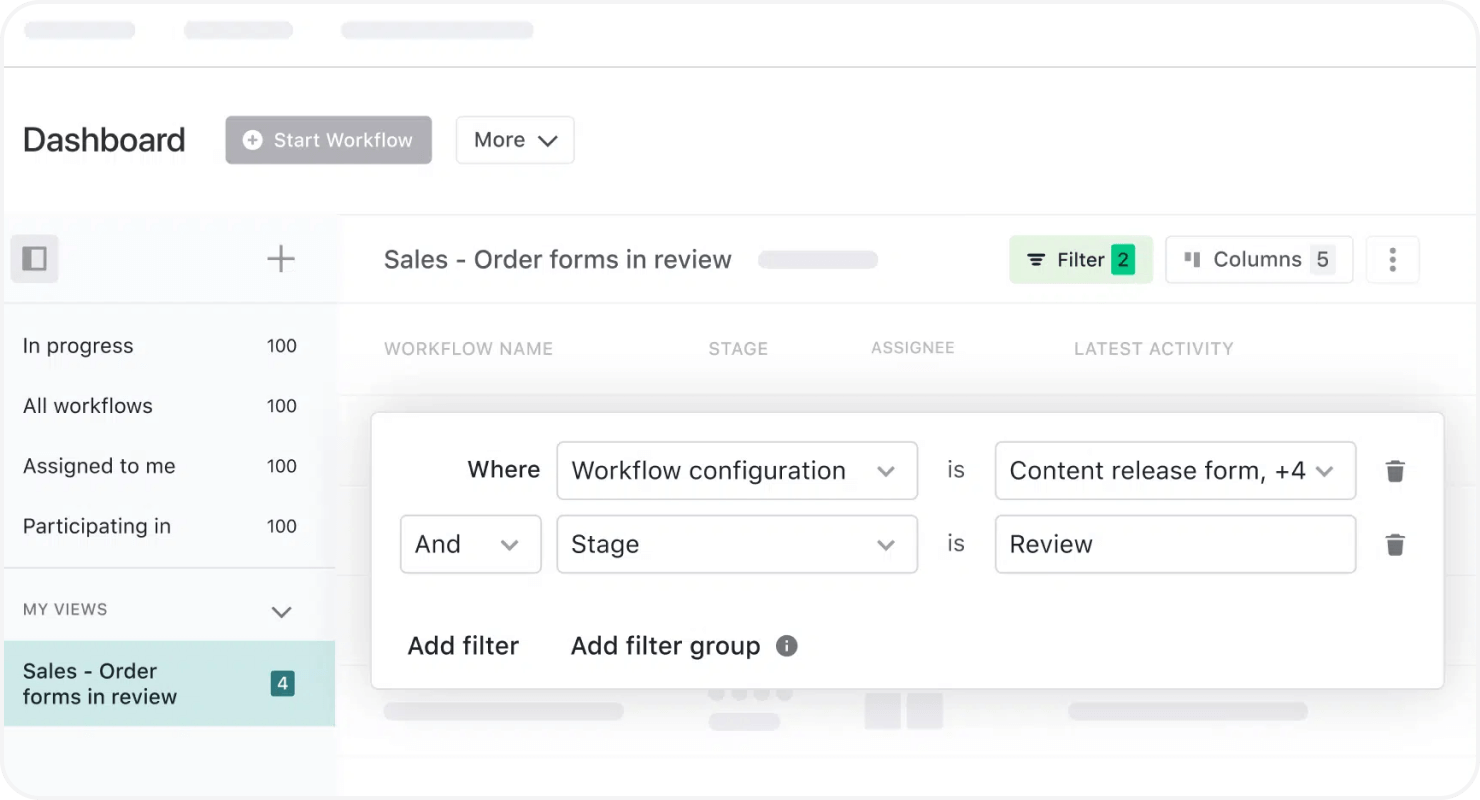
Ironclad is the name enterprise legal ops teams mention first, and usually for good reason. Its Workflow Designer builds request-to-signature flows without code, and companies like Dropbox and L’Oréal push serious contract volume through it.
Key Features
No-code workflow builder, two-way editing with Word and Google Docs, Ironclad AI for redlining against playbooks, a deeply searchable repository, and cycle-time dashboards.
Pros
Best-in-class workflow flexibility. Strong collaboration during negotiation. Mature integration ecosystem.

Ironclad helps me keep all my contracts sorted in chronological order. This software helps me eliminate redundant tasks and get a contract signed quickly and efficiently. I’m satisfied with how Ironclad helps me stay on track with my workflows.
Cons
Premium pricing – reports suggest around $80,000/year for 100 licenses, plus roughly $5,000 per workflow. Overkill for small teams.
I feel that Ironclad’s business model has shifted to “self-serve.” It would be great to have a support team to answer our queries and provide assistance. Until then, the platform only offers ‘Help Topics’ and ‘Community Forums, ’ which are helpful to a certain extent.
Best For
Enterprise legal operations running high-volume, multi-step contract workflows.
Integrations
Salesforce, Microsoft Office, Google Workspace, Coupa, and dozens more.
Pricing
Custom quote only.
Read also Ironclad Reviews, Ironclad Pricing, and Ironclad Competitors.
3. SpotDraft
Overview
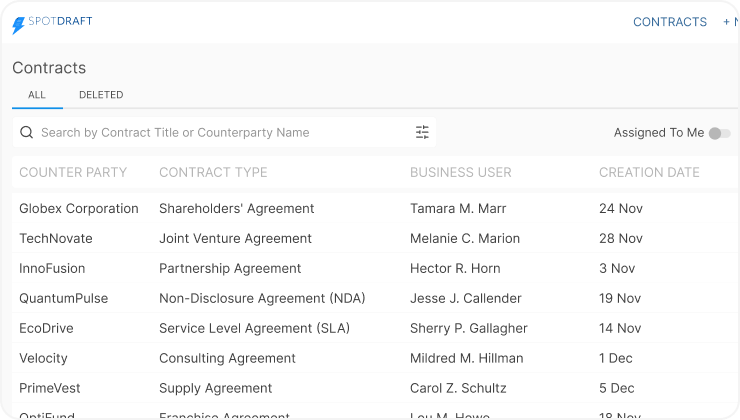
SpotDraft sits in the sweet spot between control and adoption. Legal keeps a governed process while business teams review and redline from Word, Slack, or the platform itself – wherever they already work.
Key Features
VerifAI contract review, template-driven self-serve drafting, approval routing, clickwrap support, and a searchable repository with key-date tracking.
Pros
Genuinely easy for non-legal users. Responsive support. Good value for growing teams.
SpotDraft makes it easy to write and execute contracts in less time. You can also upload all your existing contracts to the software in a very short period. I have had a great experience using SpotDraft, which has made signing agreements easy.
Cons
Reporting depth trails the enterprise heavyweights. Some advanced customization requires vendor help.
Overall, SpotDraft is a well-configured and easy-to-use tool. However, the contract editor can be tricky to operate at times. Editing the contract can be tedious as it can mess up the overall formatting of the contract.
Best For
In-house legal teams at growth-stage companies balancing control with business speed.
Integrations
Slack, Microsoft Word, Salesforce, Google Drive, and e-signature platforms.
Pricing
Custom, reportedly starting at $10,000/year.
Read also SpotDraft Alternatives and SpotDraft Pricing.
4. LinkSquares
Overview
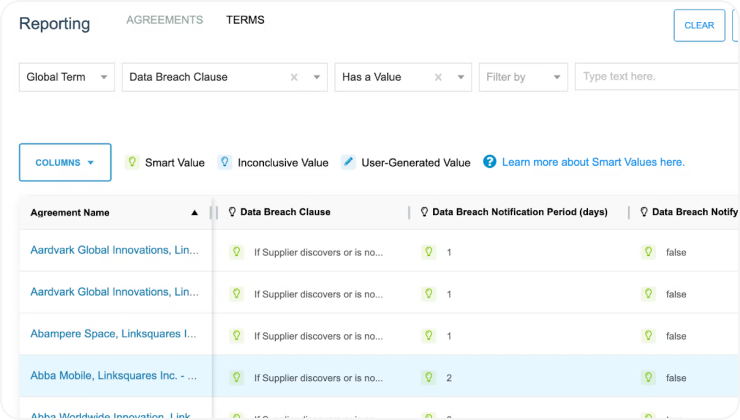
LinkSquares answers one question brilliantly: what’s actually inside your signed contracts? Its LinkAI engine extracts over 120 data points per agreement – renewal terms, liability caps, jurisdictions – across portfolios of thousands.
Key Features
AI extraction on bulk upload, calendar-based renewal view, owner-specific alerts, a Word plug-in for drafting, and compliance obligation tracking. It took the top spot for User Satisfaction in G2’s Spring 2026 Mid-Market CLM Grid.
Pros
Unmatched post-signature analytics. Alerts route to the actual contract owner, not a shared inbox.
LinkSquares has helped our tiny legal team align with our fast-growing software sales company. We could use the ‘Analyze’ feature to import our current contract library and follow each legal request using the ‘Finalize’ feature. The features are synced, meaning no time is wasted uploading completed contracts.
Cons
Implementation is billed at 100% of first-year license fees, effectively doubling year-one cost. Front-end drafting feels less polished than Juro or Ironclad.
The LinkSquares team has helped us implement the contract management software in a relatively short amount of time. However, the interface does not have folders. This makes it challenging for us to access contracts when required urgently.
Best For
Legal departments managing 1,000+ existing contracts that nobody has read in years.
Integrations
Salesforce, DocuSign, Slack, SharePoint, Google Drive, Microsoft Word.
Pricing
Custom; entry reported around $10,000-$20,000/year.
Read also: LinkSquares Pricing, Ironclad vs LinkSquares, and LinkSquares Competitors.
5. Juro
Overview
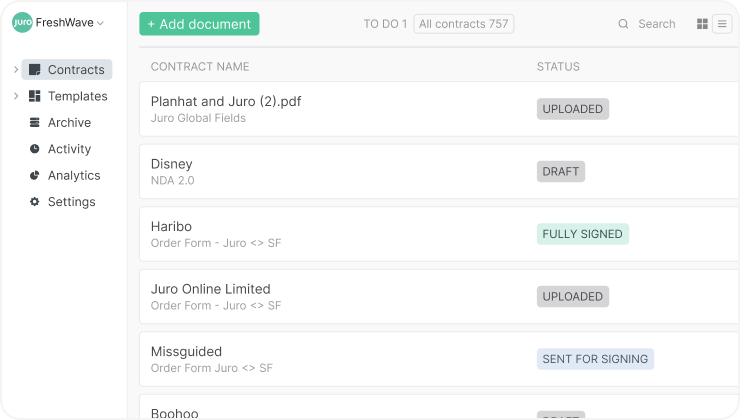
Juro replaced the Word-file shuffle with a browser-based editor where contracts behave like live documents. Recently it added MCP integration, connecting your contract repository directly to ChatGPT.
Key Features
Collaborative browser editor, Juro AI for drafting and summarizing, clause-aware redlining inside approval workflows, native e-signature, and bottleneck-spotting status reports.
Pros
The nicest editing experience in the category. Business users adopt it without training. Pricing scales with volume, not seats.
The rule function is one of my favorite Juro features. Also, I can add an individual as an approver and recipient, and Juro auto-populates this change across every contract created with this template. This feature has ensured that I always have a fully signed contract again.
Cons
Performance dips on very long contracts. Automation depth is lighter than heavyweight CLMs.
As a legal team admin, the functionality of setting up a template is not very intuitive. Moreover, the searchability of Juro’s dashboard can be improved. There is also no integration with Google Drive or Adobe Sign.
Best For
Sales-led startups and scaleups where speed of contract creation matters most.
Integrations
Over 6,000 tools through native connectors and Zapier, including Salesforce, HubSpot, and Slack.
Pricing
Quote-based, scaling with contract volume.
Read also Juro vs Docusign, Juro Alternatives, and Juro Pricing.
6. Docusign CLM
Overview
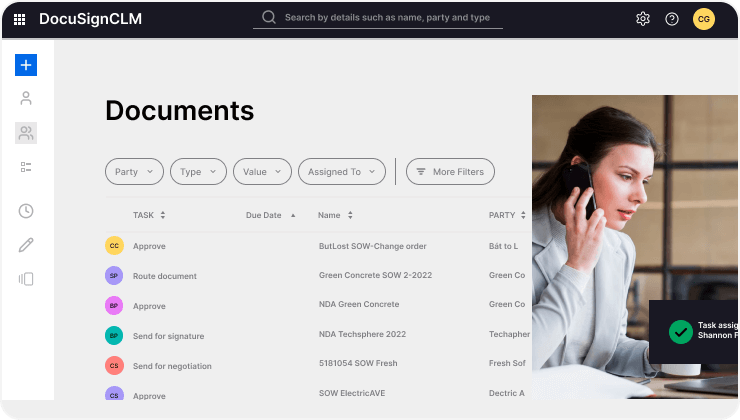
If every counterparty you deal with already signs through DocuSign, extending into its CLM is the path of least resistance. It adds routing, a clause library, and lifecycle management on top of the signature product everyone recognizes.
Key Features
Drag-and-drop workflow design with 100+ preconfigured steps, AI-powered repository search, clause library, version control, and audit trails.
Pros
Universal signature acceptance. Deep enterprise integrations. Familiar to virtually every counterparty.
The user interface of DocuSign CLM is very intuitive. This makes it easy for us to train our employees to use this software and enables them to adapt quickly to the processes. I have used this software for over 3 years at two companies and recommend it to everyone seeking a contract management solution.
Cons
The CLM module feels heavier and less modern than newer rivals. Custom pricing typically lands north of $40,000/year.
The UI of DocuSign CLM could have been better. Sometimes, the pages take a long time to load. Moreover, there is scope for filter improvement, as the current ones do not have OR AND options.
Best For
Enterprises already committed to the DocuSign ecosystem.
Integrations
Salesforce, SAP, NetSuite, Microsoft, Workday.
Pricing
Custom quote.
Read also Dropbox Sign, Pandadoc vs Docusign, Docusign CLM Pricing, and Docusign Alternatives.
7. CobbleStone Software
Overview
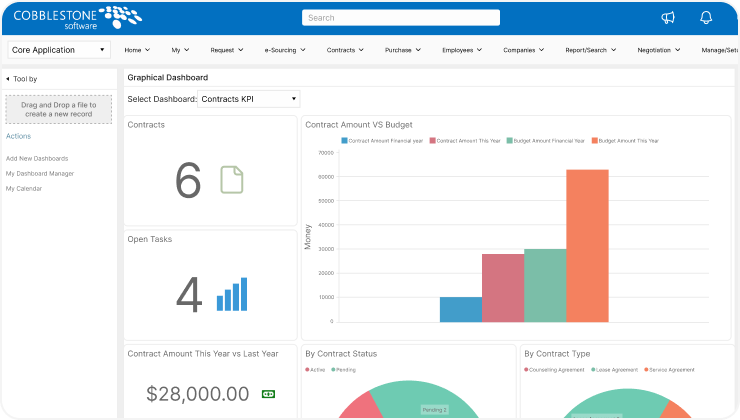
CobbleStone (Contract Insight) treats vendors and suppliers as first-class citizens, not just names in a metadata field. That focus has made it a fixture in procurement teams and the public sector.
Key Features
VISDOM AI for clause recognition and risk scoring, vendor management, purchase order tracking, compliance workflows, and configurable approval chains.
Pros
Strong procurement and sourcing features. Flexible deployment, including on-premise for government buyers.
The sales team at CobbleStone offered a great onboarding experience and helped us understand how the software works. Each of our questions was answered. The software is very customizable, and the implementation support is spot-on.
Cons
The interface shows its age. Configuration depth can slow initial setup.
The workflows in CobbleStone are highly customizable. However, we have deployed the software on our on-premise server. This results in technical design challenges as our customized changes must align with the CobbleStone software updates.
Best For
Procurement-heavy organizations and public sector teams with sourcing requirements.
Integrations
Major ERPs, Microsoft Office, and e-signature providers.
Pricing
Custom, with per-user options; free trial available.
Read also CobbleStone Contract Insight Alternatives and CobbleStone Software Reviews.
8. Agiloft
Overview
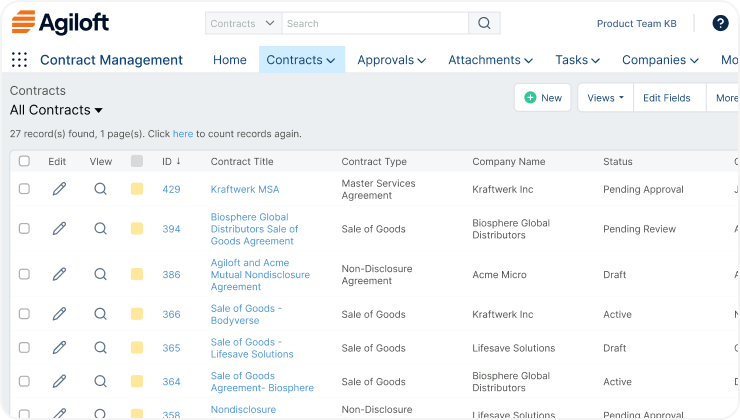
Agiloft is what you buy when your contract process is genuinely unusual. Its no-code engine reshapes itself around your workflow instead of forcing you into someone else’s. Gartner has named it a Magic Quadrant Leader for six consecutive years.
Key Features
No-code configuration, ConvoAI natural-language contract search, AI review and redlining via its Screens acquisition, obligation monitoring, and multi-language support.
Pros
Possibly the most configurable CLM on the market. 1,000+ integrations. Scales from mid-market to global enterprise.
Agiloft has helped us seamlessly organize our to-do list. Thanks to Agiloft, I no longer have to scan through emails to find contracts. I can now get everything I need related to contracts in one place. I can even see notes, track contract versions, and allocate tasks, all in one software.
Cons
That flexibility demands planning – complex builds need technical involvement. Some users report friction with implementation and licensing support.
Some software linkages need to be self-understandable. This makes it challenging to follow the logic of which tables will pick up the revision and implement it automatically. Later, this needs to be updated manually.Some software linkages need to be self-understandable. This makes it challenging to follow the logic of which tables will pick up the revision and implement it automatically. Later, this needs to be updated manually.
Best For
Organizations with complex, non-standard approval chains and compliance rules.
Integrations
Over 1,000 systems, including Salesforce, SAP, and identity providers.
Pricing
Entry around $12,000/year; higher tiers by quote.
Read also Agiloft Pricing, and Agiloft Competitors.
9. ContractWorks
Overview
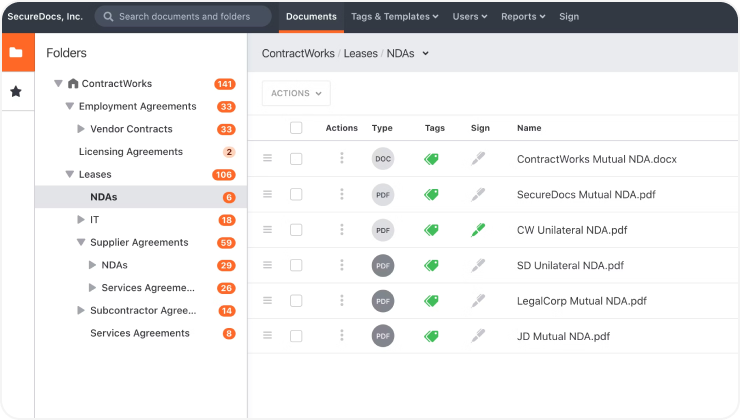
ContractWorks does one job – secure storage, tracking, and alerts – and refuses to complicate it. Same-day setup is realistic, which almost nothing else on this list can claim.
Key Features
AI-powered smart tagging, unlimited users on all plans, milestone alerts, custom reports, built-in e-signature, and OCR search.
Pros
Among the cheapest credible options. Dead simple. Unlimited users removes per-seat math entirely.
The folder organization feature of ContractWorks is highly remarkable. We have been able to create a folder for each department and, therefore, seamlessly manage access. This is an excellent feature for our organization in terms of safety and security.
Cons
No drafting or negotiation tools. It’s a repository, not a full lifecycle platform.
I would have preferred ContractWorks more if it had an option for API integration. With the way this software is, it takes a lot of time to log in and find a suitable contract. It would also be great to have some space for office automation, which the software currently needs to catch up to.
Best For
SMBs that mainly need contracts stored, searchable, and never silently auto-renewing.
Integrations
Salesforce, DocuSign, and API access.
Pricing
From around $700/month, unlimited users.
Read also ContractWorks Alternatives and ContractWorks Pricing.
10. Concord
Overview
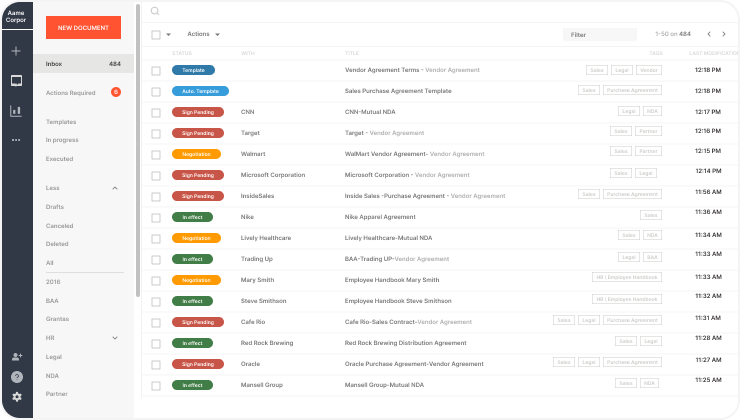
Concord bets on simplicity – draft, negotiate, sign, and store in one uncluttered tool. A neat touch: contract dates can sync straight to Google Calendar, so renewal visibility lives where people already look.
Key Features
Online editing and redlining, unlimited e-signatures, AI data extraction, approval workflows, and deadline syncing.
Pros
Quick to learn. Transparent pricing. Solid all-rounder for standard agreements.
Concord is an excellent solution for small businesses looking to manage their contracts digitally. The software’s interface is easy to use and can be quickly adapted by the legal team. The customer support team can always respond to our queries and offer help.
Cons
Power users find the automation shallow compared to Ironclad or Agiloft. Advanced reporting is limited.
I have been using the premium version of Concord for over a year. The share feature needs to be fixed, as it often results in unwanted contract sharing. Also, there is no functionality to create a new Statement of Work (SOW) from the previous one, which greatly limits our process efficiency.
Best For
Small and mid-sized teams wanting one affordable tool for the whole lifecycle.
Integrations
Google Workspace, Salesforce, Box, Dropbox, Zapier.
Pricing
Per-user plans starting around $49/user/month.
11. Conga Contracts
Overview
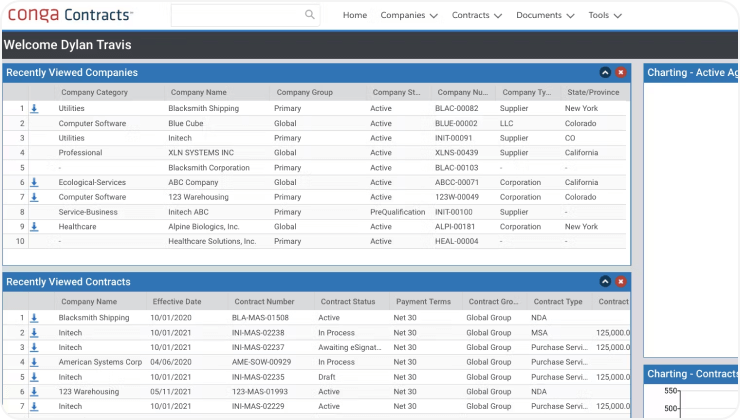
Conga grew up inside the Salesforce ecosystem, and it shows. For revenue teams generating quotes and contracts from CRM data, the handoff between CPQ and CLM is where Conga earns its keep.
Key Features
Salesforce-native contract generation, Conga AI clause analysis, negotiation tracking, approval automation, and document assembly.
Pros
Deepest Salesforce alignment in the category. Strong for quote-to-cash workflows.
Conga Contracts is an excellent place for our team to review, edit, and create contracts. We love the ability to access older documents, save templates, and handle all contractual agreements online.
Cons
Less compelling outside Salesforce. Interface and admin experience lag newer tools.
In practice, it could be more user-friendly than it appears. Our users struggle and have even resisted using it. Our proposal volume is low, so the learning curve is overly steep. There is also no track changes function, which is critical to our review process.
Best For
Sales organizations running their entire revenue stack on Salesforce.
Integrations
Salesforce-native, plus ERP and e-signature connectors.
Pricing
Custom quote.
Read also Concord Alternatives and Concord Pricing.
12. Workday CLM (formerly Evisort)
Overview
Workday acquired Evisort and folded its AI engine into the Workday suite – and that engine remains one of the best at bulk contract analysis. Point it at 10,000 legacy agreements and it structures the chaos.
Key Features
AI-native ingestion and extraction at scale, obligation tracking, contract analytics dashboards, and workflow automation tied to HR and finance data.
Pros
Elite AI extraction. Natural fit for existing Workday customers, especially on HR and procurement contracts.
We started using Evisort in August 2023. The implementation process and integrations were easy; we could roll out the software by September. We particularly liked the workflow builder and AI features. The AI tool has helped us easily capture important clauses and reduce our manual work. The Eversort team is constantly improving and adding new features, another bonus point.
Cons
Newer as a standalone CLM brand. Strongest value assumes you’re already in the Workday ecosystem.
You can set up alerts in many different ways. However, the system does not offer the option to attach an alert to a particular document or contract. Some type of hyperlinking in this area would have been great for ease of use.
Best For
Enterprises on Workday that want AI-first analysis across huge contract sets.
Integrations
Workday suite, Salesforce, Box, and major storage platforms.
Pricing
Custom quote.
Read also Evisort Reviews, Evisort Pricing, and Evisort Competitors.
13. Gatekeeper
Overview
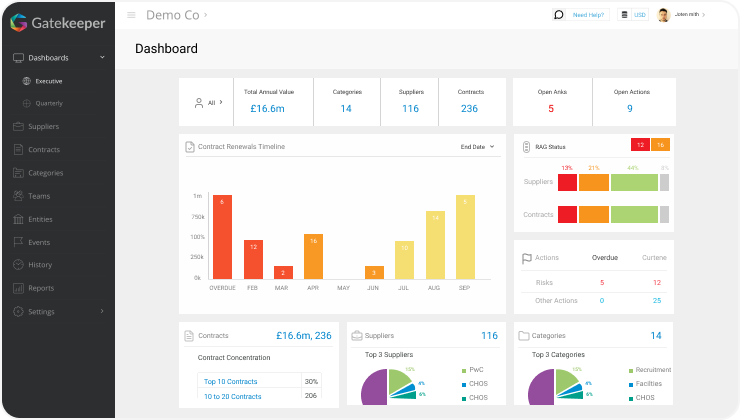
Gatekeeper refuses to treat contracts and vendors as separate problems. Each agreement lives alongside the vendor’s risk profile and committed spend, and its AI does a first-pass read of every contract that enters the system.
Key Features
AI first-pass review, vendor risk scoring, spend tracking, renewal workflows, and a self-service portal for suppliers.
Pros
The contract-vendor-spend combination replaces three separate tools. Strong workflow automation.
Gatekeeper is a great product and is very easy to implement. It covers all our basic contract management needs and is flexible for customization. The customer support is excellent, and assistance is available whenever needed.
Cons
Pricing starts higher than pure-repository tools. Sales-side contracting is not its focus.
There are some considerable bugs in Gatekeeper. For example, we use the event feature in our contracts. However, this feature sends event creation emails to all users even when the event is due. This usually needs to be clarified for the end-users about the event.
Best For
Procurement and vendor management teams tired of stitching systems together.
Integrations
220+ connectors, including ERPs, SSO, and e-signature.
Pricing
From around $1,245/month.
Read also Gatekeeper Alternatives, Gatekeeper Pricing, and Gatekeeper Reviews.
14. Icertis
Overview
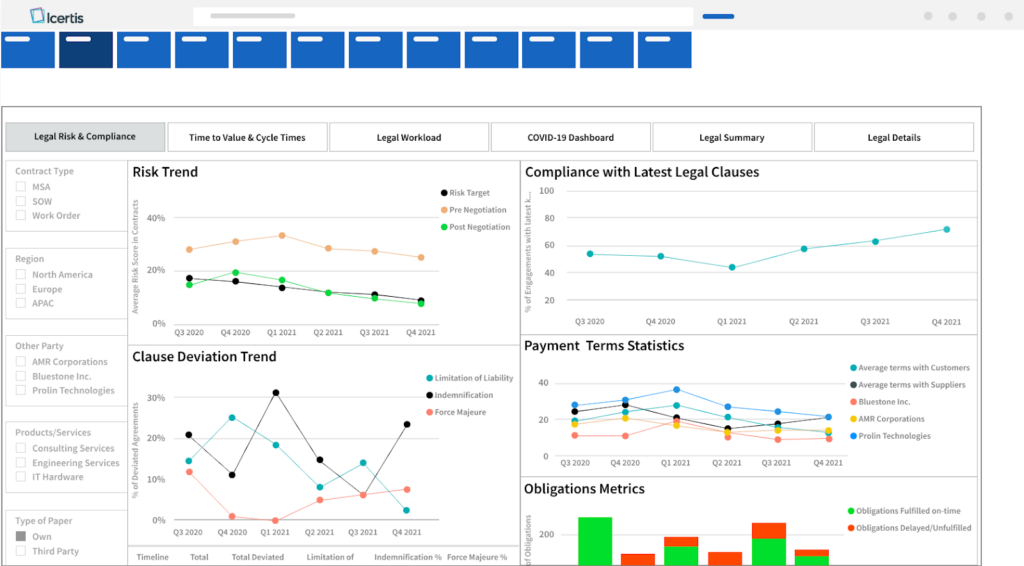
One-third of the Fortune 100 runs contracts through Icertis, which tells you the target market. It’s AI-native rather than AI-bolted-on, with ObligationsAI discovering and tracking commitments in real time across jurisdictions, languages, and currencies.
Key Features
ObligationsAI, contract intelligence copilots, multi-entity governance, deep compliance controls, and audit-ready version history.
Pros
Unmatched enterprise governance. Handles global complexity most tools can’t touch.
Cons
Six-figure investments are normal once implementation is counted. Rollouts run months, not weeks. Heavy for anyone below large enterprise.
Best For
Global enterprises with multi-region compliance and thousands of high-risk agreements.
Integrations
SAP, Microsoft Dynamics, Salesforce, ServiceNow, and major ERPs.
Pricing
Custom; commonly exceeds $100,000/year with implementation.
Read also Icertis Pricing and Icertis Competitors.
15. Contractbook
Overview
Contractbook, out of Denmark, positions contracts as structured data rather than static files. Its automation-first mindset appeals to teams that want agreements to trigger actions in the rest of their stack.
Key Features
Template-based drafting, AI data extraction, automated post-signature tasks, e-signature, and a clean shared workspace.
Pros
Elegant, low-friction workflow. Great automation through Zapier-style triggers. Fair pricing for SMBs.
Cons
Lighter on advanced legal workflow controls. Smaller integration catalog than the giants.
Best For
SMBs and Nordic-market teams that want contracts wired into their automation stack.
Integrations
Zapier, HubSpot, Pipedrive, Google Workspace, and accounting tools.
Pricing
Custom quote; demo available.
Read also Contractbook Alternatives and Contractbook Pricing.
Feature Comparison of Top Contract Management Software
| Feature | HyperStart | Ironclad | Juro | Agiloft | DocuSign CLM |
| AI review | Yes, built-in | Yes (Ironclad AI) | Yes (Juro AI) | Yes (Screens) | Limited |
| AI drafting | Yes | Yes, playbook-based | Yes | Partial | No |
| Approval workflow | Yes, no-code | Yes, best-in-class | Yes | Yes, deeply configurable | Yes, 100+ preset steps |
| Contract repository | Yes, OCR-backed | Yes | Yes | Yes | Yes |
| Search | AI metadata search | Full-text + filters | Full-text | ConvoAI natural language | AI-powered |
| Dashboards | Yes | Yes, cycle-time analytics | Yes, bottleneck reports | Yes | Yes |
| Renewal reminders | Yes, owner-routed | Yes | Yes | Yes | Yes |
| Integrations | CRM, Slack, Google, MS | Extensive | 6,000+ | 1,000+ | Enterprise ERP/CRM |
Key Features to Look for in Contract Management Software
Feature lists blur together after the third demo. These ten separate the best contract management systems from glorified file storage.
AI-powered drafting
A first draft shouldn’t cost a lawyer forty minutes of typing. Good contract drafting AI pulls from your approved templates and clause library, fills in the deal specifics from a prompt or a CRM record, and hands legal something 90% finished. The bigger win is self-serve: a sales rep generates a standard NDA in two minutes without legal touching it, and the language stays locked to what counsel already approved. Test this during the trial with your actual templates, because demo templates always behave.
Contract review
This is where AI earns or loses your trust. Strong contract review tools compare an incoming draft against your playbook, flag deviations – a liability cap that’s too low, an indemnity clause that’s missing entirely – and suggest fallback language your team has pre-approved. Insist on explainable output. A red flag with no reasoning attached just creates a second review job, and your lawyers will quietly stop using the feature within a month.
Workflow automation
Every contract has a path: who requests it, who approves it, who signs it. Automation encodes that path so a $5,000 vendor agreement takes a different route than a $500,000 one, without anyone deciding manually. The result is fewer “who has this now?” Slack messages and a request queue that legal can actually see. Look for conditional routing – approvals that change based on value, contract type, or flagged risk, not a single rigid chain.
Electronic signatures
Signing should never mean exporting a PDF and switching tools. Whether the e-signature is native or comes through a tight DocuSign integration matters less than the experience: one click from approved draft to sent-for-signature, automatic reminders for slow signers, and the executed copy landing back in the repository on its own. Also check that the signature meets legal standards in every country you do business – ESIGN and eIDAS coverage isn’t universal.
Central repository
One home for every agreement, and genuinely searchable – not a folder tree with better branding. OCR is the piece people forget to check: a decade of scanned, faxed, and photographed contracts should still turn up when you search for a clause or a counterparty name. Ask vendors to run a search on your ugliest scanned PDF during the demo. The answer tells you more than any feature sheet.
Renewal reminders
Auto-renew clauses are where money disappears quietly. A vendor contract renews for a year because nobody flagged the 60-day notice window, and now you’re paying for software nobody uses. The fix is alerts routed to the actual contract owner – not a shared legal inbox where they rot – at 90, 60, and 30 days out. Some platforms sync these dates straight into Google Calendar or Outlook, which is exactly where reminders belong.
Collaboration
Negotiation is messy by nature: redlines from opposing counsel, comments from finance, a version from three weeks ago that someone insists was final. Collaboration features keep all of it in one thread – tracked changes, threaded comments, and version control that shows exactly what changed between draft four and draft five. The alternative is negotiation history scattered across email attachments named “MSA_final_v7_REALLY_FINAL.docx”, and everyone knows how that ends.
Reporting & dashboards
You can’t fix a process you can’t see. Dashboards should answer the operational questions on demand: how long contracts take from request to signature, where they stall, which team generates the most volume, and how legal’s workload is trending. When the GC gets asked “why do deals take so long?” in a leadership meeting, a cycle-time chart is a far better answer than a shrug.
Contract analytics
Reporting looks at the process; analytics looks inside the contracts themselves. Portfolio-level questions – what’s our total liability exposure across all vendor agreements, which contracts renew next quarter and at what combined value, how many agreements still carry an outdated data-processing clause – should take seconds, not a paralegal’s week. This is the feature that turns a contract pile into business intelligence, and it’s where AI extraction quality really shows.
Security & compliance
Your contracts hold salaries, pricing, trade secrets, and personal data, so the security bar sits high. SOC 2 Type II certification is the floor, not a differentiator. Beyond it, check for encryption at rest and in transit, SSO support, role-based permissions that go down to the individual document, and audit logs that record every view, edit, and download. Regulated industries should add their own layer – HIPAA alignment and a signed BAA for healthcare, data residency options for European operations.
How to Choose the Best Contract Management Software
- Company size – A 30-person startup and a Fortune 500 need entirely different tools. Buy for the company you are, with room for the one you’re becoming.
- Legal complexity – Standard NDAs and MSAs? Almost anything works. Multi-jurisdiction regulated agreements? Shortlist enterprise platforms.
- Team size – Per-seat pricing punishes wide adoption. Unlimited-user plans (HyperStart, ContractWorks) flip that math.
- Budget – Set the total including implementation, which can add 50-100% of year-one license cost at the enterprise tier.
- Number of contracts – Under 500 a year, a lighter tool wins. Thousands? You need serious AI extraction and search.
- Required integrations – List your CRM, HRIS, and storage stack first, then eliminate anything that doesn’t connect.
- AI capabilities – Test extraction accuracy on your own messy contracts during the trial, not the vendor’s clean samples.
- Scalability – Ask what happens at 10x your current volume, both technically and on pricing.
- Industry requirements – Healthcare needs HIPAA alignment, government needs specific hosting, finance needs granular audit trails.
Common Challenges When Choosing Contract Management Software
Demo-quality bias – Every vendor demos beautifully with clean sample data. The truth appears when your own scanned, inconsistent contracts hit the AI. Always test with your ugliest real documents.
Opaque pricing – Quote-only pricing makes comparison genuinely hard. Two vendors might differ by 3x in real cost, and you won’t know until procurement calls both. Get total year-one cost in writing, implementation included.
Hidden implementation fees – Some vendors bill setup at 50-100% of the first-year license, effectively doubling your initial spend. Ask before you shortlist, not after.
Poor adoption – CLM projects fail more often from non-use than from missing features. A platform with 80% of the features and 95% adoption beats one with everything and 30% adoption, every single time.
Underestimated migration – Getting 5,000 legacy contracts uploaded, extracted, and verified is a project of its own. Ask every vendor exactly who does that work and what it costs.
Integration gaps – The connector you assumed was native turns out to be Zapier middleware that breaks under volume. Verify your must-have integrations during the trial, not after signing.
Benefits of Using Contract Management Software
- Faster contract cycles. Automated routing and self-serve templates cut turnaround from weeks to days. Sales feels this benefit first, and loudest. Teams switching from email-based review commonly report 50-70% faster closures – and quarter-end stops being a panic event.
- Nothing slips through. Owner-routed renewal alerts mean auto-renew clauses stop triggering silently. One caught renewal often pays for the software. The alert reaches the person who owns the contract, not a shared inbox where deadlines go to die.
- Reduced legal workload. When AI handles first-pass review and business teams draft standard agreements themselves, legal focuses on the 10% of contracts that carry real risk. Routine NDAs and standard MSAs stop eating hours that should go to negotiation strategy and high-stakes deals.
- Instant answers during audits. “Show me every contract with unlimited liability” becomes a 10-second search instead of a two-week fire drill. Due diligence during funding rounds or acquisitions gets the same treatment – clean answers, fast, with no weekend spent digging through folders.
- Lower value leakage. Tracked obligations, enforced SLAs, and visible spend commitments recover revenue that unmanaged contracts quietly lose. WorldCC pegs that leakage at around 9% of annual revenue for poorly managed contracts – which makes the software cost look like a rounding error.
- A single source of truth. Sales, legal, finance, and procurement all see the same contract, same version, same status. The “which draft is final?” email dies. And when someone leaves the company, their contract knowledge stays in the system instead of walking out with them.
Common Use Cases of a CLM
Legal Teams
The obvious one. Intake requests, review with AI assistance, manage approvals, and keep the whole company out of legal’s inbox. The workload data is a bonus – when requests double, legal finally has numbers to back the headcount ask.
Procurement
Vendor agreements, renewal tracking, and spend visibility – often paired with supplier risk data in tools like Gatekeeper. Notice windows stop lapsing silently, and duplicate vendor contracts surface the moment everything lands in one repository.
Sales
Self-serve NDAs and standard MSAs from CRM data, so deals stop dying in legal review queues. Reps close faster, and only the genuinely non-standard deals ever reach a lawyer’s desk.
Finance
Payment terms, revenue recognition dates, and committed spend pulled from contracts into forecasts. During audits, finance pulls any agreement in seconds instead of chasing legal for copies.
HR
Offer letters, employment agreements, and contractor paperwork generated from templates at hiring speed. Every signed document files itself against the employee record, so nothing lives in a recruiter’s downloads folder.
Vendor Management
Central visibility into every supplier relationship, obligation, and renewal date across the business. When a vendor underdelivers, the SLA terms and penalty clauses are one search away instead of one email thread away.
Healthcare
Payer agreements, physician contracts, and BAAs managed under strict compliance and access controls. Role-based permissions keep sensitive physician compensation terms visible only to the people cleared to see them.
Government
Public procurement contracts with audit trails, transparency requirements, and often on-premise hosting needs. Every approval and edit gets logged automatically, which is exactly what RTI requests and public audits demand.
Conclusion
There’s no single winner among the top contract management software platforms – there’s only the right fit for your volume, budget, and workflow. Enterprises with global complexity should look hard at Icertis, Ironclad, and Agiloft. Teams that need speed, AI accuracy, and honest pricing will find the best software for contract management in platforms like HyperStart, Juro, and SpotDraft. Whichever of the best contract management systems you shortlist, test it with your own contracts, ask about implementation fees upfront, and pick the tool your team will actually open every day.
Simplify Contract Management with HyperStart
Most teams don’t need a nine-month enterprise rollout. They need contracts drafted faster, reviewed smarter, and never lost again. HyperStart CLM delivers exactly that – 94% accurate AI extraction, unlimited users, owner-routed renewal alerts, and a go-live measured in weeks, not quarters. Starting at $399/month, it’s the best contract software value for growing teams. Book a demo and see your own contracts organized before the call ends.