


According to research from Thomson Reuters, many in‑house lawyers spend 40 to 60% of their working time drafting, reviewing, and revising documents, rather than on higher‑value strategic work
Legal document automation is the use of technology to create, assemble, and manage legal documents using templates, conditional logic, and AI. It replaces manual drafting with automated workflows that generate contracts, NDAs, agreements, and other legal documents in minutes instead of hours, while reducing errors and ensuring compliance with pre-approved terms.
In this guide, you will learn:
How legal document automation works and what it produces
The difference between document automation, document assembly, and CLM
Which document types to automate first for maximum ROI
AI-powered vs. rule-based approaches and why the best platforms combine both
A step-by-step implementation roadmap with ROI calculation
What is legal document automation, and how does it work?
Legal document automation turns manual document creation into an automated, repeatable process. It uses smart templates, variable fields, conditional logic, and increasingly, AI to produce complete legal documents without starting from scratch every time.
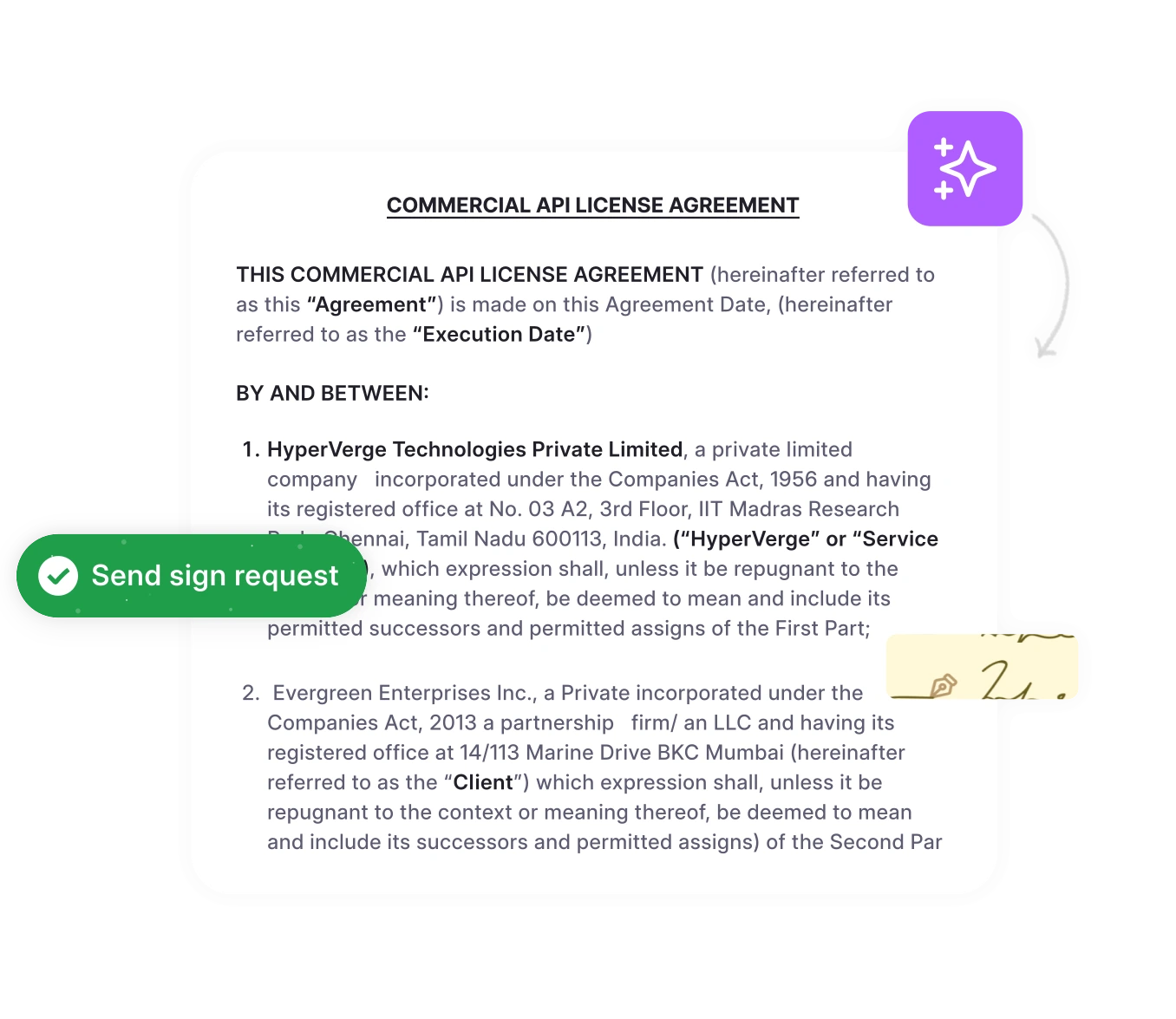
A smart template for vendor agreements contains variable fields (party names, dates, contract value, jurisdiction) and conditional logic rules. If the contract value exceeds $100K, the system includes an enhanced indemnification clause. If the counterparty is in the EU, it adds GDPR data processing terms. Users fill in key variables through a simple legal intake form, and the system generates a complete, compliant document in minutes.
The output is not a rough draft that needs heavy editing. It is a complete, near-final document that follows pre-approved language, formatting, and clause structure. Your legal team reviews the output rather than building from scratch.
The scope goes beyond contracts. Legal document automation covers NDAs, employment offers, board resolutions, compliance certificates, procurement agreements, data processing agreements, and any standardized legal document your organization creates repeatedly.
One important distinction: document automation is not the same as document management (storage and retrieval) or document review (analysis and risk assessment). It is specifically about creation and assembly. All three are important, but they solve different problems.
What is the difference between document automation, document assembly, and CLM?
These three terms get confused often. Here is how they differ.
| Dimension | Document automation | Document assembly | Contract lifecycle management (CLM) |
| Focus | Creating complete documents from templates using conditional logic and variable fields. Automates the drafting process end-to-end. | Assembling documents from reusable, modular components (clauses, paragraphs, sections). Focuses on building blocks rather than whole templates. | Managing the full contract lifecycle from creation through execution, storage, tracking, and renewal. Document creation is one component of a broader system. |
| Scope | Document creation only. Starts with a blank template and ends with a completed document. | Document creation with emphasis on component reuse. Clause libraries and modular content enable complex documents with many variations. | End-to-end lifecycle: creation, negotiation, approval workflows, eSignature, centralized storage, obligation tracking, renewal management, and analytics. |
| Best for | High-volume, standardized documents with clear structure (NDAs, employment contracts, standard vendor agreements). | Complex documents with many variations that need to pull from a library of pre-approved components (MSAs with custom schedules, regulatory filings). | Organizations that need to manage the entire contract process, not just document creation. Best for teams handling 100+ active contracts. |
| Limitation | Only solves the creation bottleneck. Does not help with negotiation, tracking, or renewal management. | Still focused on the creation phase. More complex to set up than simple templates. | Broader scope means more to implement. May be more than organizations with simple needs require. |
The key insight: document automation is step one. It solves the creation bottleneck. But without CLM, you still lack negotiation workflows, centralized storage, renewal tracking, and analytics. The most effective approach embeds document automation within a CLM platform, so the document you automate today flows through the entire lifecycle automatically.
Evaluating contract automation software? Look for platforms that include document automation as a built-in capability rather than requiring a separate tool.
What are the key benefits of legal document automation?
Here are the key benefits of legal document automation:
80–90% reduction in document creation time – Surveys of legal teams using document automation report time savings from around 80% up to over 90% for many document types, turning multi‑hour drafting into minutes. A contract that takes 3 hours to draft manually can be generated in minutes using smart templates with conditional logic. AI-powered automation accelerates first drafts even further.
Near-zero drafting errors – Pre-approved templates and conditional logic eliminate manual errors: wrong party names, outdated clauses, missing terms, incorrect jurisdiction references. Every document uses the exact language that legal has vetted and approved.
100% compliance with company policies – Every document uses pre-approved language, ensuring compliance with company policies, negotiation playbooks, and regulatory requirements. No rogue clauses. No unapproved modifications.
Scalability without headcount – Handle 10x the document volume without adding staff. When a new business initiative requires 200 vendor agreements, automation makes this a days-long project instead of a months-long one.
Material reduction in outside counsel spend – When in-house teams can draft and manage standard contracts themselves, they send less work to expensive outside firms.
Faster business outcomes – Sales, HR, and procurement teams generate standard documents through self-service without waiting for legal, removing the bottleneck perception and accelerating deals, hiring, and vendor onboarding.
Institutional knowledge retention – When lawyers leave, their knowledge of preferred clause language, fallback positions, and jurisdiction-specific terms goes with them. Document automation codifies this institutional knowledge into templates and clause libraries that the organization retains permanently. New team members get up to speed faster because best practices are built into the system rather than held in someone’s head.
Improved legal KPIs – Document automation directly improves the metrics legal ops teams track: utilization rate (more hours available for billable or strategic work), throughput (more matters handled with the same headcount), and cycle time (faster document turnaround that accelerates business decisions). These are the numbers that make the case to leadership for continued investment in legal operations.
Understanding these benefits is one thing. Putting legal automation into practice is another. The sections below cover what to automate first and how to get started.
Automate the entire contractlifecycle
HyperStart CLM combines document automation with end-to-end contract management. Smart templates with conditional logic, automated approval workflows, AI-powered review, and eSignature, all in one platform. Deploy in 4 weeks with a 100% implementation success rate.
Book a DemoWhat types of legal documents can you automate?
Not every legal document is a good automation candidate. The best candidates are high-volume, standardized, and repeatable. Here is a breakdown by department and use case.
Contracts and commercial agreements
NDAs and confidentiality agreements: The highest-volume, most standardized legal document. Most organizations create 50 to 200+ NDAs per year with minimal variation. This is the ideal starting point for any automation initiative.
Master service agreements (MSAs): Template-driven with conditional clauses based on service type, contract value, and jurisdiction. See our guide to MSA agreements for more detail on what these typically contain.
Statements of work (SOWs): Standardized structure with variable scope, timeline, and pricing fields. Our guide to statements of work covers what to include.
Vendor and supplier agreements: High volume for procurement teams, with standard terms and limited negotiation. See our guide to vendor agreements.
SaaS subscription agreements: Recurring structure with variable pricing tiers, data processing terms, and SLA commitments. Our guide to SaaS agreements covers the key terms to standardize.
Licensing agreements: Template-based with conditional royalty, territory, and exclusivity terms.
Employment and HR documents
Offer letters: High volume during hiring cycles. Variable salary, title, start date, and benefits fields with standard terms.
Employment contracts: Jurisdiction-specific with conditional non-compete, IP assignment, and severance clauses. See our guide to employment contracts.
Independent contractor agreements: Standardized but requires jurisdiction-aware classification language. See our guide to independent contractor agreements.
Non-compete and non-solicitation agreements: Template-based with variable scope, duration, and geographic restrictions.
Procurement and finance documents
Purchase orders: High-volume, highly standardized, minimal legal review needed.
Service level agreements (SLAs): Template with variable performance metrics, remedies, and reporting requirements.
Data processing agreements (DPAs): Increasingly required for every vendor handling personal data. GDPR/CCPA-compliant templates reduce compliance risk. See our guide to DPA agreements.
Corporate and compliance documents
Board resolutions: Standardized format with variable action items and dates.
Power of attorney documents: Template-based with variable scope and duration.
Compliance certificates: Standardized attestations with variable dates and signatory information.
For a deeper look at how automation fits into the drafting process specifically, see our guide on automated contract drafting.
What is the difference between AI-powered and rule-based document automation?
Most vendors blur this distinction. Understanding it helps you choose the right approach for each document type.
How does rule-based automation work?
Rule-based automation uses predefined templates with if/then conditional logic. If the contract value exceeds $100K, include the enhanced indemnification clause. If the counterparty is in the EU, include GDPR data processing terms. If the agreement type is SaaS, include uptime SLA commitments.
Strengths: Predictable and controllable. Every output follows the rules defined. Easy to audit because the logic is transparent. No “black box” concerns.
Limitations: Requires manual template setup and ongoing maintenance. Cannot handle unstructured documents. Does not learn or improve over time.
Best for: High-volume, standardized documents with clear, repeatable rules (NDAs, employment offers, standard vendor agreements).
How does AI-powered automation work?
AI-powered automation uses natural language processing (NLP) and machine learning to analyze existing documents, suggest clauses, generate drafts based on context, and learn from reviewer feedback. The AI understands contract language, not just template fields.
Strengths: Handles unstructured documents and complex variations. Improves accuracy over time. Can generate first drafts for contract types it has not been explicitly templated for.
Limitations: Requires training data and works best when built on large document corpora. Needs human review, especially for high-value or high-risk agreements.
Best for: Complex documents, first-draft generation, contract review and risk analysis, metadata extraction from legacy contracts.
Why the best approach combines both
Modern CLM platforms use both approaches together: rule-based templates for standardized, high-volume documents (predictability and compliance), plus AI for review, risk analysis, metadata extraction, and handling complex variations (intelligence and scalability). This combination delivers the consistency of templates with the intelligence of AI.
HyperStart CLM combines both approaches. Smart templates with conditional logic handle standardized document creation, while AI built on 1B+ processed documents powers contract review, metadata extraction, and risk analysis with 94% accuracy. Your legal team gets the compliance guarantees of rule-based templates and the intelligence of AI in one platform.
Automate the entire contract lifecycle
HyperStart CLM combines document automation with end-to-end contract management. Smart templates with conditional logic, automated approval workflows, AI-powered review, and eSignature, all in one platform. Deploy in 4 weeks with a 100% implementation success rate.
Book a DemoHow do you implement legal document automation step by step?
Most vendors skip implementation guidance entirely. Here is a practical five-step roadmap your team can follow.
Step 1: Audit your current document processes
Before automating anything, understand what you are automating. Identify your top 10 most-created document types. Map the current contract creation process for each: who drafts, who reviews, who approves, how long does each step take, and what tools are used.
Calculate the time and cost for each document type. This baseline is necessary for measuring ROI later and for prioritizing which documents to automate first.
Step 2: Prioritize high-volume, standardized documents
Start with documents your team creates most frequently and that have the most predictable structure. NDAs, employment contracts, standard vendor agreements, and purchase orders are typically the best starting points.
Avoid starting with your most complex document type (M&A agreements, custom enterprise deals). Quick wins build team confidence and demonstrate ROI to leadership, making it easier to secure budget for broader automation.
Step 3: Select your technology
The key decision: standalone document automation tool or CLM with built-in automation. Standalone tools solve the creation bottleneck but leave gaps in the rest of the lifecycle. CLM platforms embed automation into the full workflow, covering creation, approval, execution, storage, tracking, and renewal.
Evaluate these criteria: template flexibility and conditional logic capabilities, Word and Google Docs add-in support (critical if your team builds templates in Microsoft Word), clause library depth, AI capabilities, integrations (CRM, eSignature, cloud storage), security certifications (ISO 27001, SOC Type 2), implementation timeline, and vendor support quality. Teams that already draft in Microsoft Word should specifically confirm whether a platform has a native Word add-in, as this significantly reduces the friction of migrating existing templates.
Step 4: Build and test templates
Convert your prioritized documents into smart templates. Define conditional logic rules that determine which clauses appear based on contract type, value, jurisdiction, or risk level. Build your clause library with pre-approved alternatives for common negotiation scenarios.
Test extensively with real scenarios before rollout. Involve the teams who will use the templates (sales, HR, procurement) in the testing process to catch usability issues early.
Step 5: Pilot with one team, then scale with adoption in mind
Start with one department or one document type. Gather feedback, refine templates, and address edge cases. Measure results: time saved, errors reduced, adoption rate.
Adoption is where most automation rollouts stall. Appoint an automation champion in each department who can answer questions and model good usage. Provide role-specific training rather than generic training, since what a sales operations manager needs to know is different from what a legal ops analyst needs. Highlight quick wins publicly to build momentum. Teams that see a colleague generate an NDA in three minutes rather than three hours convert faster than teams that receive a general announcement about a new system.
Use the pilot data to build the case for expanding to additional document types and teams. Typical timeline: 4 to 8 weeks for initial deployment, 3 to 6 months for full rollout across multiple document types and departments.
What ROI can you expect from legal document automation?
Most vendors offer vague claims about “saving time.” Here is the actual math.
Consider a legal team that creates 50 contracts per month:
| Metric | Before automation | After automation |
| Time per document | 3 hours | 18 minutes (90% reduction) |
| Labor cost per document ($200/hr attorney rate) | $600 | $60 |
| Monthly labor cost (50 documents) | $30,000 | $3,000 |
| Annual labor cost | $360,000 | $36,000 |
| Annual savings from automation | $324,000 |
The savings extend beyond direct labor costs:
Reduced outside counsel fees. 20 to 35% reduction in outside counsel expenses when routine contract work is automated in-house.
Faster deal closure. Self‑service automation often accelerates standard contracts from days to hours, helping sales recognize revenue sooner and reducing bottlenecks for HR and procurement
Zero compliance errors. 100% pre-approved clause usage eliminates the cost of fixing non-compliant contracts after execution.
Staff capacity increase. Handle 33% more matters without additional headcount, avoiding $100K to $300K in hiring costs per role.
KPI improvement. Utilization rate increases as attorneys spend more hours on high-value work. Cycle time decreases as self-service reduces the back-and-forth between legal and business teams. These are the metrics that make legal’s contribution measurable to leadership.
What does the future of legal document automation look like?
Technology market analysts at Gartner project that the legal tech market will reach roughly $50 billion by 2027, driven largely by adoption of generative AI tools in corporate legal departments and law firms.
These trends point in one direction: legal document automation is becoming inseparable from the broader contract lifecycle. Platforms that integrate document creation with negotiation, execution, tracking, and renewal will define the next era of legal operations.
Stop drafting from scratch.
Legal document automation eliminates the biggest time drain for in-house legal teams. It turns hours of manual drafting into minutes of template-driven or AI-powered creation. It also preserves institutional knowledge, improves legal KPIs, and removes the friction that makes legal feel like a bottleneck to the rest of the business.
But standalone document automation only solves the creation bottleneck. Embedding it within a CLM strategy delivers the full lifecycle benefit, from automated creation through execution, tracking, and renewal.
Start with your top 5 highest-volume document types. Automate them first. Measure the ROI. Then expand.
HyperStart CLM combines smart templates with conditional logic, AI-powered contract review, automated approval workflows, and eSignature integration in a single platform. Instead of automating just document creation, HyperStart automates the entire contract management workflow. With 94% AI accuracy built on 1B+ processed documents, ISO 27001 and SOC Type 2 certification, and a 4-week deployment timeline, HyperStart helps legal teams move from manual drafting to full contract generation at scale. Book a demo to see how your team can save 90% of document creation time.