



- An act of god clause excuses a party from contract liability when an unforeseeable, uncontrollable natural event — flood, earthquake, hurricane — makes performance impossible. Negligence voids the protection..
- Act of god covers natural events only. Force majeure is the broader term — it includes acts of god plus wars, strikes, pandemics, and government actions. Modern contracts use force majeure language for wider protection.
- Insurance does not automatically cover acts of god. Standard homeowners insurance excludes floods and earthquakes. Car insurance covers acts of god only under comprehensive coverage.
Natural disasters destroy facilities. Pandemics halt global operations. Wars disrupt supply chains. When extraordinary events make contract performance impossible, businesses face a critical question: Are we liable for obligations we physically cannot fulfill?
An act of god clause provides the legal answer, protecting parties from liability when circumstances spiral beyond anyone’s control. This comprehensive guide covers what constitutes an act of God, how these clauses work in business contracts, the insurance implications, and modern contract management strategies for handling force majeure situations.
What is an act of god clause?
An act of god clause is a contractual provision that excuses one or both parties from performing their obligations when an unforeseeable, uncontrollable natural event – such as an earthquake, flood, or hurricane – makes performance impossible. It is also called a force majeure clause in modern contract law.
Acts of god clauses protect businesses from liability during extraordinary circumstances beyond their reasonable control. When a hurricane destroys a manufacturer’s production facility and prevents goods from being delivered on schedule, the act of god clause excuses the breach. If a fire results from faulty wiring the manufacturer neglected to repair, the clause does not apply — negligence voids the protection.
For example, if a hurricane destroys a manufacturer’s production facility, preventing them from delivering goods on schedule, the act of god clause excuses the breach. However, if a fire results from faulty wiring that the manufacturer neglected to repair, the clause doesn’t apply because negligence negates the protection.
Yes, “act of god” is a legal term. In contract law and insurance law, an act of god refers to any natural event that is unforeseeable, unpreventable, and entirely beyond human control — such as earthquakes, floods, hurricanes, and lightning. The act of god legal definition requires four conditions to be met before the term applies.
Automate contract risk management
Modern contract lifecycle management platforms identify vulnerable contracts and track force majeure provisions across your entire portfolio, ensuring you’re prepared when the unexpected strikes.
Book a DemoWhat qualifies as an act of god?
Not every unexpected event qualifies as an act of god under contract law. Understanding how act of god clauses fit within broader contract clauses helps businesses draft comprehensive agreements. Courts apply strict criteria to determine whether a party can legitimately invoke this protection.
1. Legal requirements for the act of god legal term
Unforeseeable: The event couldn’t have been reasonably predicted or anticipated through normal business planning.
Unpreventable: No amount of care, preparation, or reasonable effort could have stopped the event from occurring.
Beyond control: Neither party had any ability to influence, prevent, or control the occurrence.
Direct causation: The event must directly cause the inability to perform, not merely make performance more difficult or expensive.
2. Natural disasters and extraordinary events
Natural disasters that qualify include earthquakes, hurricanes, floods, wildfires, volcanic eruptions, and tornadoes of extraordinary severity. These events represent classic acts of god examples because no human intervention can prevent them.
Man-made events like wars, terrorism, government shutdown orders, and civil unrest may also qualify under modern force majeure provisions. These provisions prove especially critical in commercial contracts where delivery timelines and performance guarantees create significant liability exposure.
What does not qualify as an act of god?
Negligence or inadequate business planning cannot be excused under the act of god provisions. Predictable seasonal weather patterns, financial hardship or market downturns alone, routine labor disputes or strikes, and foreseeable regulatory changes all fall outside the legal definition of what is considered an act of god.
“Force Majeure” means anything outside the reasonable control of a Party, including but not limited to, acts of God, fire storm, earthquake, explosion, accident, war, rebellion, insurrection, sabotage, epidemic, quarantine restrictions, labour dispute, labour shortage, transportation embargo, failure or delay in transportation, or an act or omission (including laws, regulations, disapprovals or failure to approve) of any government or government agency.
ProMIS Neurosciences Inc., SEC Filing
This comprehensive definition illustrates modern force majeure language that extends beyond traditional natural disasters to include pandemics, government actions, and infrastructure failures.
Act of god in law: how courts interpret the term
In contract law, courts interpret “act of god” narrowly. For the term to apply, the event must be entirely caused by natural forces, must have been unforeseeable by a reasonable person, and must directly cause the impossibility of performance — not merely make it more difficult or expensive.
1. The foreseeability test
Courts apply a foreseeability standard when deciding if an event qualifies as an act of god. A category 5 hurricane hitting a coastal manufacturing facility may qualify. A heavy rainstorm that delays construction in a region with a known rainy season typically does not — the event was foreseeable even if the exact timing was not.
2. The causation requirement
The act of god must be the direct cause of non-performance, not a contributing factor. If a supplier’s warehouse floods because of a hurricane and goods are destroyed, that is direct causation. If the supplier failed to ship goods before the hurricane despite having time to do so, courts have held that negligence broke the causal chain and the act of god protection does not apply.
3. How courts treat “acts of god” vs “force majeure” differently
Some jurisdictions apply a narrower standard to act of god language than to force majeure language. In those jurisdictions, a court may find that a pandemic, war, or government order qualifies as force majeure but not as an act of god — because acts of god are strictly limited to natural phenomena. This is the primary legal reason why modern contracts use force majeure language instead of act of god language.
4. What does “act of god” mean in legal terms today?
In modern legal terms, “act of god” means an unforeseeable natural event beyond all human control that directly prevents a party from fulfilling a contractual obligation. Courts in most common law jurisdictions recognise the term, though many legal practitioners now prefer “force majeure” because it is broader and avoids religious connotations.
Common examples of acts of god events in contracts
Business contracts typically list specific events that trigger force majeure protection. Understanding these examples helps companies assess contractual risk exposure through proactive contract risk management strategies.
| Event Category | Specific Examples | Typical Contract Impact |
| Natural Disasters | Earthquakes, tsunamis, hurricanes, typhoons, floods, wildfires, volcanic eruptions | Infrastructure destruction, facility damage, transportation blockages |
| Extreme Weather | Blizzards, ice storms, tornadoes (extraordinary severity) | Operational shutdowns, supply chain disruption |
| Health Emergencies | Pandemics, epidemics, infectious disease outbreaks | Government lockdowns, unsafe working conditions |
| Armed Conflicts | Wars, civil wars, terrorism, military operations | Legal prohibitions on operations, physical impossibility |
| Government Actions | Emergency orders, quarantines, trade embargoes, and regulatory changes | Direct prohibition of contractual activities |
| Infrastructure Failures | Utility blackouts, telecommunications collapse, transportation shutdowns | Essential operation prevention |
Pandemics and public health emergencies became widely recognized force majeure events following COVID-19. Infectious disease outbreaks that trigger government lockdowns or make operations unsafe now appear routinely in modern contract language.
“The Parties herein acknowledge that this Letter Agreement is being entered into during a time of global uncertainty caused by the COVID-19 pandemic. If the closing herein envisioned is interrupted or prevented, directly or indirectly, by matters beyond the control of the Parties including, but not limited to, floods, fires, further governmental acts or directives, strikes or labor strife, power or service outages, civil unrest, and/or further acts of God (‘Force Majeure Event’), the Parties shall agree to postpone or suspend the running of time for the closing hereunder only for as long as any such Force Majeure Event continues.”
LNPR GROUP INC., SEC Filing
The case above demonstrates how parties adapted contracts during an actual global crisis, providing clear force majeure language that acknowledges the pandemic’s impact on business operations.
Supply chain disruptions from acts of god events require robust vendor contract management systems to track which agreements contain force majeure protections and what obligations apply during crises.
Act of god clause examples across 8 contract types
An act of god clause looks different depending on the contract type. Construction contracts use it to extend deadlines. SaaS agreements use it to excuse service outages. Lease agreements use it to suspend landlord obligations but explicitly keep rent due. Below are real act of god clause samples drawn from active contracts.
1. Construction contract
“Delays caused by acts of God, war, civil commotion, fire, flood, strikes, labor difficulties, or government regulations shall extend the completion deadline by an equivalent period, provided written notice is given within 48 hours.”
Construction act of god clauses extend deadlines, they do not excuse the work entirely. The obligation to complete remains — only the timeline shifts. This is the most important distinction in construction contract act of god language.
2. Software / SaaS agreement
“Neither party shall be liable for delays or failures caused by acts of God, changes to internet protocols, infrastructure failure, or any event beyond its reasonable control. Service fees remain due during any qualifying event.”
Technology contracts extend coverage to protocol changes and infrastructure failures alongside traditional natural events. Payment obligations survive — the clause excuses performance, not payment.
3. Lease agreement
“Performance under this lease may be delayed or prevented by an act of God or force majeure event. Rent and payment obligations are expressly excluded from this provision and remain due regardless of any qualifying event.”
Lease agreements almost universally carve rent out of act of god protection. An act of god clause in a lease agreement cannot be used to justify non-payment of rent.
4. General service agreement
“Neither party shall be liable for failure to perform caused by acts of God, strikes, equipment failure, or any event beyond reasonable control, provided the affected party notifies the other party as soon as reasonably possible.”
The notice requirement is critical. An affected party that stays silent during a qualifying event waives the protection entirely — this is one of the most common drafting errors in act of god clause samples.
5. Wedding and event venue contract
“In the event of a mandatory evacuation order or act of God preventing the event from taking place, either party may terminate this agreement and the client shall receive a full refund of deposits paid.”
Event venue act of god clauses typically include refund rights that do not appear in commercial contracts. This structure became standard after COVID-19 forced widespread event cancellations.
6. Supplier / vendor agreement
“If Supplier is unable to deliver goods by the agreed date due to an act of God, Supplier shall notify Buyer within 24 hours and the parties shall agree a revised delivery schedule. If delivery is delayed by more than 60 days, Buyer may source equivalent goods from an alternative supplier without penalty.”
What contract provision protects a supplier from natural disasters? The act of god clause — also called a force majeure clause — is the specific provision that protects a supplier when a natural disaster prevents on-time delivery. It must define the qualifying events, notice timeline, buyer’s right to source alternatives, and the termination threshold if the delay is extended.
7. Financial / loan agreement
“Borrower represents that it is not currently affected by any fire, explosion, accident, drought, storm, or act of God which has resulted in a Material Adverse Effect on the Borrower’s financial condition.”
Financial contracts use act of god language for representations about current conditions — not as a performance excuse. This is a fundamentally different use of the clause than in operational contracts.
8. Labour / union agreement
“Work not available or possible due to fire, flood, earthquake, power failure, or other acts of God shall not constitute a layoff for purposes of this Agreement.”
Union contracts use act of god clauses to distinguish force majeure shutdowns from ordinary layoffs — affecting whether workers receive severance, continuation pay, or recall rights. – is the specific provision that protects a supplier if a natural disaster prevents on-time delivery. It must define: (1) what events qualify, (2) notice timeline, (3) whether the buyer can source alternatives during the delay, and (4) when either party can terminate if the delay exceeds a set period.
Act of god clause vs force majeure clause: Key differences
Force majeure means “superior force” in French. In contract law, force majeure is a clause that excuses a party from performing their obligations when an extraordinary event beyond their control — such as a natural disaster, war, pandemic, or government action — makes performance impossible or impractical.
The difference between an act of god and force majeure is scope. An act of god clause covers natural events only — earthquakes, floods, hurricanes, lightning. A force majeure clause covers both natural events and human-caused disruptions: wars, strikes, government orders, and pandemics. All acts of god are force majeure events, but not all force majeure events are acts of god.
Ensuring contract compliance with force majeure provisions requires understanding these terminology differences.
1. Historical terminology and modern preferences
“Act of god” originates from English common law and religious legal traditions, referring specifically to divine intervention or natural phenomena beyond human causation. This terminology sometimes raises concerns about religious insurance implications in diverse business environments.
“Force majeure” (French for “superior force”) has become the preferred term in contemporary business contracts because it’s more inclusive and avoids religious connotations. This shift reflects global business needs for clear, inclusive contract language that works across diverse legal jurisdictions and cultural contexts.
2. Scope differences that matter
Traditional act of god clauses cover only natural events like earthquakes, floods, and storms, interpreting the term literally as events attributable to nature or divine forces.
Modern force majeure clauses encompass both natural and man-made events, including wars, strikes, government orders, and terrorism, providing broader protection for businesses operating in complex global environments.
3. Legal interpretation varies by jurisdiction
Some courts treat the terms identically, while others apply a narrower interpretation to “act of god” versus “force majeure.” This distinction matters during disputes when courts decide whether specific events trigger contractual protection. Service agreements should include clear force majeure language rather than relying on ambiguous “act of god” terminology to avoid interpretation problems.
Contemporary contracts overwhelmingly favor force majeure language because it offers more comprehensive protection without religious terminology, making it the safer choice for modern business relationships.
What lawyers and insurance professionals say about act of god clauses
The practical application of act of god clauses — and why the term persists despite its religious origins — is frequently debated by legal practitioners. Below are perspectives from contract law and insurance professionals.
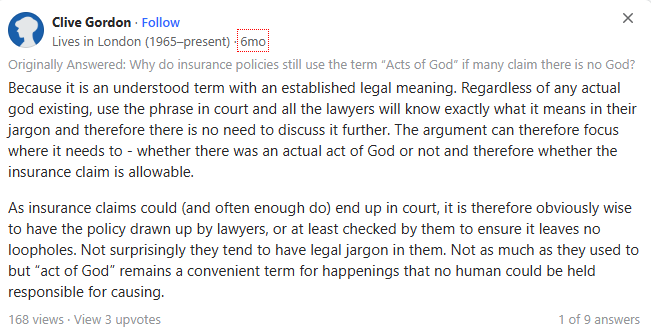
Why do insurance companies still use the term “act of god”?
Despite the term’s religious origins, “act of god” persists in legal and insurance language because it has decades of established case law behind it. Courts have repeatedly ruled on what qualifies — creating predictability that newer, vaguer alternatives lack. Insurance companies and lawyers use it because the legal certainty it provides outweighs the terminological awkwardness.
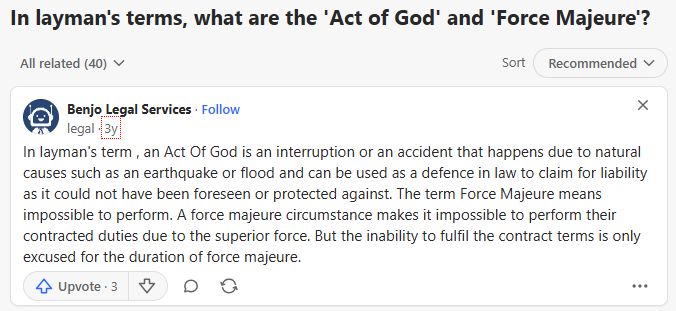
Act of god vs force majeure in plain language
The simplest way to understand the distinction: act of god is a subset of force majeure. Force majeure is the umbrella — it covers everything an act of god covers, plus human-caused disruptions like wars, strikes, and government actions. A contract with only an act of god clause has narrower protection than one with a full force majeure clause.
Does insurance cover acts of god?
Whether insurance covers acts of god depends on the policy type and the specific event. Standard homeowners insurance covers some acts of god – fire, wind, hail, lightning – but excludes flooding and earthquakes, which require separate policies.
1. What acts of god does homeowners insurance cover?
Standard homeowners insurance (HO-3 policy) typically covers:
- Wind and hail damage — including tornadoes
- Lightning strikes — including resulting fire
- Wildfires — unless a specific exclusion applies
- Volcanic eruption — covered under most standard policies
It does not cover:
- Flooding — requires a separate NFIP or private flood policy. Only 6% of U.S. homeowners carry flood insurance despite flooding being the most common natural disaster (Munich Re, 2023).
- Earthquakes — requires a separate endorsement
- Sinkholes — excluded in most states
2. Does car insurance cover acts of god?
Car insurance covers acts of god only if the policy includes comprehensive coverage. Liability-only or collision-only policies do not cover natural disaster damage. Comprehensive coverage pays for flood, hail, wind, and falling trees beyond the driver’s control.
3. Is war considered an act of god in insurance?
No. War is a human-caused event, not an act of god. Most standard policies contain explicit war exclusion clauses that operate independently of act of god exclusions.
How to file an act of god insurance claim
- Photograph and video all damage before any cleanup begins
- Notify your insurer within the policy’s required timeframe (typically 30–60 days)
- File the claim with date of loss, damage description, and supporting documentation
- Cooperate with the adjuster — do not make permanent repairs until assessment is complete
- Obtain independent repair estimates if the insurer’s payout is below your contractor’s figure
Unpredictable events that create high damage and are beyond human control are covered under the “covered perils” section of an insurance contract — not under a single act of god clause. Your policy’s named perils list determines actual coverage.
How act of god clauses work in business contracts
In a business contract, an act of god clause means that if an unforeseeable natural event prevents one party from performing their obligations, they are not liable for the breach. The clause temporarily suspends the affected party’s duties until the event passes, or permanently terminates the contract if the event lasts beyond a defined period — typically 30 to 90 days.
1. Suspension and termination of obligations
The affected party’s performance duties are temporarily excused during the event and its immediate aftermath. Standard business contracts remain valid during force majeure events, but performance timelines pause until normal operations can resume.
If the force majeure event continues beyond a specified period (commonly 30 to 90 days), either party may have the right to terminate the contract entirely without penalty. This protects both sides from indefinite limbo in prolonged crises.
2. Critical notice requirements
Timely notification proves essential for invoking force majeure protection. Most contracts require written notice within 24 to 48 hours of the event or when the party becomes aware that it will prevent performance.
The notice must describe the specific event, explain how it prevents performance, and estimate the expected duration of impact. Many clauses require regular status updates as the situation evolves, creating ongoing communication obligations even during crises.
3. Burden of proof and mitigation obligations
The party invoking the clause must demonstrate that the specific event falls within the contract’s force majeure definition and directly causes impossibility rather than mere difficulty or increased cost of performance. They must prove they took all reasonable steps to prevent or mitigate the impact and that no feasible alternative methods of performance exist.
Mitigation obligations remain in effect even during force majeure events. Parties cannot simply abandon all effort. They must take reasonable steps to minimize the event’s impact on performance, explore alternative performance methods if available, and resume full performance promptly when the event concludes.
4. Duration limits and compensation
The force majeure excuse typically expires when the event ends, and performance becomes reasonably possible again, or when the contract’s termination threshold is reached. Duration limits prevent indefinite contract suspension that would harm both parties.
Compensation issues vary by contract. Generally, no damages are owed for non-performance during legitimate force majeure events. However, contracts may address who bears costs for partially completed work, stored materials, or restart expenses. When circumstances change permanently, parties may pursue contract amendments to accommodate ongoing or recurring impacts rather than terminating valuable relationships.
From contract chaos to organized legal operations
HyperStart’s AI-powered contract management platform centralizes all your force majeure provisions and provides instant visibility into contractual exposure during crises.
Book a Demo6 essential elements of an effective act of god contract clause
Well-drafted force majeure provisions balance protection for both parties while maintaining clarity about obligations and procedures. Effective contract negotiation includes discussing force majeure provisions upfront, as they become critical during crises.
1. Definition of qualifying events
The definition should combine specific examples with general language for comprehensive protection. List concrete examples like “earthquakes, floods, hurricanes, pandemics, wars, terrorist attacks” to provide clarity. Include broader language like “any other event beyond the reasonable control of the parties” to prevent gaps. This combined approach avoids endless lists while ensuring coverage for unforeseen event types.
2. Notice requirements and timelines
Specify exact timeframe for written notice, such as “within 48 hours of the event,” rather than vague terms like “promptly.” Require description of the event and its direct impact on contractual performance, not general statements of difficulty.
Mandate proposed mitigation plan and estimated resumption timeline so both parties understand recovery expectations. Set a schedule for ongoing status updates, such as weekly during prolonged events, to maintain communication throughout the crisis.
3. Documentation obligations
Require proof of the event’s occurrence through news reports, government declarations, or expert assessments. Demand evidence showing the impossibility of performance, not mere inconvenience or expense, to prevent abuse of the clause.
Mandate records of mitigation efforts and alternative performance attempts to demonstrate good faith. Include financial impact documentation for potential insurance claims and future dispute resolution.
4. Mitigation duties and duration terms
Require “commercially reasonable efforts” to minimize disruption rather than allowing parties to abandon all attempts at performance. Specify that alternative performance methods must be pursued if available and reasonable.
Grant termination rights after a specified period, with 30, 60, or 90 days being most common. Clarify whether termination is mutual (both parties can terminate) or unilateral (only one party holds the right). Address wind-down obligations, final payments, and return of materials to avoid disputes during contract closure.
Understanding when force majeure triggers contract termination rights protects both parties from indefinite uncertainty and allows them to pursue alternative arrangements when long-term impossibility becomes clear.
5. Compensation and cost allocation
Determine who bears costs during suspension for materials, storage, and partial work completion. Address whether fees continue, are suspended, or are adjusted during force majeure periods. Clarify reimbursement obligations for work completed before the event to prevent disputes over partial performance. Specify insurance requirements and claims procedures to coordinate insurance recovery with contractual obligations.
6. Common drafting pitfalls to avoid
Vague language like “circumstances beyond control” without specific examples creates ambiguity and litigation risk when parties disagree about whether events qualify. Omitting mitigation requirements allows parties to abandon efforts without consequences, defeating the temporary nature of force majeure relief.
Missing or unrealistic notice deadlines, such as “immediate notice,” can’t be met during actual crises when communications systems may be disrupted. These drafting errors render otherwise protective clauses unenforceable when businesses need them most.
Managing force majeure situations with contract automation
When a crisis strikes, manual contract management becomes impossible. Legal teams scrambling to review hundreds of contracts for force majeure provisions lose valuable response time. Procurement contracts require systematic tracking of supplier force majeure claims to manage supply chain risk effectively.
1. Centralized visibility and risk analytics
Start by tracking all vendor, customer, and partnership contracts with act of god clauses in a single AI-powered platform. Here are a few practices you should incorporate into your workflow:
- Instantly identify which agreements are affected when specific events occur, whether natural disasters, pandemics, or regional conflicts.
- Access real-time visibility into contractual exposure across your entire portfolio without manually reviewing each agreement.
- Search contracts by force majeure event type to assess vulnerability to different risks and prepare contingency plans.
- Identify vulnerable contracts by event type, including natural disasters, pandemics, and armed conflicts.
- Assess aggregate financial exposure during regional or global crises to support executive decision-making.
Lastly, you should support data-driven decisions with real-time contract intelligence and provide executive dashboards showing force majeure impact across the business.
2. Automated tracking and compliance
Alert relevant stakeholders immediately when force majeure is invoked by any party to ensure a coordinated response. Monitor notice requirements and response deadlines automatically to prevent missed obligations that could void protection.
Track mitigation obligation timelines and follow-up action requirements to demonstrate good faith efforts. Set reminders for termination right thresholds before they expire to preserve strategic options.
Store all force majeure notices, correspondence, and supporting documentation centrally for audit trails. Create complete event impact documentation for insurance claims and legal protection. Demonstrate ongoing contract compliance with notice and mitigation requirements throughout crisis events.
Without contract automation, legal teams cannot scale their response during widespread crisis events affecting dozens or hundreds of agreements simultaneously. Modern contract lifecycle management turns reactive crisis response into proactive risk management.
Protect your contracts from the unexpected with HyperStart
Act of god clauses protect businesses from liability during extraordinary events beyond their control, from hurricanes destroying facilities to pandemics shutting down economies. Well-drafted provisions require specific event language, clear notice requirements, and defined mitigation obligations that balance protection with accountability. Modern contracts favor “force majeure” terminology for inclusive, religiously neutral coverage extending beyond natural disasters to man-made crises. Insurance coverage varies significantly by policy type and disaster, making careful review of exclusions essential for comprehensive protection.
Managing act of god situations across hundreds of vendor, customer, and partnership contracts becomes impossible with manual spreadsheets and scattered document storage. When hurricanes threaten operations or pandemics shut down supply chains, legal teams need instant visibility into which contracts contain force majeure protections and what obligations must be fulfilled immediately.
HyperStart, an AI-powered contract management platform, centralizes every force majeure provision across your entire contract portfolio. Automated tracking ensures notice deadlines and mitigation obligations are never missed when unexpected events strike. Transform contract chaos into organized operations, respond faster to crises, reduce contractual exposure, and maintain compliance even during challenging circumstances. See how HyperStart helps legal teams manage force majeure situations efficiently. Schedule a demo today.