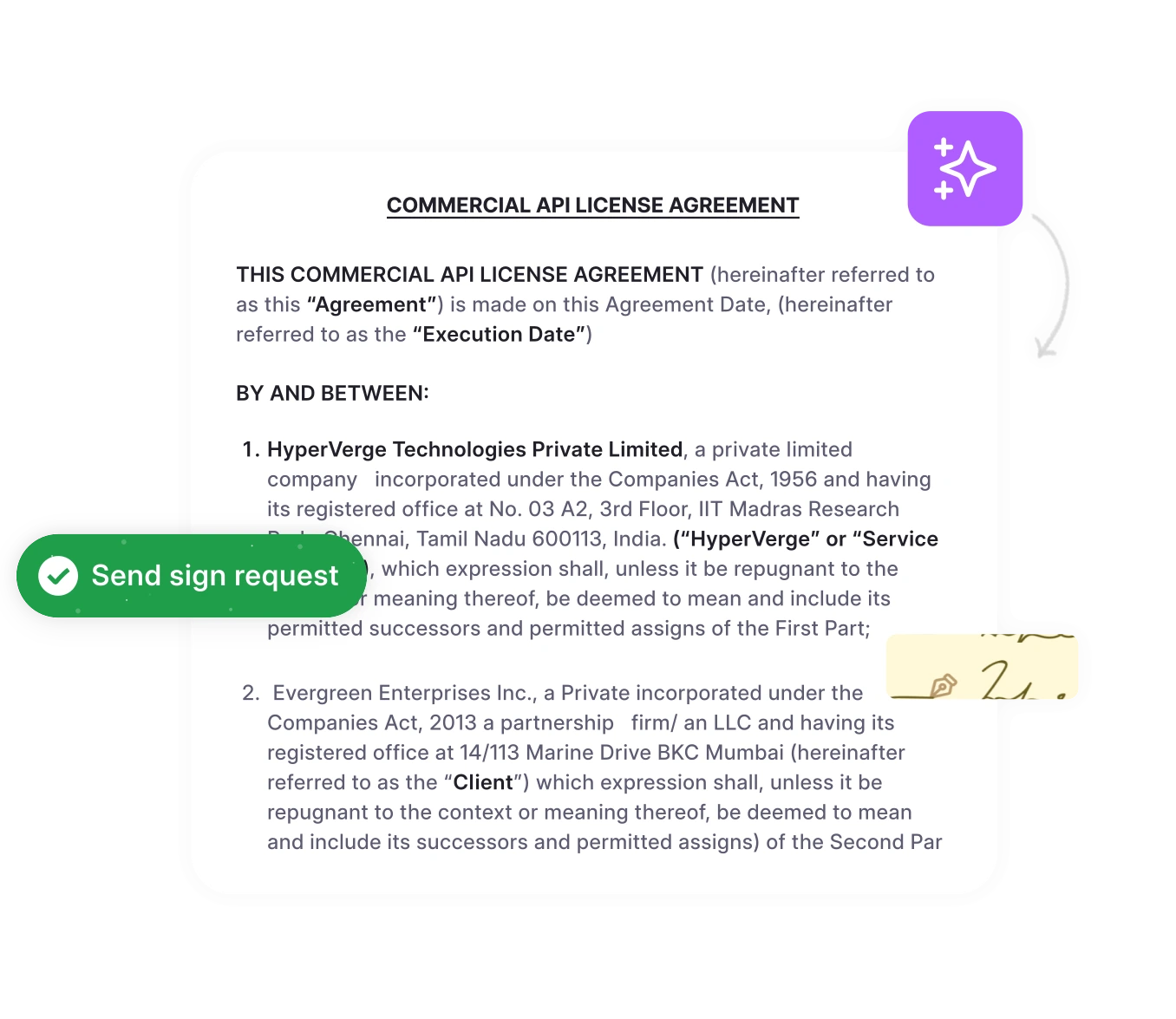




- A contract amendment is a formal written change to specific terms of an existing agreement, signed by both parties, that leaves the rest of the contract intact.
- Every amendment must reference the original contract, identify the exact terms being changed, state the effective date, and be signed by authorized signatories of both parties.
- Amendments differ from addendums (which add new provisions) and from change orders (which adjust scope in construction or IT projects).
- A contract cannot be amended unilaterally unless the original agreement explicitly grants that right.
A contract amendment is a formal change to an existing business contract. Instead of replacing the original document, you modify only the specific terms that need updating, and both parties sign off on the change. Amendments are used to adjust payment terms, extend deadlines, add or remove services, or correct errors in the original agreement. They keep contracts accurate without invalidating prior agreements, which is why they are one of the most frequently used instruments in contract lifecycle management.
This guide covers what a contract amendment is, what “amended” means, the components and types of amendments, amendment vs addendum vs change order, how to amend a contract after signing, real clause samples, a copy-paste template, and how to manage amendments with contract management software.
What is a contract amendment?
A contract amendment is a written modification to specific terms of an existing contract, signed by all parties, that leaves the rest of the original agreement unchanged. It is the standard legal instrument used to update pricing, extend deadlines, change scope, correct errors, or reflect new business circumstances without redrafting the entire contract.
The contract amendment meaning in commercial practice is simple: an amendment to contract is a targeted edit, not a replacement. The original agreement stays in force, and only the clauses identified in the amendment are changed. This applies across all categories of commercial agreements including supply contracts, service agreements, employment contracts, leases, licensing arrangements, and partnership agreements. For a broader overview of where amendments fit in the contract lifecycle, see our guide to contract management.
What does amend mean?
To amend means to formally change or correct the contract. In contract law, “amending” a contract means making a documented modification to specific terms, signed by all parties, that has the same legal force as the original agreement. The word distinguishes a formal, binding change from informal adjustments, conversations, or interpretations. See related contract terms in our glossary.
What does amended mean?
Amended meaning: a contract has been formally changed by a signed amendment. An amended contract is the combination of the original agreement plus all approved modifications. When a contract is described as “amended as of [date],” it means the changes took effect on that date and the contract now reads as the original plus the amendments.
In plain language, the amended contract meaning is straightforward: the original document is no longer the full statement of the deal. The full deal is the original plus every executed amendment, read together. This is why every amendment must be tracked and stored alongside the original in a single contract repository. Without that, you cannot know what the contract actually says today.
What does the amendment date or date of amendment mean?
The date of amendment means the date on which the amended terms become legally binding. It is distinct from the signing date: the parties can sign an amendment today that does not take effect until a future date, or they can backdate the effective date to the start of a billing period or contract anniversary. The date of amendment should always be stated explicitly to prevent disputes about when the new terms started to apply. Most well-drafted amendments include both the date of execution (when the parties signed) and the effective date (when the terms take effect).
What does a contract amendment include?
A complete contract amendment includes six essential components: a reference to the original contract by date and parties, the amendment number and effective date, identification of the specific clauses being changed with the exact old and new wording, a statement that all other terms remain unchanged, the governing law clause, and signatures from authorized signatories of all parties.
1. Reference to the original contract
Every amendment must identify the original contract by its title, the date it was executed, and the parties to it. This ties the amendment to the underlying agreement and prevents disputes about which contract is being modified.
2. Effective date of the amendment
The effective date sets when the amended terms apply. Standard practice is to use the date of full execution (when both parties have signed). For price changes, the effective date is often the start of the next billing cycle. For scope changes, the effective date is typically the date work under the new scope begins.
3. Specific changes to identified clauses
The amendment must identify which clauses are being changed, show the exact old text being removed (or the existing clause being replaced), and provide the exact new text being inserted. Vague language such as “Section 5 is changed to reflect updated pricing” creates ambiguity and weakens enforceability.
4. Statement that all other terms remain unchanged
A standard “all other terms remain in full force and effect” clause confirms the amendment is targeted. Without it, parties could later argue that the amendment implicitly changed other provisions.
5. Governing law and continued application
The amendment should confirm that the governing law of the original contract continues to apply. If the parties want to change the governing law, that must be done expressly.
6. Signatures of authorized signatories
Both parties must sign the amendment through their authorized signatories, typically the same level of authority that signed the original contract. A signature from someone without authority can invalidate the amendment.
What is the purpose of a contract amendment?
The purpose of a contract amendment is to update specific terms of an existing agreement without invalidating the rest of the contract. Amendments allow businesses to adapt contracts to new circumstances such as pricing changes, scope adjustments, deadline extensions, regulatory updates, or corrected errors, while preserving the original relationship, governing law, and continuity of obligations.
The contract amendment meaning in business is practical: it is the formal mechanism that lets a working relationship evolve without breaking it. An amendment to contract is faster than redrafting, less disruptive than termination and renegotiation, and legally cleaner than informal email agreements. Across contract management practices, amendments are one of the most frequently used legal instruments.
When do most contract amendments occur?
Most contract amendments occur at three distinct moments in the life of a commercial relationship: when commercial terms shift (most commonly a price adjustment or scope expansion), when the contract term approaches expiry and an extension is negotiated, and when business circumstances change for one or both parties (regulatory change, organizational restructure, or operational change).
Concrete example of a contract amendment
A consulting company and a client entered into a services agreement on January 15 for 40 monthly hours of consulting at a fee of $10,000 per month, with an initial term of 12 months. In November of the same year, the client requested additional capacity for a new project. Rather than redrafting the entire agreement, the parties signed Amendment No. 1, effective December 1, which:
- Amended Section 2 (Scope) to increase monthly hours from 40 to 60
- Amended Section 4 (Fees) to increase the monthly fee from $10,000 to $14,000
- Confirmed that all other terms of the original agreement remained unchanged
The original 12-month contract continued in force with the amended scope and fees. When the term ended the following January, a second amendment (Amendment No. 2) extended the contract for a further 12 months at the same revised terms.
What does not require a contract amendment
Not every change to a business relationship requires a formal amendment. The following typically do not need an amendment as long as the original contract permits them:
- Changes already permitted by the contract: if the original document allows price adjustments by notice or scope changes within agreed parameters, no amendment is needed
- Administrative updates that do not affect rights or obligations: updating a contact email or notice address, where the contract specifies how this is done
- Routine auto-renewal: renewal happens automatically by operation of the original contract
- Minor clarifications that do not change meaning: typographical corrections that do not affect substantive obligations
If a change affects pricing, scope, timelines, liability, or termination rights, a formal amendment is required regardless of how minor the change appears.
Draft, route, and track contract amendments in one platform
HyperStart’s AI-powered platform generates amendments from a template, routes them for signature, and links each executed amendment to the original contract in a centralized repository. Deploy in 4 weeks.
Book a DemoWhat are the types of contract amendments?
The four main types of contract amendments are: bilateral amendments (signed by both parties, the most common and legally strongest), unilateral amendments (made by one party where the original contract explicitly permits it), written amendments (formal documented changes), and administrative amendments (minor procedural updates). In practice, almost all enforceable business amendments are bilateral and written.
1. Bilateral amendment
A bilateral amendment is signed by both parties and is the most common and legally strongest type. It applies in nearly all standard business contracts. Both parties must agree to the change in writing, and both must sign through their authorized signatories.
2. Unilateral amendment
A unilateral amendment is a change made by one party without the other party’s signature. It is binding only if the original contract explicitly grants that right, for example a clause allowing price adjustments by notice or interest rate changes by the lender. Without that explicit right, a unilateral change is not enforceable.
3. Written amendment
A written amendment is the standard formal modification: a documented change signed by all required parties. Most contracts require all amendments to be written, and many contain a “no oral modification” clause that explicitly prohibits verbal changes from taking effect.
4. Administrative amendment
An administrative amendment covers minor procedural updates such as corrections to typographical errors, changes to notice addresses, or updates to contact information that do not affect the substantive rights or obligations of the parties. Many contracts simplify the approval process for administrative amendments while requiring full signature for substantive ones.
Employment contract amendment
An employment contract amendment formally changes specific terms of an existing employment agreement, such as the role, salary, working hours, location, benefits, or notice period. Common situations include promotions or role changes with adjusted title and compensation, salary increases, changes in working hours or remote work arrangements, updates to benefits or notice period, and the addition of restrictive covenants such as new non-compete or non-solicitation clauses. Employment amendments must be signed by both employer and employee with the same formality as the original contract. In some jurisdictions, certain changes (such as reductions in pay or significant role changes) may require additional consideration to be enforceable.
Contract extension amendment
A contract extension amendment is the most common form of bilateral amendment. It extends the term of the original contract beyond its scheduled expiry date while leaving all other terms in place, or with negotiated adjustments to pricing or scope. Extension amendments must be signed before the contract expires. Once expired, a new contract is required rather than an extension.
Amendment vs addendum: what is the difference?
An amendment modifies existing terms in the original contract. An addendum adds entirely new provisions to the original contract without changing what is already there. Both require signatures from all parties to be legally binding, but they serve different purposes: amendments correct or update existing language, while addendums extend the contract with new sections.
| Feature | Amendment | Addendum |
|---|---|---|
| Function | Changes existing terms | Adds new terms |
| Common use | Price change, scope adjustment, deadline extension | Adding a new schedule, exhibit, or section |
| Signature required | Yes, both parties | Yes, both parties |
| Effect on original | Original is changed | Original is supplemented |
Amendment vs modification: what is the difference?
An amendment is a formal written change to specific terms of a contract, signed by both parties. A modification is a broader term that can include amendments, but also covers less formal changes such as adjustments to how obligations are performed in practice. In US contract law, “amendment” and “modification” are often used interchangeably, though amendments typically require stricter signature and consideration requirements than informal modifications.
The practical distinction matters in three situations: (1) when the original contract specifies that “modifications” can be made by simple written notice, but “amendments” require a formal countersigned document; (2) when one party claims that conduct or correspondence modified the contract without a formal amendment; and (3) when the contract has a no-oral-modification (NOM) clause that limits all modifications to written and signed instruments. Most well-drafted business contracts treat the two terms as identical and require all changes to be written and signed.
Change order vs contract amendment: what is the difference?
A contract amendment is a general legal instrument used to modify any commercial contract. A change order is a specific type of modification used in construction, IT, and project-based contracts to adjust scope, cost, or timeline of an ongoing project. All change orders are amendments in legal effect, but not all amendments are change orders.
Change orders typically follow a standardized process defined in the original contract: a written request describing the change, an impact assessment on cost and schedule, approval by an authorized representative, and signature by both parties. The advantage of change orders is that they are designed for projects with frequent scope evolution, providing a faster and more standardized process than full amendments. The limitation is that they only apply where the original contract specifies a change order procedure.
How to amend a contract
To amend a contract: (1) review the original agreement to identify the specific clauses requiring change, (2) draft the amendment document referencing the original contract, (3) specify the exact old and new wording, (4) obtain legal review, (5) circulate for signature by both parties’ authorized signatories, and (6) store the executed amendment with the original contract in a centralized repository.
1. Review the original contract
Identify all clauses that will be affected by the change. Check for amendment procedures specified in the contract. Many agreements contain a “modification” or “amendment” clause that defines how changes must be made, including notice requirements, signature requirements, and any restrictions on the type of changes permitted.
2. Draft the amendment document
Use a standard amendment template (see the full template below). Reference the original contract by title, date, and parties. Number the amendment (Amendment No. 1, No. 2, etc.) so future readers can track the order in which changes were made.
3. Identify the specific changes
For each clause being changed, show the exact old text and the exact new text. Use the formats shown in the clause samples below: full replacement, partial replacement, or addition. Avoid vague language like “the price has been updated.” Write out the specific change.
4. Obtain legal review
Legal counsel should review the amendment before circulation, particularly for amendments affecting liability, indemnification, intellectual property, or termination rights. Use AI contract review software to flag any drafting risks before legal sign-off.
5. Circulate for signature
Route the amendment to authorized signatories for both parties. Use contract signing software to capture e-signatures with timestamps and audit trail. Both parties must sign for the amendment to take effect.
6. Store with the original contract
Store the executed amendment alongside the original contract in a centralized contract repository. The amendment number, effective date, and link to the original contract should all be searchable so the full contract history is accessible at any time.
How to amend a contract after signing
Amending a contract after it has been signed follows the same six-step process above. The key requirement is that both parties must agree in writing and sign through authorized signatories. An informal change made by email, phone call, or one-sided notice is generally not a valid amendment unless the original contract explicitly permits change by that method.
Pre-signature vs post-signature amendments: what changes?
Pre-signature amendments are changes made to a contract draft before either party has signed it. These are not technically amendments. They are negotiation edits or redlines, and they do not require formal amendment language. Once both parties sign, any further change becomes a post-signature amendment, which must follow the formal amendment process: written document, references to the original contract, signed by both parties, and supported by consideration if required. A pre-signature edit is just an updated draft. A post-signature change without a proper amendment is not binding.
Contract amendment clause language: real wording examples
A contract amendment clause uses specific language to identify which provision is being changed and how. The three standard formats are: full replacement (“Section X is replaced in its entirety with the following”), partial replacement (“Section X is amended by deleting [old text] and inserting [new text]”), and addition (“The following new Section X is added”). Every amendment clause should reference the original contract by date and parties.
1. Full replacement clause
Sample wording
Section [number] of the Agreement is hereby deleted in its entirety and replaced with the following:
“[New section text in full.]”
2. Partial replacement (word-level change)
Sample wording
Section [number] of the Agreement is hereby amended as follows:
(a) the phrase “[old text]” is deleted; and
(b) the phrase “[new text]” is inserted in its place.
3. Addition of a new section
Sample wording
The following new Section [number] is hereby added to the Agreement:
“[Full new section text.]”
4. Price or payment amendment
Sample wording
Effective [date], the payment terms in Section [X] are amended as follows:
(a) the monthly fee of $[old amount] is increased to $[new amount];
(b) all other payment terms remain unchanged.This amendment applies to all invoices issued on or after [date].
5. Contract extension amendment
Sample wording
The Term of the Agreement is hereby extended. Section X is amended such that the Agreement shall continue in full force and effect until [new end date], unless terminated earlier in accordance with its terms.
6. Standard “all other terms unchanged” clause
Every amendment must include a clause confirming that the rest of the contract is unaffected. This prevents disputes about whether the amendment implicitly changed other terms.
Sample wording
Except as expressly amended by this Amendment, the Agreement remains in full force and effect in accordance with its original terms. In the event of any conflict between this Amendment and the Agreement, this Amendment shall prevail.
Stop tracking amendments in spreadsheets
HyperStart links every amendment to the original contract, tracks versions automatically, and surfaces the full document history in seconds. No more lost amendments, no more orphan documents.
Book a DemoContract amendment template
A standard contract amendment template includes: an amendment number, the effective date, identification of the original contract by date and parties, the specific changes to each amended section, a clause stating that all other terms remain unchanged, governing law, and signature blocks for both parties.
Here is a contract amendment template suitable for employment contracts, service agreements, supply agreements, and most commercial contracts. Have legal counsel review before signing.
Amendment Number [X] to the [Original Contract Name]
This Amendment No. [X] (“Amendment”) is made and entered into as of [Effective Date], by and between:
Party A: [Full legal name and entity type], located at [Address] (“Party A”); and
Party B: [Full legal name and entity type], located at [Address] (“Party B”).
Recitals
WHEREAS, the parties entered into the [Original Contract Name] dated [Original Contract Date] (“the Agreement”);
WHEREAS, the parties wish to amend certain terms of the Agreement as set forth below;
NOW THEREFORE, in consideration of the mutual covenants herein, the parties agree as follows:
1. Amendments to the Agreement
Section [Section Number] of the Agreement is hereby amended as follows:
Original text: “[Old text from the original contract]“
Amended text: “[New text replacing the original]“
2. Effective Date
This Amendment shall be effective as of [Effective Date].
3. Continued Effect of the Agreement
Except as expressly amended by this Amendment, the Agreement remains in full force and effect in accordance with its original terms. In the event of any conflict between this Amendment and the Agreement, this Amendment shall prevail solely with respect to the amended terms.
4. Governing Law
This Amendment shall be governed by and construed in accordance with the laws of [State / Country], the same governing law as the Agreement.
5. Entire Agreement
This Amendment, together with the Agreement, constitutes the entire understanding of the parties with respect to its subject matter and supersedes all prior amendments, discussions, and understandings relating to the amended terms.
Signatures
IN WITNESS WHEREOF, the parties have executed this Amendment as of the date first written above.
Party A:
Signature: ___________________________
Name: [Printed name]
Title: [Title]
Date: ___________________________Party B:
Signature: ___________________________
Name: [Printed name]
Title: [Title]
Date: ___________________________
Use contract creation software to generate this template automatically with your specific details, route it for signature, and link the executed amendment to the original contract in your contract repository so the full document history is always accessible.
Contract amendment letter format
An amendment letter is a short cover note that accompanies a formal amendment document, or in some cases serves as a simplified amendment for low-complexity changes. It is most commonly used for price changes, deadline extensions, and contact information updates where a full amendment document would be disproportionate.
Amendment letter template
[Your name / Company name]
[Date][Recipient name]
[Recipient address]Re: Amendment to [Original Contract Name] dated [Original Date]
Dear [Recipient name],
This letter confirms the amendment to the [Original Contract Name] entered into between [Party A] and [Party B] on [Original Date] (“the Agreement”).
Effective [Effective Date], the parties have agreed to amend the Agreement as follows:
[Describe the specific change, for example: “Section 4 (Payment Terms) is amended such that the monthly fee is increased from $5,000 to $5,500.”]
All other terms and conditions of the Agreement remain in full force and effect.
Please countersign below to confirm your acceptance of this amendment.
Sincerely,
[Signature]
[Name and title]Accepted and agreed:
[Recipient name]
Signature: _______________
Date: _______________
What are the best practices for contract amendments?
The five best practices for contract amendments are: always document in writing, reference the original contract precisely by date and parties, use authorized signatories, track all amendments in a centralized repository alongside the original contract, and state effective dates explicitly to prevent ambiguity about when terms take effect.
1. Always document in writing
Verbal or email-only changes are difficult to enforce. Even when permitted by the contract, written documentation prevents disputes about what was agreed.
2. Reference the original contract precisely
Identify the original contract by title, date, and parties. Avoid generic references such as “our previous agreement” which leave room for interpretation if there are multiple agreements between the parties.
3. Use authorized signatories
Confirm that each signatory has the legal authority to bind their organization. An amendment signed by someone without authority is unenforceable, and discovering this after the fact can leave the relationship in a legal limbo.
4. Track in a centralized repository
Every amendment should be linked to the original contract in a single searchable system. This prevents “orphan amendments” that exist in isolation and ensures anyone reviewing the contract sees the full current state. Use contract tracking software to maintain version history and audit trails.
5. State effective dates explicitly
Every amendment should state both the date of execution (when the parties signed) and the date the amended terms take effect. These can be the same date, or the effective date can be in the future or backdated to the start of a billing period. Stating both prevents disputes.
How to automate contract amendments with CLM software
To automate contract amendments, use Contract Lifecycle Management (CLM) software that generates amendment documents from standardized templates, routes them through approval workflows, captures e-signatures, links each amendment to the original contract, and maintains a complete version history. Amendments that previously took days to draft, route, and file are completed in hours.
Modern contract automation software handles the full amendment lifecycle. HyperStart automates each stage:
- Template-based amendment generation: draft a complete amendment from a standardized template in minutes, with your terms pre-populated
- Automated approval workflows: route amendments through the right approvers using contract collaboration software that brings legal, finance, and business stakeholders into one workflow
- E-signature capture: collect signatures from both parties with full audit trail, timestamp, and IP record
- Linking to the original contract: every amendment is automatically linked to the original agreement so the full contract history is always one click away
- Version control and redlining: see exactly what changed, when, and who approved it. The contract redlining view shows old text and new text side by side
- Renewal and deadline alerts: contract reminder software updates obligation tracking automatically when an amendment changes a payment schedule or deadline
- Risk surfacing: contract risk management software flags amendments that introduce new liability exposure or change indemnification terms
- Portfolio visibility: the contract management dashboard shows every active amendment across the contract portfolio at a glance
HyperStart deploys in 4 weeks with a 100% implementation success rate. Legal teams managing high amendment volumes, typically in supplier portfolios, employment contracts, and SaaS subscription bases, can reduce amendment turnaround time by 80% with structured automation. The result is faster contract negotiation, faster execution, and a single source of truth for every contract and its current amended state.