


- A contract repository is a centralized digital system where organizations store, organize, track, and manage all signed contracts and agreements in one searchable location.
- Key features of a modern contract repository include metadata extraction, AI-powered search, automated renewal alerts, role-based access controls, and integrations with CRM and ERP platforms..
A contract repository is a centralized digital system that stores, organizes, and manages all of an organization’s signed contracts in one searchable location. Legal, procurement, and operations teams use contract repositories to maintain a single source of truth for every agreement, from vendor contracts to employment agreements.
Without a central contract repository, organizations struggle to locate critical documents when deadlines approach. A survey conducted by EY Global revealed that over 49% of businesses don’t have a defined process to store contracts after execution. A well-structured repository eliminates this problem by combining document storage with metadata tagging, automated alerts, and AI-powered search.
So how do businesses make their contracts accessible, visible, and organized? The answer is simple- by using a contract repository. This repository centralizes business contracts and makes agreements searchable, accessible, and secure.
This blog provides detailed information on contract repositories. Learn how to use a contract repository to store and manage contracts over time and maximize your contract visibility. Let’s start.
What is a contract repository and how does it work?
A contract repository is a centralized digital system that stores, organizes, and manages all of an organization’s signed contracts and related documents in one searchable location. Contract repositories work by combining document storage with metadata tagging, AI-powered search, automated renewal alerts, and role-based access controls. Legal, procurement, and operations teams use contract repositories to maintain a single source of truth across the entire post-signature contract lifecycle.
Legal teams use contract repository software to manage the contract database centrally. Modern contract repository tools not only support storage but also offer advanced features like clause search, metadata tagging, audit trails, and integrations with CRMs and ERPs. This software helps store, organize, track, and analyze contracts—all post-signing stages of the contract lifecycle management process.
A contract repository is a centralized document location that stores and organizes an organization’s signed contracts and agreements. This is the most basic contract repository meaning—a single source of truth for all executed contracts, accessible to relevant stakeholders across departments.
Document repository vs contract repository: what is the difference?
A document repository is a general-purpose system for storing any business file — invoices, HR records, presentations, policies, and contracts. A contract repository is purpose-built for contracts only. The distinction matters because contracts require specific data handling that a general repository of documents cannot provide.
A contract management repository automatically extracts and indexes contract-specific fields — counterparty name, effective date, expiration date, governing law, payment terms, and renewal type — enabling searches like “show all contracts expiring in Q3 with auto-renewal clauses.” A document repository stores the file but cannot understand what is inside it.
| Capability | Document repository | Contract repository |
|---|---|---|
| Store any file type | Yes | Contracts and contract-related files |
| Full-text OCR search | Sometimes | Yes — standard |
| Auto-extract contract metadata | No | Yes — AI extracts 30+ fields |
| Renewal and expiration alerts | No | Yes — automated |
| Obligation and milestone tracking | No | Yes |
| Compliance audit trail | Basic | Full contract-level history |
| Counterparty and clause search | No | Yes |
For a repository of documents that includes contracts among many file types, a document management system (DMS) works at low volumes. For teams managing 100+ contracts, a dedicated contract repository delivers precision search, renewal visibility, and compliance readiness that a general DMS cannot match.
What are the main types of contract repositories?
Contract repositories fall into four types based on deployment model and capability scope. Understanding the type you need before evaluating vendors prevents buying more — or less — than your situation requires.
- Cloud-based contract repository. Hosted on the vendor’s cloud infrastructure. No hardware, automatic updates, accessible from any device. The standard for mid-market and enterprise teams. Go-live in weeks rather than months. HyperStart is cloud-native.
- On-premise contract repository system. Installed on company servers. Offers maximum data residency control. Requires internal IT for maintenance and security patching. Common in regulated industries (defense, government) with strict data sovereignty requirements.
- CLM-integrated repository. Storage built into a full contract lifecycle management (CLM) platform. Includes drafting, negotiation, approval workflows, eSignature, and storage in one system. The right choice when teams need more than just storage and retrieval.
- Standalone contract repository solution. Storage and search only — no workflow automation. Lower cost, faster to implement. Works when a team already has drafting and signing tools but lacks a structured storage system for executed contracts.
The right type depends on contract volume, compliance requirements, and how many departments share access. Under 200 contracts with no compliance pressure — a standalone solution is enough. Over 500 contracts with multi-team workflows — a CLM-integrated repository delivers more value.
What are the benefits of a centralized contract repository?
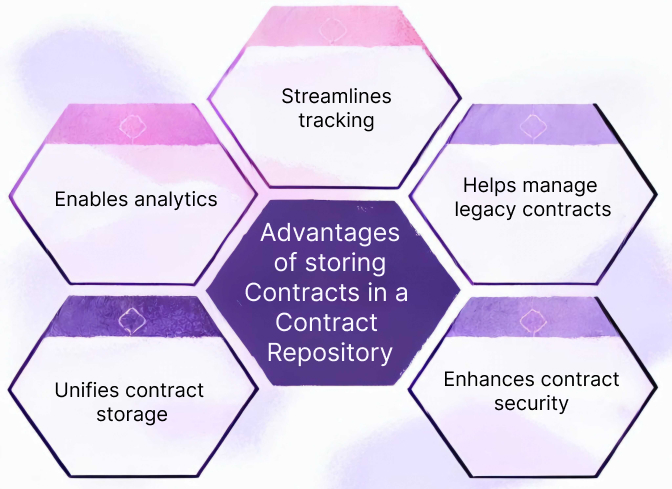
A centralized contract repository provides seven core benefits: unified document storage, faster contract retrieval, automated tracking of obligations and deadlines, enhanced security through role-based access, improved compliance and audit readiness, cost savings from reduced manual effort, and better visibility into contract performance across the organization. Organizations using centralized repositories reduce contract search time from hours to seconds, according to CLOC research.
An efficient contract repository goes beyond just storing documents—it becomes the foundation of effective contract repository management. With automated workflows, permission controls, and AI-enabled sorting, teams can gain complete visibility into their post-signature processes. Why is investing in smart contract repository software and centralizing your contract portfolio a good idea? Here are some key benefits of repository-based contract storage.
1. Unifies contract storage, searching, sorting, and management
Scattered contract storage makes agreements difficult to trace, find, and prioritize. Businesses with high contract volumes often spend a lot of time finding old contracts when required. The result is increased contract administration time and higher contract regeneration costs. A repository centralizes both current and legacy contracts—especially useful for post-signature contract storage, where signed agreements must be preserved for future use, audits, and renewals.
A central contract repository serves as the single source of truth for every agreement an organization holds, from vendor contracts to employment agreements to NDAs. It helps store, search, sort, and manage all new and legacy contracts in the same place.
If you’re looking for how to organize contracts systematically, a repository provides structured storage and easy retrieval. Advanced repositories like the one offered by HyperStart are efficient in pulling contracts regardless of their age. Finding contracts becomes easy with powerful searching, sorting, and organization functionalities.
2. Enables contract analytics
Analyzing contract data helps understand an organization’s contract management performance. Certain contract data points also give insights into department-wise performance. For example:
Sales: Contract signing time helps understand customer onboarding efficiency.
Finance: Average contract value helps with financial forecasting and budgeting.
HR: Employee contract renewal dates help renew employment bonds.
Procurement: Vendor contract expiration dates help with vendor management activities like renewal planning, deal renegotiation, and vendor hunting.
Using a contact repository system helps analyze all this contract data and gain actionable insights from it. Data visualization tools integrated with digital repositories help turn contract data into contract performance visualization dashboards to help understand contractual performance at any given time.
3. Streamlines contract tracking
A post-signature contract repository enables automated tracking of contractual milestones like renewal dates, payment terms, and SLA compliance—something traditional systems often fail to support. Tracking helps trace and fulfill contractual obligations, avoid legal penalties, and maintain positive relationships with counterparties. Traditional contract repositories don’t have built-in functionalities to track contracts.
A contract repository system effortlessly tracks key contract dates and other obligations. Contract management software like HyperStart automatically extracts important terms from contracts and generates alerts based on these terms. From never missing contract renewals again to tracking upcoming payments, digital storage is excellent in all matters.
Without a centralized repository, finding a single contract takes longer than most teams realize. CLOC (Contract Lifecycle Operations Community) research found that professionals spend up to 2 hours searching for specific contract terms and data. A searchable repository reduces this to seconds.
4. Helps manage legacy contracts
Do you have a bundle of legacy contracts stored in cabinets, drives, and local folders? If so, a contract document repository can help you store all these agreements centrally and maintain a single source of truth.
Cloud-based contract repository software like HyperStart uses Artificial Intelligence (for PDF and Word contracts) and Optical Character Recognition (for paper and image contacts) to intake documents, extract information, and store and analyze legacy business agreements.
5. Enhances contract security
Contracts contain sensitive data on business, customers, strategies, and deals. Ensuring data security is often challenging with decentralized contract storage. Contract mismanagement leads to compliance issues, NDA violations, and legal troubles.
Digital contract repositories fix this problem through advanced security features like permission control, data encryption, and blockchain storage. These repositories make contracts easily accessible but at the same time secure through controlled access permissions. A secure contract repository offers role-based access controls, encryption, and tamper-proof audit trails—ensuring sensitive legal and commercial data is protected from unauthorized access.Repositories also track contract versions for a transparent audit trail and the utmost accountability.
6. Improves cost savings and ROI
Contracting costs can be soaring high when contracts are not stored optimally. Scattered storage across multiple locations results in missed obligations, revenue opportunities, and non-compliance issues.
Centrally storing contracts in a digital repository helps reduce overheads associated with contract storage. Moreover, well-organized digital repositories provide valuable insights into contracts—ensuring the full realization of business opportunities. The financial impact of poor contract management is significant. Organizations lose an average of 9% of annual revenue due to poor contracting practices, according to World Commerce & Contracting research. A centralized contract repository directly addresses this leakage by ensuring no contract falls through the cracks.
7. Mitigates risks and elevates compliance
Managing contract compliance is tricky, especially when contracts are stored in multiple locations across filing cabinets, ERPs, CRMs, HRMS, drives, and other storages. Lack of visibility over high-stake agreements often results in missed obligations, non-compliance, and ultimately breaches of contracts.
A digital repository auto-tracks critical contracts for compliance. With proper visibility, detailed audit trails, and automated reminders, contract managers can realize potential risks on time and take steps to elevate compliance, leaving nothing to chance.
Manage All Your Contracts in One Place
Skip contract hunting and easily find what you need with HyperStart’s AI-powered contract repository. Get a fully functional contract dashboard within 48 hours.
Contract repository for procurement teams: managing supplier agreements at scale
Procurement manages more contracts than any other department — supplier MSAs, purchase orders, vendor NDAs, SLAs, and framework agreements. A procurement repository gives the team one searchable system for all supplier contracts, with automated alerts before vendor auto-renewals trigger and integration with ERP and procurement platforms.
Four things a procurement-specific contract repository must handle:
- Supplier contract visibility across all vendors. Procurement needs to see every active supplier agreement, its status, and its renewal date in a single dashboard — not scattered across department inboxes and shared folders.
- Auto-renewal alerts before the window closes. Vendor contracts with auto-renewal clauses are the most common source of unintended spend commitments. Alerts at 60 and 90 days before expiration give procurement time to renegotiate or terminate without penalty.
- ERP and procurement platform integration. A contract repository that does not connect to SAP, Oracle, Coupa, or Ariba creates a parallel data silo. Synchronized contract and purchase order data keeps supplier records accurate across systems.
- Multi-party access controls. Framework agreements and multi-supplier contracts require granular role-based access — legal reviews terms, procurement tracks renewals, finance monitors payment obligations. Each team sees what they need without exposing sensitive commercial data across the organization.
What features should you look for in a contract repository?
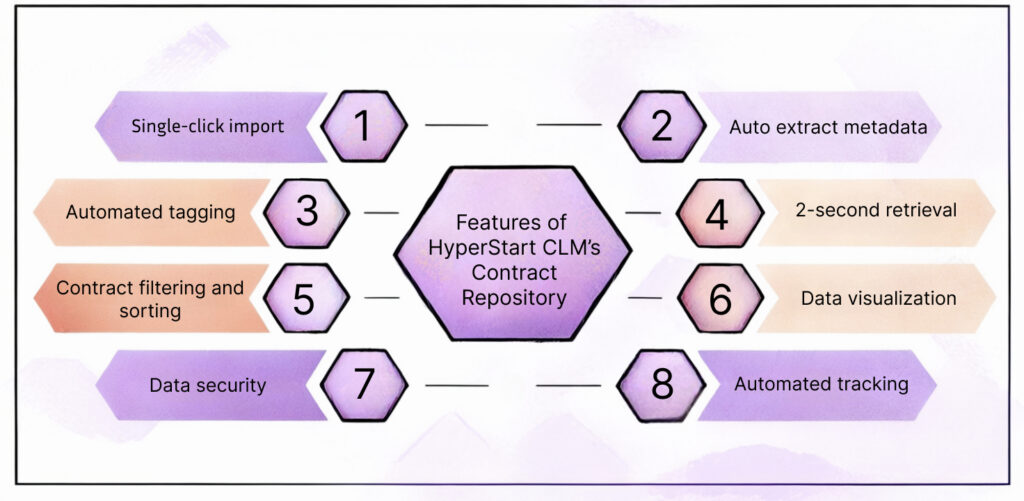
The most important features to look for in a contract repository are document import and migration tools, metadata extraction, AI-powered search with OCR, automated renewal and expiration alerts, role-based access controls, version control with audit trails, reporting dashboards, and integrations with existing CRM, ERP, and e-signature platforms. A repository without automated alerts leaves organizations vulnerable to missed deadlines and unintended renewals.
1. Document import
Import contracts from sources like drives, CRMs, ERPs, cloud storage, and other platforms.
Maintain a single source of truth with two-way sync, ensuring the repository is always up-to-date.
Streamline contract migration with bulk import features, bringing all legacy contracts into a central, accessible location.
2. Metadata extraction
Extract critical contract details—like parties, key dates, contract values, and terms—automatically, turning contracts into actionable data.
Avoid manual entry with auto-tagging, simplifying contract organization and ensuring consistency across the repository.
Enable deeper insights with structured metadata that supports compliance tracking and fast information retrieval.
3. Data tagging
Organize contracts with smart tags and enable non-legal teams to manage contract data.
Boost search precision by tagging contracts with specific keywords, making retrieval both intuitive and instant.
Facilitate collaboration with shared tags that allow team members to easily find and work on relevant contracts.
4. Search and retrieval
Use advanced filters to narrow searches by date, contract type, status, and more, reducing search time significantly.
Instantly access vital contract information, empowering teams to make faster, data-driven decisions.
5. Contract sorting and filtering
Sort and filter contracts based on critical parameters like renewal dates, contract value, and contract status.
Prioritize at-a-glance with quick access to active, pending, or expired contracts, supporting timely actions.
6. Data visualization
Transform contract data into interactive dashboards and visual summaries for quick insights.
Identify trends and performance metrics in real-time, guiding strategic decision-making with ease.
Make complex data understandable, turning contract analytics into visualized, actionable intelligence.
7. Contract security
Protect sensitive data with robust role-based access control, ensuring only authorized personnel can view or edit.
Secure contracts with industry-grade encryption, preventing unauthorized access and data breaches.
Keep an auditable trail of user actions for full transparency, reinforcing compliance and trust.
8. Obligation tracking
Stay proactive with automated alerts for critical milestones—renewals, deadlines, and compliance checkpoints.
Avoid missed obligations with reminders sent directly to responsible parties, reducing risk and penalties.
9. AI analytics
Bulk-analyze contract data for automated reposting and performance monitoring.
Get real-time insights and make informed decisions during negotiation, renewal, and termination—all of it powered through data.
Enhance decision-making with predictive analytics, uncovering optimization opportunities and cost-saving potential.
10. Integrations
Connect your repository with CRMs, HRM systems, ERPs, and other business apps.
Streamline processes like contract request, review, approval, and signing across different platforms.
If you want to learn about the top CLM solutions, that offers the above features then check out our detailed blog on the best contract lifecycle management tools.
Contracts Made Available at Your Fingertips
Store, organize, analyze, and track all your contracts in one place through our AI-powered contract retrieval. Cut down contract admin time by 80% and focus on what matters.
By now, you know why a digital contract repository is important. However, a few additional factors must be considered while storing contracts in a digital contract repository. Let’s take a look at these factors.
What is an intelligent contract repository and what can it do?
AI-powered contract repositories go beyond basic storage by offering automated clause extraction, risk scoring, obligation tracking, and natural language search across thousands of documents. These capabilities allow legal teams to review contracts in seconds rather than hours. AI contract analysis tools achieve 94% accuracy in extracting key terms, dates, and obligations, reducing the manual review burden on legal and procurement teams.
Regarding digital contract repositories, there are a few critical factors to keep in mind. Considering these factors helps ensure that your contracts are optimally stored, can be easily retrieved, and are available whenever required. Here are these factors:
Access control: Granular permission control helps increase contract visibility while ensuring the integrity of sensitive information. User-based access management is a must-have feature for all repositories.
AI-led automation: Digital agreement storage solutions with AI enablement help minimize storage, organization, and sorting time. AI helps with all storage processes—minimizing contract admin time.
Audit trails: Being able to run audit trails on contracts helps maintain transparency. Version control and change logs help keep the contract repository transparent, accountable, and secure.
Integration with third-party systems: Connecting your contract repository to external systems like CRMs and HR software helps automatically push signed contracts into the repository. This way, you can ensure all your contracts end up in the same place.
These were a few additional factors to remember while using a contract repository. Now that you know what’s important and what matters in contract storage, you are all set to implement a contract repository system and centralize your contracts.
How do you set up a centralized contract repository for your organization?
Setting up a centralized contract repository involves five steps: auditing all existing contracts across departments, selecting a repository platform that integrates with current tools, migrating documents with consistent metadata tagging, configuring automated alerts for renewals and expirations, and training teams on search and retrieval workflows. Most organizations complete a full repository setup within 4 weeks.
The audit phase is the most critical step. Organizations need to identify every contract stored in filing cabinets, shared drives, email inboxes, and individual desktops. Research from CLOC found that up to 2 hours can be spent searching for specific contract terms and data without a centralized system. A structured migration eliminates this waste permanently.
After migration, ongoing governance is essential. Assign clear ownership for each contract category, establish naming conventions, and set role-based permissions so only authorized users can view or edit sensitive agreements. A contract repository without governance rules quickly becomes as disorganized as the filing system it replaced.
Contract repository management: keeping your repository organized at scale
Setting up a contract repository is a one-time project. Contract repository management is the ongoing practice of keeping that library organized, searchable, and compliant as contract volume grows. Without active management, even well-structured repositories develop version confusion, stale metadata, and unowned agreements within months.
Four ongoing management practices that prevent repository decay:
- Enforce a consistent naming convention. Every new contract added to the repository should follow a defined format: counterparty + contract type + year (e.g., “Acme Corp — MSA — 2025”). Consistent naming makes browsing viable when search is unavailable and prevents duplicate filenames.
- Assign a contract owner to every active agreement. Every executed contract must have a named owner responsible for renewals, amendments, and obligation tracking. Unowned contracts are the most common source of missed renewals and auto-renewal commitments.
- Audit metadata completeness quarterly. AI extraction covers 30+ fields per contract, but scanned legacy documents and unusual contract structures occasionally produce incomplete metadata. A quarterly audit of missing expiration dates or blank counterparty fields takes 30 minutes and prevents reporting gaps.
- Set a retention policy and automate archiving. Most commercial contracts require a 7-year post-expiration retention period. Automate archiving so expired contracts move to a separate view rather than cluttering the active library. Retention settings in HyperStart are configurable by contract type.
Organizations that combine a central contract management repository with active ongoing management see 80% reduction in contract administration time and 93% fewer missed renewals.
How can a contract repository solve your document management challenges?
A contract repository solves document management challenges by replacing scattered spreadsheets, shared drives, and email attachments with a single, searchable platform. Organizations that implement a centralized repository eliminate the problem identified by an EY Global survey: over 49% of businesses lack a defined process for storing contracts after execution. A well-implemented repository reduces contract retrieval time from hours to seconds and prevents missed renewal deadlines.
Unorganized contracts are harmful to your business processes. They act as bottlenecks in contract management strategy and hamper overall operational efficiency. Your business needs an intelligent, efficient, and feature-rich contract repository solution that streamlines contract handling.
Simplify contract storage and retrieval with HyperStart—your one-stop solution for contract lifecycle management. Our contract repository software helps overcome contract chaos and keep your agreements organized. Book a demo with our team today to start streamlining your contracts.