


![8 Stages of Contract Lifecycle Management Process [A Detailed Guide]](https://www.hyperstart.com/wp-content/uploads/2024/05/Blog-70-white-scaled.webp)
Does your organization face delays or legal disputes due to poor contract management? Are you still relying on a manual approach for contract administration? If so, it’s important to understand that contracts are crucial for running a business regardless of an organization’s size.
Business contracts facilitate transactions, manage risks, protect rights, establish trust, and nurture cooperation between parties. However, the Deloitte and DocuSign Digital Agreement Management Study found that ineffective contract management costs businesses nearly $2 trillion annually in global economic value, driven by disconnected workflows and missed revenue opportunities.
What is contract lifecycle management?
The contract management life cycle is a systematic process that governs every stage from initiation to execution to renewal or termination. Understanding these contract management process steps, also known as the phases of contract management process, allows you to streamline the entire contract lifecycle management process flow from start to finish.
This is why following a standard contract lifecycle process is essential for organizations. The contract lifecycle management process is the end-to-end system of managing contracts from initial request through authoring, negotiation, execution, and renewal. Learn about each stage of this contract management lifecycle to streamline your contract management process, reduce costs, and avoid renewal headaches.
Here are the 8 contract management steps every organization should follow.
8 Stages of the contract lifecycle management process
- Contract request
- Contract authoring
- Contract negotiation
- Contract approval
- Contract signature
- Contract obligation tracking
- Contract compliance
- Contract renewal
Let’s understand each stage of contract management in detail.
1. Contract request
This initial stage of creating a contract begins by requesting one. At this stage, one party requests or initiates the request to develop a contract based on the organization’s requirements.
The contract request should have all important information, such as the purpose of the contract, the parties involved, and the terms and conditions.
When initiating contract requests, here are the points you should have handy:
Identification of parties
Scope of work
Parties involved
Financial terms and compensation, if any
Preferred contract type
Specific terms or conditions, if any
Approval parties and dates
Timeline and milestones
Supporting documents
Once you have all the details, assess the risks and benefits associated with the contract. Next, obtain the necessary approvals and initiate the contract creation process. Getting this first stage right is crucial for setting a strong foundation for the end-to-end contract management process.
Simplify your contract lifecycle with HyperStart CLM
HyperStart CLM streamlines your contract lifecycle from drafting to final approval, ensuring faster approvals and reduced errors.
Book a Demo2. Contract authoring
Once you have completed the contract request stage, it’s time for contract authoring. This stage is also known as the contract drafting stage. A contract document is created or generated at this stage using contract management software like HyperStart.
During this stage, it’s important to ensure the contract includes all clauses, terms, and conditions agreed upon by the parties involved.
Follow the following steps when drafting a contract:
Draft the contract document based on the agreed-upon terms and conditions.
Ensure the contract language is clear, accurate, and detailed.
Integrate applicable legal and regulatory standards into the contract.
The contract draft is then reviewed and edited by the relevant stakeholders such as legal counsel, contract managers, and subject matter experts.
3. Contract negotiation
During the contract negotiation stage, the contract owner or negotiating team communicates with the other party (whether supplier, vendor, or client) to discuss and negotiate the terms and conditions of the contract.
This stage often consists of multiple rounds of back-and-forth due to the contract negotiation process until a mutually agreeable contract is finalized.
These modifications could relate to key aspects of a contract, such as the scope of the work, the payment terms, the duration of the contract, and any performance metrics or obligations.
Stakeholders and vendors discuss any changes, modifications, or counter offers to align the contract according to their interests and requirements.
Next, the contract agreement is sent to business users for approval, paving the way for smooth contract execution.
4. Contract approval
Once the contract is finalized on the agreed terms, it undergoes an internal approval process.
Heads of departments, legal advisors, and executives review the finalized contract document to ensure it meets the organization’s requirements.
During the contract approval process, risk assessments, budget allocations, and compliance checks are performed during the contract approval process.
Approval of contracts presents an organizational commitment to the contract’s terms and establishes accountability for its execution at the ground level.
It is sent for signature after approval from all the relevant stakeholders of the contract.
5. Contract signature
When the contract is finalized, it is time for all parties to sign the document. All parties sign the contract in person or electronically to accept its terms.
Authorized representatives from both parties, such as C-suite-level executives or legal signatories, execute the contract by providing their digital or physical signatures.
Depending on the organization’s process and legal requirements, wet-ink signature or electronic signature tools are usually used to sign a contract.
For example, organizations like VWo, LeadSquared, and Khatabook use HyperStart CLM to sign contracts digitally with an e-signature feature. This makes the entire process of contract signing easy and efficient for all parties involved.
6. Contract obligation management
At this stage, contract monitoring and managing the ongoing obligation management requirements are outlined in the contract. Key milestones, dates, deliverables, and payment terms are managed through contract tracking in this stage to ensure compliance. This is where effective post-award contract management becomes crucial for ensuring deliverables are met and performance standards are maintained.
For example, if you use a CLM software solution like HyperStart, the tool sends automated notifications and reminders to alert stakeholders of upcoming obligations or deadlines.
Additionally, during this stage, organizations must manage quality problems or disputes, if any. This allows all the parties involved in the document to fulfill their obligations as outlined in the contract.
7. Contract compliance
At this stage, focus on ensuring all parties involved in the contract comply with regulatory requirements and company policies, thereby mitigating potential contract risks. The contract compliance process involves tracking contract performance, identifying deviations from the contract, and taking corrective action when necessary.
Contract compliance allows for monitoring regulatory compliance and ensuring that the organization meets any legal requirements related to the contract. Even if any discrepancies are found, legal authorities address them in the contract process.
Without proper contract management software, it becomes difficult to track the legal ramifications, late fees, bottlenecks, and other business issues necessary for compliance management.
8. Contract renewal
Once a contract reaches its end date, it needs an assessment for renewal or renegotiation based on the organization’s established contract milestones and terms of duration. At this stage, the parties involved check whether renewal or renegotiation is necessary to sustain the business relationship.
During this stage, the contract renewal process also includes reviewing the contract, determining whether it should be renewed, and negotiating any changes or modified terms and conditions to the agreement.
Performance data and metrics from the previous contract period are analyzed before the contracts are renewed to make potential adjustments.
Conversely, if the contract is not renewed on time, it could pose financial risks for the parties involved.
Once contracts are renewed, they enter a new contract cycle, starting from the contract authoring or negotiation stage, depending on the required changes.
This is the complete process of contract management stages. You have gone through all the necessary steps that help large organizations manage multiple vendors, suppliers, and clients efficiently. Next, learn about HyperStart contract management software for businesses.
What are the key benefits of CLM software for your business?
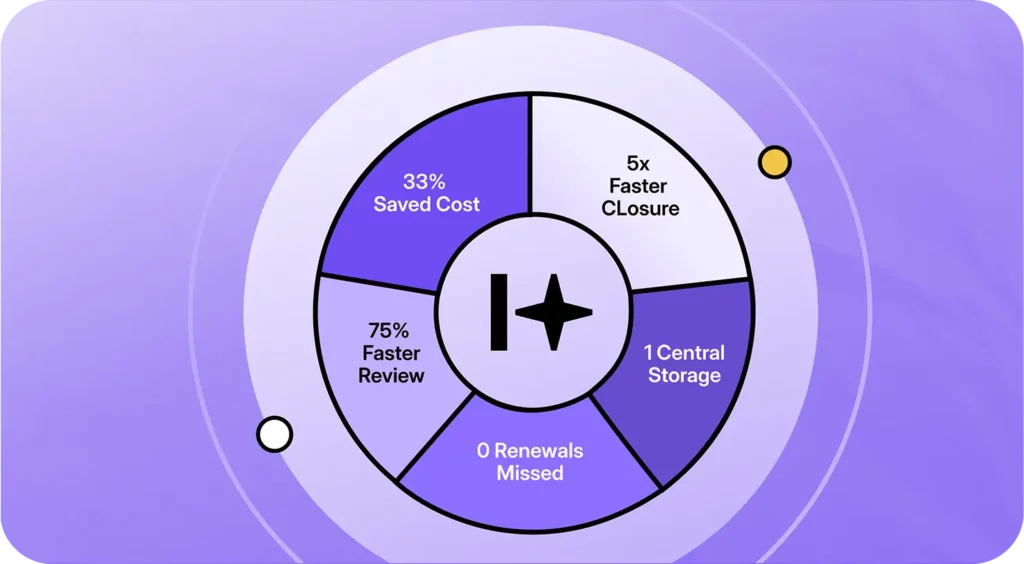
Contract management software automates the end-to-end contract management process of creating, managing, and tracking contracts. Here are the top six benefits of a CLM system.
1. Close contracts 5X faster
Contract creation, approvals, redlining, and negotiations often take a long time before signature. Fragmented collaboration with sales teams, legal counsels, procurement teams, and other departments delays contract execution.
With HyperStart, you can streamline the entire contract management process with features like approval workflow automation, version control, audit trail, analytics, and templates. This enables users to create, approve, and sign contracts 5X faster.
HyperStart CLM is an end-to-end platform that brings your entire team together to manage contracts. It streamlines the contract management process, automating contract creation with workflows.
Here is a demo video to get a better overview of how HyperStart CLM works.
2. Centralized contract repository
With HyperStart, get all your legacy contracts in one place with multiple bulk import options such as email, drive, SharePoint, or CRM. Smart filtering options make finding a contract easy.
Metadata is auto-extracted using AI and is instantly available on the platform, making the set-up time 2-7 days. Retrieve contract or contract data in 2 seconds with smart filters. No more juggling between platforms or sheets.
3. Never miss a contract renewal again
Using tools like Excel, Google Sheets, or shared drives to keep track of the expiration dates might result in missed renewals.
HyperStart provides businesses with automated alerts on contract expiration or renewal to the relevant people. Such contract management systems ensure that contract renewals are never missed.
4. Improves contract visibility
Better visibility of contracts helps you spot potential risks and avoid contract breach penalties.
HyperStart CLM offers reporting and analytics capabilities, including an auto-generated dashboard that helps teams gain insights on contract performance, compliance, and risk management.
These features of HyperStart provide complete control over the management of executed contracts.
5. Improves TAT and redlining speed
HyperStart CLM software reduces contract turnaround time (TAT) by leveraging AI and streamlining processes. The AI redlines with automated metadata extraction, which reduces contract review TAT by 30-40%.
It offers an exceptional AI feature that helps with redlining and highlights deviations as per your requirements. This capability allows contract managers, legal teams, or procurement managers to identify areas of concern and make necessary adjustments.
6. Saves contract management costs
According to a 2025 KPMG and Forbes Insights survey of 150 C-suite executives, only 31% of organizations have a single source of truth with established governance to manage their contract inventory, a gap that drives avoidable costs across the contracting lifecycle. Implementing a CLM solution across multiple industries like aerospace, banking, finance, insurance, telecoms, technology/software, health/pharma, and manufacturing results in cost savings.
The contract management process applies across industries. In healthcare contract management, CLM software helps teams maintain compliance with patient privacy regulations while tracking vendor obligations.
In finance and insurance, it enforces regulatory standards and supports audit-ready contract governance. Manufacturing teams use it to manage supplier agreements at scale and prevent production delays from missed renewals.
Regardless of industry, a structured contract management lifecycle ensures consistent oversight from creation to renewal.
Systems like HyperStart provide end-to-end contract management for businesses of all sizes. Organizations can create, negotiate, approve, review, execute, and renew contracts on a single platform. There is no need for spreadsheets or any manual process that may be prone to errors and pose compliance risks.
Optimize your contract management process
Get 70% faster contract turnaround with 94% AI accuracy, deployed in just 4 weeks.
Book a DemoStreamline your contract management process with HyperStart CLM software
The contract lifecycle management process is a systematic approach to managing every stage of the contract management process cycle, from creation and negotiation to approvals, execution, storage, and renewal. Understanding these contract management process steps allows you to streamline your entire contract management workflow from start to finish.
Whether you are already using or managing a contract management solution in-house, following a structured CLM process is essential for executing new contracts faster and tracking legacy ones effectively. The right software contract management process eliminates manual bottlenecks and gives legal and business teams complete visibility across the stages of contract management.
HyperStart is the only AI-powered CLM purpose-built for mid-market companies. With 94% AI accuracy, 70% faster contract turnaround, and 4-week deployment, HyperStart automates end-to-end contract management so your team can focus on strategic work. Book a demo with HyperStart today.