


Contract lifecycle management (CLM) software is a digital platform that automates and tracks every stage of a contract’s life, from initial request and drafting to negotiation, redlining, approval, e-signature, and renewal. Unlike a shared drive of Word templates or a standalone e-signature tool, CLM software turns contracts into searchable, data-driven business assets. Leading CLM platforms include Ironclad, Icertis, Agiloft, Conga CLM and DocuSign CLM for large, configurable deployments, and Juro, SpotDraft and HyperStart for growing legal teams. HyperStart is contract lifecycle management (CLM) software from HyperVerge for lower mid-market legal and operations teams. It covers the whole contract lifecycle in one product and goes live in weeks, with no implementation partner.
This guide compares 10 CLM tools on what a small legal or ops team actually lives with day to day. For each tool it covers what the tool is known for, how its price splits between license and implementation, and what its users praise and complain about.
- CLM software automates and tracks every stage of a contract, from request and drafting through negotiation, approval, e-signature, obligation tracking and renewal.
- Most CLM vendors in this list sell by custom quote; only third-party benchmarks such as Vendr publish typical prices.
- Implementation is often a separate cost from the license: Vendr puts Ironclad’s one-time implementation at $10,000 to $75,000+.
- Enterprise platforms (Ironclad, Icertis, Agiloft, Conga CLM, DocuSign CLM) suit large, configurable deployments; growing teams usually need something they can run without a legal-ops hire.
- HyperStart is custom-quoted with implementation and contract migration included, and teams go live in weeks without an implementation partner.
What is CLM software?
CLM software is the platform that runs contract lifecycle management: creating, reviewing, negotiating, approving and signing contracts, then tracking performance, obligations and renewals in one system. Contract lifecycle management is the process; CLM software is the tool that runs it. Our guide to the stages of the contract lifecycle management process walks through each step in depth.
Modern CLM platforms add artificial intelligence (AI) and optical character recognition (OCR). That lets them read legacy and scanned agreements as well as new digital ones. The market broadly agrees on the scope: initiation, authoring, negotiation and approval, execution, compliance, and renewal are the stages CLM automates.
What CLM software is not:
- Not a shared drive: A folder stores files. CLM knows who owes what, by when, under which version.
- Not an e-signature tool: Signature is one stage of CLM. Most teams keep the e-signature they already own, such as DocuSign, Adobe or Zoho Sign, and connect it.
- Not a sales proposal tool: Tools such as PandaDoc focus on closing sales documents rather than managing a contract estate.
Core stages of CLM software
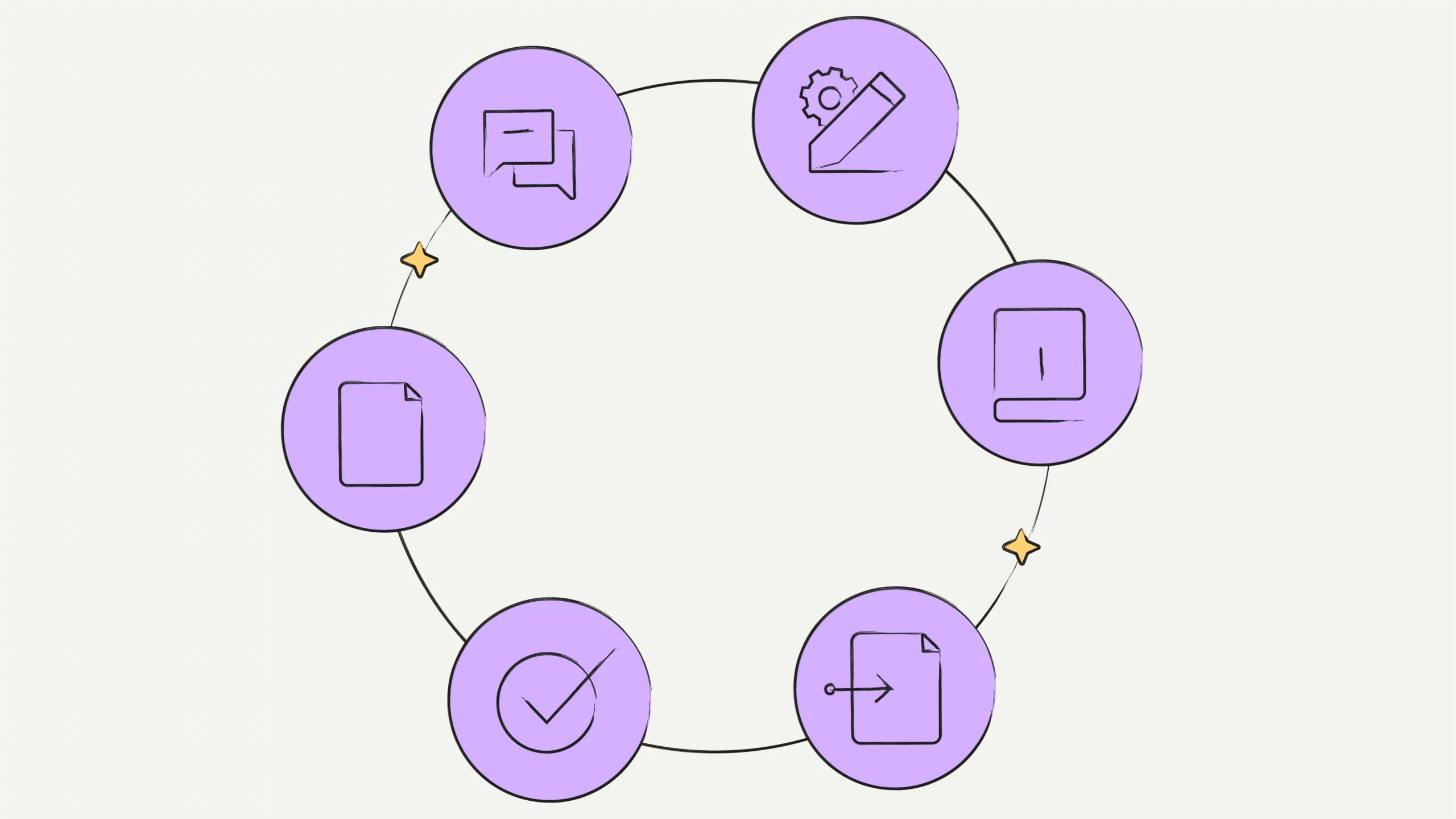
CLM software runs a contract through five stages: intake and request, authoring and templates, negotiation and redlining, approvals and execution, and post-execution tracking and renewal.
- Intake & Request: Sales, procurement, HR or finance raise a request through a form. The request routes itself to the right template and owner instead of sitting in a legal inbox.
- Authoring & Templates: Contracts are built from pre-approved templates and clause libraries, so the business can self-serve standard paper like NDAs and order forms.
- Negotiation & Redlining: Both sides redline, comment and compare versions, often in Microsoft Word, with every change tracked against the current version.
- Approvals & Execution: Approval workflows route internal sign-offs by value, risk or department, then send the final version for electronic signature.
- Post-Execution & Renewal: The signed contract lands in a searchable repository. Obligation tracking, key-date alerts and renewal reminders keep deadlines from slipping.
AI works across all five stages. It extracts key terms from signed paper, flags missing or unapproved clauses, and suggests redlines.
Key benefits of CLM software
CLM software speeds up contracting, cuts missed renewals and obligations, reduces risk from off-template language, and gives the whole business one view of every contract.
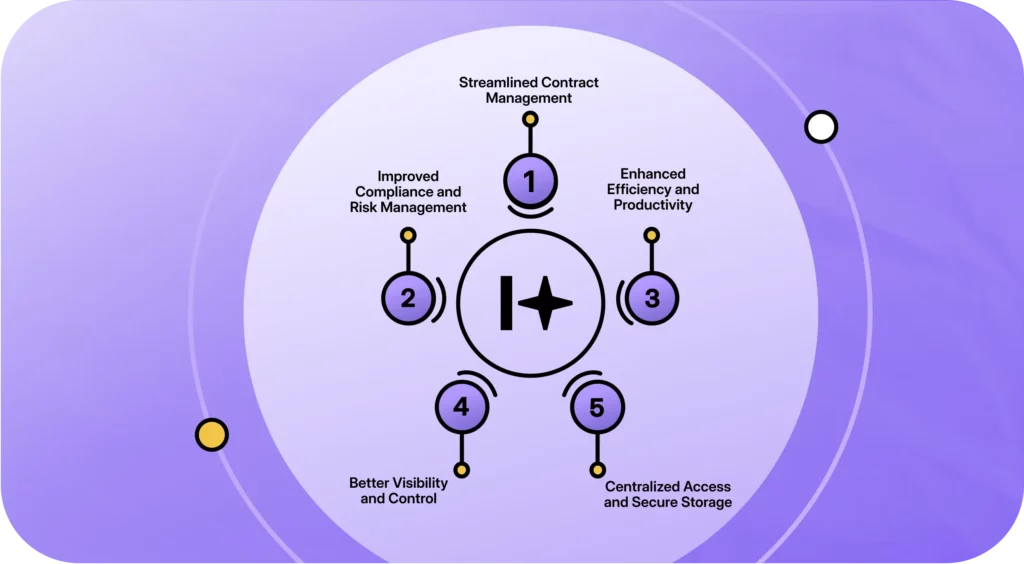
- Speed: Drafting from scratch takes hours, if not days. According to World Commerce & Contracting, drafting a basic everyday contract costs around $6,900. Self-serve templates and AI drafting cut a new draft to minutes. Real-time redlining replaces long email chains, which lowers contract turnaround time (TAT).
- Fewer missed obligations and renewals: Expiration, notice and renewal dates trigger alerts before they pass. Many CLM tools can also auto-renew contracts, sending a new contract to the counterparty before the previous one expires.
- Risk reduction: OCR and AI turn key terms into tracked obligations with their own alerts. Pre-approved language and a full audit trail keep unauthorized deviations out of signed paper.
- Visibility: Legacy contracts scattered across email, drive folders and CRMs come into one central contract repository, a single source of truth. Dashboards then chart contract performance for decisions you can defend.
Curious what those five stages would look like on your own paper? Bring ten of your real contracts to a walkthrough.
How we chose these 10 CLM tools
Our team assessed over 30 contract lifecycle management systems. We evaluated each one on:
- Coverage of the whole lifecycle, from intake to renewal
- G2 and Capterra reviews
- Feature availability, including AI assistance and integration options
- Community popularity
- Search engine results
- Fit for lower mid-market legal and operations teams moving off shared drives
Every entry below follows the same parts in the same order: About, Key features, Pros, Cons, and Pricing. Pricing separates license from implementation, and any rating carries its as-of date. Our own product is listed first and labeled as ours. For a wider view of the category, see our guide to the best contract management software.
Popular CLM software options compared
The best CLM software depends on company size and how much implementation you can absorb. Ironclad, Icertis, Agiloft, Conga CLM and DocuSign CLM are built for large, configurable deployments; Juro, SpotDraft and HyperStart are aimed at growing legal teams; LinkSquares and Evisort lead with contract analytics. HyperStart lists a 7-day free trial; the other nine sell through a demo.
| # | Tool | Known for | Free trial |
| 1 | HyperStart CLM | The whole contract lifecycle in one product for lower mid-market teams, live in weeks | 7-day free trial |
| 2 | Ironclad | Modern, AI-powered contract workflows | No; demo only |
| 3 | SpotDraft | All-in-one CLM with high-volume contract generation for business and legal teams | No; demo only |
| 4 | LinkSquares | AI-powered contract analytics and repository | No |
| 5 | Juro | Browser-native contract editor for small teams on standard paper | No |
| 6 | Icertis | Generative AI contract management built on Microsoft Azure, highly configurable | No; demo only |
| 7 | Agiloft | High no-code configurability and extensive point-and-click integrations | No; demo only |
| 8 | DocuSign CLM | DocuSign’s CLM product, built around enterprise-grade e-signatures | No; DocuSign’s 30-day trial covers eSignature only |
| 9 | Conga CLM | Streamlining complex sales and corporate contract workflows | No; demo only |
| 10 | Evisort (Workday CLM) | AI contract intelligence: data extraction and answers to contract questions | No |
The 10 CLM tools in detail
1. HyperStart CLM (our product)
HyperStart: best for lower mid-market legal and operations teams that want the whole contract lifecycle in one product, live in weeks, with no implementation partner and implementation included in the quote.
About HyperStart CLM
HyperStart CLM covers the whole lifecycle in one product. That includes intake, templates, configurable workflows, redlining and editing in Word, approvals, e-signature, a searchable repository, contract families with metadata rollup, and obligation tracking.
There is no implementation partner, no systems integrator and no configuration project. Teams go live in weeks rather than quarters and work directly with the people who build the product. HyperStart is SOC 2 Type 2 and ISO 27001 certified, and HIPAA compliant, so security review clears without a six-week detour. You can connect HyperStart CLM with your existing systems to manage new and existing contracts in one place.
Key features of HyperStart CLM
- Intake: Requests route themselves to the right template and owner.
- Create: Draft from no-code templates the business can self-serve, and use AI to review counterparty paper.
- Approve: Draw approval workflows for any structure and change them yourself, without a consultant or a change request. Every step leaves an audit trail.
- Negotiate: Redline and edit in Word inside the platform, so negotiation never leaves the system of record. Redlined versions are tracked automatically.
- Sign: Send for e-signature through DocuSign, Adobe or Zoho Sign, the signature tool you already own.
- Store: Import existing contracts in bulk with auto-extracted key terms. Find any clause across every contract in seconds, and link amendments to their parent agreement as contract families with metadata rolled up.
- Track: Renewal, expiry and obligation tracking, with reminders and escalations that chase on their own. An in-flight dashboard shows every contract, stage, owner and age.
Pros of using HyperStart CLM
- Automatic metadata extraction from both legacy and digital contracts.
- AI built on HyperVerge’s document intelligence technology drafts, summarizes and reviews contracts. You can test it on your real contracts, not demo ones.
- Simple enough to adopt that a two-person legal team runs it.
- Customers work directly with the product team before, during and after go-live.
Cons of using HyperStart CLM
- Less market recognition compared to long-established CLM competitors.
What HyperStart CLM customers say
“We took demos of around 5 CLM vendors and chose to go with HyperStart. They were the only CLM vendor who had SOC2 compliance and met the criteria of around 22 parameters which we had evaluated them on.” Om Prakash Pandey, Head of Legal at LeadSquared (Read case study)
“Implementation was very smooth. Using the bulk upload feature, all contracts were integrated into the system within minutes. I was also able to see the AI extracted metadata on the tool immediately, which was impressive.” Mayuri Jaltare, Company Secretary at Qapita (Read case study)
HyperStart CLM pricing
- License: Custom quote based on users or contract volume, never both at once, on an annual plan.
- Implementation: Included, along with integrations and contract migration, at no extra cost.
- Free trial: 7-day free trial, set up with the team after a demo.
- Rating: 4.6/5 on G2 (6 reviews, as of Oct 2026).
2. Ironclad
About Ironclad
Best for enterprise legal teams that want deep, AI-powered workflows and a strong Salesforce integration.
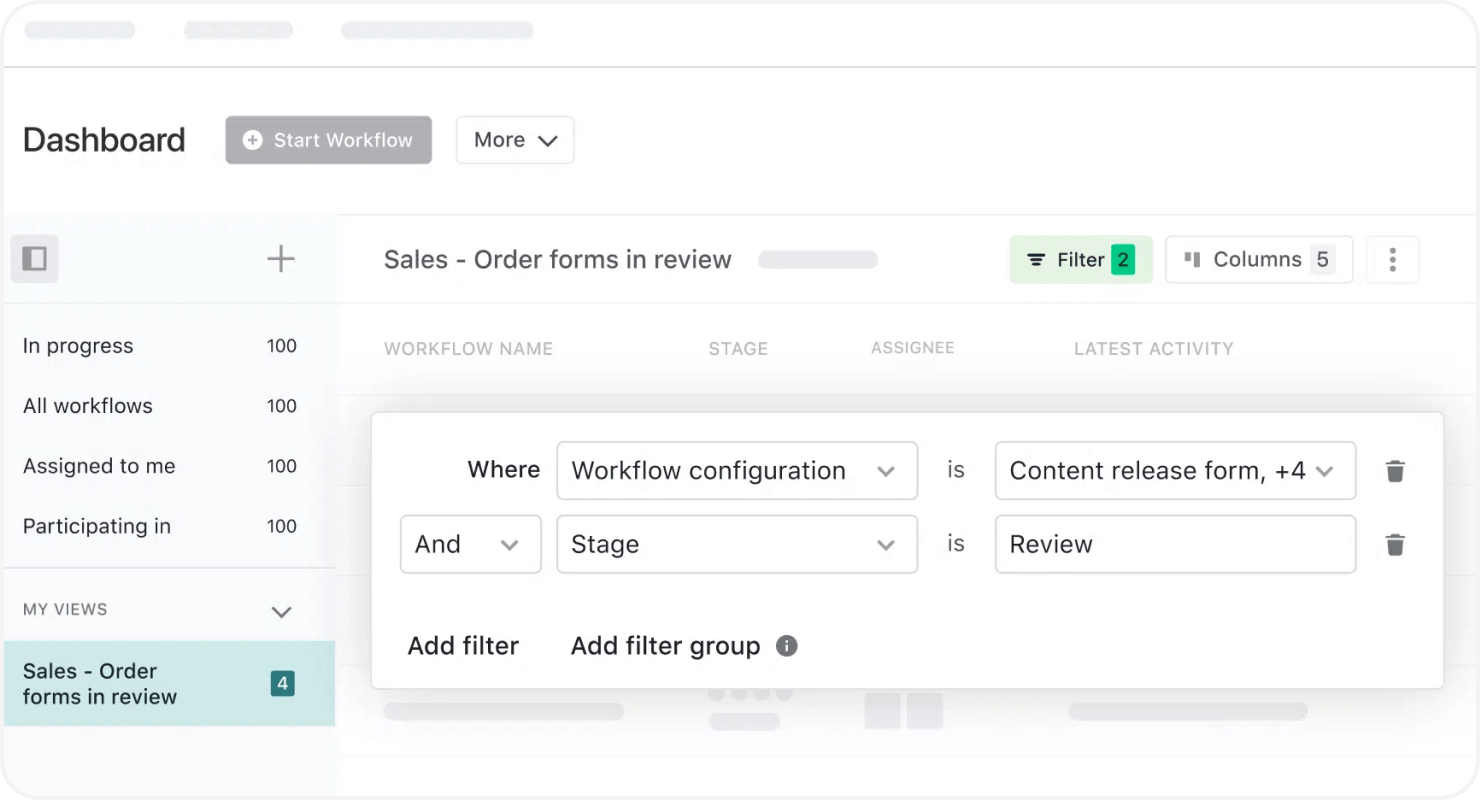
Ironclad is an AI-based CLM solution known for modern, AI-powered contract workflows. Ironclad AI automates processes like data tagging, redline suggestions and unapproved clause flagging to shorten contract TAT. Ironclad lists SOC 1 and SOC 2 Type II, ISO 27001, 27017 and 27018, GDPR and HIPAA.
Key features of Ironclad
- Workflow designer: Build and modify complex workflows with drag-and-drop. Centralize contract intake, review and approval routing.
- Editor: Draft, edit and redline contracts in Word or PDF with accurate version tracking.
- Repository: Upload, scan and create contracts in a searchable database, with automated tagging.
- Insights: Visualize contract metadata and customize views to track contracts.
Pros of using Ironclad
- Users appreciate how Ironclad saves time by automating contract requests, approvals and reporting.
- The Slack integration sends updates when signatures go out and come back, and when workflows start or are canceled.
- Workflows are highly flexible. You can add signers, participants and approvers to existing workflows.
“I have been using Ironclad for over a year now and I can say that it has exceeded my expectations in every possible way. This software has helped me streamline and automate my contractual processes, making them more efficient and reliable. Implementation was a breeze and the customer support team has been impressive in its quick responses and assistance.” Paulina G., G2 review
Cons of using Ironclad
- Users report there is no feature to track turns in workflows, so you cannot see which department or counterparty currently holds the contract.
- Despite automatic metadata extraction, users spend significant time editing metadata.
“Ironclad’s document editing functionality is not intuitive at all. You have to create new versions and know HTML, and there is no way to drag and drop fields. There is also no guide on how to add new fields and syntaxes.” Verified User in Logistics and Supply Chain, G2 review
Ironclad pricing
- License: Sold by custom quote. Vendr puts mid-market deals at $50,000-$120,000 a year.
- Implementation: A separate one-time fee of $10,000 to $75,000+ (Vendr).
- Rating: 4.4/5 on Capterra (71 reviews, as of Oct 2026).
3. SpotDraft
Best for business and legal teams that generate contracts in high volume.
About SpotDraft
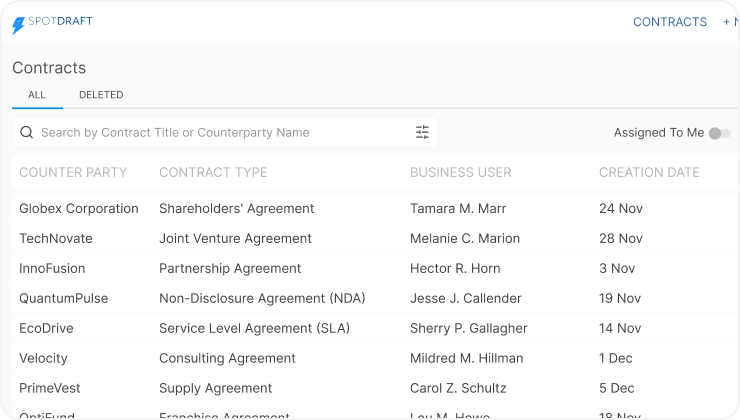
SpotDraft is an all-in-one CLM designed to help business and legal departments manage contracts. Users fill in a few details to generate a contract that is ready for redlining and negotiation. SpotDraft integrates with CRMs, HRMs, e-signature platforms, cloud storage and other systems.
Key features of SpotDraft
- Workflows: Set up custom workflows to create and approve contracts, handle review requests and collect signatures.
- Reporting: Build custom reports with advanced filters and views.
- Campaigns: Bulk-send standard contracts to multiple counterparties in one go.
- Insights: SpotDraft says contract data insights help teams close deals noticeably faster.
Pros of using SpotDraft
- Users like the ability to produce and send contracts in large volumes.
- The support team is very responsive to user queries.
- A simple UI lowers the barrier to entry and helps adoption across organizations.
“SpotDraft is extremely responsive, has the best customer support team, and offers an excellent UI. They are constantly working to make their product better. The Salesforce and Google Docs integrations are amazing. I have never worked with a team as responsive as this.” Taylor S., G2 review
Cons of using SpotDraft
- Some users find the contract editor tricky, and editing can disturb formatting.
- Template generation does not always work as required, and some AI steps still need human intervention.
“The customer service is undoubtedly great. However, SpotDraft’s turnaround time for setting up a new template is slightly disappointing. Sometimes it takes 4-5 business days to set up a template which is not great if you are relying on a single contract management tool.” Verified User in Financial Services, G2 review
SpotDraft pricing
- License: Priced by users or contract volume through a quote. Vendr puts entry deals (5-10 users, about 300 contracts) at $15,000-$25,000 a year (Vendr).
- Rating: 4.8/5 on Capterra (26 reviews, as of Oct 2026).
Still comparing CLM options?
Send us your approval matrix and a contract family and we’ll build both in the demo.
Book a Demo4. LinkSquares
Best for legal teams that want AI analytics across a large contract repository.
About LinkSquares
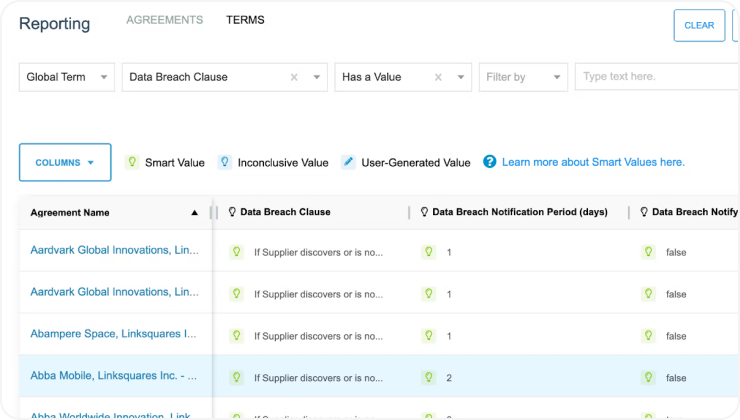
LinkSquares offers a contract lifecycle management system that takes documents from first draft to signature in one place and gives legal and business teams contract visibility. LinkSquares integrates with software like Salesforce and Microsoft Word, so teams can draft in their preferred tool. It positions itself for businesses that want quick CLM adoption, backed by implementation support and onboarding.
Key features of LinkSquares
- Analyze: Secure contract storage with AI-powered analytics.
- Finalize: Pre-saved contract templates for self-service drafting and cross-team collaboration.
- Sign: Legally binding signatures that comply with UETA, ESIGN and eIDAS.
Pros of using LinkSquares
- Users say the support team is very helpful and provides complete implementation assistance.
- AI text search extracts information from contracts automatically.
- Users praise the clean, easy-to-use interface across contract sizes and volumes.
“LinkSquares has helped our very small legal team to support our fast-growing sales company by being a one-stop shop for contract management. We particularly like the Analyze and Finalize features and have used them in our processes. Our LinkSquares representative Stephanie has been very helpful every step of the way.” Mindy O., G2 review
Cons of using LinkSquares
- Emails sent through Finalize are not linked to the document, so users may need to locate contracts manually to sign them.
- The central dashboard does not support alphabetical sorting.
“The tagging feature only sometimes works as intended. While smart tags are great, auto-populated tags can be all over the place and don’t help in group contracts. We think LinkSquares can work on improving this functionality.” Jeremy H., G2 review
LinkSquares pricing
- License: Sold by quote, with no prices. Vendr’s median buyer pays $31,000 a year.
- Implementation: Led by a LinkSquares implementation consultant; ask for the fee as a separate line in the quote.
- Rating: 4.3/5 on Capterra (41 reviews, as of Oct 2026).
5. Juro
Best for small teams on high-volume, standard paper that want a browser-native editor.
About Juro
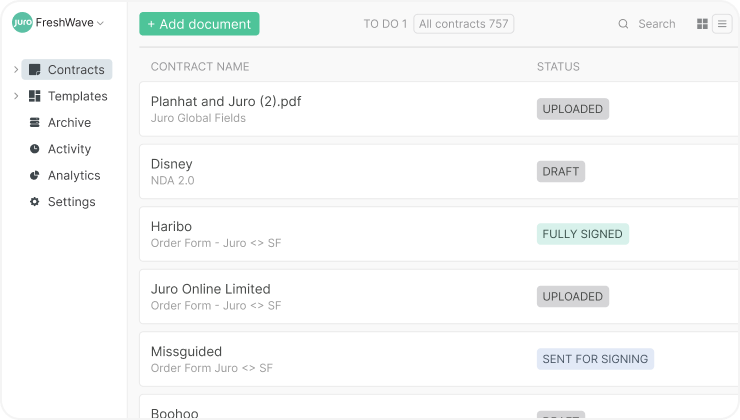
Juro brings contract processes into one browser-based workspace, with AI that drafts, summarizes and reviews contracts. Juro says it powers 3 million contracts for fast-growing businesses.
Key features of Juro
- Juro AI: Automates routine contract tasks to cut contract turnaround time.
- Sign: Secure e-signature on any device, compliant with eIDAS, E-SIGN and UETA.
- Review: Run redlines natively and collaborate with counterparties.
- Connect: Connect to external systems and build no-code contract workflows.
Pros of using Juro
- Negotiation is straightforward. You can initiate a contract and invite stakeholders to collaborate.
- Users report an attentive support team and quick resolutions.
- Real-time chat with counterparties helps clear questions and speed up signing.
“Juro completely relieved the burden of our legal team by empowering our sales team to handle all contracts. Moreover, Juro’s collaborative nature has helped our sales and legal teams share knowledge and elevate our contractual processes.” Julie N., G2 review
Cons of using Juro
- Downloading and re-uploading documents can require reconfiguring workflows and rules.
- Admin-level permissions are simplified, which limits granular control over access and layouts.
“Setting up a template in Juro can often be confusing for the legal team admin. Moreover, the overall contract searchability of the platform can be improved. The integrations with the Google Drive filing system and Adobe Sign also don’t work well.” Verified User in Information Technology and Services, G2 review
Juro pricing
- License: Quoted on contract volume and integrations
- Implementation: Juro targets activation within 30 days
- Rating: 4.8/5 on Capterra (47 reviews, as of Oct 2026).
6. Icertis
About Icertis
Best for large enterprises that need highly configurable contract management on Microsoft Azure.
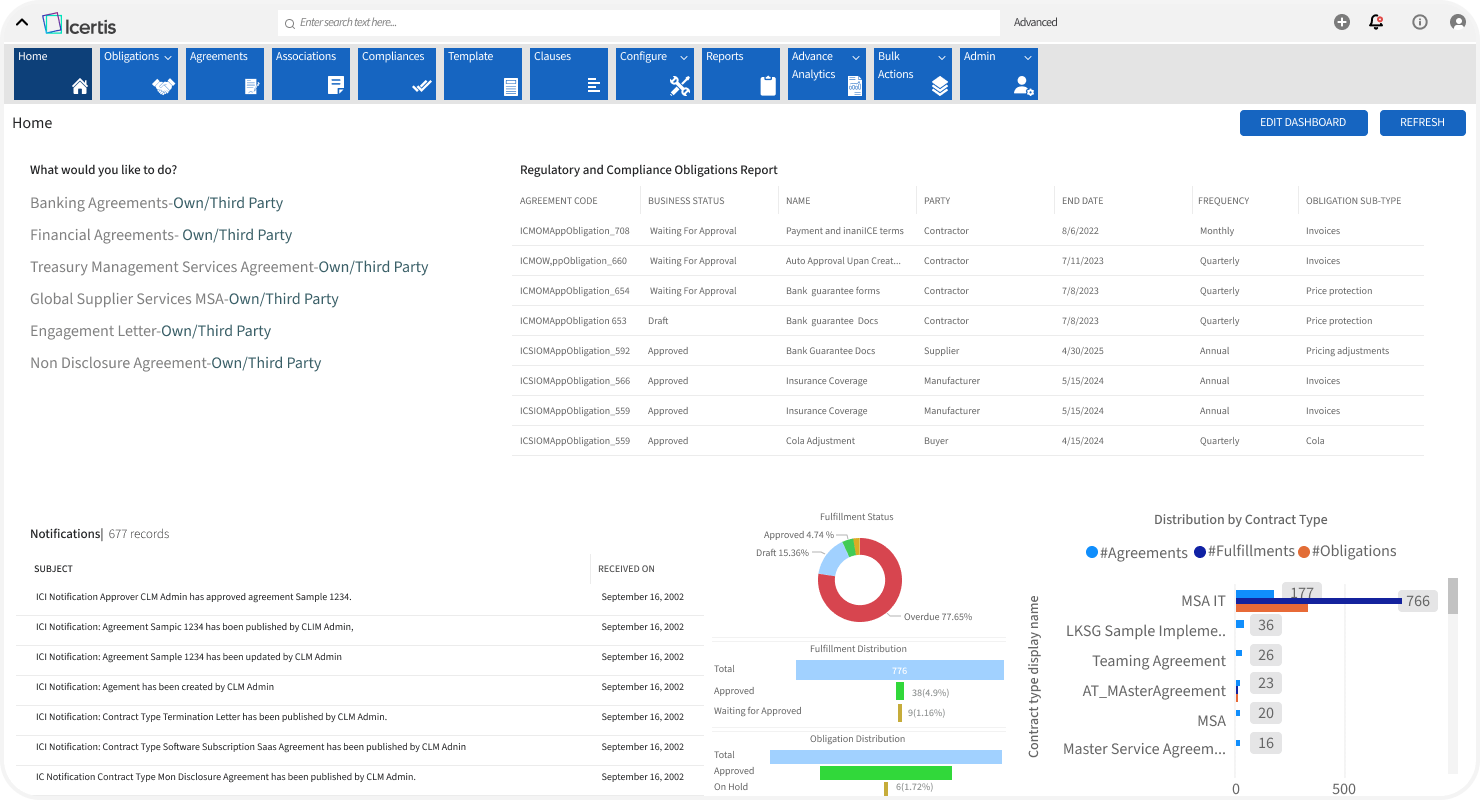
Icertis is a generative AI-based contract lifecycle management tool built on Microsoft Azure and designed for large, highly configurable deployments. AI-based contract data structuring supports deep analysis of contract information with actionable insights.
Key features of Icertis
- Contract editing: Draft contracts and collaborate with internal teams in real time.
- Reporting and dashboards: Turn contract intelligence into decision data.
- Contract collaboration: Redline and negotiate with counterparties, and communicate changes easily.
- Integrate: Connect to existing tools and platforms to automate business processes.
Pros of using Icertis
- Users cite the easy-to-use UI, reconfigurability and smooth implementation.
- The central dashboard gives an instant view of contract status and document creation metrics.
- In-app links take users to the right contracts quickly.
“Icertis is a very easy-to-use tool. The dashboard is pretty straightforward, and the help links are extremely useful and detailed. When I started using this tool, the help button gave me all the information I needed.” Camila G., G2 review
Cons of using Icertis
- Customizations need careful handling during upgrades, or they may be lost.
- Some users report that Icertis does not send automatic renewal reminder alerts, although its collaboration tools let users engage directly with counterparties.
“Some features of the platform like naming convention/search don’t work well. There is also some lack of speed in finding contracts when you are dealing with a large number of documents every day.” Verified User in Food and Beverage, G2 review
Icertis pricing
- License and implementation: Sold only by custom quote, with no published tiers. First-year costs run $100,000-$300,000, covering licensing, implementation and training
- Rating: 4.3/5 on Capterra (41 reviews, as of Oct 2026).
7. Agiloft
About Agiloft
Best for enterprises that want no-code configurability and wide integration options.
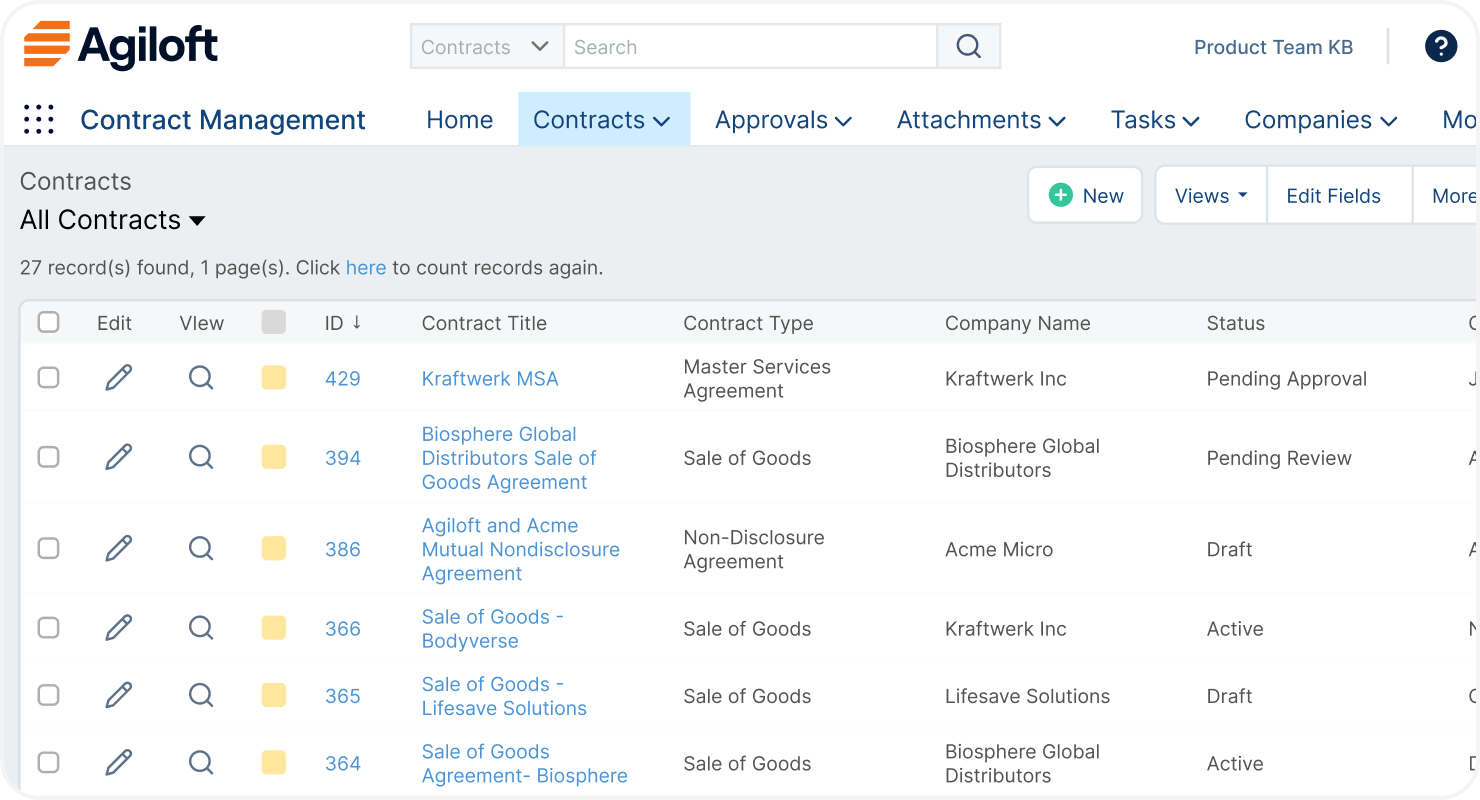
Agiloft is a user-driven CLM recognized for high no-code configurability and extensive point-and-click integrations. Agiloft says it connects with “over 1,000 existing systems”. The platform includes a strong reporting dashboard.
Key features of Agiloft
- Document automation: Dynamic contract templates, PDF conversion and PDF merging.
- Approval workflows: Sequential, parallel and conditional workflows with automated approval routing.
- Version comparison: Track redlining changes so critical details are not missed.
- Agiloft contract assistant: Create automated document templates, build a clause library and send contracts for signing.
Pros of using Agiloft
- The implementation team provides tailored insights and use cases.
- Access permissions give firm control over who can see contracts.
- Advanced search finds contracts quickly.
“I love how Agiloft is a ‘one shop stop’ for all things contracts. It captures our process, helps generate templates, saves clauses, compares past contract versions, and makes negotiations easy to track. It also has AI capabilities and software integration that we can tap into. The implementation process was also very smooth.” Lisa B., G2 review
Cons of using Agiloft
- Updates roll out in the US first, then in other countries.
- Extra plugins, such as the MS Word plugin, have limited customizability, which makes adjusting metadata fields harder.
“Some of Agiloft’s basic functionalities are highly customizable while others are not. We also think the user interface could be more visually appealing for non-technical users.” Verified User in Non-Profit Organization Management, G2 review
Agiloft pricing
- License: Sold by quote. Vendr’s median buyer pays $67,132 a year, in a range of $62,629-$80,344.
- Implementation: Ask for it as a separate line in the quote.
- Rating: 4.8/5 on Capterra (39 reviews, as of Oct 2026).
Want to see a contract family with three amendments?
Book a demo and we’ll show one live, with metadata rolled up across the family.
Book a Demo8. DocuSign CLM
About DocuSign CLM
Best for enterprises already standardized on DocuSign and Salesforce that want CLM from the same vendor.
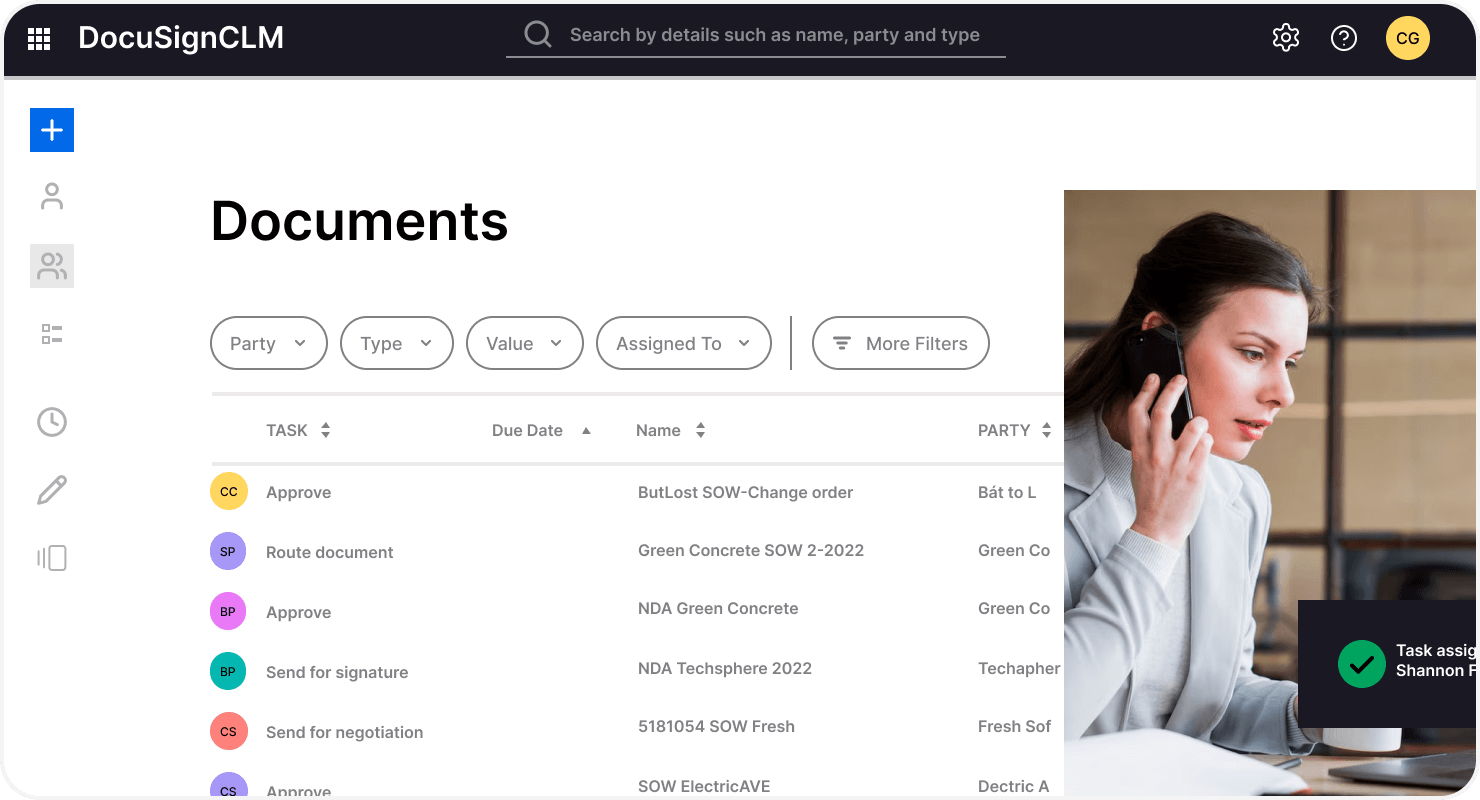
DocuSign CLM is DocuSign’s contract lifecycle management product, known for enterprise-grade e-signatures. It aims to improve efficiency, reduce risk and get more value from contracts in one place. DocuSign CLM automates workflows and identifies bottlenecks. Its drag-and-drop editor takes documents from first draft to execution.
Key features of DocuSign CLM
- Document generation: Standardized generation from customizable templates, including generation without leaving Salesforce.
- Negotiation and collaboration: Maintain a single source of truth and track versions, with comments and tasks to speed up review.
- Workflow and signing: Pre-built workflow options or a custom automated workflow builder.
- Search, analysis and reporting: Centralize, store, tag and organize contracts, and locate them on demand.
Pros of using DocuSign CLM
- Users can search, store and distribute contract documents from multiple sources.
- Workflows can be customized for multiple validation scenarios.
- The Salesforce integration lets sales teams move between sales processes and contract management.
“With DocuSign CLM, I can stay assured that my documents are delivered safely and that the signatures are promptly collected. This tool has helped us increase the efficiency of contract and agreement signing.” Hannah D., G2 review
Cons of using DocuSign CLM
- DocuSign’s CLM page gives no implementation timeframe, so ask for the go-live date in writing.
- Some users find the UI unintuitive and the dashboard hard to navigate.
“DocuSign CLM lacks the functionality to auto-sync folders with the computer. This results in co-workers often forgetting to upload the documents they are working on. Moreover, the collaboration feature of this tool does not work well.” Shannon B., G2 review
DocuSign CLM pricing
- License: Custom-quoted and separate from DocuSign eSignature. Benchmarks put it at $10,000 to $36,000+ a year, with larger deployments at $50,000+ (eSign.AI, ERP Research, Layer3 Labs).
- Implementation: A separate one-time fee of $10,000 to $30,000+
- Rating: 4.3/5 on G2 (503 reviews) and 4.5/5 on Capterra (128 reviews), as of Oct 2026.
9. Conga CLM
About Conga CLM
Best for enterprise sales and procurement teams running complex, revenue-linked contract workflows.
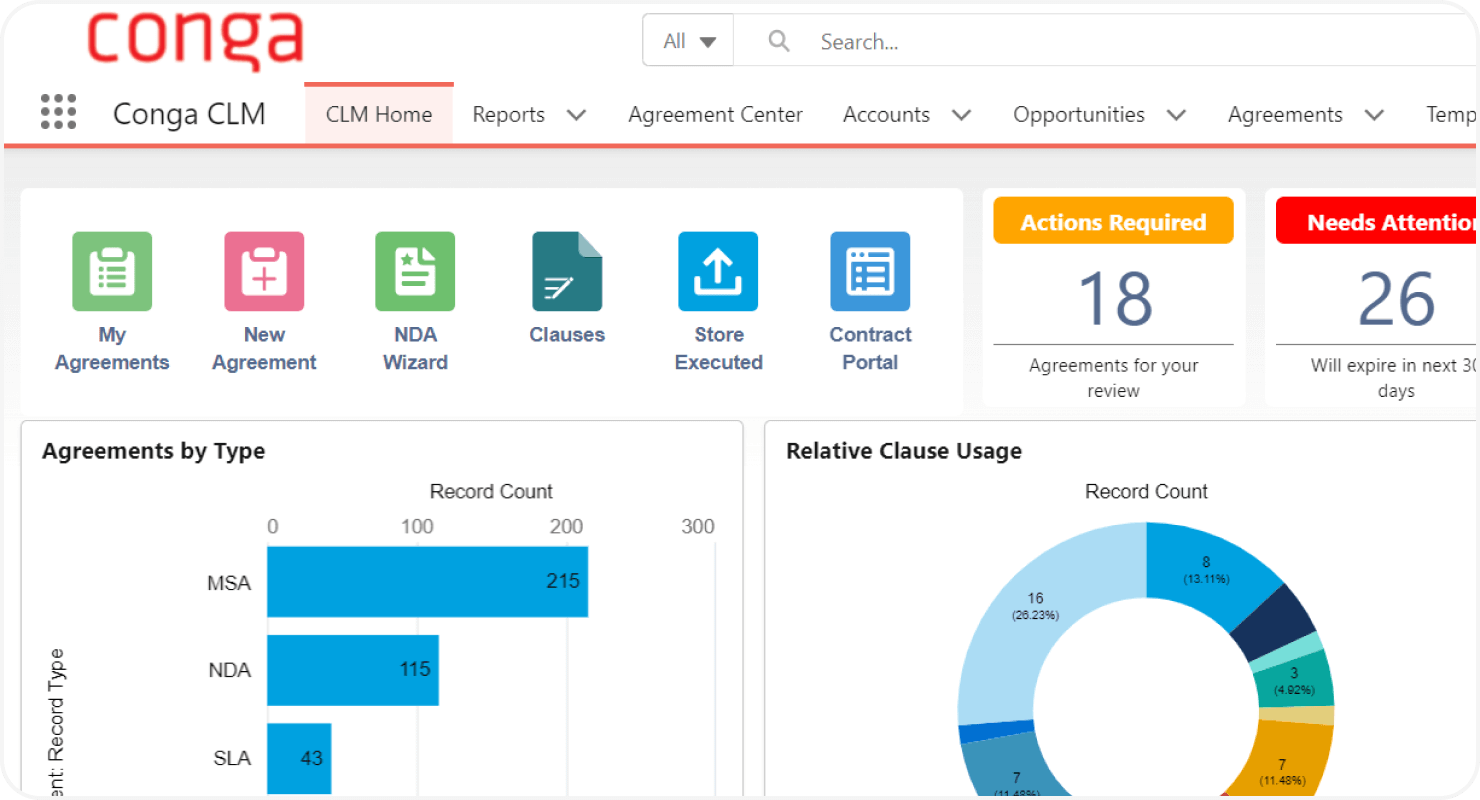
Conga CLM focuses on streamlining complex sales and corporate contract workflows. Its product page shows customers such as Southwest, LinkedIn, Peloton and AXA, and cites a 75% increase in contract accuracy with pre-approved templates. Support comes from Conga Services, Conga Community and Conga CLM’s technical team.
Key features of Conga CLM
- Central repository: Manage all contracts in one place with a full view of the contract lifecycle.
- Pre-approved language: Use pre-approved language and clauses to reduce discrepancies and risk.
- Online contract collaboration: Comment and redline in real time, and sync changes across agreements.
- Uncover insights: Use AI to extract key terms and turn contract data into decisions.
Pros of using Conga CLM
- Users find Conga CLM easy to use and adapt to their processes.
- It improves contract visibility and helps users define tasks.
- It integrates with various third-party systems, with data auto-synced for consistency.
“Conga CLM offers out-of-the-box templates for different functionalities such as initial agreements, change orders, and various other supporting documents. Another very useful feature is the ability to configure this system to meet our requirements. Overall, Conga CLM is a mature product that can be easily scaled for any required integrations.” Mahalingam S., G2 review
Cons of using Conga CLM
- Some G2 reviewers say the support team is slow to respond; ask for support response times in the contract.
- Pricing is quote-only, so ask for the all-in first-year figure, license and implementation on separate lines.
“I don’t like how Conga CLM cannot handle multiple check-ins with redlines without wiping out the previous changes. We don’t redline our contracts in any specific order but all at the same time. This has caused some issues when the metadata breaks.” Verified User in Pharmaceuticals, G2 review
Conga CLM pricing
- License and implementation: Sold by custom quote, with no dollar amounts or tiers
- Rating: Conga Contracts is 4.3/5 on Capterra (75 reviews, as of Oct 2026).
10. Evisort (Workday CLM)
Best for teams that mainly need AI extraction and answers from contracts they already hold, especially Workday customers.
About Evisort
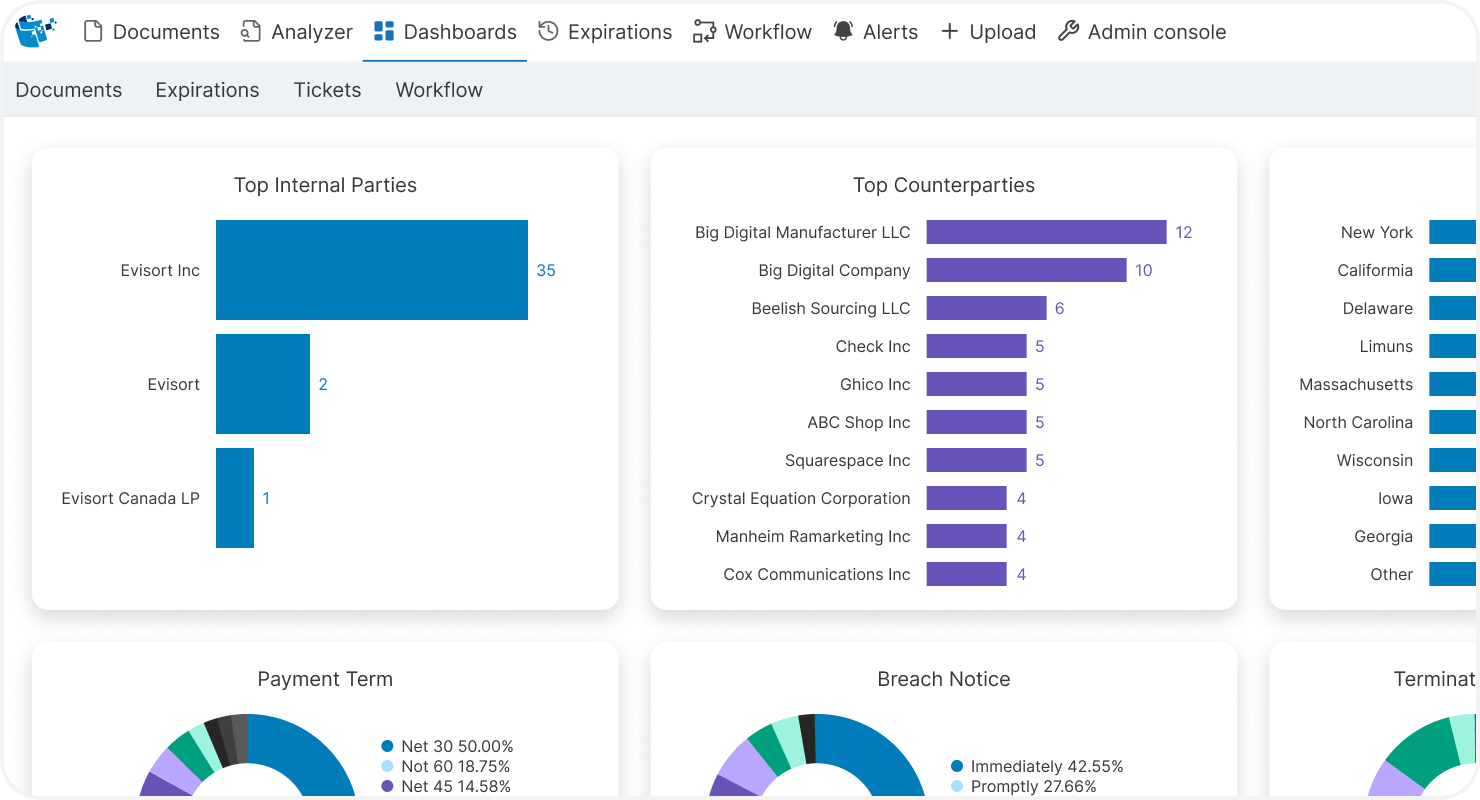
Evisort is an AI contract intelligence tool that gives stakeholders clear answers to contract-related questions. It is now part of Workday and sold as Workday CLM, powered by Evisort, and it keeps contract data connected with other systems.
Key features of Evisort
- Connect and integrate: AI-powered, OCR-based contract data extraction with role-based access.
- Draft and negotiate: A pre-approved clause library and document editor.
- Report: Track important deadlines and turn contract data into insights.
- Manage and automate: No-code workflow building and automated requests.
Pros of using Evisort
- Evisort provides strong customer service and training support.
- AI-based tagging and search are reliable.
“We appreciate the search feature. It helps us locate the required contracts with ease! We also use contract automation– our business and legal teams appreciate how easy it has become to create, sign, and file contracts. We have automated over 20 contracting processes so far and have also integrated other teams into our contracting process thanks to Evisort.” Johanna J., G2 review
Cons of using Evisort
- Users report that sorting contracts is somewhat difficult.
- Version tracking shows only user-made updates, not team-made updates.
“There are many ways to use the alert feature. However, there is no way to attach a document to a specific alert. It would be great if there were a way to tie an alert to a contract, maybe through a hyperlink. Otherwise, alerts work like a charm.” Verified User in Legal Services, G2 review
Evisort pricing
- License: No public price list. Vendr puts deployments at $30,000 to over $250,000 a year, with a median of $41,850.
- Rating: 4.7/5 on G2 (92 reviews) and 4.8/5 on Capterra (19 reviews), as of Oct 2026.
Comparing a specific tool in more depth?
See our guides to Ironclad alternatives, LinkSquares alternatives, Juro alternatives, Icertis alternatives, Agiloft alternatives, DocuSign CLM alternatives and Conga CLM alternatives.
The pairing no CLM list makes: teams leaving a shared drive and Word templates
Most CLM lists sort vendors by company size. Almost none pairs a tool with the moment a lower mid-market team actually starts looking. A new legal or operations hire inherits contracts spread across a shared drive, Word templates rebuilt deal by deal, and renewal dates kept in someone’s calendar. What matters then is the order you move things in, and what going live really costs.
What should move off the shared drive first?
Move the repository and renewal dates first, then the templates people reuse, then your real approval structure and negotiation.
- The repository: Every signed contract and its amendments goes into one searchable place, so the current version is obvious and amendments sit with the agreement they change.
- Renewal and obligation dates: Auto-renewal and notice windows are the most expensive things a shared drive hides. Get them alerting before anything else.
- The templates people already reuse: The NDA and order form that get rebuilt forty times should become self-serve.
- Your real approval structure: Draw the approval workflow you actually run, not an idealized one, and change it yourself as it changes.
- Negotiation in Word, inside the system: Keep redlining in Word, but inside the system of record, so versions stop scattering across inboxes.
How should you read a CLM price?
A quoted CLM price usually covers the license only. Contract management software ranges from $7 to over $700 per month for simple tools (Capterra). CLM platforms run about $15,000-$50,000 a year for mid-market teams (Bind) and $100,000-$500,000+ for enterprises (ERP Research). None of those figures includes implementation: the systems integrator, the configuration project and the contract migration that sit behind many CLM rollouts.
That is why every entry above lists license and implementation separately. Ask each vendor two questions: what does the license cost, and what does going live cost, in dollars and in months?
Three questions to answer before you shortlist
Before you shortlist CLM software, know which departments will use it, how many contracts you handle each month, and which tools it must connect to.
Which departments will use it?
- General counsel: Wants routine paper handled without the team touching it, and obligations and auto-renewals visible as the contract estate grows.
- Legal operations: Wants a live view of every contract in flight, with reminders and escalations that go out without anyone chasing.
- Sales and sales ops: Want standard paper out the same day and contract status without asking legal.
- Procurement: Wants vendor intake, every amendment linked to its agreement, and notice dates visible before the window closes.
- Finance: Wants a renewal calendar it can read, plus payment terms and total contracted value rolled up across a contract family.
- IT and security: Want SOC 2, ISO 27001, HIPAA and SSO answered before the questionnaire arrives.
How many contracts do you handle each month?
Count last quarter’s contracts by type before you talk to vendors. If most are standard paper like NDAs, order forms and renewals, self-serve templates and intake will save the most time. If most are negotiated, redlining and approval routing matter more. A per-user license gets expensive fast when sales, procurement and finance all need access, so check whether pricing follows users or contract volume.
Which tools does it need to connect to?
- Microsoft Word: If your counterparties negotiate in Word, check whether redlining happens inside the CLM or outside it.
- E-signature: Keep the one you own, and confirm the CLM connects to it.
- CRM and ERP: If syncing with Salesforce, HubSpot, SAP, Workday or Oracle is a must-have, confirm it on each vendor’s integration page. Ours is on our integrations page.
How to find the right CLM tool in five steps
To find the right CLM tool, consult your legal team, list your critical challenges, define the scope, run a proof of concept on your real contracts, then implement and gather feedback.
- Consult your legal team: They will use the CLM most. Learn their current pain points, compliance needs and feature requirements.
- Identify critical challenges: List what hurts most, such as high TAT, obligations that are hard to manage, missed renewals, or rising contract volume.
- Outline software scope: Define the number of users, AI functionality, core features and how much you want automated.
- Evaluate CLMs through a proof of concept (PoC): Test each shortlisted tool on your real contracts. Check integration with your existing systems, feature fit and ease of use.
- Implement and adopt: Load legacy contracts, connect your third-party software and gather regular feedback from legal and business teams after go-live.
Ready to move contracts off the shared drive?
HyperStart runs the whole contract lifecycle in one place. Your team can draft, collaborate, negotiate, sign, track and renew contracts without an implementation project, and it works directly with the people who build the product. If you want to see it on your own paper rather than ours, book a demo with the HyperStart team. Send us your approval matrix and a contract family, and we’ll build both in the demo.
Run it on ten of your own contracts
The whole contract lifecycle in one product. Live in weeks, with implementation included in a custom quote and no implementation partner.
Book a Demo