


DocuSign alternatives are e-signature and contract management platforms that replace or supplement DocuSign for document signing, workflow automation, and agreement tracking. Options range from free tools like DocHub and OpenSign to full CLM platforms like HyperStart that bundle e-signatures with contract lifecycle management.
Businesses switch from DocuSign for three main reasons: high per-seat pricing that compounds as teams grow, limited customer support responsiveness (cited by 32% of users in review analysis), and complex navigation that slows adoption. This guide compares 12 alternatives across pricing, features, and ideal use cases to help you find the right fit.
Poor agreement management practices and systems result in a nearly $2 trillion annual loss in global economic value, according to research from Deloitte and DocuSign.
- DocuSign dominates eSignature, but complaints include limited support, complex UI, and a lack of value for money.
- Free Docusign alternatives are DocHub and Zoho Sign
- HyperStart allows you to keep signing on Docusign with end-to-end CLM for mid-market firms
In this blog, you will understand the top alternatives to DocuSign with their ideal use cases, features, pricing, pros, and cons. Let’s start with why anyone would look for DocuSign eSignature alternatives.
Why do businesses switch from DocuSign?
Businesses switch from DocuSign primarily because of high per-seat pricing, limited customer support, and complex navigation. In user review analysis, 32% of DocuSign users cite slow or unresponsive support as their top complaint, 20% report difficulty navigating the interface, and 16% say the platform is overpriced for the features they actually use. Smaller teams and startups are most affected because DocuSign’s costs compound with each added user seat.
DocuSign ties core functionality to per-seat pricing, and businesses with growing teams face compounding costs. Some organizations report saving 50% or more by switching to alternative platforms that use flat-fee or volume-based pricing models. However, Docusign is not a one-size-fits-all solution and may not be the best choice in every scenario. Whether you have already used Docusign eSignature and want to switch to another e-signature software alternative or want to compare it with other options, knowing alternative options will help you make informed decisions
How were these DocuSign alternatives evaluated?
These DocuSign alternatives were evaluated across six criteria: G2 and Capterra review scores, feature depth (e-signatures, templates, workflows, API access), community preference on Reddit and Quora, implementation complexity, integration ecosystem, and pricing transparency. Over 50 platforms were screened, and the final 12 were selected based on consistent performance across all six factors.
We began by evaluating the shortcomings and limitations of Docusign. This helped us determine the grounds for selecting Docusign competitors. We then evaluated over 50 document signing tools on factors like:
| Evaluation Factors | How We Evaluated |
| Reviews | We analyzed user reviews on SaaS listing portals like G2 and Capterra to understand the first-hand experiences of people using digital signing platforms. |
| Features | We compared the commonly shared security features with Docusign along with unique/standout features that overcome Docusign’s limitations. |
| Community preference | We assessed community platforms like Reddit and Quora to understand user perception of what is considered an ‘ideal Docusign alternative’. |
| Implementation | We evaluated factors like ease and time requirement for implementation, with preference given to the least implementation time and effort. |
| Integration | We checked the configurability of shortlisted platforms that integrate well with CRMs, ERPs, HRMs, CLMs, and other commonly used business systems. |
| Use case | We assessed ideal use cases and environments for each platform. |
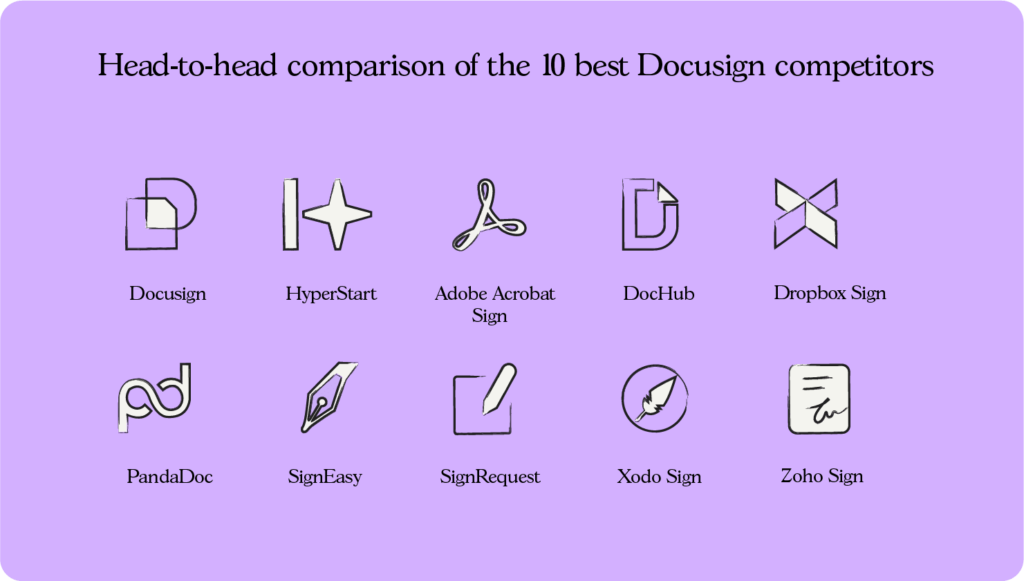
This exercise helped us narrow down from 50+ options to the 12 best alternatives to Docusign. Several tools on this list serve as a cheaper alternative to DocuSign without sacrificing core signing and compliance features. SignNow starts at $8 per user per month (billed annually), and DocHub offers a free plan for basic use. Whether you are looking for DocuSign alternatives free of charge, a cheaper alternative with robust features, or a full CLM platform for small businesses, our list covers it all. The coming section provides a head-to-head comparison of these Docusign competitors to help you find the right fit.
How do the top DocuSign alternatives compare on pricing and features?
DocuSign alternatives range from free plans (DocHub, OpenSign) to enterprise pricing ($50+ per user per month for platforms like Adobe Acrobat Sign and OneSpan). The most common pricing model is per-user-per-month billing, with annual contracts offering 40 to 60% savings over monthly rates. Key differentiators include template libraries, API access, audit trails, and compliance certifications (SOC 2, HIPAA, eIDAS).
The tools below were selected based on G2 rating (minimum 4.0), active user reviews from 2024–2025, and coverage of at least three of five evaluation criteria: pricing transparency, implementation time, eSignature compliance, CLM depth, and integration range. HyperStart is included as the only tool evaluated that covers all five criteria for contract-specific use cases.
Whether you need apps like Docusign with a lower price point, sites like Docusign with stronger CLM capabilities, or programs like Docusign built for mobile teams, the tools below cover every use case. Each DocuSign competitor listed below has been evaluated on pricing, features, security compliance, and user reviews to help you identify the strongest match for your workflow. Apps similar to DocuSign range from free document signing tools to full contract automation platforms — and the right choice depends on whether signing is your only requirement or one part of a larger workflow. For a side-by-side DocuSign comparison, explore our detailed pages on companies like DocuSign that offer DocuSign similar apps with end-to-end CLM.
| Platform | Best For | Free Trial | Starting Pricing (billed monthly) |
 Adobe Acrobat Sign | Enterprise document management | 14 Days | $22.19/mo/license for teams |
 DocHub | Simple and cost-effective PDF signing | 30 Days | $11/month |
 Dropbox Sign | Complete Dropbox integration | 30 Days | $20/month |
 PandaDoc | Comprehensive document workflows | 14 Days | $35/month |
 SignEasy | Mobile-friendly signing experience | 14 Days | $15/month |
 HyperStart CLM | Bulk-signing and managing contracts | 7 Days | Custom |
 airSlate SignNow | Scalable signing platform | 7 Days | $20/month |
 SignRequest | Cost-effective eSignature integration | 14 Days | $9/month |
 Xodo Sign | Multi-device signing support | 7 Days | $20/month |
 Zoho Sign | Integration with the Zoho ecosystem | 14 Days | $12/month |
| GetAccept | Sales-driven contract workflows with deal rooms | 14 Days | $25/month |
| OneSpan Sign | Regulated industries requiring advanced security | 14 Days | $22/month |
Now, let’s dive into each alternative platform’s details and see how it stands against Docusign.
What types of DocuSign alternatives are available?
DocuSign alternatives fall into four categories: standalone e-signature tools (SignNow, Dropbox Sign, SignEasy), full contract lifecycle management platforms with built-in e-signatures (HyperStart, PandaDoc), document management suites with signing capabilities (Adobe Acrobat Sign, Zoho Sign), and free or open-source options (DocHub, OpenSign, Xodo Sign). The digital signature market was valued at $5.2 billion in 2024 and is projected to reach $38.16 billion by 2030, growing at a 40.5% CAGR, according to Grand View Research. This growth is driving rapid expansion across all four alternative categories, with cloud-based e-signature platforms and AI-powered CLM tools seeing the fastest adoption.
The right category depends on whether a business needs simple signing or end-to-end contract workflow automation. Not every Docusign alternative serves the same purpose. Understanding the types of tools available helps narrow your search. Apps like DocuSign generally fall into four categories: standalone e-signature tools, document workflow platforms, enterprise security solutions, and full contract lifecycle management (CLM) platforms.
- Standalone eSignature tools focus purely on sending, signing, and tracking documents. Examples include Dropbox Sign, SignRequest, and Xodo Sign. These work best for teams that need fast, simple contract signing without additional workflow features.
- Document workflow and sales platforms bundle eSignatures with proposal creation, CRM integrations, and payment collection. PandaDoc and GetAccept fall into this category.
- Enterprise and security-focused solutions prioritize compliance, identity verification, and white-labeling for regulated industries. Adobe Acrobat Sign and OneSpan Sign are built for this.
- Full CLM platforms go beyond signing to cover the entire contract lifecycle, from creation and negotiation to storage and renewal tracking. HyperStart is purpose-built for mid-market teams that need contract automation software under one roof.
What are the best DocuSign alternatives in 2026?
The best DocuSign alternatives in 2026 are HyperStart (best for full CLM with e-signatures, deploys in 4 weeks), Adobe Acrobat Sign (best for enterprises already using Adobe products), PandaDoc (best for sales teams needing proposals and signatures), Dropbox Sign (best for simple, fast signing), and SignNow (best for teams needing multi-user plans at low cost). Each platform addresses a different use case and budget range.
1. Adobe Acrobat Sign (formerly known as Adobe Sign)
Best for enterprise-level document signing and management
Adobe Acrobat Sign (a.k.a. Adobe Sign) is a part of the Adobe Document Cloud suite and a popular choice for digitally signed documents. Adobe Acrobat Sign is useful for sending, signing, and tracking documents on the cloud using web and mobile app platforms.
What makes Adobe Acrobat Sign one of the best Docusign alternatives is its ability to integrate and work well with most of the popular systems and software. Moreover, with the Adobe Document Cloud, you can manage all stages of your documents effortlessly and smartly.
Adobe Acrobat Sign pricing
Adobe Acrobat Sign offers two different pricing plans for individuals and businesses. Each of these plans includes a standard plan and a pro plan.
Adobe Acrobat Standard for Individuals: USD 12.99/month
Acrobat Pro for individuals: USD 19.99/month
Acrobat Standard for Teams: USD 14.99/month/license
Acrobat Pro for Teams: USD 22.19/month/license
Key features of Adobe Acrobat Sign
Tracking and management: Get real-time notifications and reminders for your signatures. Track and manage all to-be-signed documents in one place.
Agreement templates: Turn PDFs and documents into standard templates. Import existing templates and avoid creating documents from scratch for all requirements.
Mega sign for bulk sending: Offer a single-click signature option for documents with multiple signatories. Personalize the signing form for each signatory for elevated customer experience.
Signer identity authentication: Use knowledge-based and phone authentication to verify the signatory’s identity. Secure high-stake documents from fraud.
Pros and cons of Adobe Acrobat Sign
| Pros | Cons |
 Highly easy to use Highly easy to use |  Unresponsive customer support Unresponsive customer support |
| Diverse device compatibility | Frequent bugs and glitches |
| HIPAA, FERPA, GLBA, and FDA 21 CFR part 11 security | – |
2. DocHub
Best for PDF editing and e-signing
DocHub is a complete platform for document collaboration and management. When considering DocHub vs Docusign, this platform stands out due to its team collaboration capabilities, editing functionalities, and simple-to-configure signatures.
At its heart, DocHub offers a comprehensive yet simple-to-use platform that individuals, small businesses, and educational institutions can easily use for signing documents. Moreover, with integration support for all popular web apps, DocHub can be easily connected with existing systems for complete document workflow automation and management.
DocHub pricing
DocHub offers two pricing options: a free plan and a pro plan.
Pro: USD 11/month
Key features of DocHub
Send and receive signatures: Add drag-and-drop signatures or request signatures in your documents from co-signers. Avoid printing, scanning, and emailing documents.
Multiple signer workflows: Add multiple signatories in your document with tailored signature workflows. Send sign requests and handle documents with ease.
PDF form creator: Create, edit, and fill PDF forms with great intuitiveness. Leverage File Manager to create new fields or modify existing ones.
Publish forms online: Create simple-to-fill forms and publish them online on your socials. Enable counterparties to easily fill templates and submit information.
Pros and cons of DocHub
| Pros | Cons |
| Highly user-friendly interface | Lengthy signature workflows |
| Offers functionalities to manage all stages of the document lifecycle | Rare feature glitches |
| Cost effective | – |
3. Dropbox Sign (formerly known as HelloSign)
Best for integrating with the Dropbox suite
Dropbox Sign helps send and request signatures for legal documents seamlessly. Dropbox Sign integrates seamlessly with external tools and apps and can help collect signatures 80% faster than traditional paper signatures.
eSignatures made using Dropbox Sign are completely legally binding under the ESIGN Act. For a detailed feature-by-feature breakdown, see our Dropbox Sign vs Docusign comparison. Moreover, a detailed digital audit trail offered by the platform helps ensure that all signatures can be traced back, along with time stamps. These factors make DropBox Sign a reliable solution for electronic signatures.
Dropbox Sign pricing
DropBox Sign offers three pricing plans: Essentials, Standard, and Premium.
Essential plan: USD 20/month
Standard plan: USD 30/month
Premium plan: Custom quotations
Key features of Dropbox Sign
Templates: Standardize and streamline frequently used document formats. Spend less time recreating documents and speed up signatures.
Team management: Manage permissions for your business team through a central dashboard. Implement access control and restrictions for document security.
No-code integrations: Integrate Dropbox Sign with the top CRMs, HRMs, and other cloud solution providers. Avoid switching between apps to get signatures.
Signature requests: Send signature requests to signatories, enabling them to easily agree to documents.
Multiple languages: Overcome language barriers with DropBox Sign’s support for 22 languages.
Pros and cons of Dropbox Sign
| Pros | Cons |
| Offers customizable signing experiences | Frequent text and signature misalignment |
| Automatically saves signed documents | Glitches in Google Docs plugin |
| Rapid scaling with changing team sizes | High spam rates for signature emails |
4. PandaDoc
Best for creating comprehensive document workflows
PandaDoc is a complete platform for creating, managing, and tracking documents online. With 750+ ready-to-use document and contract templates and drag-and-drop document editing functionalities, this platform is useful for overall document management.
The eSignature feature of PandaDoc helps agree to documents without any delays—accelerating approval workflows and minimizing costly mistakes in document management. With PandaDoc, businesses can easily collect signatures anytime, anywhere, thus adding convenience to the signing process.
PandaDoc pricing
PandaDoc offers three pricing models: Standard, Business, and Enterprise.
Standard plan: USD 35/month
Business plan: USD 65/month
Enterprise plan: Custom quote
Key features of PandaDoc
Create documents: Use PandaDoc’s native drag-and-drop document builder and create consistent and branded documents. Place signature blocks wherever required.
Customized branding: Apply your brand’s theme elements to your documents for a personal brand experience.
Signing order: Arrange the signing sequence and create workflows to collect signatures in order. Automate document distribution and ensure adherence to created workflows.
Bulk send: Bulk-share up to 1000 documents per hour to accelerate signing. Meet high signing request volumes effectively.
Pros and cons of PandaDoc
| Pros | Cons |
| Cost-free for basic features | Unresponsive customer service team |
| Swift and intuitive document generation | Can be expensive for SMEs |
| Easily integrates with many CRM tools | Buggy API |
While PandaDoc offers a solid set of features, it may not be the perfect fit for every business. See how PandaDoc compares to Docusign in a head-to-head breakdown, or explore a list of PandaDoc alternatives to see how it stacks up against other solutions.
5. HyperStart
Best for bulk-signing contracts and configuring eSignature workflows
See HyperStart in action 👇
HyperStart offers end-to-end contract lifecycle management, covering creation, review, approval, signing, storage, and tracking. Unlike Docusign CLM pricing plans that can escalate quickly, HyperStart bundles these capabilities at a competitive price point. The signature feature of HyperStart helps execute contracts in 2 clicks.
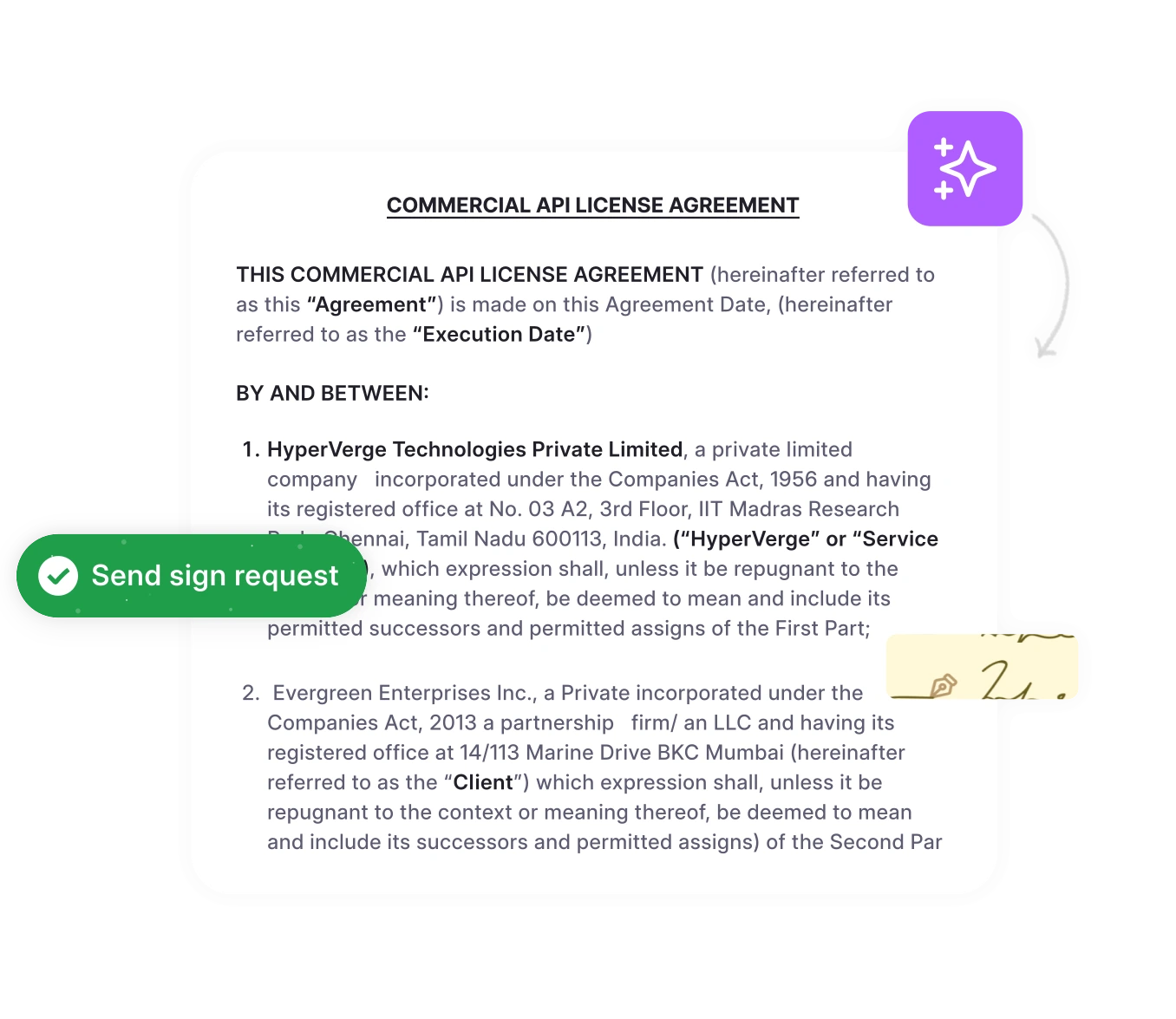
HyperStart supports various eSignature options, including hand-drawn, OTP, Adobe Sign, and Docusign integration. Apart from this, HyperStart CLM’s integrations also extend to leading CRM tools, cloud storage solutions, email tools, and other eSignature platforms. Its no-code eSignature workflow builder is ideal for bulk signing NDAs, MSAs, and offer letters, making it a strong DocuSign alternative for both signing and managing contracts. HyperStart deploys in 4 weeks and includes AI-assisted contract review with 94% accuracy, eliminating the need for a separate e-signature tool. The platform combines document generation, e-signatures, obligation tracking, and automated renewal alerts in a single CLM system.
HyperStart pricing plans
HyperStart offers custom pricing based on individual needs. The quotations are based on the number of users, number of contracts, and modules. You can also avail the 7 day free trial before purchasing a subscription to see how eSignatures work in HyperStart.
How HyperStart stands out against Docusign
Here’s how HyperStart compares to Docusign in terms of pricing, implementation, customer support, free trial availability, and self-setup.
| Criteria | HyperStart | Docusign |
| Pricing | $ | $$$ |
| Implementation time | 4-6 weeks | 1-3 months |
| Free trial | 7 days | 30 days |
| Self Sign Up | Yes | Yes |
| Support | Proactive and delivers promptly | Unresponsive and fails to deliver expectations |
What HyperStart’s customers have to say
We took demos of around 5 CLM vendors and chose to use HyperStart. They were the only CLM vendor who had SOC2 compliance and met the criteria of around 22 parameters which we had evaluated them on.

Om Prakash Pandey
Head of Legal at LeadSquared
Implementation was very smooth. Using the bulk upload feature, all contracts were integrated into the system within minutes. I could also see the AI-extracted metadata on the tool immediately, which was impressive.

Mayuri Jaltare
Company Secretary at Qapita
6. SignEasy
Best for offering a mobile-friendly signing experience
Eliminate the print-sign-scan process and overcome signing bottlenecks with Signeasy. Signeasy is one of the best Docusign alternatives for maintaining flexibility in the signature process and simplifying document management, thus ensuring that you get your documents signed efficiently and with minimal hassle.
Signeasy’s eSignature solution is fully compliant with ESIGN, eIDAS, and HIPAA regulations—thus making your signatures legally enforceable and secure. What’s more? Signeasy comes with flexible pricing options and top-notch functionalities, hence guaranteeing a sleek signing experience.
Signeasy pricing
Signeasy offers three pricing plans for individuals, small teams, and businesses, along with a custom plan for enterprises. Here are the starting prices:
Personal: USD 15/month/user
Business: USD 30/month/user
Business Pro: USD 40/month/user
Custom: Custom quote
Key features of Signeasy
Reusable templates: Create templates for frequently used documents. Send documents for signing as and when required without waiting for document generation.
Signing order: Customize eSignature collection orders and workflows. Choose between parallel signing and sequential signing between multiple signatories.
Offline signing: Sign documents and save them to your local drive with Signeasy’s offline signing access. Don’t let internet connectivity hinder signing workflows.
Guided signing: Make signing intuitive and self-navigable with guided signing steps. Help users when required for error-free signing.
Mobile signing: Enable users to sign documents from anywhere at any time on their mobile device. Signeasy works with Android and iOS devices to make signing convenient.
Pros and cons of Signeasy
| Pros | Cons |
| Easy-to-navigate user interface | Integration requires work through |
| Seamless implementation process | Frequently lagging performance |
| Responsive customer support team | – |
7. airSlate SignNow
Best Docusign competitor for rapid scalability
If you are looking for a quick and easy-to-implement eSignature solution, airSlate SignNow is the right option for you. This tool is one of the best Docusign alternatives for small teams and individuals who want to track documents throughout the signing process. With two-factor authentication and detailed audit trails, airSlate SignNow is the best option for simple document signing.
You can use airSlate SignNow through its application or even integrate its API into your existing system for a native signing experience. The API helps embed signatures in the right field in the document, thus avoiding signature misplacement, which is a common limitation of Docusign.
airSlate SignNow pricing
airSlate SignNow offers four pricing options: Business, Business Premium, Enterprise, and Site License. Here is the price of each of these plans:
Business plan: USD 20 per month per user
Business Premium plan: USD 30 per month per user
Enterprise plan: USD 50 per month per user
Site License plan: USD 1.50 per signature invite
Key features of airSlate SignNow
Conditional workflows: Route documents for signatures in custom orders. Choose between role-based conditions and custom conditions.
Custom branding: Brand your documents and eSignature invitations with custom brand elements. Add your company’s logo for better brand awareness and CX personalization.
Reminders and notifications: Automate reminders to ensure that your signatories don’t forget to sign documents. Customize reminders for a personalized experience.
In-person signing: Use mobile devices to collect signatures from signatories in person.
Pros and cons of airSlate SignNow
| Pros | Cons |
| Offers advanced security options | Requires downloading a mobile app |
| Easy setup | Difficult to contact customer support |
| Self-navigable UI | – |
8. SignRequest
Best for simple and cost-effective e-signing
Looking to automate document management and signing? If so, SignRequest is a tool you must consider. This powerful document-signing app can be integrated with over 2000 platforms and can work the way you want. With SignRequest, organizations can accelerate conversion rates by 200% and reduce costs by 47%.
SignRequest abides with ISO 207001 certification regulations, thus ensuring great security in eSignatures. This tool offers multiple signing options, including uploading a signature image, hand-drawing a sign, typing your name, and generating a signature with SignRequest’s sign generator.
SignRequest pricing
SignRequest offers two pricing options: Professional and Business.
Professional plan: USD 9 per month per user
Business plan: USD 15 per month per user
Key features of SignRequest
Authorization mode: Ask signatories to sign the document or only approve it. Manage approvals for multiple documents from authorized team members.
Bulk send: Leverage SignRequest API to bulk-share documents to multiple signatories. Get approvals easily even with a large number of stakeholders.
Reminders: Set automated or manual reminders to avoid missing signature deadlines. Get an analytical overview of due signatures and track actionable tasks effectively.
Templates: Create your most-used document once and use them again and again. Maintain templates with signing orders, default messages, and notification settings.
Pros and cons of SignRequest
| Pros | Cons |
| Offers custom integrations | Requires a stable internet connection |
| Sign from a laptop, smartphone, or tablet | Limited feature options |
| Highly cost-effective | – |
9. Xodo Sign (formerly known as Eversign)
Best for signing documents using different devices
Formerly known as Eversign, Xodo Sign is a versatile document signing software suited for the needs of individuals, small and medium-sized businesses, and enterprises alike. This platform helps sign documents securely on multiple devices—thus ensuring document signing speed, flexibility, and convenience.
You can connect Xodo Sign with all popular cloud storage tools like Dropbox, OneDrive, and Evernote, and even consent to documents simply through Gmail, Google Drive, Google Docs, and Google Chrome—owing to this platform’s excellent configurability.
Xodo Sign pricing
Xodo Sign offers five pricing options: Free, Basic, Professional, Professional Plus, and Enterprise. Here is how much each of these plans cost:
Basic: USD 20/month
Professional: USD 32/month
Enterprise: Custom quotations
Key features of Xodo Sign
Security management: Set security controls like auto-expiration or move documents to a private storage for ensured data security.
Document editor: Upload existing PDFs and edit them using Xodo Sign’s native editor tool.
App integrations: Connect Xodo Sign with your everyday apps like Zoho, Salesforce, Dropbox, and Google Docs. Sign documents without leaving your familiar apps.
Templates: Create templates for frequently used document types. Pre-fill templates using custom text, dropdown menus, checkboxes, and other elements.
Pros and cons of Xodo Sign
| Pros | Cons |
| Easy to implement | Accepts limited types of documents |
| Basic features available cost-free | Does not allow editing uploaded docs |
| Highly intuitive and self-navigable | Inconsistency in notification alerts |
10. Zoho Sign
Best for integrating e-Signature software with the Zoho ecosystem
If you are currently using the Zoho suite for your organization, using Zoho Sign to digitally sign documents is your best choice. Zoho offers various apps for email, collaboration, and contract management, and Zoho Sign is the best fit for integrating with these tools.
What’s more? Zoho Sign also offers features and functionalities to create self-serving online forms for signature, automates billing, and even adds a QSPT (Qualified Trust Service Provider) certificate to signatures. The blockchain timestamping feature is great for adding advanced electronic signatures that can be traced back for authenticity.
Zoho Sign pricing
Zoho Sign offers four pricing plans: Free, Standard, Professional, and Enterprise. Here is how each plan is priced:
Standard: Priced at USD 12 per user per month
Professional: Priced at USD 20 per user per month
Enterprise: Priced at USD 28 per user per month
Key features of Zoho Sign
Configure workflows: Define the signing order through which documents move across different signatories.
Sign documents: Digitally agree to documents or send them to signatories to collect signatures for your documents.
Track status: Get instant and real-time alerts on document progress. Locate and eliminate signing bottlenecks and accelerate the signature process.
Bulk send: Send a single document to multiple signatories. Eliminate repetitive document sharing with different signatories.
Reusable templates: Create customized document templates and reuse them every time you need a document. Avoid recreating similar documents repeatedly.
Pros and cons of Zoho Sign
| Pros | Cons |
| Enables record keeping for signed docs | Can be cost-intensive |
| Compatible with multiple devices | Limited customizability |
| Works well with the Zoho cloud | – |
These are the 12 best Docusign alternatives. However, out of these ten options, which is the right tool for an organization? Keep reading to find out how you can choose the right alternative.
11. GetAccept
Best for sales teams that need deal rooms and signer engagement
GetAccept combines eSignatures with digital sales rooms, live chat, and engagement tracking. Unlike most eSignature tools that treat signing as a standalone step, GetAccept wraps every contract in a dedicated communication thread where reps and signers can negotiate, ask questions, and close deals in real time.
With native integrations for Salesforce, HubSpot, Microsoft Dynamics, and Pipedrive, GetAccept is built for sales-driven contract workflows. Its block-based editor makes assembling proposals feel more like building a sales deck than a legal document, and customizable email notifications address one of Docusign’s most common complaints.
GetAccept pricing
GetAccept offers three pricing plans for teams and enterprises:
- eSign: $25 per user per month — unlimited signatures, basic branding, automated reminders
- Professional: $49 per user per month — document tracking, insights, advanced branding
- Enterprise: Custom quote — advanced contract management, premium integrations, SSO
Key features of GetAccept
Digital sales rooms: Create a live deal room for each contract where reps and signers can communicate directly, reducing email back-and-forth.
Engagement tracking: See which sections of your proposal signers viewed, how long they spent, and where they dropped off.
Block-based editor: Assemble and customize contract pages using a drag-and-drop block editor designed for speed.
CRM integrations: Connect to Salesforce, HubSpot, Pipedrive, and Microsoft Dynamics to automate contract workflows from your existing pipeline.
Pros and cons of GetAccept
| Pros | Cons |
| Excellent signer collaboration and communication | Missing niche features like bulk sending and in-person signing |
| Strong sales-specific integrations | Non-sales contract types feel awkward |
| Customizable email notification templates | Payment gateways and some integrations are paid add-ons |
12. OneSpan Sign
Best for regulated industries requiring advanced security
OneSpan Sign is an enterprise-grade eSignature platform with over 25 years of security experience. OneSpan is purpose-built for industries where compliance, fraud prevention, and auditability are non-negotiable, including financial services, insurance, and healthcare.
What sets OneSpan apart from most Docusign alternatives is its white-labeled signing experience. Instead of sending invitations from a third-party domain, OneSpan lets you brand the entire signing flow with your own logo, colors, and email domain, reducing phishing risk and building signer trust. It also offers advanced identity verification methods including biometrics, government ID validation, and knowledge-based authentication.
OneSpan Sign pricing
OneSpan offers two pricing models:
- Professional: $22 per month per user — includes 1,000 transactions per year, unlimited templates, and audit trails
- Enterprise: Custom quote — capacity-based or consumption-based pricing, advanced integrations, and dedicated support
Key features of OneSpan Sign
White-labeled signing: Brand the entire signing experience with your organization’s logo, colors, and email domain to build trust and reduce phishing exposure.
Advanced identity verification: Verify signers using SMS OTP, government ID validation, biometric checks, knowledge-based authentication, or passkeys.
Tamper-evident audit trails: A unified audit trail is generated for every identity verification, authentication, and signature event, and permanently embedded in the signed document.
Enterprise integrations: Connect with Salesforce, SharePoint, Microsoft Dynamics, and industry-specific platforms like Guidewire and Smart Communications.
Pros and cons of OneSpan Sign
| Pros | Cons |
| Industry-leading security and fraud prevention | Lower brand awareness compared to Docusign |
| 93% customer satisfaction rate for support on G2 | Enterprise-focused, may be more than small teams need |
| Flexible enterprise pricing (capacity or consumption-based) |
Are there free DocuSign alternatives that actually work?
Yes, several free DocuSign alternatives handle basic e-signature needs reliably. DocHub offers unlimited signature requests on its free plan with PDF editing, annotation, and Google Drive integration. OpenSign is a fully open-source platform with no document limits. Xodo Sign (formerly eversign) provides five free documents per month with audit trails. SignWell allows three free documents monthly with tracking.
Free alternatives work well for individuals and small teams sending fewer than 10 documents per month. Limitations typically include restricted template libraries, no API access, limited audit trail detail, and no advanced workflow automation. Teams sending more than 25 documents monthly or needing compliance certifications (SOC 2, HIPAA) should consider paid options starting at $8 to $20 per user per month.
How does DocuSign compare to its top competitors?
The global e-signature platform market is expected to reach $7.04 billion in 2025 and grow at a CAGR of 28.31% to reach $24.50 billion by 2030 as per MarketsandMarkets. DocuSign holds approximately 35 to 40% of the US e-signature market share, with Adobe Acrobat Sign as the second-largest player at 25 to 30%.
DocuSign leads the e-signature market with approximately 35 to 40% US market share and processes over 1 billion envelopes annually. Adobe Acrobat Sign is the closest competitor at an estimated 25 to 30% market share. However, DocuSign’s pricing starts at $10 per month for individual plans and scales to $40+ per user for business plans, making it more expensive than alternatives like SignNow ($8 per user per month billed annually) and PandaDoc ($19 per month for Starter).
The gap between DocuSign and competitors is narrowing in three areas: AI-powered document processing, workflow automation, and integration depth. Platforms like HyperStart bundle e-signatures into a full CLM system with AI-assisted contract review (94% accuracy), obligation tracking, and automated renewal alerts. This approach eliminates the need for a separate e-signature subscription entirely
How to choose the right Docusign eSignature alternative
Choosing the best Docusign alternative depends on your budget, team size, and use case. A small business concerned about Docusign pricing will have different priorities than an enterprise evaluating contract management software with full CLM capabilities. To find the best alternative to Docusign for your workflow, consider factors like security and compliance certifications, integration depth with your existing tools, white-labeling options to reduce phishing risk, and the level of customer support included in your plan. To save you months of evaluation, we have identified the ideal use cases of each tool across different scenarios.
Here are a few factors and the best electronic signature software options as per these factors:
| Factor | Description | Best Options |
| Affordability | Affordability is the key factor when choosing an alternative to Docusign. The lesser the price, the lesser it will cost you per sign. |
|
| Ease of Use | A simple and intuitive UI, great navigability, and accessible features enable people with less tech literacy to leverage digital signatures. |
|
| Integrations | If you are using CRMs, ERPs, HRMs, and business apps, it is important to ensure that the chosen eSignature tool can be configured with them. |
|
| Legal Recognition | Ensure that your eSignature tool complies with eSignature regulations like the ESIGN Act and the UETA. |
|
| Multi-device Support | Does your app allow users to sign documents using any device? This factor matters in cases when remote signing and convenience are a priority. |
|
| End-to-end CLM | For signing contracts, it is good to choose software offering end-to-end CLM functionalities. This helps manage all CLM stages in one app. |
|
Use these factors to evaluate what different Docusign competitors offer and choose the right alternative. By analyzing and prioritizing the relevant factors, you can select the right tool for your organization.
Summing up
Docusign is a great starting point for digital document signing, but it is clearly not a one-size-fits-all solution. This blog focuses on exploring different electronic signature solutions that are either at par or better than Docusign.
HyperStart is best suited for teams managing 50+ contracts per month who need more than a signature tool. In a 2024 customer deployment, contract turnaround time dropped by 70% within the first 4 weeks. It is the only tool in this list offering no-code approval workflows, AI redlining, and a SOC Type 2 certified repository under one subscription — features that Docusign charges separately for through its CLM tier.
End-to-end CLM
Tailored approval workflows
4-week implementation
The end-to-end CLM functionalities make HyperStart the best alternative to Docusign for creating, reviewing, negotiating, signing, storing, and analyzing contracts.
Many users specifically look for Docusign alternatives free of cost before committing to paid plans. Among Docusign free alternatives, several offer surprisingly robust features. DocHub is a popular Docusign free alternative for PDF signing, while Xodo Sign provides a Docusign alternative free to try with its 7-day trial. If you need a free tool similar to Docusign with more advanced capabilities, HyperStart’s trial includes full CLM features. There are also other free alternatives to Docusign and free document signing software alternatives worth exploring depending on your workflow needs.
Considering a switch from Docusign?
HyperStart is built specifically for contract-heavy teams. It combines eSignature, AI review, and renewal tracking in one platform.
Book a Demo