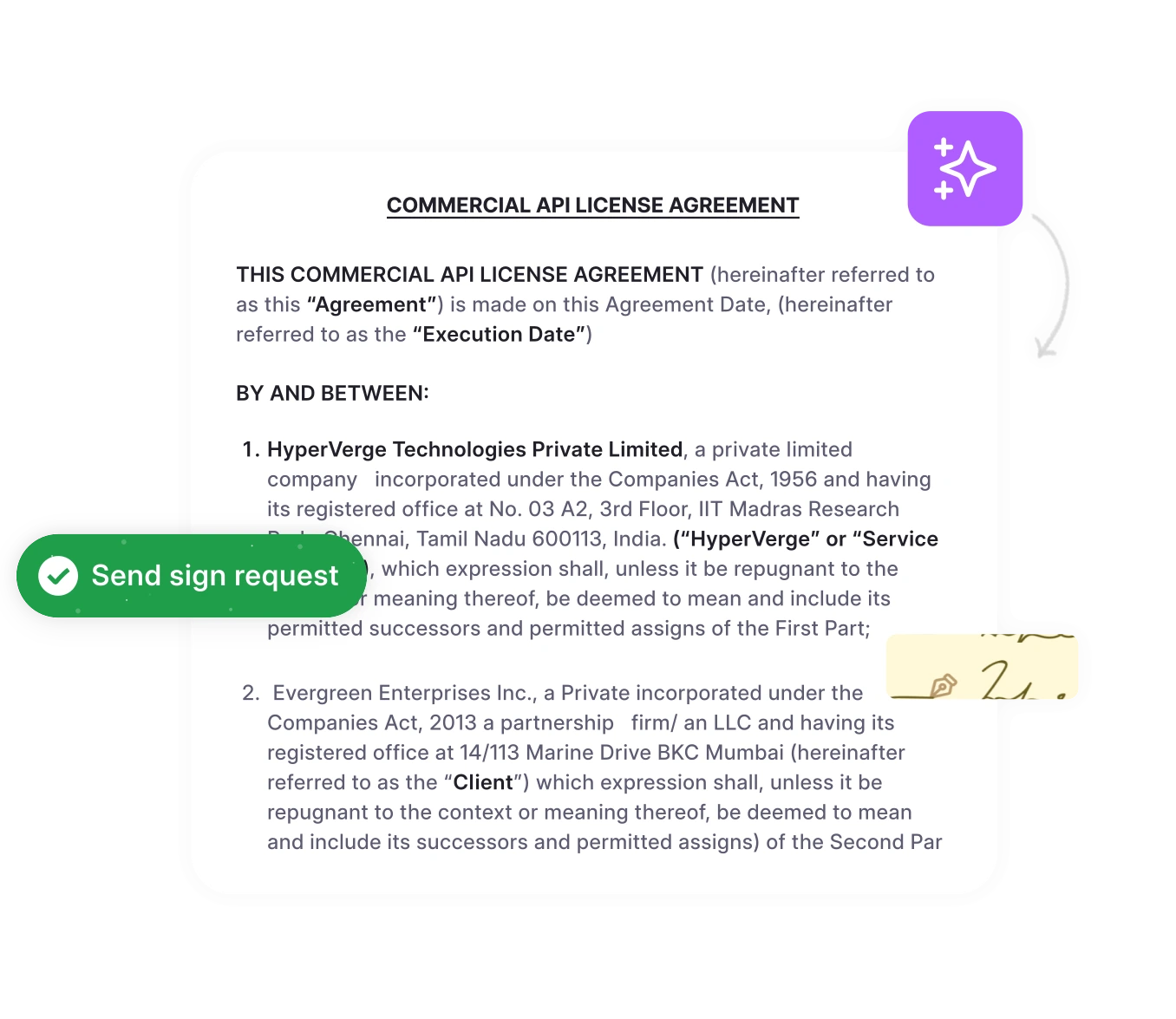




Legal document review is the process where attorneys, paralegals, and legal teams examine electronic and paper documents to identify relevant evidence, determine privilege, and ensure compliance. According to a RAND Corporation study, document review accounts for roughly 73% of total document production costs in litigation — a figure that reflects how much manual review work slows legal teams down and strains budgets.
Missing a single clause or misclassifying a document can change the outcome of an entire legal matter.
In this blog, we’ll explain how to review documents effectively in a legal context, covering how to do document review from collection through production. Whether you’re reviewing legal documents for litigation, compliance, or due diligence, you’ll find practical strategies to make the process faster and more accurate.
What is a legal document review?
Legal document review is the systematic process of examining electronic and paper documents to identify relevant evidence, assess privilege, and ensure compliance with legal and regulatory requirements. The process is used in litigation discovery, due diligence for mergers and acquisitions, internal investigations, and regulatory compliance reviews. Document review typically follows legal intake, the upstream process of capturing, categorizing, and routing requests before the review work begins.
Document review in law refers to the same process, specifically applied within the context of legal proceedings, regulatory filings, and corporate governance.
Legal document review is the process where attorneys, paralegals, and legal teams examine electronic and paper documents to identify relevant evidence, determine privilege, and ensure compliance for litigation, regulatory matters, due diligence, or internal investigations.
Also commonly called documentation review, legal review, or legal doc review, this practice covers the full scope of document examination from initial collection through production. Understanding the document review meaning is essential for anyone managing litigation, compliance, or transaction workflows.
The goal is to ensure documents are accurate, complete, and aligned with case or compliance requirements.
In litigation, the legal document review process helps identify relevant internal documents while excluding privileged or sensitive ones, fulfilling legal obligations for disclosing relevant materials to opposing parties.
While attorneys often contend with disorganized files, automated legal document review tools now streamline this process—using AI to enable faster, more accurate, and scalable reviews compared to manual methods.
Now, let’s take a closer look at the kinds of documents that usually need a careful review.
What are the different types of legal document review?
The four main types of legal document review are litigation and discovery review, due diligence review, internal investigations, and compliance document review. Litigation discovery is the most resource-intensive, often involving millions of electronically stored information (ESI) files including emails, spreadsheets, and internal memos. Due diligence reviews focus on contracts and financial records during mergers and acquisitions, where speed and accuracy are critical due to tight deal timelines.
| Type | Trigger | Primary goal | Typical volume | Timeline |
|---|---|---|---|---|
| Litigation and discovery | Lawsuit or legal dispute | Identify relevant evidence, protect privilege | Thousands to millions of ESI files | Weeks to months |
| Due diligence | Merger, acquisition, or transaction | Assess risk and verify representations | Hundreds to thousands of contracts | Days to weeks (deal-driven) |
| Internal investigation | Whistleblower, audit, or regulatory inquiry | Investigate misconduct or compliance violations | Varies (targeted scope) | Weeks to months |
| Compliance review | Ongoing regulatory requirements | Ensure adherence to HIPAA, GDPR, SOX, CCPA | Ongoing document monitoring | Continuous |
Legal document review takes different forms depending on the context. Understanding these types helps legal teams tailor their approach to each situation.
1. Litigation and discovery review
During the discovery phase of litigation, legal teams review documents to identify what must be produced to opposing counsel and what can be withheld as privileged. The document review legal proceedings definition centers on this phase, the formal examination of all case-relevant materials before trial.
Litigation and discovery is often the most resource-intensive type of review, involving large volumes of electronically stored information (ESI) such as emails, spreadsheets, and internal memos.
2. Due diligence review
In mergers, acquisitions, and other transactions, due diligence review examines contracts, financial records, and compliance documents to assess risk and verify the accuracy of representations. Speed and accuracy are critical since deal timelines are tight.
3. Internal investigations
Organizations conduct internal reviews to investigate potential misconduct, fraud, or compliance violations. These reviews may be triggered by whistleblower complaints, regulatory inquiries, or audit findings.
4. Compliance document review
Regulatory requirements such as HIPAA, GDPR, SOX, and CCPA often require organizations to review documents for adherence to specific legal standards. This type of review ensures ongoing contract compliance and reduces exposure to penalties.
What types of legal documents require review?
The most common legal documents requiring review include contracts (employment, service, and sales agreements), pleadings (complaints, answers, and motions), wills and trusts, property deeds, and affidavits. Each document type has specific review requirements. Contracts must be checked for clause accuracy and obligation alignment, while pleadings require verification against procedural rules and case strategy.
Here are some of the most common legal document types that require careful review:
Contracts: Contracts are legally binding agreements that spell out responsibilities between parties. From contract creation to employment agreements, service agreements, or sales contract management, reviewing these ensures clarity and avoids surprises.
Pleadings: If you’re stepping into a courtroom, pleadings are where it all begins. These are the complaints, answers, and motions that start or respond to lawsuits. One small mistake here, and the whole case could hit a snag.
Wills and Trusts: Essential for executing a person’s final wishes, these documents must comply with state laws and accurately reflect the intended outcomes to prevent disputes among heirs.
Deeds: Buying or selling property? Deeds transfer ownership from one person to another. Checking these ensure the descriptions are accurate and all the legal boxes are ticked because no one wants title trouble later.
Affidavits: These are sworn statements used as evidence in court. They need to be accurate, follow the rules, and reflect what the person actually knows. Otherwise, they won’t hold up when it matters.
Now, let’s talk about why reviewing these legal documents are so important.
What is the purpose of reviewing legal documents?
The purpose of reviewing legal documents is to prepare cases for litigation, comply with discovery obligations, organize evidence for hearings or trials, and identify risks before they become liabilities. During litigation discovery, legal teams must share relevant information with opposing counsel while protecting privileged communications. Failing to disclose discoverable materials can result in court sanctions and case-damaging penalties.
1. Case preparation
Document review lays the foundation for a strong legal strategy by uncovering the facts and evidence that shape the case.
Helps attorneys identify key pieces of evidence that support their client’s arguments.
Provides clarity on timelines, events, and the roles of involved parties.
2. Compliance with legal obligations
The discovery phase of litigation imposes strict requirements on sharing relevant information with the opposing side.
Ensure all requested documents are identified, reviewed, and disclosed when required.
Prevent inadvertent withholding of discoverable materials, which could lead to sanctions.
3. Evidence preparation
A well-executed review process ensures that attorneys are fully prepared for depositions, hearings, or trials.
Analyze and organize documents to identify key evidence.
Create exhibits and summaries to present a clear and compelling argument in court.
4. Risk mitigation
Document review helps identify and address potential risks before they become liabilities.
Ensure disclosures are complete and accurate to avoid penalties or accusations of bad faith.
Flag any language, evidence, or omissions that might harm the client’s position.
Mitigate risks effectively with contract risk management tools and strategies.
Now, let’s delve into the specific areas that demand attention during the review process.
Who performs legal document review?
Legal document review is performed by document review attorneys (contract attorneys hired for first-pass reviews), paralegals who manage day-to-day review mechanics, senior attorneys who provide strategic oversight, managed review providers for large-scale matters, and e-discovery specialists who handle technical aspects of the review platform. For complex litigation, organizations often combine internal teams with external managed review vendors to balance cost and quality.
1. Document review attorneys
Also called contract attorneys, these are lawyers hired on a project basis to conduct first-pass reviews. They apply coding protocols for relevance, privilege, and key issues across large document sets.
2. Paralegals
Paralegals assist with document collection, organization, first-pass review, managing review platforms, and preparing privilege logs. They often handle the day-to-day mechanics of the review process.
3. Senior attorneys and partners
Senior lawyers provide oversight and make strategic decisions about review scope. They conduct second-level reviews and use the reviewed documents to build the case strategy.
4. Managed review providers
For large or complex matters, organizations may outsource to managed review vendors that offer dedicated teams, project management, and e-discovery platforms. This can be a cost-effective alternative to building an internal review team. Legal document review services from managed providers typically include document collection, processing, first-pass and second-level review, privilege logging, and production at a fixed per-document rate.
5. E-discovery specialists
These technical professionals manage the e-discovery software, oversee data processing, and ensure the defensibility of the technical aspects of the review. They coordinate with legal teams on search criteria and production formats.
For contract-heavy reviews, contract lifecycle management tools help streamline the workload across these roles by automating document sorting, clause extraction, and version tracking.
What are the key elements of a successful legal document review?
A successful legal document review process includes four key elements: a relevance check to filter documents related to the legal matter, a privilege review to identify attorney-client protected communications, a confidentiality check to safeguard sensitive personal data and trade secrets, and annotation and flagging to mark important sections for later retrieval. Privilege review is the most critical element because any failure to protect privileged communications can result in waived protections.
1. Relevance check
The first question to ask about every document is: “Does this actually relate to the legal matter at hand?” This might seem obvious, but it’s essential for efficiency. If a document has no bearing on the case, there’s no need to spend time reviewing it in detail.
2. Privilege review
This is arguably the most critical aspect of a detailed review. “Privilege” refers to legal protections that shield certain communications from disclosure to the opposing party. The most common type is attorney-client privilege, which protects confidential communications between a lawyer and their client to seek or provide legal advice.
For any document withheld on the grounds of privilege, legal teams must create a privilege log. This log records details about each withheld document, including the date, author, recipients, and the basis for the privilege claim. The privilege log is typically provided to opposing counsel during discovery.
3. Confidentiality check
Safeguard confidential information, including trade secrets and sensitive personal data. This includes sensitive personal data (like Social Security numbers, medical records, or financial information) or trade secrets.
4. Annotation and flagging
As you review, you’ll likely come across important sections, key facts, potential issues, or questions that need further investigation. Annotation and flagging are ways to mark these items for easy retrieval later.
Knowing the key elements is essential, but how do you apply them? The next section will guide you through performing a legal document review.
How do you perform a legal document review?
Legal document review process follows six steps: collection (gathering documents from shared drives, email servers, and physical archives), processing (converting to searchable electronic formats using OCR), reviewing (assessing relevance and flagging privileged content), analysis (extracting actionable insights), collaboration (engaging legal, compliance, and business teams), and production (preparing the final document set for disclosure with Bates numbering and required formatting).
1. Collection
Begin by identifying potential sources such as shared drives, physical archives, or email chains. Filter out irrelevant materials and centralize documents in a secure repository for easy access. Tools like legal contract management software simplify organization by enabling proper tagging and indexing.
2. Processing
Prepare documents for review by converting physical files into searchable electronic formats using OCR (optical character recognition). Redact sensitive information to ensure confidentiality and compliance with regulations. Index and categorize documents using metadata, such as type, date, or subject, for efficient retrieval and management.
3. Reviewing
Conduct a detailed examination of each document. Assess relevance to the case or legal strategy, flag privileged communications to maintain confidentiality, and ensure sensitive data is handled appropriately. Highlight key sections or clauses for further discussion.
After the first pass, conduct quality control checks to review document coding for consistency. A second reviewer should sample batches of tagged documents to catch errors, verify privilege calls, and ensure the team is applying review criteria uniformly.
4. Analysis
As the documents review phase wraps up, conduct a thorough legal document analysis to extract actionable insights from your findings. Identify critical points, recurring risks, or compliance gaps, and note any issues requiring attention.
Compile the results into a comprehensive report, using visual aids like tables or charts to enhance understanding. This step often reveals patterns across documents that individual reviews may miss.
5. Collaboration
Engage stakeholders, including legal, compliance, and business teams, to provide insights or address ambiguities. Use tools with real-time commenting and version tracking to streamline collaboration and ensure alignment across teams.
6. Production
After the legal documents review is complete, prepare the final document set for disclosure. The review of documents concludes with redaction of sensitive non-privileged information, application of Bates numbering for identification, and conversion to the required production format. Deliver the finalized set to opposing counsel or the requesting party according to legal requirements and agreed-upon protocols.
Document review does not always end after initial production. As a case evolves, new evidence can emerge and additional documents may need to be collected and reviewed. Legal teams should plan for ongoing review cycles, especially in complex litigation where discovery is iterative.
Tired of Time-Consuming Document Reviews?
Automate routine tasks like clause identification and metadata analysis with HyperStart CLM.
In the next section, we’ll explore common obstacles in legal document review and practical solutions to overcome them.
What are the challenges of legal document review and how can you solve them?
The six biggest challenges in legal document review are managing high document volumes, meeting tight court-imposed deadlines, interpreting ambiguous legal language, keeping up with regulatory changes, protecting privileged and confidential information, and handling cross-jurisdictional complexities. AI-powered review tools and e-discovery software address many of these challenges by automating document sorting, keyword searches, and clause analysis at scale.
Here are the key challenges and their solutions:
1. Volume of documents
Sometimes, you’re dealing with a ton of documents – files, emails, Google sheets. This is especially true in big lawsuits, high-stakes business deals, or when a law firm manages multiple clients’ documents simultaneously. It’s a mess of different file types, maybe even different languages, scattered everywhere. Organizing and making sense of it all? Forget about it.
Solution:
Use automated legal document review tools and e-discovery software to handle document sorting, keyword searches, and clause analysis at scale.
When reviewing legal documents at scale, combining human judgment with technology produces the most accurate and defensible results.
The scale of document volume is growing rapidly. The global document drafting and review market generated $206.4 million in revenue in 2024 and is projected to reach $549.5 million by 2030, growing at a 17% CAGR, according to Grand View Research.
2. Tight deadlines
Legal deadlines are, well, they’re deadlines. And they’re usually tight. Time-sensitive projects or court-imposed deadlines can add pressure, increasing the risk of oversight.
Solution:
Establish a streamlined review process with clear workflows and roles.
Use tools like OCR for scanned documents to extract text.
Legal professionals using AI-powered review tools report saving up to 32.5 working days per year. Document review efficiency is one of the measurable outcomes that legal operations teams track to demonstrate the ROI of technology investment, according to an Everlaw survey of over 500 lawyers and legal professionals in 2025.
3. Ambiguity in language
When people are reviewing documents manually, mistakes happen. It’s easy to get tired, especially when the legal language is super dense. Plus, everyone has unconscious biases that can affect how they interpret things.
Solution:
Have more than one person review the documents and use quality control methods to catch errors.
AI tools can help reduce human bias and make sure documents are analyzed consistently.
Leverage a redlining tool to catch errors and inconsistencies.
4. Legal and regulatory changes
Protecting sensitive information is a huge deal. Data breaches or accidental leaks can have serious consequences.
Solution:
Keep up with the latest legal changes. In the US, this means tracking federal laws like HIPAA (for healthcare) and state-specific laws like the California Consumer Privacy Act (CCPA) and the California Privacy Rights Act (CPRA).
Legal spend among companies has risen 30% over recent years, driven in part by increasing regulatory complexity, according to Legal Dive research.
Make sure you’re following all the data privacy laws and best practices.
5. Managing privilege and confidentiality
Identifying privileged information, like attorney-client communications, is crucial for US legal systems. In the US, this is governed by common law and rules of evidence.
Solution:
Use technology-assisted review tools to identify privileged information quickly.
Use secure legal contract management systems to control access and maintain confidentiality, ensuring compliance with US standards. This is a crucial aspect of legal document review services provided by qualified attorneys.
6. Cross-jurisdictional complexities
Documents that span the US and Europe (or other jurisdictions) create significant challenges due to differing laws, languages, and standards. For example, data transfer between the US and Europe has been a complex issue, with evolving regulations like the Privacy Shield and subsequent legal challenges.
Solution:
Consult local legal experts for jurisdiction-specific advice.
Use tools with multilingual support and cross-jurisdictional compliance features.
Now, let’s dive into some best practices that can take your document review to the next level.
What are the best practices for a legal document review?
The five best practices for legal document review are developing a review plan with clear criteria and role assignments, leveraging AI-powered technology for clause identification and predictive coding, focusing on relevance and privilege as the primary filters, examining metadata to uncover creation history and unauthorized changes, and checking every document for completeness and accuracy including signatures and compliance formatting.
1. Develop a review plan
A solid plan ensures nothing gets missed and allows for a more organized approach. Include:
Criteria definition: What makes a document relevant, privileged, or confidential?
Batching: Break the document set into smaller, manageable groups for systematic review.
Role assignments: Define who will handle what, especially if working in a team.
Use pre-made templates or checklists to track progress and ensure thoroughness.
2. Leverage technology
Modern legal tools can save significant time and effort. Consider:
AI-powered legal tools for clause identification, risk analysis, and Technology-Assisted Review (TAR) to prioritize documents by relevance.
Online document review platforms and e-discovery software with predictive coding to quickly filter out irrelevant documents and reduce manual review volume.
Contract management software and CLM tools to check for completeness and track changes.
The adoption of AI in legal workflows is accelerating. In the American Bar Association‘s 2024 Legal Technology Survey, 54.4% of attorneys cited time savings and improved efficiency as the biggest benefits of AI tools in their practice.
3. Focus on relevance and privilege
Identifying what matters is the backbone of legal review.
Relevance: Narrow down documents that directly pertain to the case or project.
Privilege: Flag any communications or information that is legally protected.
Create a privilege log, which provides a detailed record of all privileged documents to streamline discovery phases.
4. Examine metadata
When reviewing legal documents, metadata can serve as a silent witness, revealing critical details that might not be evident in the document’s visible content.
Creation and modification history: Determine when a document was created and if it’s been altered.
Authorship: Identify the individuals involved in drafting or editing.
Effective contract analysis of metadata can uncover inconsistencies or unauthorized changes that may affect the integrity of your legal documents.
5. Check for completeness and accuracy
Incomplete or inaccurate documents can undermine your case or project. Verify:
Signatures: Are all required signatures present and valid?
Consistency: Does the document align with related agreements or filings?
Formatting and compliance: Ensure adherence to legal standards and formatting rules.
What is compliance document review, and why does it matter?
Compliance document review is the process of examining contracts, policies, and records to ensure they meet regulatory requirements such as HIPAA, GDPR, SOX, and CCPA. Organizations that fail compliance reviews face financial penalties, legal action, and reputational damage. The U.S. Department of Health and Human Services has issued over $142 million in HIPAA enforcement penalties since 2003.
Compliance reviews differ from litigation discovery reviews in three key ways. First, compliance reviews are ongoing and proactive rather than triggered by a specific legal matter. Second, compliance reviews focus on adherence to regulatory standards rather than case relevance. Third, compliance reviews often require cross-functional collaboration between legal, IT, and operations teams.
Organizations in healthcare, finance, and government contracting face the most demanding compliance review requirements. Automated compliance monitoring tools can flag outdated clauses, track regulatory changes, and generate audit-ready reports, reducing the manual effort required for ongoing compliance.
How does automated legal document review work?
Automated legal document review uses artificial intelligence, machine learning, and natural language processing to examine documents at scale. This is legal automation applied directly to the review stage — reducing the volume requiring manual examination by 60% to 80%. AI-powered review tools can classify documents by relevance, identify privileged content, extract key clauses, and flag potential risks in a fraction of the time required for manual review. A 2024 Relativity and Redgrave Data study found that a GPT-4-powered review prototype achieved a 96% recall rate compared to senior attorney benchmarks.
| Factor | Manual document review | AI-powered document review |
|---|---|---|
| Speed | 50 to 100 documents per reviewer per day | Thousands of documents per hour |
| Cost | $25 to $75 per hour per contract attorney | Fraction of manual cost at scale |
| Accuracy | Varies by reviewer fatigue and experience | Up to 96% recall rate (Relativity/Redgrave 2024 study) |
| Scalability | Requires hiring additional reviewers | Scales with computing resources |
| Consistency | Subject to human bias and fatigue | Applies criteria uniformly across all documents |
| Best for | Small sets, nuanced judgment calls | Large-scale discovery, first-pass filtering |
The three main technologies used in automated document review are technology-assisted review (TAR) with predictive coding, optical character recognition (OCR) for converting scanned documents to searchable text, and AI-powered clause identification that detects standard and non-standard terms across large document sets. These tools do not replace human reviewers but reduce the volume of documents requiring manual examination by 60% to 80%.
Legal teams that adopt automated review tools report saving up to 32.5 working days per year, according to Everlaw research. The cost savings are equally significant: organizations using CLM platforms with built-in review automation can reduce contract turnaround time by 30% to 40% while maintaining accuracy on critical terms and obligations.
Is HyperStart CLM a legal document review software?
HyperStart CLM is a powerful CLM solution that streamlines the legal document review process for law firms and in-house legal teams. Whether you need automated legal document review services or a platform to manage the entire contract review lifecycle, here’s how HyperStart supports complex document reviews:
| Highlight | Description |
| AI-powered redlining tools | Reduces contract redlining time by 40% and delivers first-pass review in 1 minute. |
| Automation of repetitive tasks | Frees up legal teams by handling routine tasks, enabling a 5X faster reviewing and signing of a contract. |
| AI-driven metadata extraction | Cuts contract turnaround time (TAT) by 30-40%, allowing organizations to respond quickly in fast-paced environments. |
| Real-time collaborative editing tools | Improves collaboration by allowing multiple stakeholders to edit and review contracts simultaneously, streamlining negotiations. |
| Automation workflows | Reduces administrative overhead and staffing needs, saving costs while managing a high volume of contracts efficiently. |
Stop spending hours on manual document reviews. HyperStart CLM delivers 94% AI accuracy on critical terms and obligations. Schedule your demo with HyperStart now.