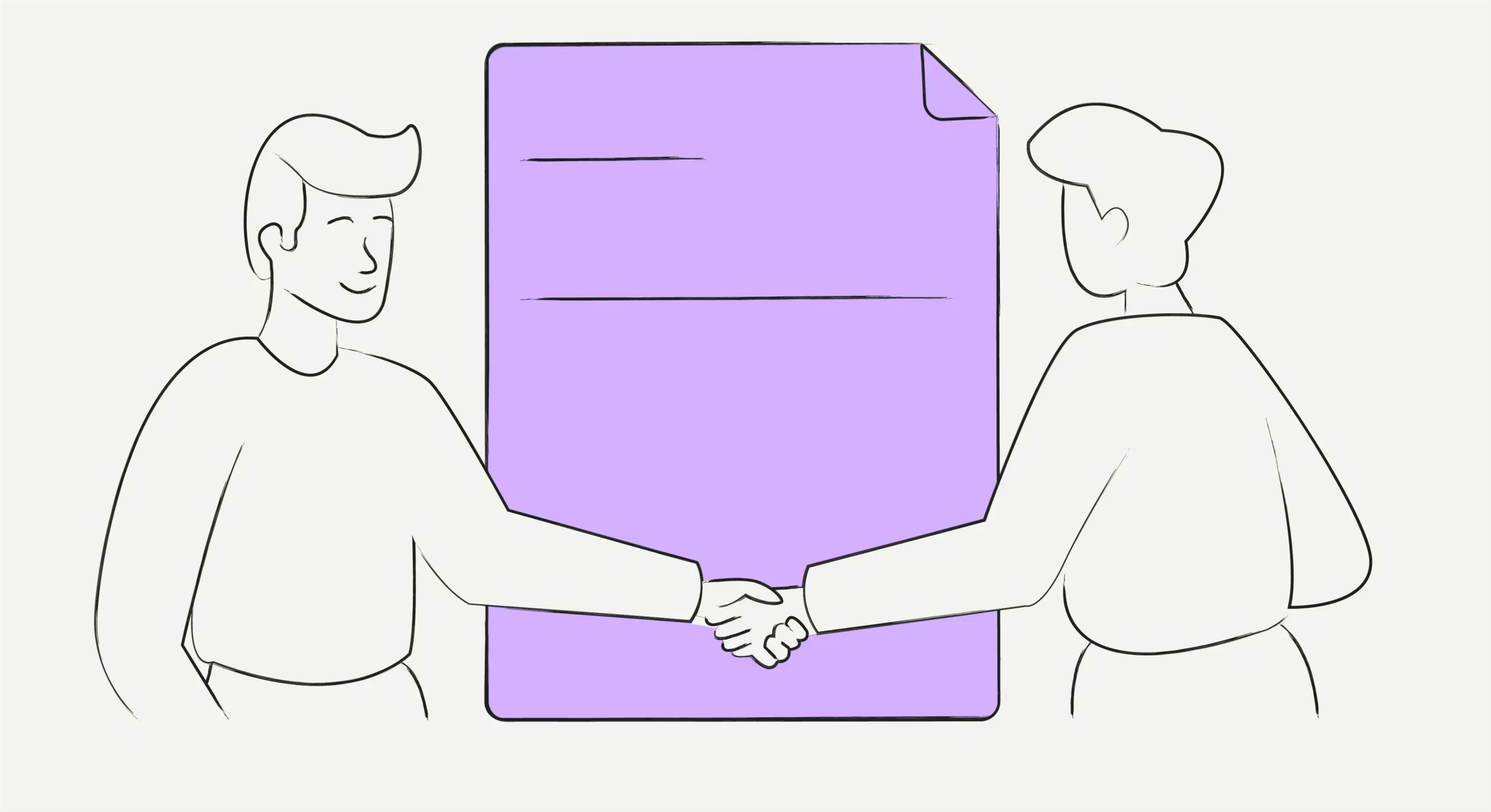


Every deal has an invisible line, a range where both parties can actually say yes. Miss it, and you’re either leaving value on the table or walking away from a deal that could have worked. That line has a name: the Zone of Possible Agreement, or ZOPA negotiation. Understanding it is the difference between closing with confidence and spinning your wheels on clauses that were never going to move anyway.
Whether you’re finalizing a vendor contract, navigating an M&A transaction, or hammering out a service level agreement (SLA), the same principle applies: deals don’t fall apart on price alone. They fall apart because neither side could see where the overlap actually was. This guide breaks down exactly how to find it — and how to use it.
Key Takeaway
The ZOPA is the range of outcomes both parties find acceptable.
No ZOPA = no deal.
A well-mapped ZOPA = faster, smarter closes with fewer concessions.
What is ZOPA?
The Zone of Possible Agreement is the overlap between what a buyer is willing to pay and what a seller is willing to accept. It’s a range. If the buyer’s ceiling is $500,000 and the seller’s floor is $420,000, the ZOPA runs from $420,000 to $500,000. Any number in that range is theoretically a deal.
Here’s the catch: Both parties rarely know the other’s boundaries up front. And negotiators who anchor too high, concede too fast. Those who spend hours debating irrelevant issues sit entirely outside any possible agreement.
Only 16% of contract negotiators believe they’re negotiating the “right things” for the business — meaning the vast majority are focused on the wrong issues entirely. That stat alone explains a lot of deal fatigue. The ZOPA isn’t being missed because negotiators are bad at their jobs — it’s being missed because they haven’t done the upfront work to map the bargaining range before the conversation starts.
The relationship between ZOPA and BATNA
You can’t calculate your ZOPA without understanding your BATNA, your Best Alternative to a Negotiated Agreement. Your BATNA is what you’ll do if this deal falls through. And critically, it sets your reservation price: the walkaway point below (or above) which you won’t go.
ZOPA vs. BATNA: What’s the difference?
| ZOPA | BATNA | |
| What it is | The range of outcomes both parties would accept | Your best option if this deal doesn’t happen |
| Purpose | Identifies where a deal is possible | Determines your walkaway point (reservation price) |
| When to use | Before and during negotiation to guide your strategy | Before negotiation to set your floor/ceiling — revisit if deal conditions change |
| What strengthens it | Adding non-monetary variables, expanding integrative options | Developing real alternatives; avoiding deadline pressure |
| What weakens it | Information asymmetry, positional bargaining, trust barriers | Urgency, limited alternatives, time pressure |
Think of it this way: If your BATNA is strong — say, you have two other qualified vendors ready to sign — your reservation price is high. You can afford to walk. That shifts the ZOPA in your favour. If your BATNA is weak, you’re more exposed, and the other party’s subjective utility hfrom the deal increases accordingly.
Read: 8 Proven Strategies for Negotiating Contracts with Vendors
The anatomy of a bargaining zone
A positive bargaining zone exists when there is a ZOPA — when the buyer’s maximum price exceeds the seller’s minimum price. This is the territory where a deal is mathematically possible.
But possible doesn’t mean automatic. Even within a positive ZOPA, deals die because of anchoring effect distortions, trust barriers, or both sides being too positional to find the mutual agreement zone. The first offer in a negotiation carries disproportionate weight. It anchors the conversation in a direction that’s hard to reverse, even when both parties know the opening bid is inflated.
Negative bargaining zone: When to walk away
A negative bargaining zone is exactly what it sounds like — there’s no overlap. The buyer’s maximum is lower than the seller’s minimum. No amount of integrative bargaining or relational goodwill bridges that gap unless one party changes its reservation value.
This doesn’t mean the conversation was wasted. A well-conducted negotiation that ends in “no deal” still generates intelligence: you learn the other party’s priorities, constraints, and potential flexibility in a future round. That’s data. And in complex commercial environments, that data has real value.
Spending time negotiating inside a negative bargaining zone without realizing it. If you’re two rounds in and the gap isn’t closing, it may be time to ask whether a ZOPA actually exists — and whether either party has the flexibility to create one.
Establishing the negotiation range
A core element of modern negotiation strategy is identifying the specific boundaries of a deal before you enter the room. The most effective negotiators don’t improvise — they prepare a tiered structure of positions that gives them clarity and flexibility at the same time.
- Optimum position: What you’d ideally walk away with. Your opening anchor.
- Acceptable position: A deal you’d take without hesitation. Solid win.
- Fall-back position: The minimum you’d accept to keep the relationship and deal alive.
- Walkaway point (reservation price): The hard floor. Cross it, and you’re better off with your BATNA.
This process happens during what’s known as the Transactional Phase of the contracting lifecycle — the point where parties establish their strategy and trade-offs before consensus is reached. In contract management terms, this is where advanced CLM systems earn their keep.
How CLM helps
Modern contract management platforms use clause libraries with pre-approved fallback options, allowing non-legal teams to navigate the negotiation range without pulling in legal for every deviation. That self-service capability alone can cut days off a standard negotiation cycle.
The practical result? Legal teams aren’t spending time redlining standard commercial positions. They’re focusing on the decisions that actually require judgment — the outliers, the novel structures, the deals that don’t fit the template.
Read also: AI Contract Negotiations
Factors impacting agreement success
Knowing your ZOPA is only part of the equation. Several human and structural factors complicate even well-mapped bargaining ranges:
Positional vs. integrative negotiation. Many businesses default to a positional approach — anchoring hard on specific clauses and treating every concession as a loss. This creates friction, wastes time, and often produces worse outcomes than a more integrative strategy. Integrative bargaining focuses on expanding value for both sides: finding non-monetary variables, structuring terms creatively, and identifying what each party actually cares about rather than what they’re saying they want.
In the Ultimatum Game experiment, participants routinely reject financially rational offers simply because the split feels unfair. In a commercial context, this is why a deal that’s technically inside the ZOPA can still die — if the other party feels steamrolled, the logic breaks down.
Read
How to calculate your ZOPA before you reach the table
1. Establish your reservation price (the walkaway point)
Before any other preparation, you need to know the point at which you’d rather walk away than accept the terms on the table. This is your reservation value, and it needs to be calculated, not felt. Factor in your BATNA, your internal cost of a deal falling through, and any time pressure you’re under. Then write it down and commit to it. Teams that go in without a firm walkaway point tend to drift under pressure.
2. Research the other party’s BATNA
You won’t know their reservation price directly, but you can infer it. What alternatives do they have? How urgently do they need this deal? What’s their competitive situation? Research their recent deals, their market position, and their pipeline. In complex commercial negotiations — M&A transactions, long-term supply agreements, strategic partnerships — this intelligence work is what separates experienced negotiators from the rest. Their BATNA sets their floor or ceiling, and understanding it is how you identify where the bargaining range actually sits.
3. Map the overlap
With your own reservation price set and a reasonable estimate of theirs, you can map the probable ZOPA. This isn’t precise science — you’re working with estimates. But having a mapped range transforms the negotiation from a guessing game into a structured conversation. You know roughly where you have room to move, where they don’t, and where genuine mutual agreement is possible. The integrative opportunity often lies in the non-monetary variables: timing, exclusivity, warranty terms, payment structure, and delivery milestones.
Don’t guess the ZOPA
Get contract intelligence to see historical settlement ranges and enter every negotiation with actual data.
Book a DemoMoving beyond price: Expanding the ZOPA
1. The “fixed pie” myth and value creatio
One of the most persistent mistakes in commercial negotiation is treating the deal as a fixed pie — where every dollar or concession won by one party is lost by the other. This distributive negotiation mindset drags out timelines, destroys goodwill, and often results in agreements that technically get signed but breed resentment.
Integrative bargaining flips this. Instead of fighting over how to divide value, it looks for ways to create more of it. And in doing so, it often expands the ZOPA itself — making a deal possible where none existed, or improving the outcome for both sides simultaneously.
2. Adding non-monetary variables (terms, timing, and exclusivity
Price concessions are the most visible negotiating lever, but rarely the only one. In complex commercial deals, the ZOPA can be shaped — and sometimes created — by adjusting the following:
- Contract duration: Longer terms often justify better pricing. A three-year agreement that reduces your counterparty’s customer acquisition cost has real value worth trading against.
- Delivery timelines: Flexibility on when performance is due can be worth more than a small price movement.
- Exclusivity clauses: Granting preferred or exclusive status can unlock price concessions that aren’t available on a standard deal.
- Payment structure: Front-loaded, milestone-based, or deferred payments all have different present values — and different risk profiles for each party.
- SLA parameters: Adjusting service level agreement thresholds, remedy periods, or credit structures can make an otherwise stuck deal move.
🏠 Real estate deal
Buyer’s ceiling: $820K. Seller’s floor: $800K. ZOPA exists on price. But the seller also wants a 60-day close and to leave the fixtures. The buyer agrees to both. Result: seller accepts $805K — well inside the ZOPA, with non-monetary terms sealing it.
💼 Salary negotiation
Company’s budget cap: $120K. Candidate’s floor: $115K. ZOPA exists, but the candidate also wants remote-work flexibility and an accelerated review cycle. The company agrees. Both sides leave with a win-win.
In relational contract models — which are increasingly common in strategic partnerships — the “zone” of agreement isn’t just about terms. It’s guided by reciprocity: the principle that neither party places expectations on the other that they aren’t prepared to meet themselves.
High-performing negotiation teams build this principle into the deal structure from the start.
Best practice
For complex or high-value deals, consider forming an integrated negotiation team: commercial, legal, and operational stakeholders aligned on a common definition of success before discussions begin. This prevents the internal misalignment that can collapse deals even when the external ZOPA is clear.
Common pitfalls in ZOPA analysis
The agreement trap: Reaching a deal just to reach a deal
Here’s a scenario: both parties are fatigued, the deadline is close, and there’s an agreement within reach. It’s inside the ZOPA. But it’s at the very edge of acceptable — on the wrong side of “good enough.” The temptation to just close is enormous.
This is the agreement trap. Closing a deal that technically exists inside the ZOPA isn’t always the right call. If the terms are at your reservation value — not your target — you’ve essentially extracted zero surplus from the negotiation. You got the minimum. And often, that minimum comes with a shadow: a contract that one party immediately starts looking for ways around, a relationship that starts on an imbalanced footing, or terms that create friction at every renewal.
“A deal done badly is often worse than no deal at all — it costs you the relationship and the outcome.”
If you find yourself repeatedly closing at your reservation price rather than near your target, it’s worth examining whether your BATNA is weak, whether your anchoring strategy is off, or whether the information asymmetry is working against you.
Information asymmetry: Why the first offer matters
The party that makes the first offer anchors the negotiation. This is well-documented and consistent across contexts. The anchoring effect means that even experienced negotiators are influenced by the opening number — it shapes the reference point against which all subsequent offers are evaluated.
The implication for ZOPA analysis: if you have a good estimate of the ZOPA, making the first offer with a well-calibrated anchor can shift where, within that zone, the final agreement lands. Too high and you’re dismissed as unreasonable. Too low and you’ve left value on the table. The right anchor is ambitious but credible — and ideally, it’s supported by data.
Information asymmetry in practice
The party with better data about historical deal terms, accepted language, and the other side’s past positions holds a significant structural advantage. This is exactly what contract intelligence platforms are designed to close.
Close deals 30% faster
Stop the endless back-and-forth. Map your ZOPA and automate your contract approvals with HyperStart.
Book a DemoTools for modern negotiation management
The ZOPA, in commercial contracting, has a historical record. Every deal you’ve done with a counterparty leaves a data trail: what terms they accepted, where they pushed back, and what language they ultimately signed off on. That data is almost always sitting unused in a shared drive.
AI-enabled contract management systems change that equation. Commercial managers can query thousands of historical contracts to see what language a specific counterparty has agreed to in the past — effectively reverse-engineering their historical reservation price on key terms. That’s a significant source of leverage, and it’s entirely data-driven.
- Flagging deviations: AI tools can analyze incoming contracts for deviation from standard positions, automatically surfacing risky clauses and suggesting redlines that keep you within your pre-defined acceptable range.
- Accelerating review cycles: When the system can handle first-pass clause analysis, legal teams spend their time on high-stakes judgment calls — not routine markup. AI-assisted contract review is one of the highest-leverage investments a legal team can make right now.
- Informing anchoring strategy: Knowing what a counterparty has historically accepted gives you a much more calibrated anchor — one that’s ambitious but grounded in evidence rather than guesswork.
Studies show that prepared negotiators who map their ZOPA achieve 15–20% better financial outcomes on average. Harvard Program on Negotiation
The organisations getting the best results out of their commercial negotiations aren’t necessarily the ones with the sharpest negotiators. They’re the ones with the best preparation infrastructure — the systems, data, and processes that let their team walk into every conversation with a clear picture of the ZOPA before the other party has said a word.
Conclusion
The ZOPA negotiation framework works because it forces preparation. It asks you to think like both parties before the conversation starts — to understand not just what you want, but what’s actually achievable given the other side’s constraints, alternatives, and psychology.
Done well, ZOPA analysis transforms negotiation from a battle of wills into a structured search for mutual agreement. It doesn’t eliminate tension — tension is part of any serious negotiation — but it focuses that tension productively, on the issues where movement is possible, and value can be created.
And with the right tools, the analysis that used to take days of manual research can happen in hours. Historical deal data, AI-assisted clause review, pre-approved fallback libraries — these aren’t just efficiency plays. They’re what give legal and commercial teams the strategic clarity to negotiate with confidence rather than intuition.
Map your ZOPA. Know your BATNA. Walk in with data. That’s the formula.
Ready to negotiate smarter?
HyperStart gives your legal and commercial team the contract intelligence to identify ZOPA ranges, surface historical terms, and close deals faster — without the guesswork.
Book a Demo