


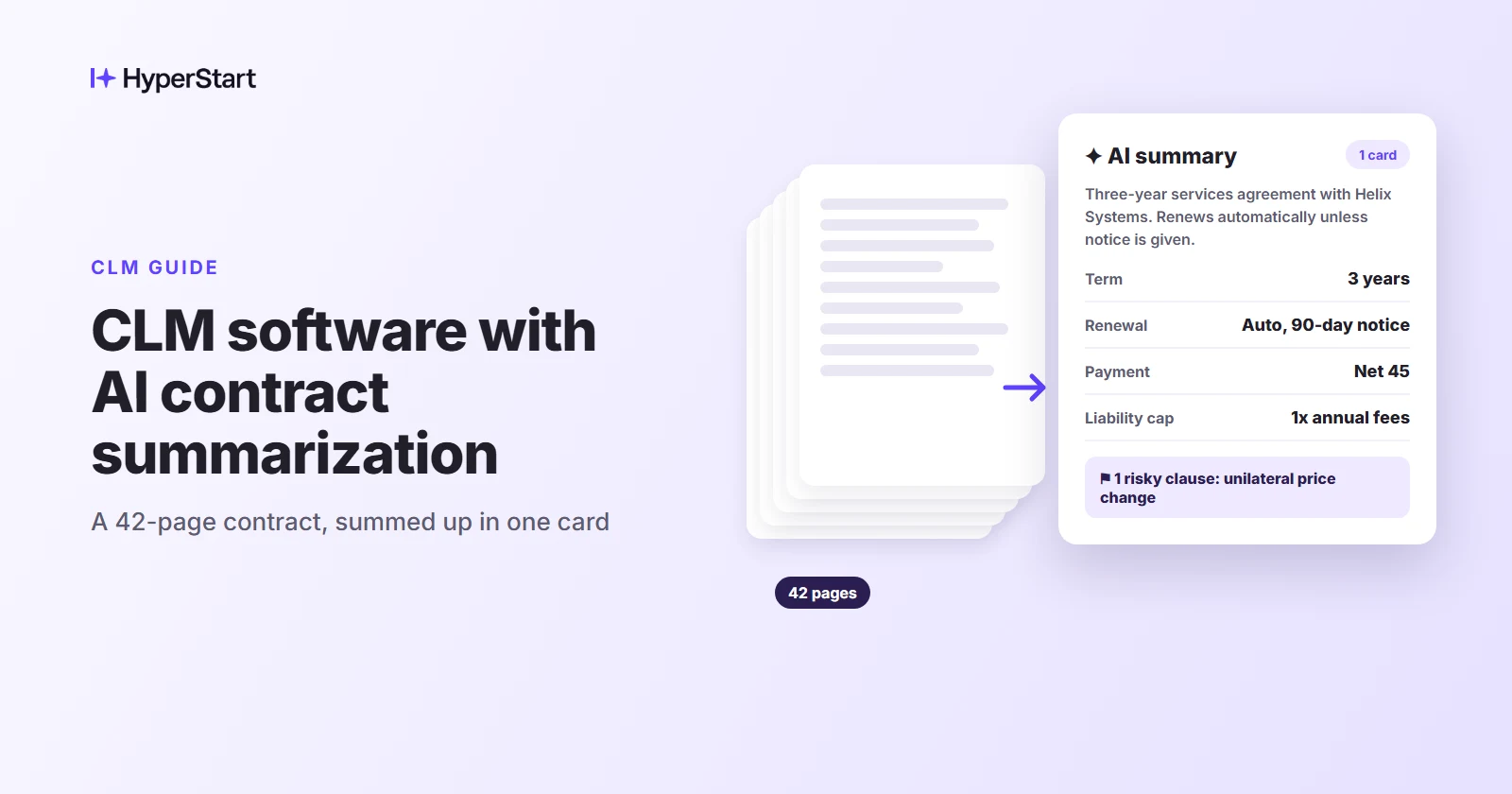
AI contract summarization in contract lifecycle management (CLM) software means the system reads each agreement and pulls its parties, dates, clauses and obligations into a short summary and searchable fields. Buyers also call this AI contract abstraction.
Most tools then check the language against your playbook and flag non-standard terms.
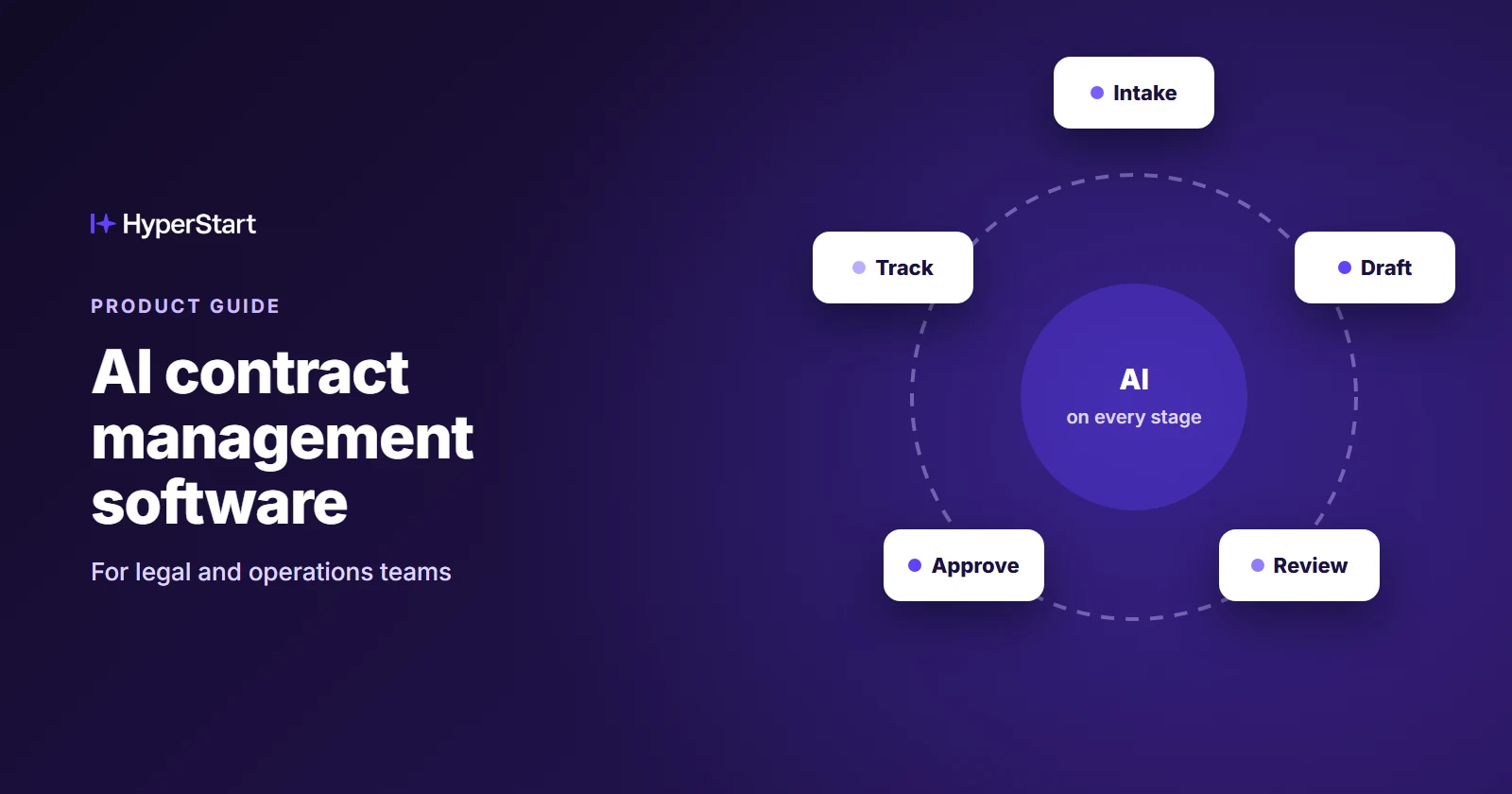
HyperStart is contract lifecycle management (CLM) software for mid-market legal and operations teams. It covers the whole contract lifecycle in one product and goes live in weeks, with no implementation partner.
Its AI contract summaries spotlight the critical data in each agreement, and its AI review flags clauses that depart from your playbook.
Unread contracts hide the terms your team answers for
Most mid-market teams already have the contracts. What they lack is the data inside them. The answers to everyday questions sit in PDFs and Word files that nobody has opened since signature.
Key terms sit inside files, not fields
Questions like “what is our liability cap with this vendor?” or “which governing law applies?” mean opening the contract and reading it. Each answer takes minutes. A full audit of the drive takes weeks the team does not have.
Renewal and notice dates pass without a decision
Auto-renewal clauses do not announce themselves. When the notice period is buried in section 14 of a scanned PDF, the renewal happens by default rather than by choice. Procurement and finance find out when the invoice arrives.
Legacy paper never made it into any system
Older agreements often exist only as scans, email attachments or printed copies. Amendments live in different folders from the agreements they change. A keyword search on the drive cannot connect the two.
HyperStart summarizes your contracts and keeps the data working after signature
HyperStart turns contract text into AI summaries and structured fields in a repository. It then puts those fields to work in review, approval and renewal tracking. The four capabilities below are the ones buyers compare when they evaluate AI contract summarization.
AI summaries built on metadata and clause extraction
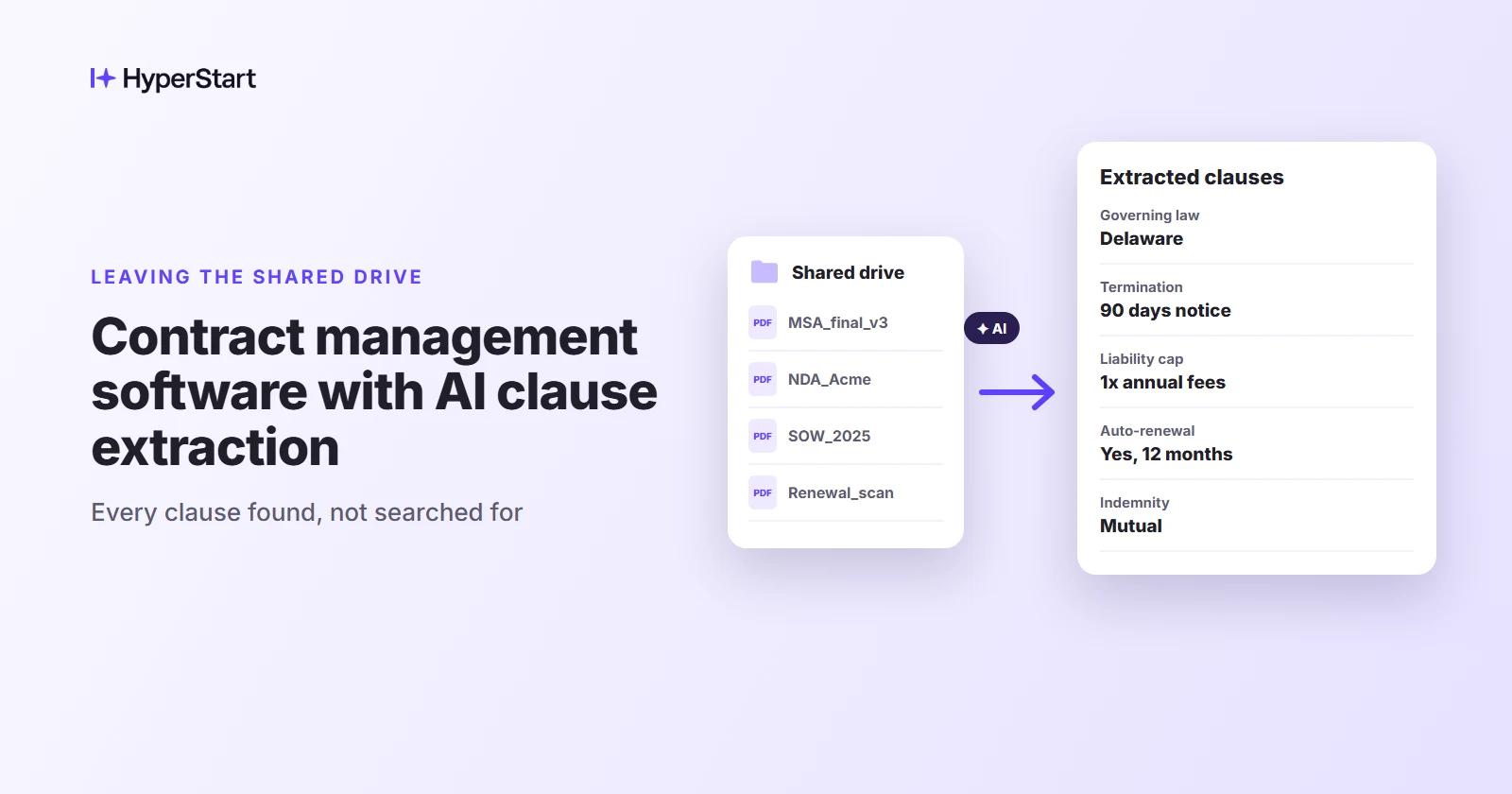
HyperStart’s AI reads PDFs, Word files and scanned documents, then summarizes each contract into the terms your team is usually asked about, stored as searchable fields.
| Field extracted | What your team does with it |
| Parties | Filters the repository by customer or vendor |
| Effective and expiration dates | Builds a renewal calendar that finance can read |
| Renewal terms and notice period | Sets reminders before the notice window closes |
| Payment terms | Surfaces what the company owes and is owed |
| Governing law | Answers jurisdiction questions without opening the file |
| Liability caps | Shows exposure across agreements at a glance |
| Obligations | Assigns follow-ups to an owner |
- Search by field: filter the repository by any extracted field, such as renewal date or governing law, and find the contract in seconds.
- Contract families: each amendment is linked to the agreement it amends, and metadata rolls up across the whole contract family, so the current terms are the ones you see.
Obligation and renewal tracking
HyperStart tracks the renewal, expiry and notice dates it extracts. Reminders go out on their own, so nobody has to keep a spreadsheet of dates.
- Renewal reminders: alerts sent ahead of each notice window, not on the renewal date itself.
- Obligation tracking: duties owed by either side, each with an owner and a due date.
Risk and playbook review
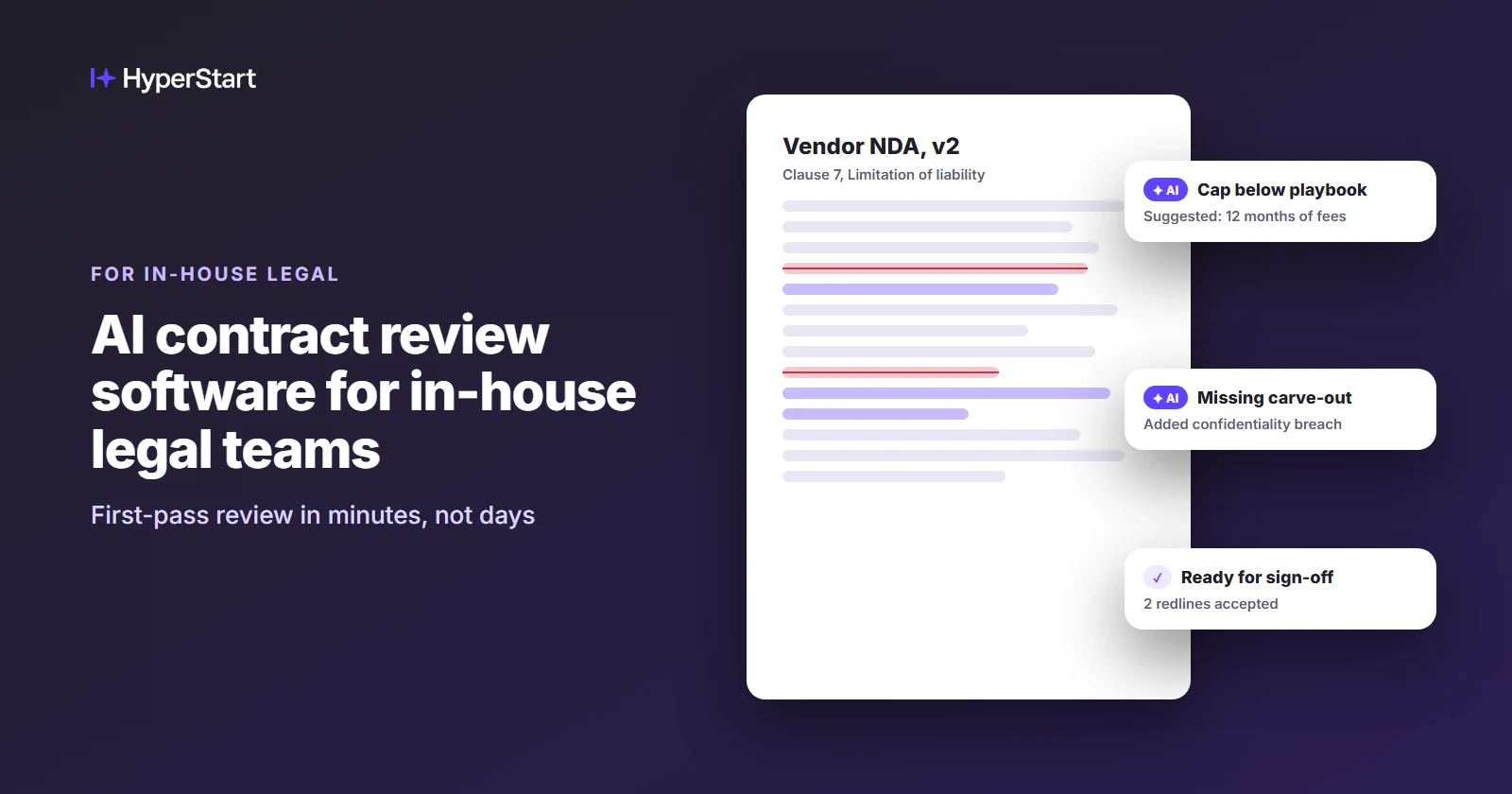
HyperStart’s AI compares contract language against your playbook. Clauses that are non-standard, risky or missing are flagged, both on executed paper and on third-party drafts coming in.
- Playbook flags: deviations from your standard positions, highlighted clause by clause.
- Redlining in Word, inside the platform: negotiation happens in the tool your counterparties already use, and the document stays in the system of record.
- Approval workflows: drawn visually and changed by your own team, so a flagged contract goes to the right approver without a consultant or a change request.
Legacy migration
Legacy contracts are ingested in bulk through one-click smart import. AI metadata tagging applies to the whole backlog, not only to new agreements.
- Bulk import: move folders of old agreements across at once.
- OCR for scans: scanned and image-based PDFs are made readable before extraction.
- Family linking: amendments found in the backlog are connected to their parent agreements.
Four steps from a shared drive to a summarized repository
Getting from a shared drive to summarized, trusted contract data takes four steps: ingest, extract, review and track.
- Ingest. Import your existing folders in bulk, as described under Legacy migration above.
- Extract. AI summarizes and tags every contract, and amendments are linked into contract families.
- Review. Someone on your team checks each extracted value against the clause it came from before the record is treated as final. We recommend this on every import, because it is what makes the data safe to rely on.
- Track. Renewal reminders, obligation owners and playbook flags start running from the reviewed data, and new contracts flow in through templates and approval workflows.
See HyperStart CLM on your own contracts
Bring a few of your own contracts, and we’ll run them through HyperStart with you in a live demo.
Book a DemoSecurity review clears before your backlog moves
Uploading a legacy backlog for summarization means security will want attestations first. HyperStart is SOC 2 Type 2 and ISO 27001 certified, and HIPAA compliant, so that review can start at the beginning of the evaluation.
Role-based access control and encryption decide who can open which contracts.
Why HyperStart fits a team inheriting contracts on a shared drive
HyperStart is a good fit for a mid-market legal or operations team moving off a shared drive and Word templates. The team’s legacy contracts are summarized into a searchable repository in weeks, without an implementation project.
Live in weeks, with implementation included
Summarizing your backlog does not require a systems integrator, an implementation partner or a configuration project. HyperStart goes live in weeks, and most of that time goes on the bulk import and tagging.
The team that builds the product works with you directly, both before and after go-live.
HyperStart quotes a custom price on either users or contract volume, not a combination of the two. Contract migration, workflows and integrations are always part of implementation, which carries no extra fees.
One vendor may bundle backlog migration while another prices it as an implementation extra. Split each quote into license and implementation before you compare them. The license figure alone understates the real cost.
How the options compare on the points that decide go-live
HyperStart differs from a shared drive and from other CLM types mainly on go-live time, included implementation, Word redlining and contract families.
| Shared drive plus Word templates | Lightweight browser-based CLM | CLM that needs an implementation project | HyperStart | |
| Time to go live | Already in place | Varies by vendor | Set by the implementation project | Live in weeks |
| Implementation cost separate from license | None | Varies by vendor | Often quoted separately | Included, no extra fees |
| Redlining in Word inside the platform | In Word, but versions scatter across email | Check where negotiation happens | Varies by vendor | Yes |
| Contract family linking | Folder names only | Varies by vendor | Varies by vendor | Parent-child linking with metadata rollup |
| Visually configurable approval workflows | Email and chat | Varies by vendor | Often configured by the implementer | Drawn visually and changed by your team |
| Security attestations | Depends on your drive provider | Varies by vendor | Varies by vendor | SOC 2 Type 2, ISO 27001, HIPAA compliant |
What each team gets from summarized contracts
- General Counsel: routine paper is handled without the team touching it, while obligations, liability and auto-renewals stay visible as the estate grows.
- Legal operations: an in-flight dashboard shows where every open contract sits, and workflows and templates are yours to change.
- Sales: standard paper goes out from templates without waiting on legal, and contract status is visible without asking.
- Procurement and vendor management: every amendment is linked to its agreement, and auto-renewal dates appear before the notice window closes.
- Finance: total contracted value rolls up across a contract family, with payment terms surfaced from executed paper.
- IT and security: role-based access control and encryption are in place, and the certifications are documented up front.
Other CLM platforms buyers shortlist for AI contract summarization
These platforms come up most often when buyers shortlist CLM software with AI contract summarization or abstraction. Run the same ten contracts through each one and compare the extracted fields.
Ironclad
- Best for: teams that want AI risk review connected to Slack and Salesforce.
- What buyer guides describe: AI that summarizes agreements, highlights risks, flags obligations and redlines against your playbook.
- G2 rating: 4.4/5 (332 reviews, as of Nov 2026).
Juro
- Best for: small teams working mostly on standard paper.
- What buyer guides describe: a browser-based contract workspace with AI-driven summaries and repository tagging.
- G2 rating: 4.5/5 (248 reviews, as of Nov 2026).
ContractWorks
- Best for: lean legal teams that want straightforward setup.
- What buyer guides describe: AI tagging, key-date alerts, a central repository and unlimited users.
- G2 rating: 4.6/5 (95 reviews, as of Nov 2026).
SpotDraft
- Best for: teams reviewing third-party paper against a playbook.
- What buyer guides describe: an AI CLM platform that extracts key clauses, obligations and parties.
- G2 rating: 4.5/5 (203 reviews, as of Nov 2026).
LinkSquares
- Best for: teams focused on repository analytics.
- What buyer guides describe: a repository and analytics platform for executed contracts.
- G2 rating: 4.7/5 (445 reviews, as of Nov 2026).
DocuSign CLM
- Best for: teams that want a CLM product from the same vendor as their e-signature tool.
- What buyer guides describe: DocuSign’s contract lifecycle management product, with AI-assisted data capture.
- G2 rating: 4.3/5 (504 reviews, as of Nov 2026).
Sirion
- Best for: large enterprise contract portfolios.
- What buyer guides describe: AI extraction agents that turn legacy paper and digital contracts into structured records, with obligation tracking after signature.
- G2 rating: 4.5/5 (65 reviews, as of Nov 2026).
Aline
- Best for: teams that want document management, approvals and reporting in one AI platform.
- What buyer guides describe: a contract intelligence platform with AI-driven extraction and redlining.
FlowForma
- Best for: Microsoft 365 teams that run purchasing, tenders and contracts together.
- What buyer guides describe: contract management with AI agents that work inside your own business rules and keep key terms and milestones in one register.
Conclusion
CLM software with AI contract summarization turns contracts nobody has reread into short summaries and fields your team can search, track and check against a playbook. Ironclad, SpotDraft and LinkSquares all offer AI extraction, so test each one on your own paper.
HyperStart suits a mid-market team inheriting a shared drive, because its summaries feed renewal reminders, playbook review and contract families in the same product.
Before the call, tell us how many people will use it, whether the backlog or new contracts come first, and which signing tool you use. Book a demo and bring ten contracts so we can summarize them with you.
Try HyperStart CLM before you decide
The whole contract lifecycle in one product, live in weeks, with implementation included in the quote and no implementation partner.
Book a Demo