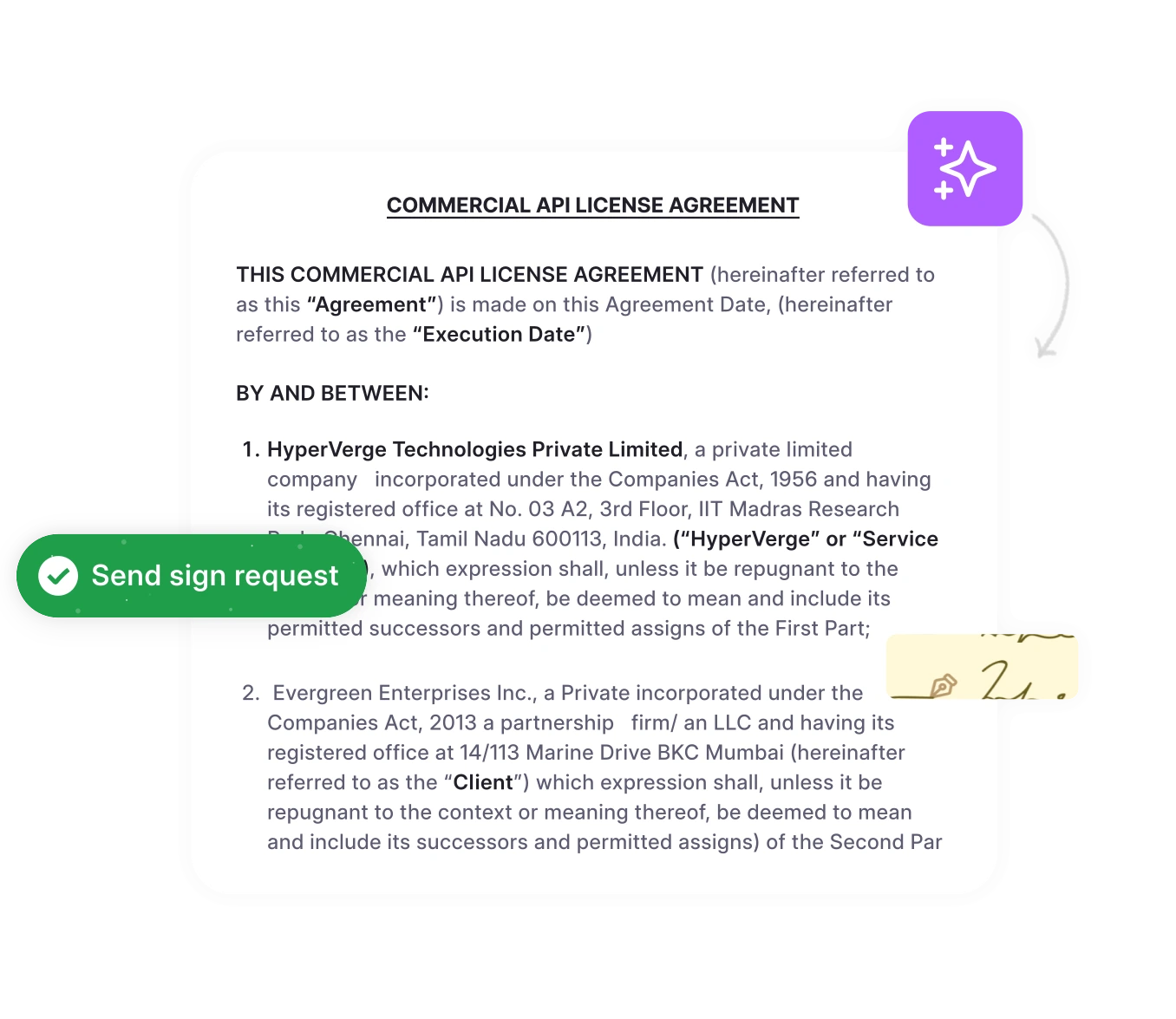


A single contract can pass through five or more teams before it reaches a signature. Legal drafts it, sales pushes for faster terms, procurement reviews pricing, and finance validates payment schedules. When that process runs on email threads, shared drives, and Word documents flying back and forth, the result is predictable: version confusion, stalled approvals, and deals that take weeks longer than they should. According to a Deloitte study of over 1,000 business leaders, companies with disconnected agreement workflows spend an extra 18% of their time just working on agreements.
Contract collaboration software solves this by replacing fragmented workflows with a single, structured workspace. This guide covers what it is, how it compares to the tools you might already use, the features that matter most, and how to evaluate the right platform for your team. Whether you manage contract negotiations across departments or with external counterparties, this is the breakdown you need before making a decision.
What is contract collaboration software?
Contract collaboration software is a centralized platform that enables multiple stakeholders to draft, review, negotiate, and approve contracts together in real time, within a single shared workspace.
Instead of routing a Word document through email, waiting days for redlines, and then reconciling three conflicting versions manually, teams work on one live version. Legal adds approved clause language, sales adjusts commercial terms, and procurement flags pricing discrepancies, all within the same document, with every change tracked and attributed.
It is important to distinguish this from general document editing tools like Google Docs or Microsoft Word. While those tools handle text editing, they lack the security controls, approval routing, audit trails, and clause-level collaboration that contracts require. A contract is not just a document. It is a legally binding asset with financial and compliance implications, and it needs a purpose-built environment for collaborative contract management.
“Contracts are more than just legal safeguards; in many situations, they should be dynamic tools that support collaboration, mitigate risk, and create value. This report underscores the urgent need for fresh thinking in how businesses approach and manage contracts.”
This shift in thinking is exactly what contract collaboration software enables, moving contracts from static documents passed between inboxes to living assets that teams build, negotiate, and finalize together.
Chasing contracts across emails and drives?
AI-powered contract collaboration platforms centralize drafting, negotiation, and approvals in one workspace.
Book a DemoHow contract collaboration software compares to general editing tools and CLM platforms
One of the most common questions teams face is whether their existing tools are enough or whether they need a full contract lifecycle management platform. The answer usually sits somewhere in the middle, and understanding where contract collaboration software fits helps clarify the decision.
The table below breaks down how general editing tools, contract collaboration software, and full CLM platforms differ across the capabilities that matter most.
| Capability | General tools (Word, Google Docs) | Contract collaboration software | Full CLM platform |
| Version control | Manual file naming (v1, v2, final_v3) | Automated, single source of truth | Automated with full lifecycle tracking |
| Collaboration | General comments, email chains | Clause-level comments, real-time co-editing | Collaboration across the entire lifecycle |
| Security and access | Basic file sharing permissions | Role-based access with audit trails | Enterprise-grade compliance controls |
| Approval workflows | Manual email follow-ups | Automated, rule-based routing | Multi-stage automated workflows |
| E-signatures | Requires separate third-party tools | Built-in or natively integrated | Fully integrated end-to-end |
| AI capabilities | None | AI-assisted review and risk flagging | AI across drafting, review, and analytics |
| Primary focus | Document editing | Pre-signature collaboration | End-to-end contract management |
The key takeaway is this: contract collaboration software is purpose-built for the pre-signature phase, where drafting, redlining, negotiation, and approvals happen. Full CLM platforms extend beyond that to cover post-signature obligations, renewals, and analytics. Many modern CLM solutions now bundle strong collaboration features into a broader platform, giving teams the best of both.
Who uses contract collaboration software?
Contract collaboration is not just a legal function. Multiple teams across an organization engage with contracts at different stages, each with distinct needs and priorities. A platform that supports all of them reduces handoff delays and keeps everyone working from the same source of truth.
Here is how different teams typically use contract collaboration software:
- Legal teams lead contract drafting, redlining, and risk review. They rely on collaboration platforms to enforce approved clause language, manage negotiation workflows, and maintain defensible audit trails for high-value agreements.
- Sales teams engage during deal negotiations and contract execution. Their priority is speed. They need visibility into where a contract sits in the approval chain and the ability to respond to legal feedback without chasing email threads. Platforms that integrate with CRMs, such as Salesforce contract management workflows, are especially valuable here.
- Procurement teams collaborate heavily during supplier negotiations and renewals. They need a centralized workspace to consolidate supplier redlines, coordinate internal reviews, and ensure commercial terms align with legal requirements before final approval.
- Finance teams participate during review, approval, and post-signature stages. They validate pricing, payment terms, penalties, and renewal conditions to ensure financial commitments are accurate and enforceable downstream.
- External stakeholders such as vendors, customers, partners, and outside counsel engage during negotiation and review. Secure, role-based guest access lets them contribute within a controlled environment without purchasing a license or creating version conflicts.
When all of these stakeholders operate within a single governed system, contracts move faster and with less risk of miscommunication or unauthorized changes.
7 key features to look for in contract collaboration software
Not every platform offers the same level of collaboration capability. Some focus primarily on storage and signatures, while others are built specifically for the messy, multi-stakeholder reality of contract negotiation. Here are the features that make the biggest difference.
1. Real-time editing and redlining
Multiple stakeholders should be able to edit, suggest changes, and add comments within the same document simultaneously. The best platforms separate internal and external comment threads, so your team can discuss negotiation strategy without exposing those conversations to the counterparty.
This eliminates the cycle of emailing Word documents back and forth, which is where most version control problems start. Modern contract redlining capabilities take this further by letting stakeholders suggest, accept, and reject changes within a governed workflow rather than manually comparing document versions.
2. Centralized contract repository
Every draft, version, and executed agreement should live in a single, searchable location. A centralized contract repository eliminates the “which version is the latest?” problem and makes it easy to retrieve contracts for audits, renewals, or dispute resolution.
Look for platforms that support OCR-based search, metadata tagging, and folder structures that mirror your team’s actual workflows.
3. Automated approval workflows
Contracts often stall because they are sitting in someone’s inbox without a clear next step. Automated approval workflows route contracts to the right stakeholders based on predefined rules, such as contract type, deal value, or risk level.
This keeps the process moving without manual follow-up and ensures that the right people review the right contracts at the right time.
4. AI-powered contract review
AI capabilities such as clause extraction, risk flagging, and playbook-based suggestions are becoming essential for teams managing high volumes. AI contract review tools can scan a contract in minutes and surface deviations from approved language, saving hours of manual review on standard agreements.
The result is that legal teams spend less time on routine checks and more time on the negotiations that actually require human judgment.
5. E-signature integration
A smooth handoff from negotiation to execution matters. Built-in or natively integrated electronic signing capabilities let teams finalize agreements without switching platforms, printing documents, or waiting for wet-ink signatures.
Look for platforms that support mass signing, sequential signature routing, and authentication methods that meet your compliance requirements.
6. Version control and audit trails
Every edit, comment, and approval should be logged with timestamps and user attribution. This creates a complete, immutable record that is critical for contract compliance, dispute resolution, and regulatory audits.
Robust version control also means any team member can see exactly what changed between drafts, who made the change, and when it was approved.
7. Integrations with CRM, ERP, and business tools
Contract collaboration does not happen in isolation. The platform should connect natively with the tools your teams already use, including CRM systems, ERP platforms, email clients, and cloud storage providers.
This eliminates duplicate data entry and keeps contract data flowing seamlessly between systems. For teams where contract management software features need to work alongside existing infrastructure, integration depth is a non-negotiable evaluation criterion.
What are the benefits of using contract collaboration software?
The features above translate into tangible business outcomes that go beyond convenience. Here is what teams typically gain when they move from fragmented workflows to a dedicated collaboration platform.
1. Faster contract turnaround times
Real-time collaboration, automated routing, and structured review cycles compress the time between first draft and final signature. When contracts are not waiting in email queues or getting lost between versions, deal cycles accelerate significantly.
For sales-driven organizations, this directly impacts revenue. The faster a contract moves through negotiation and approval workflows, the sooner revenue recognition begins.
2. Reduced risk of errors and compliance gaps
Version control and governed collaboration prevent unauthorized edits, missed clauses, and outdated terms from making it into executed agreements. AI-assisted review catches deviations from approved language before they become costly compliance issues.
According to Deloitte, organizations experience an average of 8.6% contract value erosion due to fragmented contracting processes, with the worst performers losing more than 20%. This is especially critical in regulated industries, where a single clause error can trigger penalties, litigation, or audit failures.
3. Greater visibility across teams
Centralized dashboards show exactly where every contract sits in the pipeline, who is responsible for the next action, and what deadlines are approaching. Legal, sales, procurement, and finance all work from the same data without relying on manual status updates.
Better visibility also means better contract tracking and reporting, giving leadership the data they need to identify bottlenecks and measure team performance.
4. Lower administrative overhead
Automation replaces repetitive manual tasks such as status update emails, approval reminders, and document routing. Legal automation tools built into collaboration platforms free up legal teams to focus on strategic work rather than administrative coordination.
When routine tasks are handled by the platform, teams can manage higher contract volumes without proportional headcount increases.
5. Stronger cross-functional and external collaboration
Secure guest access lets external parties, including vendors, outside counsel, and partners, view, comment, and redline contracts without purchasing a license or installing software. Role-based permissions control exactly what each participant can see and do.
This structured approach replaces the risks of emailing sensitive documents and ensures that collaboration with external stakeholders is governed, auditable, and efficient.
6. Improved counterparty experience
A clean, well-organized negotiation process reflects well on your organization. When counterparties can collaborate in a transparent, structured environment instead of navigating confusing email threads and multiple document versions, the experience is smoother for everyone.
Faster, more transparent contracting also strengthens long-term business relationships with vendors, customers, and partners.
Contracts stuck between legal, sales, and procurement?
See how AI-powered collaboration eliminates bottlenecks and accelerates contract cycles.
Book a DemoHow to choose the right contract collaboration platform?
With dozens of platforms on the market, selecting the right one requires more than comparing feature checklists. Here are the criteria that matter most, especially for mid-market teams evaluating their options.
“For too long, organizations have treated commercial and contracting excellence as a complex, second-tier priority, and that has created a structural vulnerability we can no longer afford. The data is definitive: the organizations that will thrive in this ‘new normal’ are the ones who recognize that CCM is the catalyst for business resilience.”
With that urgency in mind, here is what to prioritize during your evaluation.
1. Assess your team’s collaboration pain points first
Before evaluating platforms, map where your contracts slow down today. Is it during drafting, redlining, approval routing, or execution? The right platform should solve your actual bottlenecks, not just offer the longest feature list.
Talk to the teams involved, including legal, sales, procurement, and finance, and identify the specific handoff points where delays, confusion, or rework happen most frequently.
2. Prioritize ease of adoption over feature depth
The best contract collaboration tool is the one your teams actually use. A platform loaded with advanced features delivers zero value if the interface is so complex that teams revert to email and Word documents within a month.
Look for intuitive design, minimal training requirements, and a user experience that works for both legal and non-legal users.
3. Evaluate integration compatibility
Confirm that the platform offers native integrations with your existing CRM, ERP, email, and e-signature tools. Avoid solutions that require custom development or middleware for basic connections.
A smooth integration layer means contract data flows between systems without manual entry, keeping your tech stack connected rather than fragmented.
4. Verify security and compliance standards
For any platform handling sensitive legal agreements, security is non-negotiable. Look for role-based access controls, end-to-end encryption, detailed audit trails, and compliance certifications such as SOC 2.
Teams handling contracts across industries or geographies should also evaluate data residency options and regulatory compliance support. Cloud contract management platforms typically offer the strongest security infrastructure for distributed teams.
5. Consider implementation timeline and support model
Ask vendors directly about deployment timelines. Some platforms can be up and running in weeks, while enterprise-grade solutions may take months. For mid-market teams, a CLM implementation that stretches beyond 4-6 weeks often signals unnecessary complexity.
Also, evaluate whether implementation is handled in-house by the vendor or requires third-party consultants, as this significantly impacts both cost and timeline.
6. Test with a pilot before full rollout
Roll out the platform to one team or contract type first. Measure cycle time reduction, adoption rate, and user satisfaction during the pilot period. Use that data to refine workflows and build internal champions before scaling across the organization.
A successful pilot reduces risk and gives leadership the evidence they need to approve a broader deployment.
Best practices for implementing contract collaboration software
Selecting the right platform is only the first step. Getting real value from it requires a deliberate rollout strategy that addresses how your teams actually work.
1. Start with a focused pilot group.
Choose one team or contract type to begin with. Early wins with a small group build momentum and generate internal advocacy before a company-wide launch.
2. Map your current workflows before configuring the tool.
Document how contracts move through your organization today, from drafting through execution. Configure the platform to mirror and improve those workflows rather than forcing teams into an unfamiliar process.
3. Train by pain point, not by feature.
Each team cares about different outcomes. Show sales how the platform speeds up deal cycles. Show how legal it enforces clause standards. Show procurement how it consolidates supplier reviews. Generic training sessions waste time and reduce adoption.
4. Define success metrics from day one.
Track contract cycle time, approval turnaround, and user adoption rate from the beginning. Without a baseline, you cannot prove ROI or identify where further optimization is needed. A clear contract management strategy includes measurable goals from the outset.
Streamline contract collaboration with HyperStart.
The right contract collaboration software replaces scattered workflows with a single, governed workspace where every team, from legal to sales to procurement, can draft, negotiate, and approve contracts without the version chaos and bottleneck delays that slow deals down. When collaboration is centralized and structured, contracts move faster, risk decreases, and teams spend less time on coordination and more on work that drives revenue.
HyperStart brings AI-powered contract collaboration to mid-market teams, with fast deployment, automated workflows, and a platform built for cross-functional use from day one. With 94% AI accuracy and implementation timelines measured in weeks rather than months, it is purpose-built for teams that need results without the enterprise complexity. If your contracts are still bouncing between inboxes, it is time to see what a purpose-built solution can do.