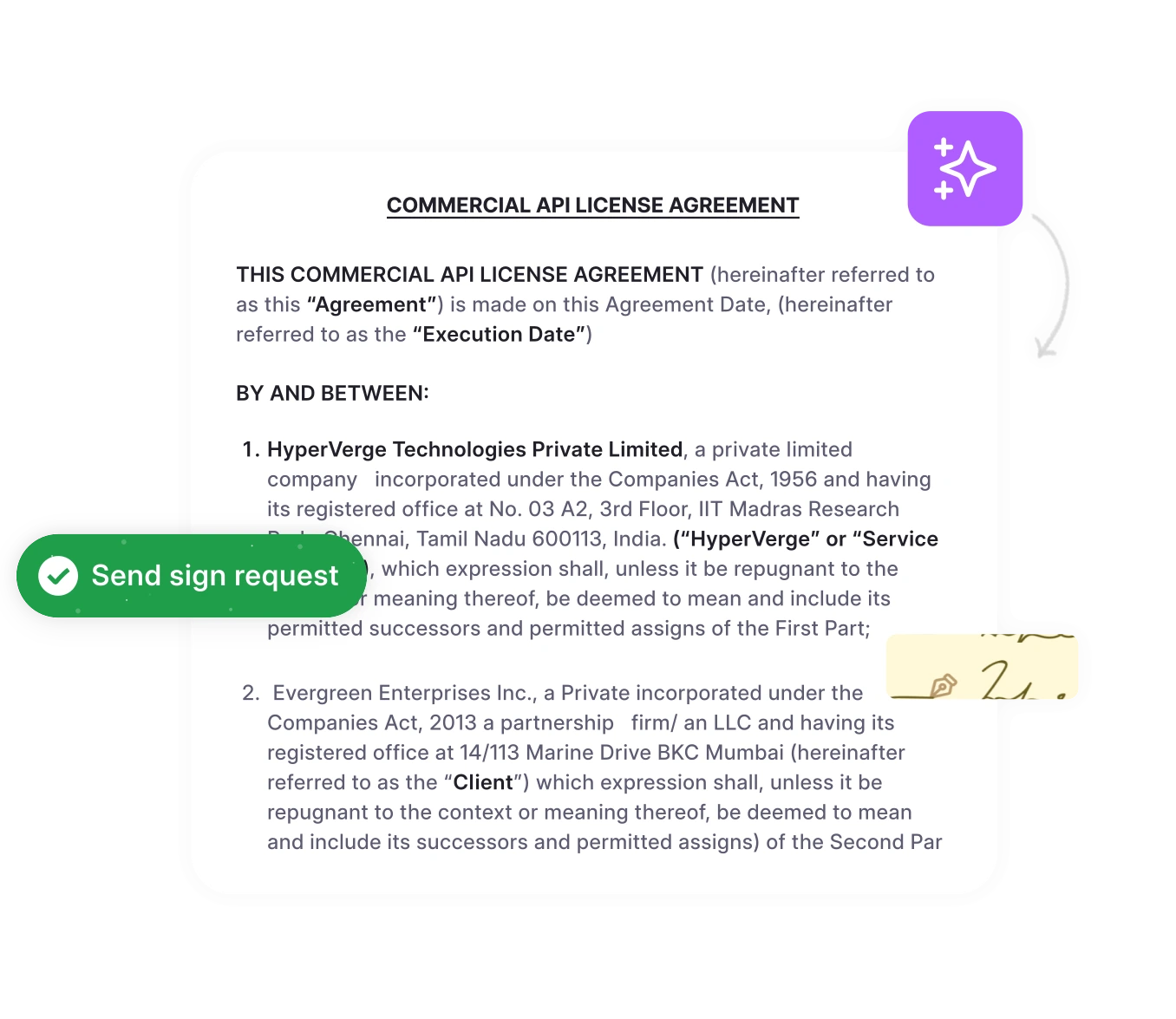




When a contract is nearing its expiration but the work isn’t finished, businesses often face a critical decision: draft a new agreement, let the contract lapse, or extend the existing agreement.
In many cases, a contract extension offers the most efficient and cost-effective solution- especially when the working relationship is strong and market dynamics remain stable.
In this guide, we’ll cover everything you need to know about the contract extension process, including:
- What an extension means in contract management
- When to use contract extension
- The benefits automating deadlines and extensions with a CLM software
- Points to review before finalizing an extension
Let’s get started.
What is contract extension?
A contract extension is the formal process of lengthening the duration of an existing contract beyond its original expiration date.
Instead of creating a new agreement, both parties agree to extend the current one, often under the same terms or with minor updates, so the relationship continues without interruption.
This is common in long-term business relationships where drafting a new contract would be unnecessary, time-consuming, or disruptive. Extensions maintain the legal validity of the agreement while supporting evolving business needs.
According to the American Bar Association (ABA), contract extensions are enforceable if they are clearly defined and mutually agreed upon by all parties involved.
Now that we’ve defined what a contract extension is, let’s explore when it makes the most sense to use one – and why it’s often a smarter alternative to drafting a new agreement from scratch.
When and why do you need a contract extension?
You may need a contract extension when a deadline is approaching, but the parties involved still wish to continue working together.
Rather than negotiating an entirely new agreement, extending the existing contract is often faster, more cost-effective, and less disruptive.
Here are some common scenarios where a contract extension makes sense:
- Both parties are happy with the existing terms
- Delays from an unforeseen event like a supply chain disruption
- The contract expires soon, but there’s not enough time to create a new contract
- You want to maintain service continuity while renegotiating favorable terms
- There’s a need to adjust to evolving needs without interrupting operations
Consider this.
Rick, procurement manager at Steel Deal, recently discovered that their steel supplier contract was set to expire in 90 days amid ongoing global supply change challenges. He quickly arranges for a 6-month extension. This gave her team enough time to re-tender while production lines stayed supplied. The best part—the extension helped re-renegotiate a better price with the suppliers, and customers were happy to keep the relationship during a volatile time.
Extending a contract is like being at the right place at the right time and grabbing the opportunity. It supports long-term business goals in sectors like real estate agreements, procurement, and IT, where contract renewal occurs frequently.
Understanding when to extend a contract is just the first step. Let’s look at the specific advantages of doing so, from cost savings to operational continuity.
Need to manage contract extensions faster?
HyperStart CLM helps legal teams automate extension workflows, reduce risk, and ensure timely approvals, all in one place.
Book a Demo6 Key benefits of contract extension
Extending contracts has clear advantages over letting them slide and starting from scratch. Let’s go over them:
1. Keep operations running smoothly
When a contract expires and there’s no plan in place, things come to a grinding halt. But, well-timed contract extension ensures business continuity. It extends the validity of an agreement, so operations or service don’t lapse and the relationship stays intact.
2. Save time and legal costs
Creating a new contract takes effort—drafting, redlining, back-and-forth negotiating. But if the parties involved are happy with the existing terms, why not stick to what’s already working? It’s faster, less expensive, and simple.
According to World Commerce & Contracting, poor contract management costs organizations up to 9% of their annual revenue. Extensions help avoid this by keeping agreements active without renegotiation overhead.
3. Update terms without starting over
Not every contract extension implies that everything stays the same. It also gives you a chance to renegotiate terms, maybe adjust pricing, add services, or update outdated clauses to match current organizational policies. It’s a great way to align the contract with today’s reality.
4. Minimize legal risk with a quick review
When you’ve signed an annual or biannual contract, you’re likely to run into outdated terms at the end of it. A contract extension gives your legal team the opportunity to review the contract and weed out risks. This helps avoid costly problems down the next leg of the engagement.
5. Reinforce trust and strengthen the partnership
When you extend a contract, you’re implicitly demonstrating trust. It signals that both parties value what they are building and want to keep it going. Whether it’s a service provider, supplier, or partner, a mutually beneficial extension reforges a stronger working relationship.
Contract extensions aren’t one-size-fits-all. Depending on your business model and industry, there are different types of extensions to consider. Each has unique triggers and use cases.
While they indicate what’s working well for the business, using contract management software can help you further supercharge them. You can monitor deadlines, get 30-60-90 day alerts before deadlines, and notify everyone involved with the gruntwork. Tools like HyperStart CLM automate the process from start to finish. You can isolate clauses you intend to re-negotiate and keep the rest of the contract intact with fallback clauses. Benchmark workflows reduce the costs of manual drafting, redlining, approvals, signing, and non-compliance.
Straddling contract end dates across departments?
Set up renewal alerts and automate metadata extraction HyperStart’s AI-powered CLM.
Book a Demo5 Different types of contract extensions and when to use them
| Type | Description | Best For |
| Fixed-term extension | Extends the contract for a specific period under existing terms | Short-term needs, project continuity, clear deadlines |
| Automatic or rolling extension | Automatically renews for a set duration unless canceled within a notice period | Ongoing services, subscriptions, maintenance contracts |
| Evergreen extension | Continuously renews indefinitely until either party gives termination notice | Stable, long-term vendor or partner relationships |
| Conditional/performance-based | Extension is granted only if certain conditions or performance targets are met | Results-driven contracts, service-level agreements (SLAs) |
| One-time extension | Allows a single predefined extension, usually stated in the original contract | Fixed-scope projects, contracts with limited flexibility |
Many sharp, seasoned lawyers are far better at negotiations and analytical work than at contract drafting. They are more knowledgeable about substance than style. The next section explores all the characteristics of a great contract extension draft.
What makes a well-drafted contract extension clause?
A well-drafted contract extension clause is crucial for ensuring clarity, avoiding disputes, and providing a smooth continuation of the contractual relationship if desired by the parties. Based on legal principles and best practices, here are the key characteristics:
1. Clarity and unambiguity
The clause must speak plainly and directly about if and how the contract can live on. Forget convoluted language. It should be instantly clear whether extension is automatic, requires a handshake and signature, or is an option waiting to be exercised. Ambiguity here is a guaranteed pathway to future headaches and potential legal battles.
2. Mechanism for extension
It must clearly define how the contract can be extended. Common mechanisms include:
- Mutual written agreement: Requires a conscious, written thumbs-up from both sides before the clock runs out. It’s active consent, ensuring both parties genuinely want to continue.
- Automatic renewal (evergreen clause): The contract automatically extends for a specified period unless one party provides notice of non-renewal within a pre-determined timeframe. If using this, the clause must be particularly clear and the notice period prominent to avoid unintended extensions.
- Option to extend: Grants one or both parties the option to extend the term, usually requiring written notice within a specific period before expiry. The conditions for exercising the option should be clearly defined.
3. Duration of extension
The clause must put a firm stake in the ground regarding the duration of the extension. Is it another year of the same? A shorter bridging period? Certainty here is key to future planning.
4. Terms governing the extended period
Will the extended period run under the exact same terms? Or will there be changes? This needs to be addressed directly. If terms will change, the clause can either detail them or, importantly, lay out a clear process for how those new terms will be discussed and agreed upon.
5. Notice requirements
If saying “no thanks” to an automatic extension, or saying “yes please” to an option, requires notice, this clause is the alarm clock. It must specify the exact timing (e.g., “no less than 90 days, no more than 180 days before expiry”), the format (email won’t cut it if it demands certified mail), and where to send it. Missed notices are a prime source of disputes.
6. Conditions precedent to extension
Sometimes, the right to extend is conditional. The clause can act as a performance review mechanism, stating that extension is only possible if both parties have held up their end of the original bargain. This protects the diligent party.
7. Reference to original contract
The extension clause should clearly reference the original contract it pertains to, including the effective date and any relevant identifying numbers.
8. Governing law and jurisdiction
Like the rest of the contract, the extension clause should be subject to the same governing law and dispute resolution provisions.
Here is an example of an extension clause you can adapt for your own contracts:
“Extension of term.” This Agreement may be extended for successive periods of twelve (12) months each upon mutual written consent of both Parties. The requesting Party shall provide written notice of its intent to extend no fewer than sixty (60) days prior to the expiration of the then-current term. All terms and conditions of this Agreement shall remain in full force and effect during any extension period, unless expressly modified by a written amendment signed by both Parties. The total duration of all extensions shall not exceed thirty-six (36) months from the original expiration date.
A clear extension clause like this removes ambiguity by defining the mechanism (mutual written consent), notice period (60 days), term continuation, and maximum duration. Adjust the timeframes and conditions to match your specific contract needs.
Beyond contract drafting characteristics, managing extensions effectively requires thoughtful planning and collaboration. These best practices will help ensure every stage outside your control goes smoothly.
5 best practices for managing contract extensions
Here’s how to manage contract extensions like a pro:
1. Start the process early
Rushing the extension process right before the expiration date often leads to mistakes, overlooked risks, unfavorable terms accepted under pressure, or even unintentional contract lapse.
A lapse can cause significant operational disruptions, loss of service, or legal complications.
Starting early provides ample time for thorough review, negotiation, and internal contract approvals, putting you in a stronger negotiating position.
How to actually do it:
- Set advance reminders: Pop a reminder on your calendar or use CLM software months ahead for the big ones.
- Know the rules: Glance back at the original contract. Does it say you need to give notice by a certain date to renew or cancel? Don’t miss those!
- Tap someone on the shoulder: Make it clear whose job it is to kick off the review for each contract.
2. Read the old contract again
An extension isn’t just about buying more time, it’s a chance to pause and reflect. Are both sides meeting expectations? Has the business evolved? Are the original terms still aligned with your goals? Here are things to evaluate:
- Are the deliverables still relevant?
- Is the pricing still competitive?
- Have there been any service issues or performance gaps?
Loop in your operations or finance team to see if there are inefficiencies that could be addressed before extending.
3. Engage stakeholders early
Contract extensions often impact multiple departments, from legal and procurement to IT, marketing, or HR. Looping them in early prevents last-minute surprises and ensures the extension reflects the needs of everyone affected.
If only one stakeholder reviews the extension, you might miss red flags like contract compliance risks, cost overruns, or shifting business requirements. What this looks like in practice:
- Legal checks for regulatory changes
- Finance validates pricing alignment
- Operations confirms the vendor still meets service needs
4. Document the extension properly
Even if you’re not making any changes, you still need formal documentation. That means an addendum or contract extension letter that states:
- The intent to extend the original agreement
- The new expiration date
- Any revised terms (if applicable)
Informal agreements made over email or calls without official signoff.
Clear documentation protects both parties and eliminates confusion over dates, pricing, and responsibilities.
5. Negotiate where needed
Just because you’re extending a contract doesn’t mean you have to keep everything the same. If your business needs have changed or if the vendor hasn’t delivered as expected this is your chance to renegotiate terms. Areas to revisit:
- Volume discounts
- Pricing tiers
- Payment terms
- SLAs or KPIs
- Contractual obligations
If a vendor hasn’t met SLAs or if market rates have shifted, use that info to request better terms.
7 common mistakes businesses make with contract extensions
Even experienced legal teams make avoidable errors during the contract extension process. Watch out for these:
1. Operating on an expired contract without a formal extension
Continuing to perform work under an expired contract creates legal uncertainty. Without a signed extension, neither party has enforceable rights. Courts may treat this as an implied contract, but the terms become unpredictable and difficult to enforce.
2. Relying on verbal agreements instead of written documentation
A handshake agreement to “keep things going” is not enforceable in most jurisdictions. Contract extensions require written documentation signed by authorized representatives. Always formalize the extension before the original contract expires.
3. Missing the notice deadline for automatic renewal clauses
Many contracts include automatic renewal (evergreen) clauses that trigger unless notice is given within a specific window. Missing this deadline can lock you into another term with outdated pricing or unfavorable conditions. Set calendar reminders 90, 60, and 30 days before expiration.
4. Extending without reviewing the original contract terms
The original contract may contain restrictions on extensions, such as a maximum number of extensions allowed or conditions that must be met first. Always review the original agreement before initiating an extension to avoid non-compliance.
5. Skipping a performance review before extending
An extension is the right moment to evaluate whether the vendor, partner, or service provider has met expectations. Blindly extending without performance review wastes the opportunity to address service gaps, renegotiate SLAs, or switch providers.
6. Failing to update contract management systems with new dates
After signing the extension, teams often forget to update the new expiration date in their contract management software. This leads to the same missed-deadline problem repeating on the extended contract. Update your CLM system immediately after execution.
7. Ignoring regulatory and compliance changes since the original signing
Laws and regulations evolve. A contract signed two years ago may not account for recent data privacy requirements (like GDPR updates or the DPDP Act, 2023), industry regulations, or tax changes. Review compliance obligations before extending.
Once you know the dos and don’ts and mistakes, the next step is putting it into action. Here’s a step-by-step process to draft and finalize your next contract extension.
6-Step guide to drafting a contract extension
Whether you’re working with a vendor, client, employee, or partner, here’s a step-by-step approach to drafting a solid extension:
Step 1: Review the contract performance
Before you write anything, go back to the original agreement:
- Review the terms and performance history
- Check if the original contract already includes an extension or renewal clause
- Identify if any provisions need to be updated (e.g., pricing, deadlines, deliverables)
Step 2: Choose your format: amendment vs. extension letter
There are two common ways to document an extension:
- Amendment or Addendum: A formal legal document that references the original contract and lists the changes (like new end dates, revised pricing, etc.)
- Extension letter or agreement: A shorter, often more informal document that both parties sign to confirm the extension with or without changes
Step 3: Add essential details to the extension draft
Here’s what to outline in the draft:
| Element | What to Include |
| Reference to the original contract | Mention the contract title, date, and parties involved |
| New end date | Clearly state the new expiration or completion date |
| Effective date of the extension | Specify when the extension becomes valid |
| Any revised terms | Adjust pricing, scope, deliverables, SLAs, etc., if needed |
| Confirmation of unchanged terms | Note that all other terms from the original contract remain in full force |
| Signature blocks | Include spaces for both parties to sign and date the extension |
Step 4: Review and approve internally
Before sending the draft to the other party:
- Run it through legal and compliance (if needed)
- Get internal approvals from relevant stakeholders (finance, operations, leadership)
- Double-check for consistency with your original agreement
Step 5: Send for negotiation or signature
Once you’ve finalized the draft:
- Share it with the other party for review
- Be open to questions or changes they may want to negotiate specific terms
- Finalize the agreement and ensure both sides sign
Step 6: Finalize the extension, archive It, and set reminders
After signing:
- Attach the extension to the original contract in your records
- Update your contract management system (if using one)
- Set reminders for the new expiration date and any key deadlines
At this point, you might be wondering—how is an extension different from a renewal? Let’s compare both to clear up any confusion.
Free contract extension agreement template
Use this contract extension template as a starting point when you need to extend an existing agreement. Customize the bracketed fields to match your specific contract.
CONTRACT EXTENSION AGREEMENT
Effective date: [Date]
This Contract Extension Agreement (“Extension Agreement”) is entered into by and between:
Party A: [Full legal name], a [entity type] with its principal place of business at [address] (“Party A”)
Party B: [Full legal name], a [entity type] with its principal place of business at [address] (“Party B”)
Party A and Party B are collectively referred to as the “Parties.”
RECITALS
WHEREAS, the Parties entered into a [type of agreement] dated [original contract date] (the “Original Agreement”); and
WHEREAS, the Original Agreement is set to expire on [original expiration date]; and
WHEREAS, the Parties mutually desire to extend the term of the Original Agreement under the conditions set forth herein;
NOW, THEREFORE, in consideration of the mutual covenants contained herein, the Parties agree as follows:
1. Extension of term
The term of the Original Agreement is hereby extended for an additional period of [number] [months/years], commencing on [extension start date] and ending on [new expiration date] (the “Extended Term”).
2. Continuation of terms
All terms, conditions, covenants, and obligations of the Original Agreement shall remain in full force and effect during the Extended Term, except as expressly modified by this Extension Agreement.
3. Modifications to original agreement (if any)
[Option A: No modifications]
No modifications are made to the Original Agreement. All terms continue unchanged.
[Option B: With modifications]
The following modifications shall apply during the Extended Term:
- [Modification 1, such as: Section 4 (Compensation) is amended to reflect a revised fee of $[amount] per [month/project]]
- [Modification 2, such as: Section 6 (Deliverables) is amended to include [additional deliverable]]
- [Modification 3, if applicable]
4. Consideration
The Parties acknowledge that continued performance under the Original Agreement during the Extended Term constitutes sufficient consideration for this Extension Agreement.
5. Further extensions
[Option A] This Extension Agreement provides for a single extension only. Any further extension requires a new written agreement signed by both Parties.
[Option B] The Original Agreement may be further extended upon mutual written consent, subject to the terms of the Original Agreement.
6. Inconsistency
In the event of any inconsistency between this Extension Agreement and the Original Agreement, the terms of this Extension Agreement shall prevail.
7. Governing law
This Extension Agreement shall be governed by the laws of [state/country], consistent with the Original Agreement.
8. Entire agreement
This Extension Agreement, together with the Original Agreement, constitutes the entire agreement between the Parties regarding the subject matter hereof.
9. Counterparts and electronic signatures
This Extension Agreement may be executed in counterparts, each of which shall be deemed an original. Electronic signatures shall be deemed valid and binding.
SIGNATURES
| Party A | Party B | |
|---|---|---|
| Name | _________________ | _________________ |
| Title | _________________ | _________________ |
| Signature | _________________ | _________________ |
| Date | _________________ | _________________ |
This template covers the most common contract extension scenarios. For complex agreements involving multiple parties, cross-border obligations, or regulated industries, consult a qualified attorney before executing.
Contract extension vs. Contract renewal: What’s the difference?
Here is a table that shows the difference between contract extensions and contract renewals.
| Aspect | Contract Extension | Contract Renewal |
| New Agreement Required | No | Yes |
| Continuity of Original Terms | Yes (with optional minor changes) | Often new terms are negotiated |
| Common Usage | Short-term continuation, project-based contracts | Long-term agreements (e.g., 12+ months) |
| Legal Structure | Amendment to existing contract | New, standalone contract |
| Process time | Shorter (days to weeks) | Longer (weeks to months) |
| Legal complexity | Lower; addendum or amendment | Higher; full review of new terms |
| Negotiation scope | Minimal; focused on duration | Comprehensive; all terms open |
| When to use | Current terms still work, just need more time | Terms need significant updating |
Whether you’re extending or renewing, managing the process manually can be risky and time-consuming. This is where contract lifecycle management (CLM) software becomes essential.
Contract extension considerations by industry
Contract extensions work differently depending on the industry. Here are the key considerations for the most common sectors:
Government and public sector contracts
Government contracts often have strict rules about extensions. In the US, the Federal Acquisition Regulation (FAR) requires option years to be pre-defined in the original contract. Extensions may need budget approval from oversight bodies, and public disclosure requirements often apply. Always check procurement regulations before initiating.
Construction and infrastructure projects
Construction contract extensions are frequently triggered by force majeure events like weather delays, supply chain disruptions, or permitting holdups. Liquidated damages clauses may need adjustment for the extended period. Subcontractor extensions must align with the prime contract timeline.
SaaS and technology agreements
Technology contracts evolve quickly. Before extending a SaaS agreement, review whether pricing still reflects actual usage, whether SLA terms remain relevant, and whether data privacy clauses comply with current regulations (GDPR, CCPA, DPDP Act). API access terms and integration commitments may also need updating.
Employment contracts
Employment contract extensions must comply with local labor laws. Benefits, compensation structures, and notice periods carry specific legal requirements that vary by jurisdiction. Non-compete and confidentiality clauses should be reviewed for enforceability during the extended period.
Real estate and lease agreements
Lease extensions may trigger rent escalation clauses or require updated insurance documentation. Verify that zoning regulations and permitted use restrictions have not changed since the original signing. Maintenance and improvement obligations carry forward into the extended term.
Why use CLM software for contract extensions?
The global CLM market is projected to reach $3.24 billion by 2030, growing at a 12.5% CAGR, according to Grand View Research. Organizations that use CLM software report up to 80% faster contract turnaround times and 50% fewer contract-related errors.
Contract extensions might seem simple but without the right systems in place, they can quickly spiral into missed deadlines, scattered approvals, and forgotten clauses. Contract management software brings structure, automation, and visibility to the process.
Here’s how contract management software makes contract extensions effortless:
1. Automated expiry reminders
One of the most significant risks of contract extensions is forgetting to act in a timely manner. Top CLM solutions steps in:
- Sending reminders 30, 60, or 90 days before the contract expires.
- Notifying contract owners and key stakeholders automatically.
- Giving everyone the time they need to review performance and prepare for the extension, so nothing gets left to the last minute.
Tools like HyperStart CLM offer automated contract reminders to ensure you never miss a renewal deadline or extension window again.
2. Centralized contract repository
With a centralized contract repository all your contracts and their extensions get saved in one place. Key benefits include:
- Instantly search and retrieve original contracts and addendums
- View contract history and related documents side by side
- Maintain an audit trail of changes and actions
3. Standardized workflow temp
Extensions often involve legal, procurement, finance, and business teams. With CLM, you can:
- Route extension drafts through automated approval flows
- Set conditional logic (e.g., high-value extensions go to senior counsel)
- Track who’s approved what and what’s still pending
4. Real-time dashboards and reporting
As your contract portfolio grows, visibility becomes critical. What CLM dashboards show you:
- Contracts nearing expiration
- Pending extension requests
- Bottlenecks in review or approval workflows
- Workload by contract owner or department
5. Audit-ready documentation
For compliance and internal governance, CLM software keeps everything traceable, especially important when extensions are influenced by applicable laws, policy changes, or specific circumstances that require documentation for audits.
- Real-time central action log
- Full version history
- Integrations with email, Slack, and productivity tools
HyperStart’s CLM platform automates every part of the contract extension workflow from renewal alerts and approval chains to clause libraries and audit logs so your team can move faster, stay compliant, and reduce risk.
Technology aside, having a clear checklist helps ensure nothing slips through the cracks. Here’s a comprehensive one you can follow before, during, and after an extension.
Contract extension checklist
Here’s your go-to checklist to manage contract extensions with confidence, compliance, and zero surprises. Use this before, during, and after every extension to ensure nothing slips through the cracks.
Before the extension
During the extension process
After the extension is finalized
Still have questions? You’re not alone. Here are some of the most frequently asked questions about contract extensions, answered.