


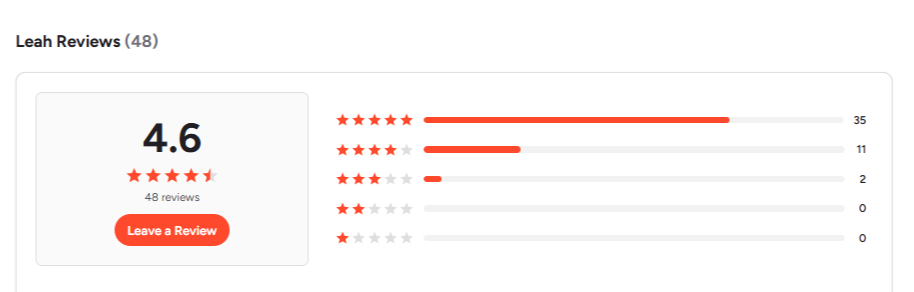
ContractPodAi—rebranded to Leah in 2026—is an enterprise-grade contract lifecycle management (CLM) platform rated 4.6 out of 5 on G2 (48 reviews, as of Oct 2026) and 4.7 out of 5 on Gartner Peer Insights (169 ratings, as of Oct 2026), praised for its GenAI assistant (drafting, summarizing and clause extraction), its searchable repository and customizable approval workflows, with the most common criticisms being opaque custom-quote pricing, a steep learning curve and a roughly five-month implementation.
This review covers verified user feedback from G2, Gartner Peer Insights and Capterra, ContractPodAi’s pricing model, where its features are strong and where they are thin, and an honest read on who it fits—and who it doesn’t. Where it helps, we compare it with HyperStart. HyperStart is contract lifecycle management (CLM) software from HyperVerge for lower mid-market legal and operations teams. It covers the whole contract lifecycle in one product and goes live in weeks, with no implementation partner.
- ContractPodAi rebranded to Leah in 2026 and positions itself as an agentic AI platform for enterprises.
- It is rated 4.6 out of 5 on G2 (48 reviews) and 4.7 out of 5 on Gartner Peer Insights (169 ratings, as of Oct 2026).
- Users praise its GenAI assistant, searchable repository and customizable approval workflows.
- The most common criticisms are opaque custom-quote pricing, a steep learning curve and a roughly five-month implementation.
- HyperStart is an alternative for lower mid-market teams that goes live in weeks with no implementation partner.
What is ContractPodAi, and who is it built for?
ContractPodAi, now rebranded to Leah, positions itself as an agentic AI platform for enterprises. Its product lineup includes Leah Agentic OS and Leah Agentic CLM, targeting legal, procurement, finance and operations teams. According to a 2025 legal operations survey, 31% of legal departments are already using AI for contract analysis, with another 24% planning implementation within 12 months. ContractPodAi aims at the high-tech, communications, media and pharmaceutical sectors within that market.
The company was founded in 2015 and has offices in London, New York, Dubai, Sydney, Glasgow, Mumbai and Singapore. The company says it has been recognized as a Gartner CLM Visionary five times (leahai.com, as of Oct 2026). ContractPodAi operates in a sizable and steadily growing CLM market, according to Fortune Business Insights.
Implementation is primarily handled by ContractPodAi’s in-house team, partly supported by an ecosystem of partners. Its roadmap focuses on expanded generative AI for negotiation, a live clause library and template alignment with evolving business needs. Leah Agentic OS extends the product beyond CLM, letting enterprises build and govern AI agents across legal, procurement and finance workflows.
Best for: midsize and large enterprises with complex contract workflows and the budget for a configuration project—particularly in high-tech, communications, media and pharmaceutical verticals.
Ratings: 4.6 out of 5 on G2 (48 reviews) and 4.7 out of 5 on Gartner Peer Insights (169 ratings, as of Oct 2026).
[Image: Ratings of G2 for ContractPodAI]
If you are a smaller legal or operations team looking for a tool you can run yourself, it is worth seeing how ContractPodAi stacks up against the best alternatives to ContractPodAi before you commit to a long rollout.
What do real users say about ContractPodAi?
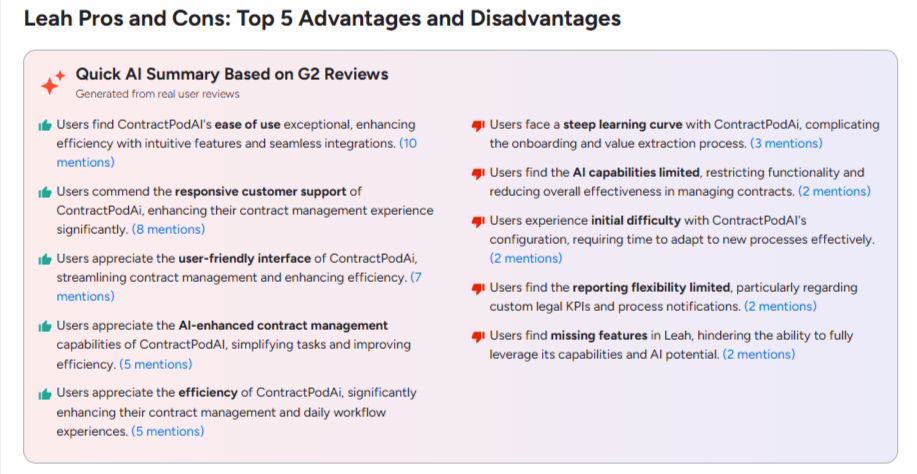
ContractPodAi holds a 4.6 out of 5 rating on G2 across 48 reviews and 4.7 out of 5 on Gartner Peer Insights across 169 ratings (as of Oct 2026). Users consistently praise the GenAI assistant, the centralized searchable repository and customizable workflows; the recurring complaints are opaque pricing, a steep learning curve, a long implementation and limited AI accuracy.
[Image: Pros and Cons of ContractPodAI]
What users like (pros)
Users most often praise ContractPodAi’s GenAI assistant, searchable repository, customizable approval workflows and responsive support.
- GenAI capabilities (LeahAI): The standalone LeahAI assistant earns praise for generating first-draft playbooks, summarizing long agreements and identifying key clauses quickly. One Enterprise user called it “a gamechanger” for reducing lawyer review time.
- Centralized searchable repository: Users report that the central repository with smart search gives easy access and visibility across every contract, and integrates cleanly with surrounding business workflows.
- Customizable approval workflows: The platform flexes to unique business processes, including custom approval paths and automated alerts. Multiple G2 reviewers highlight this configurability.
- Responsive customer support: Eight of 48 G2 reviewers singled out the support team and customer success managers. One Enterprise user noted, “There is simply no ask too big or too small, they are true partners.”
What users dislike (cons)
The most common complaints are opaque pricing, a lengthy implementation, a steep learning curve, limited AI accuracy, inflexible reporting and e-signature licensing.
- Opaque, custom-quote pricing: ContractPodAi does not publish pricing (ERP Research). Users report unexpected add-on costs for contract migration, and one Reddit user described it as “rumored to be expensive.” Smaller teams struggle to estimate total cost upfront.
- Lengthy, complex implementation: Average implementation runs about five months, per Gartner data. A Gartner reviewer wrote: “The implementation process was a complete mess. It felt like we were guiding their team through the process instead of them providing that guidance.”
- Steep learning curve: Several G2 reviewers mention the learning curve. Getting full value tends to require a dedicated legal operations team or heavy vendor support.
- Limited AI accuracy: One G2 reviewer noted: “I wish the artificial intelligence capabilities were not limited to a small number of attributes.” A March 2026 2.5-star review added: “Because it is an AI, it can make mistakes and may also fail to understand nuances that a human lawyer would be capable of.”
- Inflexible reporting: Reporting exists out of the box but lacks flexibility. A Financial Services reviewer wrote: “Reporting is an area that could use some development as end users have a difficult time leveraging what is available.”
- E-signature and email licensing: Recipients are required to hold a license to sign, and the system sends an email at every step with limited control over which go out—one Insurance reviewer asked for “the flexibility to choose which automated messages go out.”
Here are some critical G2 reviews from real users of ContractPodAi.
While our overall experience has been excellent, one area that could use improvement is the customization flexibility within certain modules—especially when it comes to adapting workflows or dashboards beyond standard configurations. Some advanced configurations required support from the ContractPodAi team instead of being fully self-service.—Verified User
Although it’s extremely user friendly, users that only submit one or two contracts a year have some difficulty. The system sends emails out to users for every step of the process—we would prefer to have the flexibility to choose which automated messages go out.—Verified User in Insurance
Best for, and not the right fit
ContractPodAi (Leah) is a genuine enterprise CLM, and if you are a large corporate legal, procurement or finance team with a configuration budget and the time for a multi-month rollout, the depth is there and the five-month runway is the price of it.
It is not the right fit if you are a mid-market legal or operations team—the kind running contracts on a shared drive and Word templates, with a new hire inheriting the mess. For that reader, the recurring criticisms are the ones to test before signing: ask how long until you are running contracts in it (Gartner reviewers report about five months), ask for license, implementation and migration as separate lines, and run its AI on ten of your own contracts and check the fields yourself.
That gap is the one HyperStart was built to fill: the whole contract lifecycle in one product, live in weeks rather than a five-month implementation, with implementation included in a custom quote and no implementation partner taking a margin. A two-person legal team can run it, and run what used to take six.
See how fast a mid-market team actually goes live—book a HyperStart demo.
Still comparing CLM options?
Send us your approval matrix and a contract family and we’ll build both in the demo.
Book a DemoHow does ContractPodAi compare to HyperStart?
ContractPodAi and HyperStart differ most on how fast you go live, what you pay, and who you work with to get there. ContractPodAi averages five months to deploy per Gartner Peer Insights data; HyperStart goes live in weeks. ContractPodAi uses a custom-quote model with no public pricing (ERP Research); HyperStart is also priced by custom quote, but implementation is included, with no implementation partner and no partner margin. And where ContractPodAi reviewers report limited AI accuracy, HyperStart’s AI is built to be reliable on metadata extraction—on your real contracts, not demo contracts. The fair test is the same for both: run them on ten of your own contracts and check the fields.
| Parameters | HyperStart | ContractPodAi (Leah) |
| Time to live | Live in weeks | ~5 months (Gartner avg.) |
| Pricing transparency | Custom quote, implementation included | Custom quote, not disclosed (ERP Research) |
| Who you work with | The product team, before, during and after | In-house team plus partner ecosystem |
| Free trial | 7-day free trial (HyperStart pricing) | Not available (ERP Research) |
| Product focus | The whole lifecycle in one product; AI | Agentic AI, generative AI, legal project management |
| UX/UI | Intuitive, clean interface | Feature-rich but steep learning curve |
| AI extraction | Automated metadata extraction | Limited; accuracy not publicly disclosed |
| Reporting | Dynamic real-time dashboards | Out-of-box but inflexible |
| Redlining | Redlining and editing in Word, inside the platform | Ask to see a counterparty’s Word redline handled inside the platform |
| Contract families | Parent-child linking with metadata rollup | Ask for a demo of a contract family with three amendments and rolled-up metadata |
| E-signature | Integrates with DocuSign, Adobe Acrobat Sign and Zoho Sign | Recipients require a license; Adobe Sign, Zoho CRM |
| Renewal tracking | Automated | Ask to see renewal alerts set up on your own contracts |
| CRM integrations | Salesforce, Pipedrive, HubSpot | Salesforce, Microsoft Word, Zoho CRM |
| Security | SOC 2 Type 2, ISO 27001 (certified); HIPAA compliant | Ask for the current certificate list |
A note on the comparison that matters most: separate the license from the implementation. An enterprise CLM quote rarely includes the configuration project, the integrator and the partner margin that go with it—so the number you are quoted is not the number you will pay. HyperStart’s implementation cost is zero.
How much does ContractPodAi cost?
ContractPodAi does not publicly disclose pricing (ERP Research). It uses a custom-quote model where cost depends on user count, contract volume, required features and AI automation levels. Each package bundles configuration, implementation, e-signature integration and customer success support. Some users report unexpected costs for contract migration and for features beyond the initial quote.
The absence of published pricing makes it hard for a smaller team to estimate total cost of ownership before signing. Poor contract management—missed renewals and unfavorable auto-renewals—costs organizations an average of 9.2% of annual revenue, according to World Commerce and Contracting research, so the cost of getting this wrong is real either way. To get a figure that reflects your organization, you have to contact the Leah sales team directly.
Why do teams switch from ContractPodAi to HyperStart?
Teams move for three reasons: faster deployment (live in weeks versus a five-month average), implementation and contract migration included in the quote, and reliable AI on metadata. You can run HyperStart on ten of your own contracts before you commit. For a fuller breakdown of what different vendors charge, see our guide to contract management software pricing.
What features does ContractPodAi offer?
ContractPodAi offers four core feature categories: contract creation with templates and clause libraries; centralized storage with smart search and metadata extraction; AI-powered negotiation with precedent-based recommendations; and Leah Agentic OS for building AI agents across legal, procurement and finance workflows. It targets enterprise-scale legal operations.
Contract creation and automation
ContractPodAi offers self-serve contract creation with pre-approved templates, clause libraries and workflows to draft standard contracts independently. Teams can create, negotiate, execute and manage contract renewal across the business, with approvals automated through a low-code/no-code workflow designer.
Centralized contract storage and search
ContractPodAi’s automated extraction and analysis function analyzes contracts, creates records, identifies key clauses and compares them to historical data. Party insights give visibility into vendor and customer contracts within the platform. The standalone LeahAI assistant generates first-draft playbooks, summarizes agreements and flags risks—though reviewers report contract type classification accuracy remains limited compared with purpose-built AI.
AI-powered contract negotiations
Leah suggests clauses, terms and redlines with precedent-based recommendations during negotiation. For teams that want to compare how different platforms handle this, see our overview of the best contract management software.
Leah Agentic OS
Leah’s newer product line lets enterprises build, orchestrate and govern AI agents across legal, procurement, finance and beyond—positioning Leah past traditional CLM into broader workflow automation.
What makes HyperStart a strong ContractPodAi alternative?
HyperStart is a strong alternative for lower mid-market legal and operations teams because it covers the whole contract lifecycle in one product and goes live in weeks—no implementation partner, no configuration project, no six-month runway. You work directly with the people who build the product, before, during and after. [Image: HyperStart CLM dashboard]
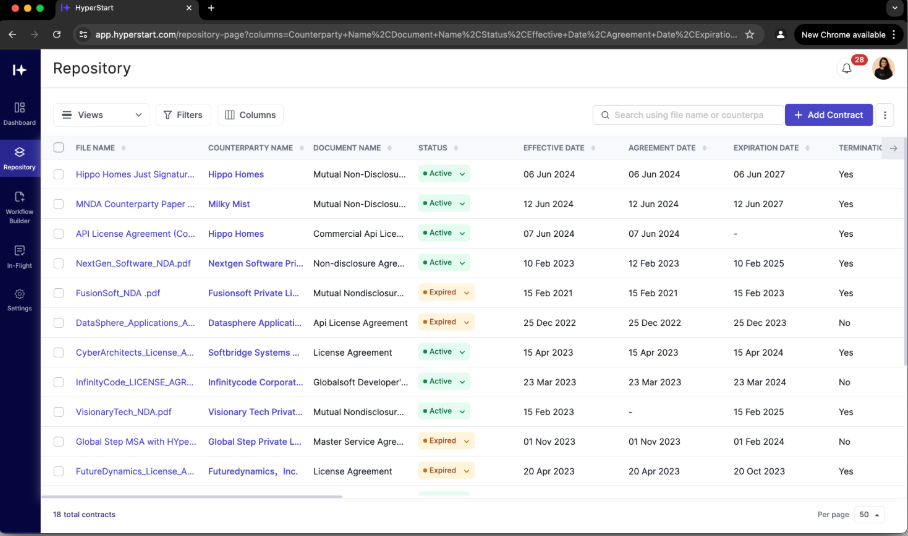
- Live in weeks, not quarters: Go live in weeks—and you deal with us directly, not a systems integrator.
- Reliable AI on your real contracts: Metadata extraction, clause identification and contract risk management—the test is running it on ten of your own contracts.
- Redlining in Word, inside the platform: Negotiation never leaves the system of record, and the repository stays the single source of truth.
- Contract families done properly: Parent-child linking and metadata rolled up across the family, so finance sees total contracted value without opening six PDFs.
- Security review clears without a detour: SOC 2 Type 2 and ISO 27001 certified, and HIPAA compliant, so IT can say yes fast.
The point is not more features—it is a tool a small, stretched legal team can actually run, so the routine paper handles itself and the lawyers’ attention goes where the risk actually is.Bring ten of your own contracts, including the messy ones, and we will run them in front of you. Book a demo.
Run it on ten of your own contracts
The whole contract lifecycle in one product. Live in weeks, with implementation included in a custom quote and no implementation partner.
Book a Demo