



The strongest ContractPodAi (now Leah) alternatives are contract lifecycle management (CLM) platforms, best chosen by company size and primary use case: HyperStart for lower mid-market legal and operations teams who want the whole lifecycle live in weeks without an integrator; Ironclad for enterprise workflow design; Sirion and Icertis for enterprise AI extraction; LinkSquares for post-signature analytics; Juro for browser-native drafting on standard paper; DocuSign CLM for teams built around e-signature; and Evisort and Conga CLM for AI-driven analysis and revenue-focused contracting.
ContractPodAi rebranded to Leah and shifted from a focused CLM tool to an “Agentic OS” spanning legal, procurement, finance, and operations. For a team that signed up for a dedicated CLM—obligation tracking, renewal automation, and a fast go-live—that pivot raises a fair question: is this still the tool you bought?
If your contracts still live on a shared drive and in Word templates, and you need a platform you can run without a six-month implementation project, the ten alternatives below are worth evaluating.
- ContractPodAi rebranded to Leah and shifted from a focused CLM tool to an “Agentic OS” spanning legal, procurement, finance, and operations.
- Teams re-evaluate it over a multi-month implementation, opaque custom pricing, and a steep learning curve.
- Ironclad, Agiloft, Sirion, Icertis, and Conga suit enterprise teams with an implementation budget; Juro suits small teams on standard paper.
- LinkSquares and Evisort focus on post-signature analytics and AI extraction.
- HyperStart fits lower mid-market legal and ops teams that want the whole lifecycle live in weeks without an integrator.
Why consider alternatives to ContractPodAi (now Leah)?
Teams consider ContractPodAi alternatives because of its multi-month implementation, opaque pricing, steep learning curve, thin reporting, and obligation tracking gaps. Beyond the rebrand, these are the reasons teams re-evaluate the platform—and the three criticisms search engines already pull from our own ContractPodAi reviews:

- Multi-month implementation: ContractPodAi averages several months to deploy and the setup is resource-intensive. Teams looking for quick impact can struggle to get up and running.
- Opaque, custom pricing: Pricing is quote-based rather than published (ERP Research), so ask for the license, implementation and contract migration as separate lines before you compare.
- Steep learning curve: The platform is highly configurable, which brings a support dependency and slows business-wide adoption.
- Inadequate reporting: Reporting is reported as thin, with little admin control over out-of-the-box contract properties.
- Obligation tracking gaps: Some users report problems with obligation tracking; test it on your own renewal and notice dates before you rely on it.
[Image: Why consider ContractPodAI alternatives | HyperStart CLM]
How we analyzed ContractPodAi competitors
We reviewed top rating platforms—G2, Gartner, and Capterra—and assessed each product on core CLM functionality, pricing, ease of use, integrations, AI features, and the organizations it serves best. We factored in the Leah rebrand. Every alternative here is a stable, focused CLM platform, which is the thing teams re-evaluating ContractPodAi actually need.
The alternatives at a glance
The alternatives are HyperStart, Ironclad, Sirion, Icertis, LinkSquares, Juro, DocuSign CLM, Evisort, Conga CLM, and Agiloft, each best suited to a different team size and use case.
| CLM player | Best suited for |
| HyperStart CLM | Lower mid-market legal and ops teams who want the whole lifecycle, live in weeks |
| Ironclad | Enterprise workflow design and UX for legal professionals |
| Sirion | Enterprise AI contract extraction and analytics |
| Icertis | Enterprise, industry-specific contracting with heavy security needs |
| LinkSquares | AI contract intelligence and post-signature analytics |
| Juro | Browser-native drafting for small teams on standard paper |
| DocuSign CLM | Teams built around e-signature and agreement workflows |
| Evisort | AI-driven contract analysis and extraction post-signature |
| Conga CLM | Revenue lifecycle management with Salesforce integration |
| Agiloft | Heavy enterprise customization and no-code configuration of complex contract processes |
The slot enterprise tools leave open: live in weeks, self-run, the whole lifecycle
The open slot is a CLM that goes live in weeks, covers the whole lifecycle, and can be run by a small team without a systems integrator. Most of the landscape sorts into two camps: deep enterprise AI with an implementation project and a quote you can’t see (Ironclad, Agiloft, Sirion, Icertis, Conga), or a simpler repository that stops short of the full lifecycle. The gap in the middle is a team that has outgrown shared drives and Word templates but has no systems integrator and no six-month runway—a two-person legal or ops function that needs the whole lifecycle and has to run it themselves.
That is the slot HyperStart was built for. A few things it does that this reader actually needs:
- Word redlining handled inside the platform—negotiating parties stay in the system of record instead of emailing drafts back and forth.
- Linked contract families with value rollup—amendments and parent agreements stay connected so finance can see total contracted value at the family level.
- Approval workflow you configure visually—drawn rather than coded, and changed by the team without a ticket or a consultant.
- Renewal and obligation tracking with auto-escalation—reminders and escalations that chase on their own so nothing auto-renews by accident.
- Security review cleared because HyperStart is SOC 2 Type 2 and ISO 27001 certified, and HIPAA compliant—the questionnaire is answered before IT asks.
Live in weeks, not quarters. No integrator, no partner margin, no configuration project—and you work directly with the people who build the product.
Want to see it run on your own contracts? Book a demo and bring ten of yours.
The alternatives in detail
1. HyperStart CLM
HyperStart is contract lifecycle management (CLM) software from HyperVerge for lower mid-market legal and operations teams. It covers the whole contract lifecycle in one product and goes live in weeks, with no implementation partner. That lifecycle includes intake, templates, configurable approval workflow, redlining in Word, e-signature, a searchable repository, contract families, and obligation tracking; customers include LeadSquared and Qapita.
Best for: lower mid-market legal and operations teams that want the whole contract lifecycle in one product, live in weeks, with no implementation partner and implementation included in the quote.
Key features:
- Automated renewal tracking: Track expiry dates, liability exposure, and obligations with AI-powered contract review.
- No-code approval workflow: Automate repetitive routing without a consultant.
- Searchable repository: A unified contract repository.
- Live dashboard: Every contract, stage, owner, and age in one contract management dashboard.
HyperStart vs ContractPodAi:
| Parameter | HyperStart | ContractPodAi (Leah) |
| Implementation | Live in weeks, repository and custom workflows included | Long and resource-intensive |
| User experience | Intuitive, business-wide adoption | Highly configurable, support-dependent |
| Reporting | Visual drillable dashboard | Limited, little admin control |
| Tracking | Dependable automated renewal tracking | Reported gaps; stronger at pre-execution GenAI |
| Salesforce integration | Yes: run contracts from quote to close without leaving Salesforce (HyperStart + Salesforce) | Available |
Pros: Live in weeks, a two-person team can run it, reliable AI on real contracts, custom quote with implementation included, direct access to the people who build the product.
Cons: HyperStart’s AI works inside the CLM (review, first-cut redlining and suggested preferred language in Word) rather than as a standalone generative AI assistant like LeahAI—teams whose core bottleneck is generative drafting and legal research will find Leah more relevant.
What customers say: “Implementation was very smooth. Using the bulk upload feature, all contracts were integrated into the system within minutes. I was also able to see the AI extracted metadata on the tool immediately, which was impressive.”—Mayuri Jaltare, Company Secretary, Qapita (read case study)
HyperStart is purpose-built for lower mid-market teams that need a focused CLM with a fast go-live. ContractPodAi (now Leah) is repositioning as a broader enterprise orchestration tool, which may add complexity for teams that simply need reliable contract management.
2. Ironclad
[Image: Ironclad dashboard]
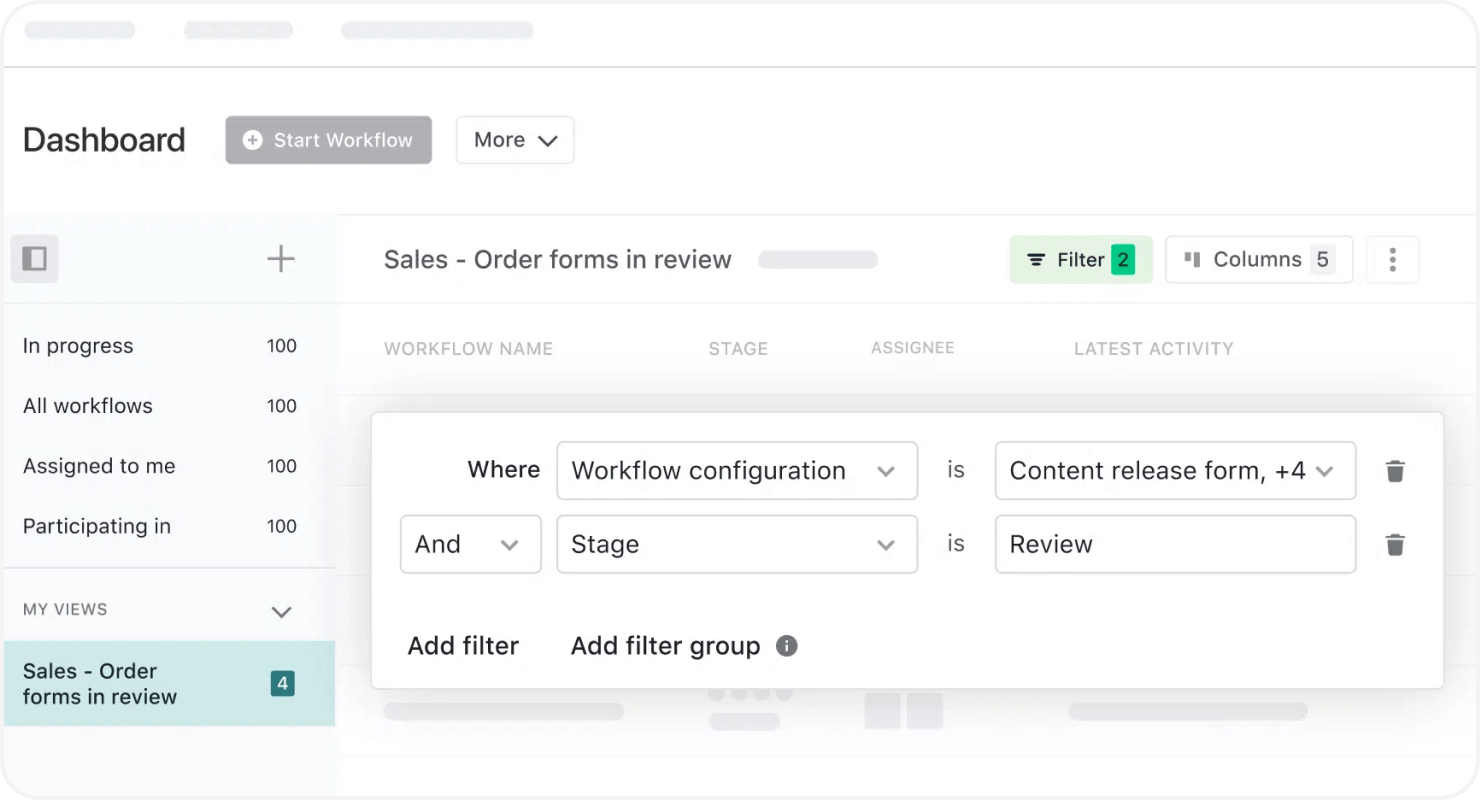
Ironclad is a CLM platform built by engineers, lawyers, and business experts. Its workflow designer and automation are particularly popular with law firms and in-house counsel, though the UI is not always intuitive for org-wide adoption. Ideal for: Enterprise legal teams with an implementation budget.
Key features:
- Workflow designer: A self-serve tool to build contract creation and approval processes in minutes.
- Integrations: Supports CRM and ERP systems.
Pros:
- The Workflow Designer builds and launches approval processes without long lead times.
- Intuitive for legal professionals.
- Ironclad AI detects 194+ contract properties like value, counterparties, and dates.
Cons:
- Setup can be time-consuming.
- The interface can be complex for non-legal business teams.
- Priced for enterprises; onboarding, support, and integration costs add up.
Pricing: Ironclad is quote-only with no published figures (Ironclad pricing, as of Oct 2026); benchmarks such as Vendr put mid-market (100-500 employees) contracts at $50,000-$120,000 a year, plus $10,000-$75,000+ one-time implementation. Ask for the implementation quote separately from the license. It holds 4.4 stars across 71 Capterra reviews (as of Oct 2026). See our Ironclad pricing and reviews breakdowns.
Ironclad’s AI analyzes agreements and flags areas for review. ContractPodAi (now Leah) is pivoting toward agentic AI workflows, making Ironclad the more stable choice for teams focused purely on CLM.
3. Sirion
Sirion is named a CLM Leader in the Magic Quadrant, serving procurement, legal, and sales at large enterprises in banking, communications, and manufacturing.
Best for: Mid-sized to large enterprises with high contract volumes.
Key features:
- Single Extraction Agent (SEA™): An interactive, searchable repository with strong contract visibility.
- Contract authoring: AI playbooks for fast contract creation.
- AI redlining: Auto-redlines and flags terms during negotiation.
- Manage dashboard: Real-time insights into obligations, service levels, and financial risk.
Pros:
- Highly rated for sales, implementation, and support (Gartner reviews).
- Strong integrations with CRM, CPQ, and matter management tools.
- Investments in generative AI, conversational search, and predictive analytics.
Cons:
- Limited social media footprint.
- Reliance on channel partners can complicate scaling.
Pricing: Sirion lists no public pricing and sells only by quote.
Sirion excels in AI-powered extraction and predictive analytics for complex contracting. Unlike ContractPodAi’s broad pivot to Leah, Sirion stays focused on enterprise CLM.
4. Icertis
[Image: Icertis dashboard]
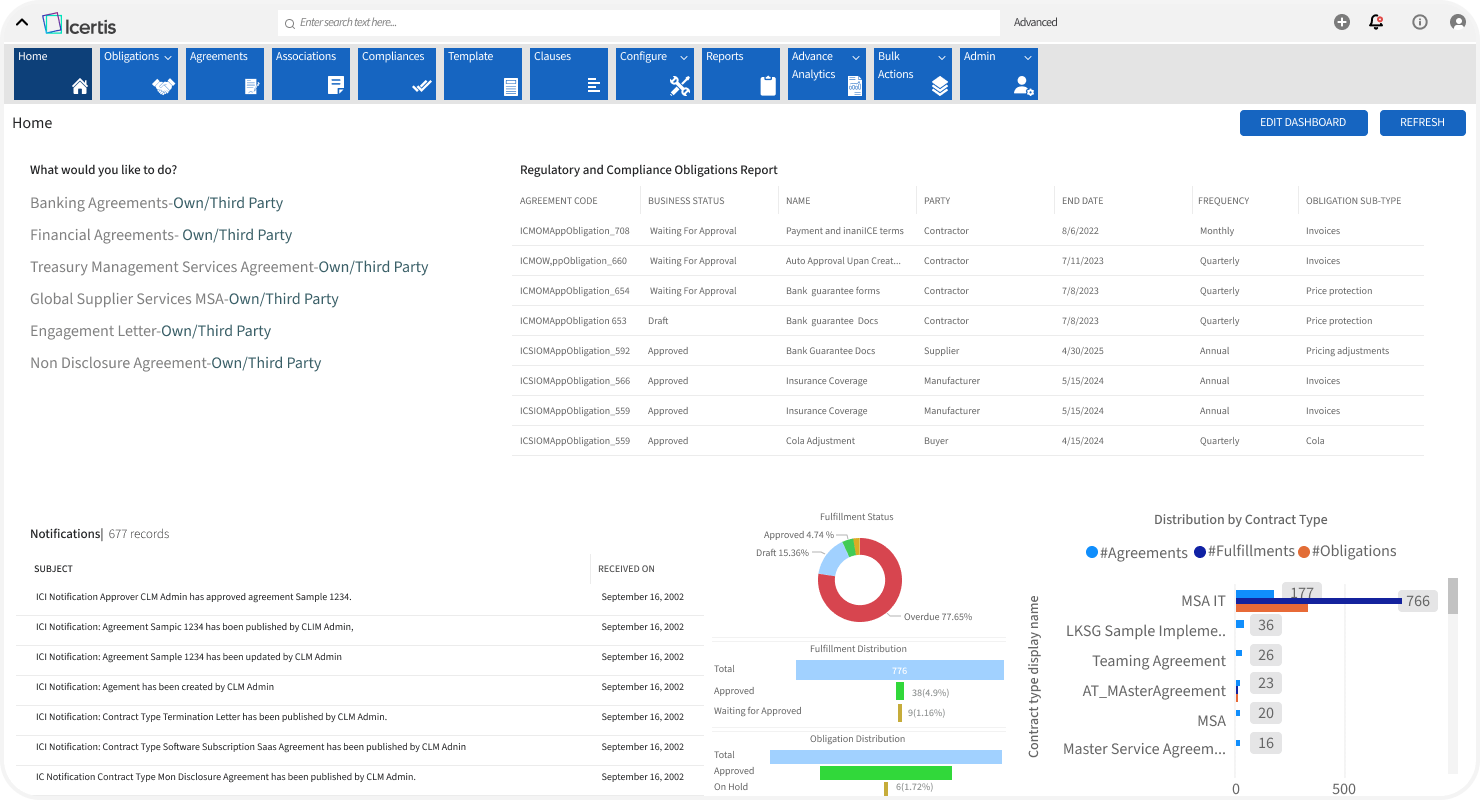
Icertis is known for enterprise-wide contract management, with redlining AI, a secure unified repository, and vertical expertise in healthcare, supply chain, and real estate.
Best forfor: Large enterprises with stringent compliance and hierarchical needs.
Key features:
- Contract negotiations: Redline insights and predefined playbooks.
- Contract analytics: Ready-to-use reports and customizable dashboards.
- Contract review: AI redlining flags terms to accelerate closures.
Pros:
- Strong security for sensitive contracts across global operations.
- Adapts to sector-specific requirements.
- Extractive AI for redlining.
Cons:
- Premium pricing.
- Extensive, data-intensive initial setup.
- AI excels at extraction but reporting and dashboards lag.
Pricing: Icertis offers only quote-based pricing with nothing published (Signeasy, as of Oct 2026), and sits at 4.3 stars from 41 Capterra reviews (as of Oct 2026). More in our Icertis reviews and pricing guide.
Icertis delivers security, industry tooling, and enterprise contracting. ContractPodAi (now Leah) is broadening beyond CLM.
5. LinkSquares
[Image: LinkSquares dashboard]
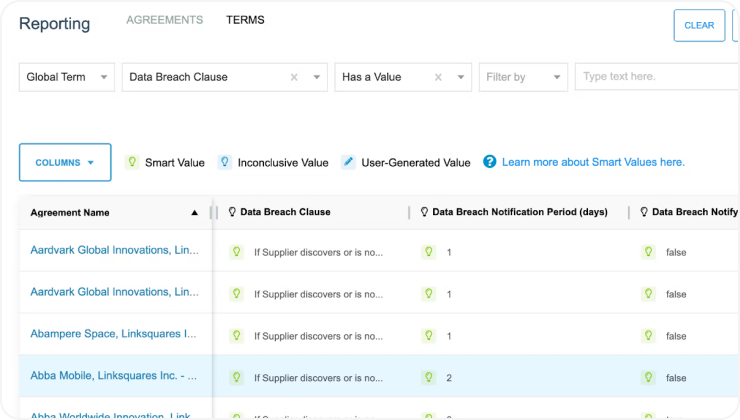
LinkSquares is a CLM platform trusted by brands like Drift, DraftKings, and Fitbit, strongest in post-signature analytics.
Best for: Teams that need contract storage and analytics at scale.
Key features:
- Finalize: Streamlines contract creation.
- Sign: Enables execution.
- Analyze: Post-signature analytics and repository functions.
- CLM Suite: The full product suite.
Pros:
- Responsive sales and support.
- Securely stores large volumes of agreements.
- Useful onboarding training resources.
Cons:
- Modular pricing—extra tags and user licenses cost more.
- AI Analyze falls short on advanced extraction and Boolean search.
- Setup can be time- and data-intensive.
Pricing: LinkSquares publishes no prices—sold by quote (LinkSquares pricing, as of Oct 2026); 4.3 stars on Capterra (as of Oct 2026, 41 reviews). Read more on LinkSquares pricing.
LinkSquares excels at post-execution storage and tracking with a stable roadmap. ContractPodAi’s rebrand to Leah broadens it beyond CLM.
Still comparing CLM options?
Send us your approval matrix and a contract family and we’ll build both in the demo.
Book a Demo6. Juro
Juro is a browser-native CLM built for small teams working on standard paper, with a well-regarded in-browser editor.
Best for: Small teams drafting and signing standard agreements.
Key features:
- Browser-native editor: Drafting and collaboration in the browser.
- Templates and automation: Self-serve standard agreements.
- E-signature: Built-in execution.
Pros:
- Easy to start with for small teams.
- Clean editor for standard paper.
- Strong onboarding for non-legal users.
Cons:
- Negotiation happens in Word, so contracts leave Juro to be redlined.
- Lighter on contract families and post-signature tracking as teams scale.
Pricing: Juro keeps pricing to quotes with no published rates (Juro pricing, as of Oct 2026); its Capterra score is 4.8 stars over 47 reviews (as of Oct 2026). Juro is a strong place to start on standard paper. The test before you choose it: when your counterparty sends back a redline, where does that actually happen? If the answer is Word and email, look for redlining in Word inside the platform and contract families after signature.
7. DocuSign CLM
[Image: DocuSign CLM dashboard]
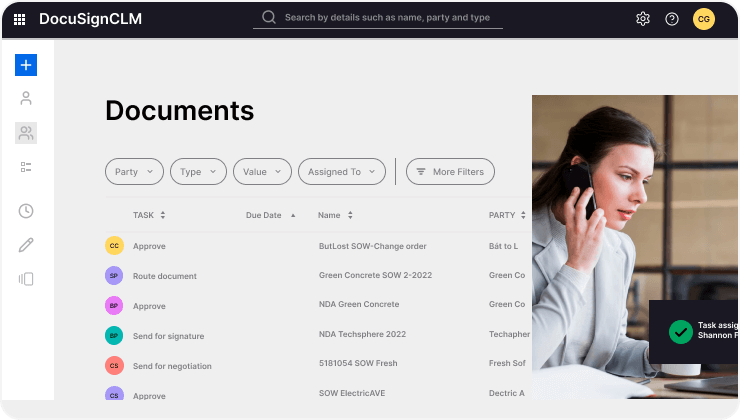
DocuSign CLM is an enterprise CLM built around the market-leading e-signature, covering pre-signature workflows, repository, and post-execution analytics. For most teams, the e-signature is something you keep—a CLM sits around it.
Best for: Teams built around DocuSign e-signature that want agreement workflows on top.
Key features:
- Maestro: No-code agreement workflow design.
- Navigator: A unified secure repository with portfolio relationships.
- DocuSign AI: Contract review and metadata extraction.
Pros:
- Widely used e-signature, which most teams keep alongside a CLM.
- Enterprise-grade storage and security.
Cons:
- Initial workflow and repository setup need significant time and data.
- AI redlining is effective but reporting lacks custom filters.
Pricing: Base price $40 per user/month, billed annually, “IAM Starter” plan (vendor’s own page as of Sep 30, 2026).
DocuSign is the established e-signature leader. Its CLM is the bolt-on rather than the core; teams that need the signature keep it and add a CLM layer around it.
8. Conga CLM
[Image: Conga Contracts dashboard]
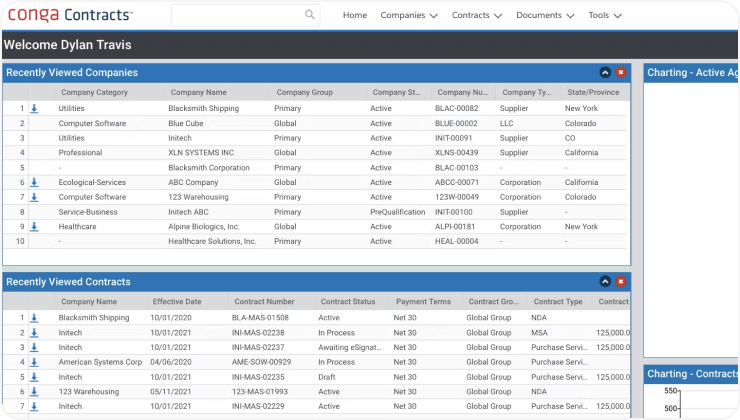
Conga CLM is part of the Conga Revenue Lifecycle Cloud, tuned for revenue and contract management with tight Salesforce and CPQ integration.
Best for: Enterprise teams tracking the whole revenue lifecycle.
Key features:
- Bulk import and data extraction: Processes legacy and third-party documents at scale.
- Agreement hierarchy: Visualizes parent and related agreements.
- Natural language search: Precision search of structured and unstructured data.
- Dynamic approvals and signature management: Customizable approval workflow and e-signature.
Pros:
- Advanced search locates clauses fast.
- Native Salesforce and enterprise integrations.
- Real-time commenting and collaboration.
Cons:
- Steep learning curve for new users.
- Onboarding and training gaps delay implementation.
- Complex setup needs expert help.
Pricing: Conga publishes no prices—sold by quote (vendor’s own page as of Sep 30, 2026); 4.3 stars on Capterra (75 reviews, as of Oct 2026). Read more on Conga CLM competitors.
Conga specializes in revenue lifecycle management with CLM and CPQ integration. ContractPodAi’s rebrand to Leah positions it broader, but Conga’s Salesforce-native approach remains proven for revenue teams.
9. Evisort
[Image: Evisort dashboard]
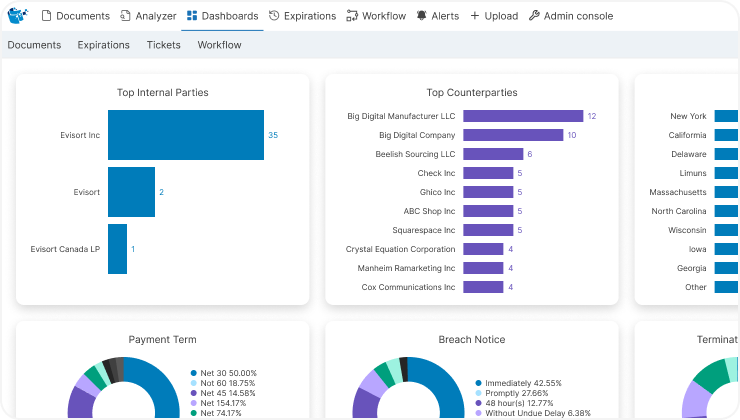
Evisort (now Workday) is an AI-native CLM whose LLM surfaces risks, spots opportunities, and tracks obligations.
Best for: Midsize and enterprise companies across finance, healthcare, life sciences, and technology.
Key features:
- AI-powered extraction: Pulls pricing, payment terms, and renewals automatically.
- Contract repository: Central, controlled-access storage.
- Approval workflow: Configurable for compliance across stakeholders.
- Renewal management: Monitors metadata for proactive renewals.
Pros:
- Advanced AI automates analysis and redlining.
- Easy to navigate, well-rated support.
- Streamlined approval processes.
Cons:
- Pricing may not suit smaller budgets.
- Initial setup and training require effort.
- Limited advanced reporting customization.
Evisort focuses on AI-driven analysis and post-signature extraction. ContractPodAi (now Leah) is expanding beyond CLM into orchestration; for teams wanting a focused, AI-native CLM, Evisort is the more predictable choice.
10. Agiloft
Agiloft is a no-code, highly configurable enterprise CLM, best for heavy enterprise customization and flexible, no-code configuration of complex contract processes.
Best for: Enterprises with complex, non-standard contract processes and the admin capacity to configure them.
Key features:
- No-code configuration: Approved users configure contracts, approval chains, and processes without code or a support request.
- Embedded AI: Extraction, risk analysis, contract questions, and configurable agents for automated tasks.
- Integrations: Over 1,000 pre-built connectors to other systems.
Pros:
- Among the most configurable CLMs on the market.
- Named a Leader in the Gartner Magic Quadrant for CLM six years in a row (vendor’s own site, Oct 8, 2026).
Cons:
- Flexibility demands planning; complex builds need technical involvement and time.
- Ask who on your team would own configuration after go-live, and what implementation costs separately from the license.
Pricing: Agiloft publishes no price. Independent benchmarks put the median buyer at $67,132 a year (range $62,629-$80,344), based on Vendr marketplace data, with implementation billed on top (see our Agiloft pricing breakdown). It holds 4.8 stars on Capterra (as of Oct 2026, 39 reviews).
Agiloft fits when your contract process is genuinely unusual and you have the people to configure around it. ContractPodAi (now Leah) is broadening into an agentic platform; Agiloft stays a CLM you shape to your own process.
How to choose the right ContractPodAi alternative
The right pick depends on your company size and which department feels the pain most. For enterprise workflow design: Ironclad. For heavy enterprise customization and no-code configuration of complex processes: Agiloft. For post-signature analytics: LinkSquares. For browser-native drafting on standard paper: Juro. For teams built around DocuSign e-signature: DocuSign CLM. For a lean legal team that needs to go live in weeks: HyperStart.
- By size: Enterprise legal teams with an integrator budget lean to Ironclad, Agiloft, Sirion, Icertis, or Conga. Lower mid-market legal and ops teams who need the whole lifecycle without a project are the fit for HyperStart. Small teams on standard paper can start with Juro.
- Legal / General Counsel: If the goal is handling routine paper without the team touching it while risk-carrying agreements get the lawyers’ attention, prioritize reliable tracking and a self-run approval workflow.
- Legal Operations: If you are the queue and the chaser, prioritize a live view of every contract in flight and workflows you change yourself, without a ticket.
- Sales / Sales Ops: If deals slip on paperwork at quarter-end, prioritize self-serve standard agreements and fast redlining.
- Procurement: If spend renews without anyone deciding to, prioritize amendment linking and auto-renewal dates visible before the window closes.
- Finance: If you forecast off PDFs, prioritize total contracted value rolled up across a contract family.
- IT / Security: If vendor review is the bottleneck, prioritize SOC 2, ISO 27001, and HIPAA answered up front.
Why choose HyperStart CLM for your business?
HyperStart gives lower mid-market legal and ops teams the full contract lifecycle in a single product, with a go-live in weeks instead of the integrator-led, multi-quarter rollout enterprise CLM demands—and support that stays with the team past go-live.
HyperStart’s strongest difference versus ContractPodAi is implementation speed and cost for teams that don’t need generative AI drafting. If your primary need is post-execution tracking, metadata extraction, and renewal management, HyperStart may be all you need:
- Rapid repository setup with minimal downtime.
- No-code approval workflow, live in weeks.
- Intuitive interface for business-wide adoption.
- Powered by HyperVerge AI, built to be reliable on your real contracts.
- Custom quote, with implementation and contract migration included.
Bring ten of your own contracts, including the messy ones, and we will run them in front of you. Book a demo.
Run it on ten of your own contracts
The whole contract lifecycle in one product. Live in weeks, with implementation included in a custom quote and no implementation partner.
Book a Demo