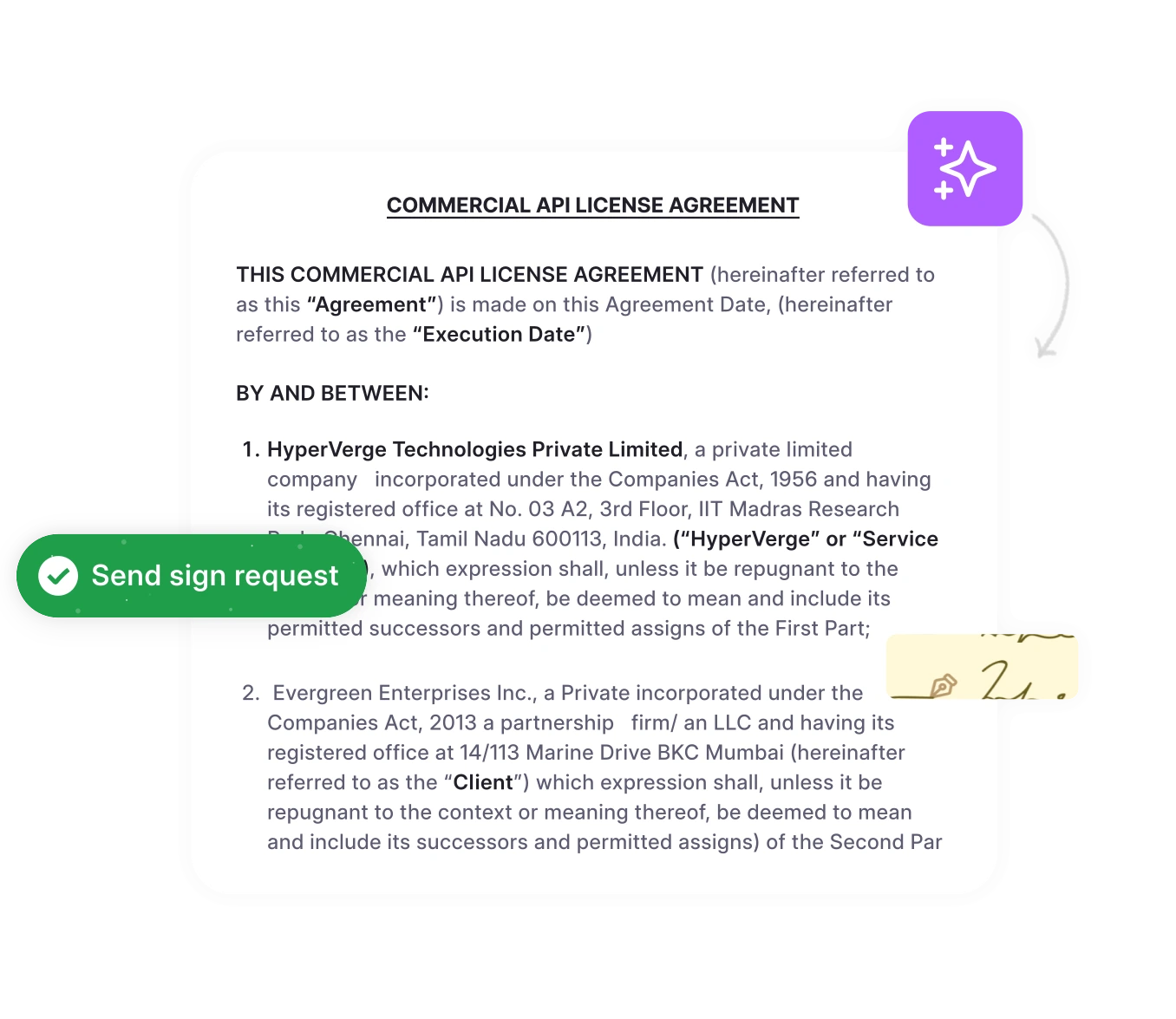



Escrow Agreement Template
Download a professional escrow agreement template to secure high-value transactions. Clearly define release conditions, duties of the escrow agent, and dispute resolution terms to protect all parties involved.
High-value transactions fail when parties exchange assets before contractual conditions are verified. A botched escrow release can cost companies millions in disputed M&A deals, stalled real estate closings, or litigation over unmet obligations.
For legal teams managing dozens of transactions simultaneously, tracking which escrow agreement is tied to which release trigger becomes a coordination nightmare. According to the International Chamber of Commerce, commercial disputes that reach arbitration take an average of 26 months to resolve, making clear escrow documentation critical to avoiding lengthy conflicts.
In this guide, you’ll learn what escrow agreements are, their essential components, how to draft and negotiate them effectively, and how modern contract management software helps legal teams track complex escrow obligations without buried spreadsheets or missed deadlines.
What is an escrow agreement?
An escrow agreement is a contract where a neutral third party, often called the stakeholder or escrow agent, holds assets such as money, property deeds, or securities on behalf of two or more parties until specific conditions of a transaction are fulfilled.
The agreement protects both buyers and sellers by ensuring that funds or assets are only disbursed when all contractual obligations have been met. Common in real estate closings, mergers and acquisitions, and legal settlements, escrow agreements reduce counterparty risk by inserting an independent intermediary who follows explicit written instructions for holding and disbursing assets.
Centralize agreements and automate obligation tracking
Modern contract lifecycle management platforms store escrow agreements alongside related transaction documents, track release conditions, and alert legal and finance teams before deadlines.
Book a DemoWhat are the key elements of an escrow agreement?
Escrow agreements fail when critical terms are vague or incomplete. Legal teams reviewing dozens of escrow agreements during M&A due diligence or real estate portfolio closings need standardized elements to assess risk quickly. Missing any of these components creates disputes between buyers, sellers, and escrow agents.
Quick overview of essential elements:
| Element | What It Covers |
| Parties | Buyer, seller, and escrow agent with full legal names and contact details |
| Assets held | Cash, consideration (purchase price), stock certificates, deeds, IP assignments, settlement funds, earnest money |
| Release conditions | Specific triggering events: inspections satisfied, approvals obtained, claim periods expired |
| Escrow agent duties | Safeguarding assets, verifying conditions, disbursing funds, maintaining records |
| Timeline and deadlines | Deposit dates, verification periods, automatic release dates, termination dates |
| Fees and costs | Agent compensation, payment responsibility, expense reimbursement |
| Dispute resolution | Arbitration, mediation, interpleader procedures, court jurisdiction |
| Indemnification | Agent liability protections when following written instructions in good faith |
| Governing law | Jurisdiction for interpretation and enforcement of agreement terms |
A comprehensive escrow agreement addresses each of these elements with specificity. Here’s what legal teams should verify in each component:
1. Parties and authorized representatives
Identify all parties with complete legal names, entity types, and jurisdictions of formation. Include full contact information for notices and specify who has the authority to provide instructions to the escrow agent.
For corporate parties, attach board resolutions or delegation authorities authorizing the transaction. Ambiguity about who can instruct the escrow agent creates delays when parties need to approve releases or resolve disputes.
2. Assets held in escrow
Describe exactly what the escrow agent will hold, including cash amounts, stock certificates, property deeds, IP assignment documents, settlement funds, or earnest money deposits.
Specify the form of deposit (wire transfer, certified check, or physical certificates) and account details where funds will be maintained. For non-cash assets, include serial numbers, recording information, or other identifiers that prevent confusion about which assets are subject to escrow.
“In acquisition deals, the typical escrow amount is around 8% of the purchase price for non-insured transactions, and 1% for insured deals.”
Read
3. Release conditions and triggering events
Draft objective, verifiable conditions that specify exactly when the escrow agent must disburse assets. Effective release conditions reference specific events, such as “receipt of signed regulatory approval letter dated no earlier than [date]” or “30 days after closing date with no indemnity claims filed in writing.”
Avoid subjective standards like “when regulatory concerns are resolved” that require interpretation. Include verification procedures that demonstrate how the agent confirms that conditions were satisfied.
4. Escrow agent duties and limitations
State precisely what actions the agent can take unilaterally versus what require party agreement. Specify how the agent verifies release conditions, maintains records, and handles disputed instructions.
Address whether the agent has discretion to interpret ambiguous terms or must seek party clarification. Define the agent’s standard of care and include protections like indemnification for good-faith actions and the right to interplead disputed funds in court if parties cannot agree.
5. Timeline and critical deadlines
Establish when assets must be deposited, how long the agent has to verify conditions, when automatic releases occur if conditions aren’t met, and when the escrow terminates.
Include notice requirements specifying how many days’ advance notice parties must provide before releases. For multi-tranche releases, create a schedule showing release dates and corresponding conditions for each disbursement.
6. Fees, costs, and payment allocation
Specify the agent’s compensation structure (flat fee, percentage of assets held, hourly rates for dispute resolution), who pays fees, and when payment is due. Address whether fees are deducted from escrowed funds or paid separately.
Include provisions for reimbursing the agent’s reasonable expenses, including legal fee,s if the agent must respond to disputes or interplead funds in court.
7. Dispute resolution procedures
Define how disputes are resolved when parties disagree about whether release conditions were satisfied. Options include the agent holding funds pending arbitration, the agent depositing funds in court through an interpleader action, or appointing a neutral third party to verify condition satisfaction.
Specify notice requirements, timelines for dispute resolution, and whether disputed amounts are segregated while undisputed amounts are released.
8. Indemnification and liability protections
Include clauses protecting the agent from liability when following written instructions in good faith. Specify that parties, not the agent, bear responsibility for determining whether release conditions were met.
Address what happens if the agent receives conflicting instructions or becomes aware of fraud. Limit the agent’s liability to gross negligence or willful misconduct rather than simple errors in judgment.
9. Governing law and jurisdiction
Specify which state’s law governs the escrow agreement and where disputes must be litigated or arbitrated. Confirm the chosen jurisdiction allows the contemplated escrow arrangement and that the selected agent is properly licensed in that jurisdiction.
For multi-state transactions, address potential conflicts between the escrow agreement’s governing law and the underlying transaction’s governing law.
Legal teams at companies handling multiple escrow agreements simultaneously need to extract these elements systematically to monitor upcoming release dates and coordinate with finance for fund availability.
Why escrow agreements matter for legal, GC, and ops
Escrow agreements serve as critical risk management tools in high-value transactions, but their effectiveness depends on legal teams’ ability to manage obligations systematically.
Poor visibility into escrow terms creates cash flow surprises, compliance gaps, and litigation risk. For legal operations teams managing transaction portfolios, understanding why escrow agreements matter drives better implementation and oversight.
1. They prevent premature asset transfer before obligations are fulfilled
Escrow agreements protect against counterparty risk by ensuring neither party receives funds or assets until contractual conditions are objectively satisfied. Without escrow, buyers face the risk of paying purchase prices before sellers deliver a clear title, complete regulatory approvals, or satisfy post-closing obligations.
Why it matters: Sellers risk transferring ownership before receiving payment. The neutral third party creates accountability that direct party-to-party exchanges cannot provide, reducing disputes about whether performance occurred before payment.
2. They create enforceable verification mechanisms for complex conditions
Release conditions scattered across transaction documents create verification challenges where parties dispute whether requirements were met. Escrow agreements consolidate release triggers into a single enforceable framework with objective verification procedures.
Why it matters: Legal teams reviewing M&A transactions, real estate closings, or settlement agreements need clear documentation showing exactly what must occur before funds are disbursed. Without systematic contract tracking, release conditions get missed or disputed.
3. They enable multi-stakeholder coordination across legal, finance, and operations
Escrow releases require synchronization between legal (confirming conditions met), finance (fund availability), third parties (agent instructions), and business stakeholders (transaction approvals).
Why it matters: Each group operates on different timelines and information systems. Legal counsel verifies compliance documentation while finance teams prepare wire transfer instructions and business leaders evaluate whether post-closing obligations justify release. When escrow agreements live in email attachments rather than centralized systems, stakeholders cannot see the current release status or understand what actions they need to take.
4. They support audit compliance and regulatory scrutiny
During due diligence, IPO readiness reviews, or regulatory audits, legal teams must quickly produce all active escrow agreements, prove condition fulfillment, and demonstrate proper authorization for releases.
Why it matters: Auditors examining escrow accounts verify that held amounts reconcile to agreement terms, release conditions were objectively satisfied, and proper authorization protocols were followed. Companies with multiple simultaneous escrow agreements face particular scrutiny about tracking obligations across agreements spanning months or years.
5. They provide documented dispute resolution when conditions are contested
When buyers and sellers disagree about whether release conditions were satisfied, or when one party alleges breach of the underlying transaction agreement, legal teams need complete documentation trails.
Why it matters: documentation weakens negotiating positions during disputes and increases litigation risk. According to Secured Trust Escrow, escrow disputes that escalate to arbitration or litigation typically take 6 to 24 months to resolve, with costs escalating rapidly throughout the process.
Escrow agreements that specify objective verification procedures, define agent authority, and establish clear dispute resolution mechanisms provide stronger defensive positions than vague arrangements relying on party agreement.
6. They align financial planning with transaction milestones
Finance leaders managing cash forecasts need visibility into when escrowed funds will be released or when additional deposits are required. Operations teams executing post-closing integration or real estate transitions depend on escrow releases to trigger next-phase activities.
This matters because when legal teams don’t communicate escrow status proactively, finance discovers last-minute funding requirements that disrupt cash management.
In real estate transactions, mortgage lenders maintain separate escrow accounts to collect and pay property taxes and insurance premiums, creating additional coordination requirements between transaction escrow and ongoing payment obligations.
How do you draft and negotiate an escrow agreement?
Drafting escrow agreements requires balancing buyer protection, seller flexibility, and agent clarity. Poorly drafted release conditions create disputes that tie up funds for months while parties litigate interpretations. For transactions involving complex merger and acquisition structures, precision in escrow terms becomes even more critical.
Follow this 5-step approach when drafting or negotiating escrow agreements:
Step 1: Identify transaction structure and risks
Determine what protection each party needs (buyer wants assurance seller fulfills obligations, seller wants prompt payment, agent wants clear instructions limiting liability), what assets require escrow (purchase price, earnest money, indemnity holdbacks, settlement funds), and what conditions trigger release (inspections, regulatory approvals, third-party consents, time periods expiring).
Consider the specific transaction type. Real estate closings may require earnest money deposits held until title transfer and mortgage funding. M&A indemnity escrows protect buyers against undisclosed liabilities for 12-24 months post-closing. Vendor disputes may escrow contested payment amounts pending arbitration outcomes.
Step 2: Define release conditions objectively
Draft conditions that can be verified by the escrow agent without subjective judgment. Use “upon receipt of signed regulatory approval letter,” not “when regulatory concerns are resolved.” Use “30 days after closing date with no indemnity claims filed,” not “when indemnity risk is acceptable.”
Specify whether releases are subject to contingencies such as financing approval or inspection results. For complex transactions, create a release conditions checklist as an exhibit to the escrow agreement, listing each condition with verification procedures and responsible parties.
Step 3: Specify agent authority and limitations
State what actions the agent can take unilaterally (release upon joint written instruction, hold funds pending court order) versus what requires party agreement, how the agent verifies conditions are met, and what protections the agent receives (indemnification, right to interplead disputed funds, reimbursement for costs).
Address scenarios where parties disagree about condition satisfaction. Can the agent make determinations, or must the agent hold funds until parties resolve disputes? What happens if one party becomes unresponsive or faces bankruptcy during the escrow period? Clear agent authority provisions prevent paralysis when unexpected circumstances arise.
Step 4: Establish dispute procedures
Address how disputes are resolved when parties disagree about release (agent holds funds pending arbitration, agent deposits funds in court through interpleader action, neutral third party verifies condition satisfaction), what notice each party must provide, and what timeline applies before the agent can take action.
Specify whether disputes trigger automatic holds on all releases or only contested amounts. For escrows with multiple release tranches, parties may want mechanisms to release undisputed amounts while resolving contested portions.
Step 5: Coordinate with transaction documents
Ensure escrow agreement references match purchase agreement terms, cross-reference related exhibits (inspection reports, regulatory filing requirements), and clarify which document controls if terms conflict.
Legal teams should involve finance early to verify fund availability for deposits, confirm account details for disbursements, and align release timelines with cash flow projections. Real estate transactions may require coordination with title companies serving dual roles as escrow agents. M&A deals often involve multiple escrow agreements for different purposes (purchase price holdback, indemnity escrow, management retention), each with distinct release conditions requiring careful contract negotiation to balance stakeholder interests.
Jurisdiction matters for escrow agreements. Some states impose licensing requirements on escrow agents, regulate permissible escrow terms, or provide statutory frameworks for disputes. Legal teams should confirm the proposed escrow agent is properly licensed and insured for the transaction value.
How do you manage escrow agreements at scale?
Companies managing multiple escrow agreements across M&A transactions, real estate portfolios, vendor relationships, and legal settlements face coordination challenges when agreements live in email threads, shared drives, or individual counsel’s files.
Release conditions buried in 50-page agreements get missed, cross-functional approvals happen through disconnected email chains, and finance teams don’t see upcoming deposit or release obligations until the last minute.
“Those who have already pursued digitally enabled commercial management operations are not only more competitive in their markets, but also realize a substantial uplift in profitability according to our research.”
1. Centralized contract repository and metadata extraction
Legal teams need centralized storage where a contract repository links escrow agreements to related transaction documents. Modern contract management systems extract key metadata, including parties, held assets, release conditions, amounts, and dates, providing visibility to finance and operations stakeholders without requiring manual agreement review.
Automatically identifying release conditions, deposit deadlines, verification requirements, and termination dates through contract data extraction reduces manual calendar tracking and ensures obligations aren’t overlooked. Legal teams can surface upcoming escrow deadlines across all active agreements rather than relying on individual counsel’s memory.
2. Cross-functional approval workflows
Route escrow releases through proper approval chains where legal verifies conditions were met, finance confirms fund availability, business stakeholders approve the transaction phase, and authorized signers provide agent instructions. Workflow automation ensures each stakeholder receives notifications at the appropriate time with relevant documentation attached.
Instead of email chains where approval requests get buried, structured workflows track approval status, escalate overdue approvals, and maintain audit trails showing who authorized each release and when.
3. Timeline and obligation tracking
Monitor upcoming deposit requirements, condition verification deadlines, automatic release dates, and indemnity claim period expirations with automated alerts to legal and finance through obligation management capabilities. Legal teams can set reminder intervals based on business criticality, 45 days before release for routine escrows, 90 days for complex M&A indemnity releases requiring extensive verification.
Linking escrow obligations to calendar systems ensures finance teams can plan cash requirements and operations teams can schedule post-release activities without last-minute surprises.
4. Document linkage and verification support
Connect escrow agreements to purchase agreements, inspection reports, regulatory approval letters, and post-closing adjustment calculations so legal teams can verify release conditions without searching across systems. When reviewing whether release conditions were satisfied, counsel needs immediate access to referenced documents to confirm compliance.
Linking escrow agreements to related contracts also helps identify potential conflicts between documents during due diligence reviews or dispute resolution.
5. Audit reporting and compliance monitoring
Generate reports showing all active escrow agreements, amounts held, release condition status, and authorization trails for due diligence, compliance monitoring, and financial audits. Auditors examining escrow accounts want to see that legal teams have systematic processes for tracking obligations, verifying release conditions, and obtaining proper approvals.
Portfolio-level reporting helps legal teams identify escrow exposure across the organization, assess concentration risk, and plan resource allocation for upcoming verification activities.
For companies executing multiple M&A transactions annually, systematized escrow management reduces the risk of missed release conditions, unauthorized disbursements, or disputes caused by poor documentation. Legal teams can see portfolio-wide escrow exposure, identify upcoming release obligations, and coordinate with finance on cash flow timing. When disputes arise, complete documentation trails showing condition verification and authorization approvals provide stronger defensive positions.
Modern contract automation software extracts escrow terms from transaction documents, tracks obligations alongside related agreements, and integrates with financial systems to align release timing with cash management. Legal teams no longer rely on individual counsel remembering which escrow agreements require action next quarter.
Track obligations without spreadsheet chaos
See how legal teams at scaling companies centralize escrow agreements, automate release condition tracking, and coordinate cross-functional approvals.
Book a DemoAutomate escrow agreement tracking with HyperStart
Escrow agreements protect high-value transactions by inserting neutral third-party oversight between contractual obligations and asset transfer. But legal teams managing multiple escrow agreements face coordination challenges when release conditions are buried in transaction documents, cross-functional approvals happen through email, and finance doesn’t see upcoming deposit or release obligations. Clear drafting, objective release conditions, and proper agent protections reduce disputes, while systematic tracking across agreements prevents missed deadlines.
HyperStart’s AI-powered CLM platform centralizes escrow agreements alongside related transaction documents, extracts release conditions and deadlines, and routes approvals through proper stakeholder workflows. Teams handling finance contract management at growing companies gain visibility into portfolio-wide escrow exposure, track upcoming obligations, and coordinate on release timing without relying on spreadsheets or individual counsel’s memory. See how HyperStart helps legal operations teams manage complex obligations across hundreds of agreements. Book a demo