


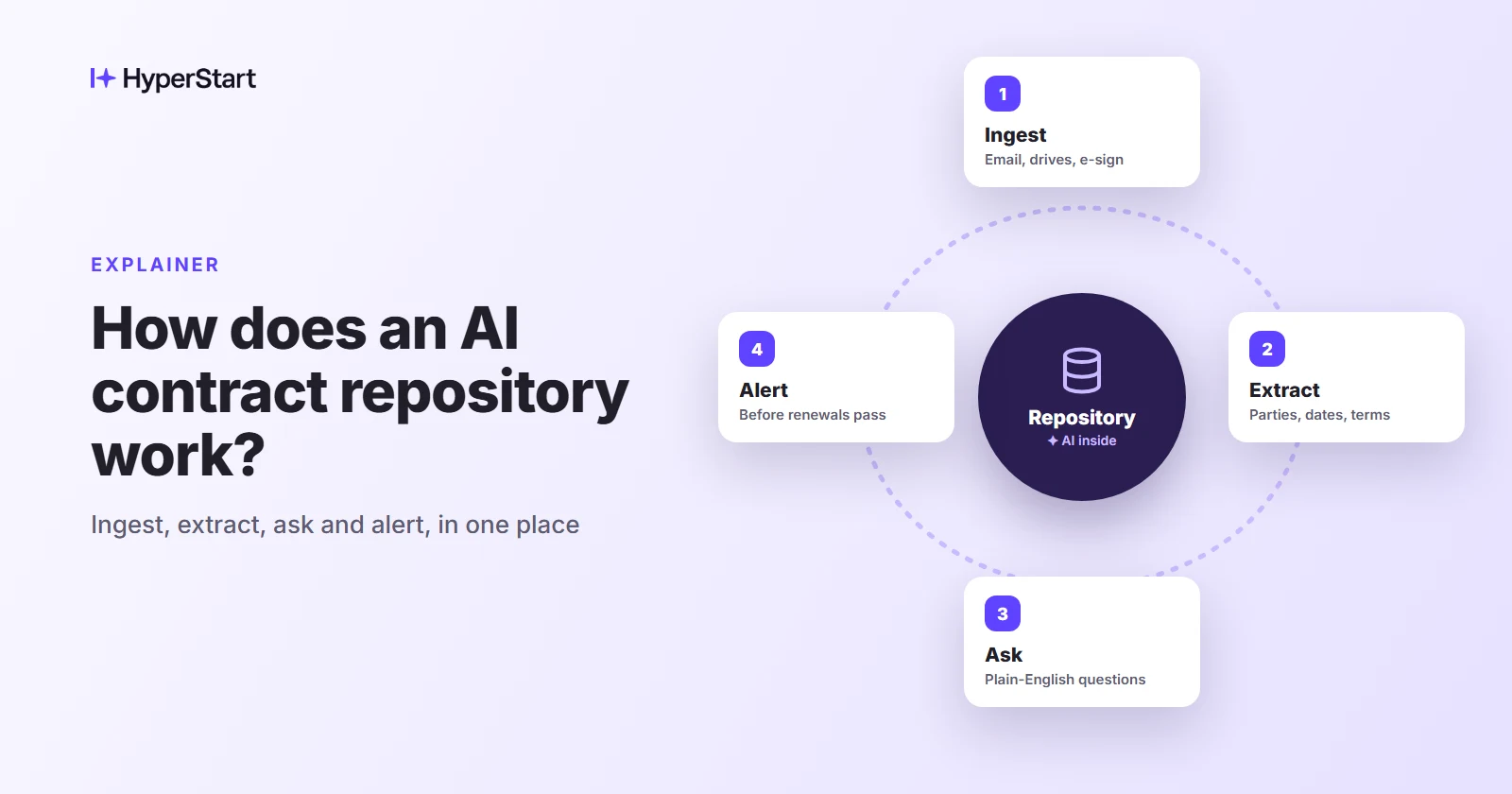
An AI contract repository works by using artificial intelligence to ingest, read, organize and extract data from contracts, so they can be searched and tracked, not just stored.
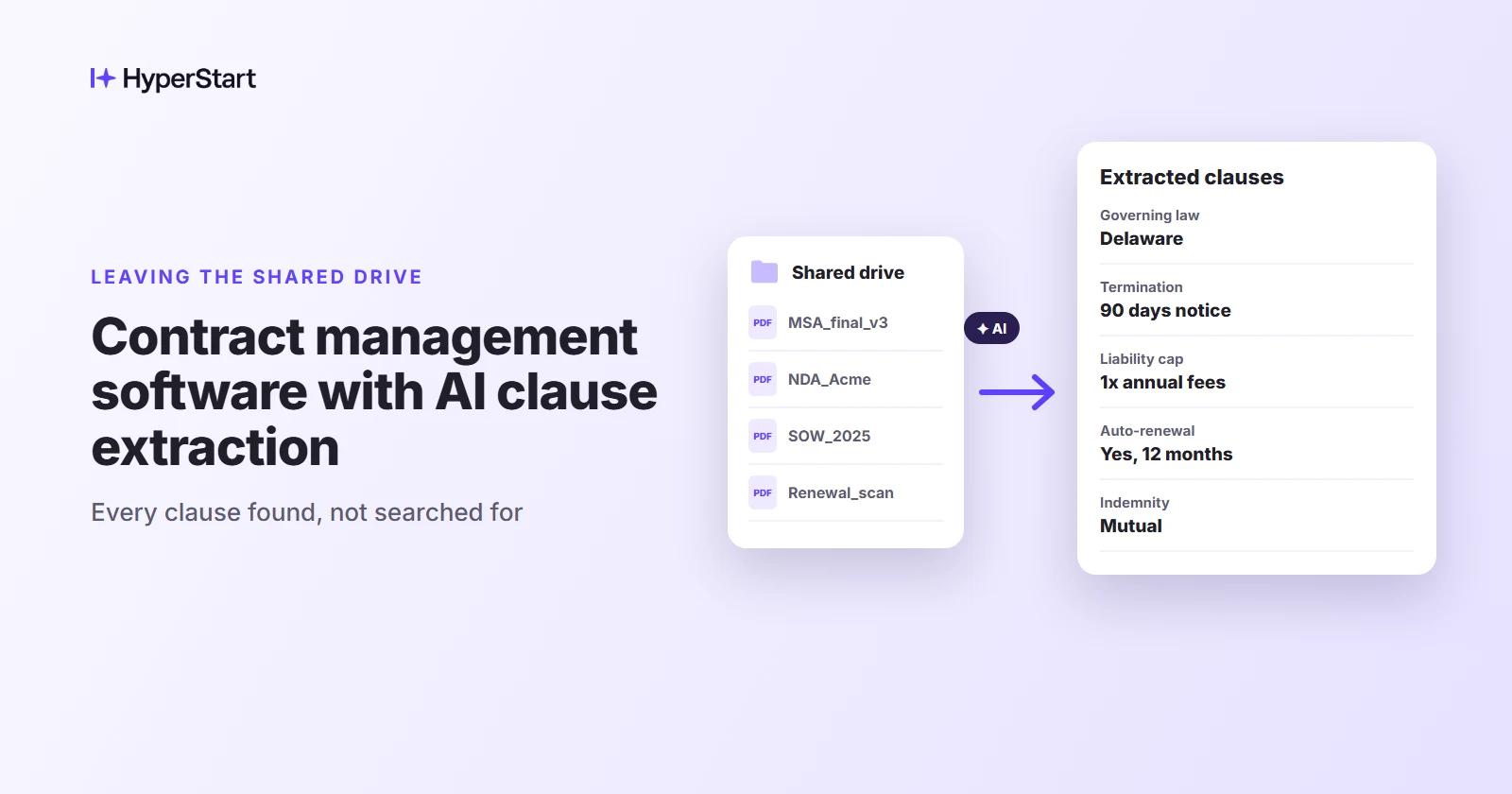
A shared drive behaves like a passive filing cabinet: it holds the file, but nothing in it knows what the contract says.
The repository collects agreements from email, shared drives and e-signature tools, and pulls out counterparties, dates and payment terms automatically. It then answers plain-English questions and sends alerts before renewal and expiration deadlines.
- An AI contract repository works in five steps: ingest, extract, link, search and alert.
- OCR makes scanned contracts readable, and natural language processing turns contract text into fields.
- A trustworthy repository lets you trace every extracted value back to the clause it came from.
- Metadata rollup across a contract family shows the current terms, which no single document may state.
How an AI contract repository works (step-by-step)
Step 1: How do contracts get into the repository?
An AI contract repository starts with ingestion: contracts are uploaded or collected from shared drives, email, e-signature tools and your CRM into one centralized place.
- Bulk upload: Existing folders go in together, so nobody has to refile them by hand first.
- Connected sources: Newly signed agreements can arrive from the e-signature tool or CRM that already holds them.
- OCR for paper: Optical character recognition (OCR) turns scanned contracts into text the AI can read.
Step 2: How does the AI extract contract data?
An AI contract repository then uses natural language processing and machine learning to read each contract and extract key metadata automatically, replacing manual data entry into a spreadsheet.
Typical fields include:
- Parties: The counterparties and the legal entities that signed.
- Dates: Effective, expiration and renewal dates, plus notice deadlines.
- Payment terms: Pricing, financial obligations and terms such as net-30.
- Clauses: Governing law, liability caps and auto-renewal language.
Step 3: How are related contracts linked?
An AI contract repository links related documents into a contract family, so a parent agreement sits with its amendments and statements of work (SOWs) instead of being scattered across folders.
- Relationship mapping: Each amendment or SOW is tied to the agreement it belongs to.
- Current version: Reviewers can see which documents make up the live deal.
- Family-level data: Some systems also roll metadata up across the family, which changes what search and alerts report.
Step 4: How do you search in plain English?
An AI contract repository lets anyone with access ask questions in plain English, returning matching contracts and answers instead of forcing keyword guesses or folder hunting.
- Renewal questions: “Which vendor contracts auto-renew next quarter?”
- Commercial questions: “Show me all contracts with net-30 payment terms.”
- Legal questions: “Which agreements are governed by Delaware law?”
Step 5: How do renewal alerts work?
An AI contract repository turns extracted dates into automated renewal and expiration alerts, warning owners ahead of notice deadlines so contracts do not auto-renew without anyone deciding.
- Reminder timing: Owners usually choose how far ahead each alert goes out, so a long notice period gets an earlier warning.
- Notice periods: The deadline that matters is often the last day to give notice, which comes before the expiration date.
- Named owners: Reminders can go to the person in legal, sales, procurement or finance who has to make the call.
Many repositories add further layers after these five steps, such as flagging risky terms against an internal playbook and reporting across the contract set.
How a repository shows its work
A trustworthy AI contract repository lets you check every extracted value against the signed document, because a wrong renewal date produces a wrong alert with no visible warning.
Look for these four checks:
- Source highlighting: Selecting a field jumps to the exact clause or paragraph it came from.
- Confidence flags: Uncertain values are marked for review, so people can spend their time where the AI was least sure.
- Human review: Someone confirms key fields before the team relies on them.
- Field-level correction: When a value is wrong, a reviewer can fix it. Ask each vendor whether the correction also updates alerts and search results.
See HyperStart CLM on your own contracts
Bring a few of your own contracts, and we’ll run them through HyperStart with you in a live demo.
Book a DemoA contract family, worked through
A contract family’s current terms often can’t be read from any single document. An AI contract repository with metadata rollup combines the parent agreement, amendments and SOWs into one current record.
Here is a hypothetical software purchase. All dates and dollar figures are made up for illustration.
- Parent agreement: Effective January 1, 2026, for two years at an annual fee.
- Amendment 1: Effective September 1, 2026. It changes payment terms and extends the term by one year.
- SOW 1: Effective October 1, 2026, for a one-time data migration project fee.
| Field | Parent agreement | Amendment 1 | SOW 1 | Current family value |
| Payment terms | Net-45 | Net-30 | Silent | Net-30 |
| Term end date | December 31, 2027 | December 31, 2028 | Silent on the parent term | December 31, 2028 |
| Notice deadline (60 days) | November 1, 2027 | Follows the new term end date | Not applicable | November 1, 2028 |
| Governing law | Delaware | Silent | Silent | Delaware |
| Contracted value | $240,000 | Adds $120,000 | Adds $30,000 | $390,000 |
Which document governs?
Start with the parent agreement’s order-of-precedence clause, if it has one. In this example, the amendment controls the two terms it expressly changes, the SOW adds its own project and fee, and the parent’s other terms carry forward.
Have legal confirm the result when documents conflict or the wording is unclear.
What goes wrong without rollup?
If the system reads only the parent agreement, it reports net-45 payment terms and sets the notice alert a full year early. Finance also sees only the parent agreement’s value instead of the full contracted value.
Each figure matches a real document, but none reflects the current deal.
HyperStart is contract lifecycle management (CLM) software for mid-market legal and operations teams. It covers the whole contract lifecycle in one product and goes live in weeks, with no implementation partner.
In HyperStart, this purchase would be one contract family: the amendment and the SOW link to the parent agreement, and the metadata rolls up. The renewal reminder then follows the 2028 date the amendment set, not the one in the original PDF.
Conclusion
An AI contract repository works by reading each contract on the way in, turning its terms into fields, linking related documents and acting on the dates it finds.
The step that decides whether you can trust it is the last mile: tracing each value to its clause and rolling amendments into the current terms.
HyperStart does that inside its contract families, so the renewal reminder reflects the latest amendment.
Book a demo and bring a contract that has been amended twice, then compare the rolled-up terms with what your team believes is current.
Try HyperStart CLM before you decide
The whole contract lifecycle in one product, live in weeks, with implementation included in the quote and no implementation partner.
Book a Demo