


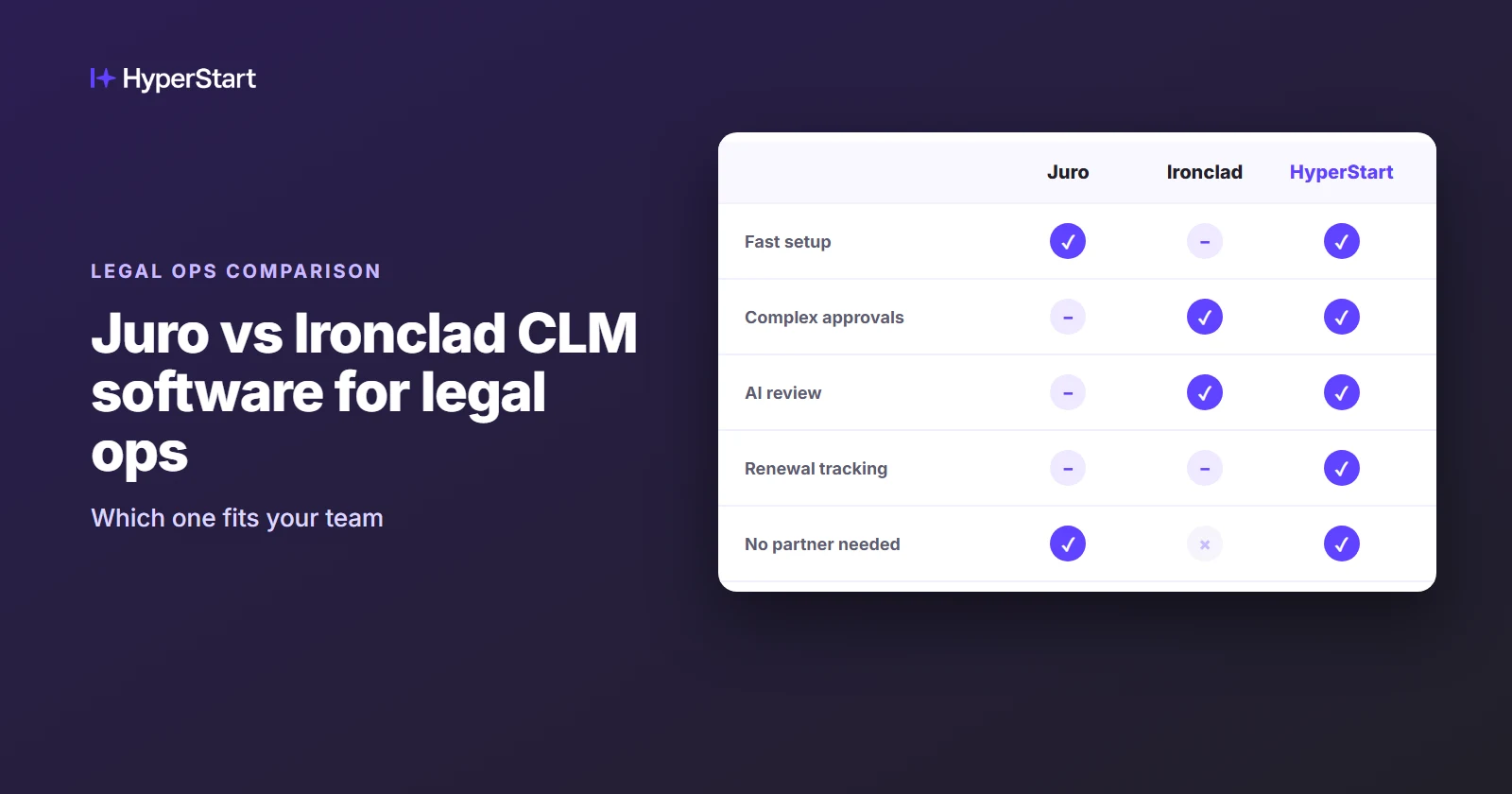
Juro is the pick for ease of use and fast setup. Ironclad is the pick for complex, multi-department approval workflows. Both are contract lifecycle management (CLM) platforms, and neither wins outright.
The choice comes down to company size, contract volume and who will maintain the system. For a lean legal ops team still working from folders and Word files, HyperStart is a third option, covered below.
- Juro is built for fast setup and ease of use, with a browser-native editor for standard paper.
- Ironclad is built for approvals that cross legal, finance, procurement and sales, with deep Salesforce and Coupa connections.
- Neither Juro nor Ironclad publishes a price list, so compare license and implementation as two separate lines.
- Vendr’s median price for Juro sits below Ironclad’s, but Juro charges extra for deeper integrations.
- HyperStart suits lean legal ops teams that negotiate in Word and want to change approval paths themselves, with implementation in the quote.
Which should you choose?
Juro suits small teams on standard paper that need to be live quickly. Ironclad suits approvals that cross several departments. HyperStart suits teams moving off folders and Word templates who want the whole lifecycle without a configuration project.
Comparison sites give a fit verdict like this, not a ranking.
- Choose Juro if: your contracts are mostly standard paper, your business users will draft in a browser, and speed of setup matters more than workflow depth.
- Choose Ironclad if: approvals route through several departments, you need Salesforce and Coupa connected, and someone on the team can own configuration as an ongoing job.
- Choose HyperStart if: your counterparties negotiate in Word, your legal ops lead wants to redraw approvals without an admin, and you want implementation inside the quote.
Juro vs Ironclad vs HyperStart at a glance
The biggest differences are setup effort, where redlining happens and who changes approval workflows.
| HyperStart | Juro | Ironclad | |
| Setup | Implementation included in the quote, with no implementation partner; live in weeks | Known for fast, self-service setup | Configured in depth; Vendr lists implementation as a cost on top of the license (see price below) |
| Main strength | The whole lifecycle for a lean team: intake, templates, approvals, Word redlining, repository, contract families and renewal tracking | Browser-native drafting, a shared negotiation workspace, and obligation and milestone tracking | Complex approval workflows, Salesforce and Coupa integrations, and Jurist AI review |
| Redlining in Word | In Word, inside the platform | Browser-native editor, plus a Word add-in that syncs back into Juro | Microsoft Word integration; Jurist works in an editable .docx workspace |
| Who changes approval workflows | Your legal ops team, by redrawing the flow on screen | Suited to simpler approval paths | A no-code workflow designer for multi-step, conditional approvals, usually owned by an admin |
| Pricing model | Custom quote by users or contract volume, never both; implementation included | Quote based on contract volume and integrations, unlimited users (see price below) | Custom quote (see price below) |
In plain terms, Juro is quicker to start, and Ironclad goes deeper on approval routing and integrations. HyperStart keeps negotiation in Word and lets legal ops redraw approvals, for teams that need a little of both.
Juro: best for fast, easy setup on standard paper
Juro is a contract lifecycle management platform known for ease of use and fast deployment. Its browser-native editor lets sales and other business users create and agree standard contracts without legal handling each one.
That makes Juro a common first CLM for small teams with predictable paper.
- Best for: small legal teams and business users working mainly on standard agreements who want to be live quickly.
- Strengths:
- Ease of use: a browser-native editor, so there is no round trip between Word and PDF (erpresearch, aivortex).
- Bulk generation: contracts can be created in bulk from CRM or applicant-tracking data (erpresearch).
- Negotiation: a shared workspace where counterparties negotiate (erpresearch).
- Tracking: obligation and milestone tracking after signature (erpresearch).
- AI: Juro Operator answers natural-language questions about contracts (erpresearch).
- What to test:
- Growth: ask how templates, reporting and integrations hold up if your contract volume doubles.
- Regulated work: if you work in pharma or financial services, ask Juro for references from teams in your sector.
- Workflow depth: if approvals cross several departments, build your real approval path in Juro before you commit.
- Price: Juro publishes no prices. Plans are based on contract volume and integration complexity, every plan has unlimited users, and deeper integrations such as Salesforce, HubSpot and Workday cost extra (Juro pricing, as of Nov 2026). Vendr puts the median at $31,164 a year, with a range of $11,976 to $132,339 (as of Nov 2026).
- Reviews: 4.5/5 on G2 (247 reviews, as of Nov 2026).
Ironclad: best for complex, multi-department approval workflows
Ironclad is a contract lifecycle management platform known for complex, multi-department approval workflows and deep customization. It connects contract work to Salesforce and Coupa and ships Jurist, an AI agent for review and redlining. It suits teams that have someone to own its configuration.
- Best for: teams whose approvals cross legal, finance, procurement and sales, and who need contracts tied into several business systems.
- Strengths:
- Approval routing: multi-step, conditional approval chains built in a no-code workflow designer.
- Integrations: native two-way sync with Salesforce, plus procurement sync with Coupa (techbible, oneflow).
- AI: Jurist reviews and redlines contracts, and Gartner reviewers single it out for that work.
- Word: a Microsoft Word integration, with Jurist working in an editable .docx workspace (oneflow, vaquill).
- What to test:
- Admin load: ask who on your team would own workflow and metadata configuration after go-live.
- Implementation: ask for implementation as its own line, separate from the license.
- AI: ask whether AI features are in the base quote.
- Price: Ironclad publishes no prices and sells by custom quote, shaped by products, users, workflows and growth (Ironclad pricing, as of Nov 2026). Vendr puts the median at $40,875 a year, with implementation of $10,000 to $75,000+ on top (as of Nov 2026).
- Reviews: 4.4/5 on G2 (332 reviews, as of Nov 2026).
See HyperStart CLM on your own contracts
Bring a few of your own contracts, and we’ll run them through HyperStart with you in a live demo.
Book a DemoHyperStart: the whole lifecycle for teams moving off folders and Word files
HyperStart is contract lifecycle management (CLM) software for mid-market legal and operations teams. It covers the whole contract lifecycle in one product and goes live in weeks, with no implementation partner.
If your team is torn between Juro’s quick start and Ironclad’s routing depth, HyperStart is a middle path. Negotiation stays in Word, and legal ops draws approvals on screen instead of waiting on an admin.
- Best for: legal and operations teams whose contracts sit in folders and Word templates, and who need more than a drafting tool without starting a configuration project.
- Strengths:
- Redlining: negotiation happens in Word, inside the platform, so the contract never leaves the system of record.
- Approval workflows: drawn visually and changed by your own team, with no consultant and no change request.
- Contract families: each amendment sits under the agreement it changes, and key terms roll up across the family.
- AI: pulls key terms and dates out of each contract, and reviews drafts against your playbook with risk flags. Judge it on a batch of your own paper, not on a demo file.
- Trade-offs:
- Price: there is no public price list, so you need a quote.
- Fit: if your team only needs a browser editor for a handful of standard templates, it is more product than you need.
- Price: a custom quote on an annual plan, based on users or contract volume, never both at once. Workflows, integrations and contract migration are included (see pricing).
- Reviews: 4.5/5 on G2 (9 reviews, as of Nov 2026).
What changes for a legal ops team
- Requests: business teams start contracts from templates and intake forms, so legal ops stops rebuilding standard paper by hand.
- Status: one dashboard shows the stage of every contract, so fewer people message you to ask where things stand.
- Renewals: each renewal and obligation date gets an owner and a reminder, so procurement hears about an auto-renewal before notice runs out.
Want to see the redlining-in-Word flow on one of your own agreements? Book a demo and bring that agreement with you.
How much do Juro and Ironclad cost?
Neither Juro nor Ironclad publishes prices, so the figures in each tool’s price line come from Vendr’s buyer data.
Vendr’s median for Juro is lower than Ironclad’s, but Juro charges extra for deeper integrations, and Vendr lists Ironclad implementation on top of the license. Compare license and implementation as separate lines, not one headline number.
When you collect quotes, ask every vendor for three lines:
- License: the annual subscription, and whether it is priced by seats, contract volume or both.
- Implementation: whether a partner or professional services team is required, and what that costs.
- Internal admin time: how many hours a week someone on your side will spend configuring and maintaining workflows.
HyperStart puts implementation inside its quote, so for HyperStart the second line adds nothing.
How long does it take to go live?
Juro usually goes live faster than Ironclad, because it has less to configure. Comparison sites give different timelines for each product, so ask every vendor for a written plan with dates. For a small team, the timeline mostly depends on who does the configuration.
HyperStart is live in weeks for a legal ops team coming off shared folders. One-click import brings your existing contracts across, and AI metadata tagging fills in dates, parties and terms so nobody keys them in.
With no systems integrator involved, migration is not a separate project to scope.
Before you book any vendor call, answer these
Each vendor will ask you these questions, so have the answers ready:
- Volume: how many contracts does your team handle a month, and do you expect that to double?
- Editing: do your counterparties negotiate in Word, or will most paper stay on your own browser templates?
- Integrations: which systems does contract data need to reach, such as your CRM, procurement tool or e-signature?
Conclusion
Juro vs Ironclad comes down to how much configuration your team can carry. Juro suits small teams on standard paper that want to start fast in a browser editor.
Ironclad suits companies whose approvals pass through legal, finance, procurement and sales, with an admin to keep the setup running.
HyperStart sits between them for a lean legal ops team. Counterparties keep negotiating in Word, your own staff redraw approval paths, and setup comes inside the quote.
Book a demo with your answers to the three questions above and two or three contracts your team handles often.
Try HyperStart CLM before you decide
The whole contract lifecycle in one product, live in weeks, with implementation included in the quote and no implementation partner.
Book a Demo