


ContractPodAi vs Ironclad AI CLM is a choice between two enterprise-grade platforms: Ironclad, a workflow-centric contract lifecycle management (CLM) platform, and Leah (formerly ContractPodAi), an AI-first, agentic platform covering legal, procurement and finance. For a team without a CLM, both products are sold by custom quote and take months to implement, so the real question is whether you need workflow routing or AI-led legal analysis.
If your contracts sit on a shared drive and in Word templates, HyperStart is a third option to weigh alongside them.
- Ironclad is a workflow-centric CLM built around its no-code Workflow Designer, with contracts launched from Salesforce and Slack.
- Leah is ContractPodAi’s name since January 2026: an AI-first, agentic platform that reaches into legal operations, procurement, finance and compliance.
- Both sell by custom quote; Vendr puts Ironclad’s mid-market deals at $50,000 to $120,000 a year (as of Nov 2026), and Leah gives its figure only in a quote.
- Choose Ironclad when routing and sales-led contracting are the main job, and Leah when AI-led analysis across legal work is the main job.
- HyperStart is a third option for mid-market teams with no CLM yet that want to go live in weeks without an implementation partner.
Ironclad vs Leah comparison at a glance
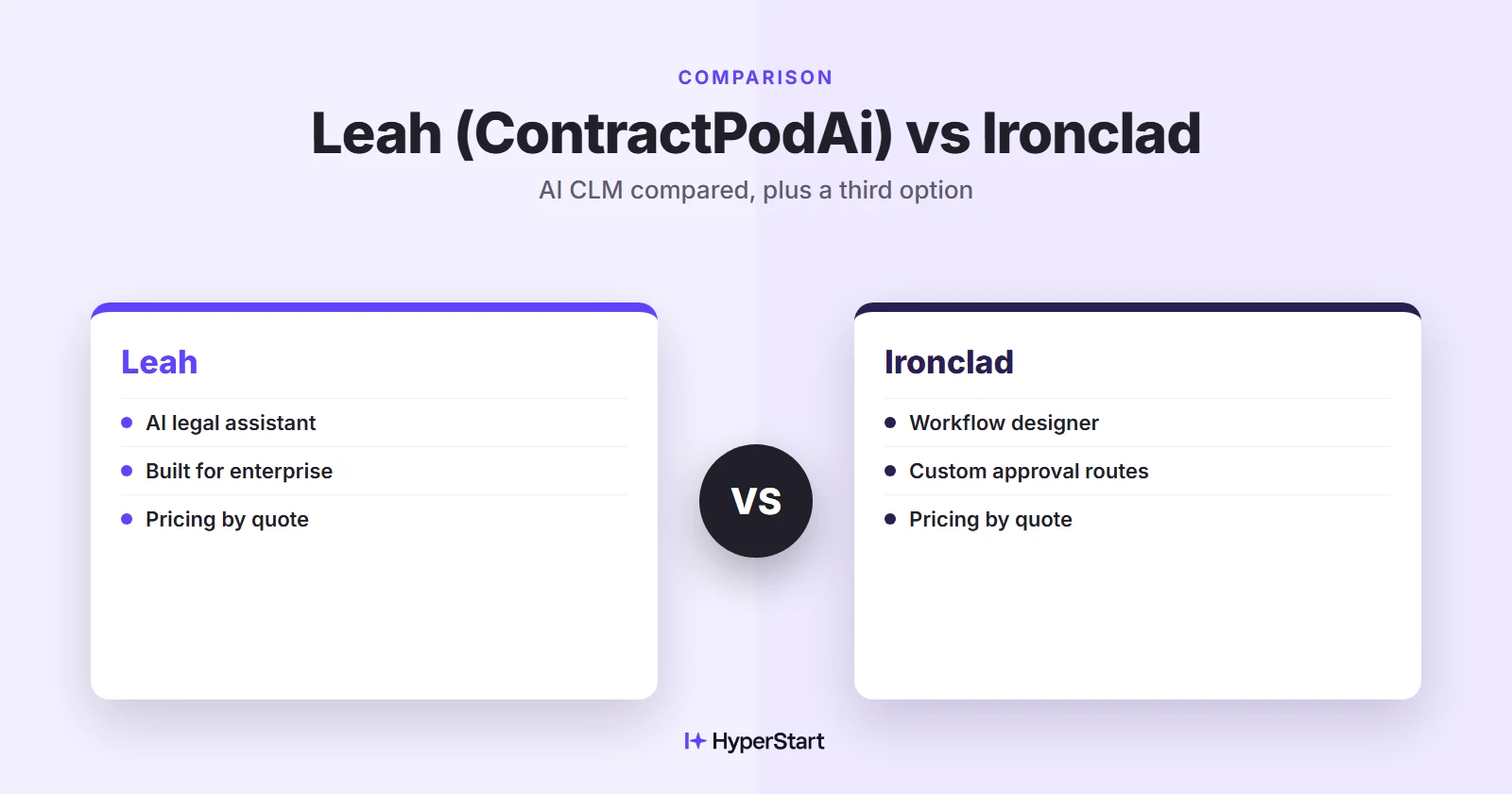
Ironclad is built around workflows and Leah around AI agents, and both sell by custom quote. HyperStart sits beside them as the mid-market option that runs the whole lifecycle in one product.
| Ironclad | Leah (formerly ContractPodAi) | HyperStart | |
| Built around | Workflows, through the no-code Workflow Designer | AI and agents, through Leah Agentic OS and Leah Agentic CLM | Contract operations across the whole lifecycle in one product, with redlining in Word inside the platform, visual approval workflows and contract families |
| Reach | Contracting, with launches from Salesforce and Slack | Legal operations, procurement, finance and compliance | Legal, sales, procurement and finance on one repository |
| E-signature | Native and bundled (Contracko, as of Nov 2026) | Add-on (Contracko, as of Nov 2026) | Through DocuSign, Adobe Acrobat Sign or Zoho Sign |
| Price (as of Nov 2026) | Custom quote; Vendr puts mid-market deals at $50,000 to $120,000 a year | Custom quote through a demo | Custom quote, implementation included |
| Buyer test to run | Ask for implementation as a separate line, and who owns the Workflow Designer after go-live | Run ten of your own contracts, including scanned ones, through the extraction and check the fields | Ask for a contract family with three amendments and rolled-up metadata |
How do Ironclad and Leah differ?
What is Ironclad known for?
Ironclad is a workflow-centric CLM whose no-code Workflow Designer handles contract routing and the approval workflow. Contracts can start where sales already works, because Ironclad launches them from Salesforce and Slack.
Key features:
- Ironclad Agent: Grounded in the Contract Knowledge Graph, which draws on a customer’s contracts, approved positions and earlier decisions. Ironclad’s October 8, 2026 press release says this knowledge stays with the company after negotiators move on (as of Nov 2026).
- Contract Review Agent (formerly Jurist): Ironclad renamed this product on October 8, 2026, according to gc.ai’s review (as of Nov 2026).
- Workflow Designer: A visual builder for routing and approvals, without code.
What is Leah (formerly ContractPodAi) known for?
Leah is the AI-first, agentic platform formerly called ContractPodAi, renamed in a company announcement dated January 5, 2026. Its products include Leah Agentic OS, Leah Agentic CLM and Leah Legal, and its reach extends past core contracting into legal operations, procurement, finance and compliance. Leah holds 4.6/5 on G2 (48 reviews, as of Nov 2026).
Key features:
- Answers with sources: Business teams question their contracts directly, and every answer links to the clause or document it came from, according to Leah’s Agentic CLM page (as of Nov 2026).
- Microsoft and SAP fit: Leah works inside Microsoft Word through an add-in and lists SAP Ariba among its integrations (Leah Agentic CLM), and SAP’s partner catalog lists Leah Agentic CLM for SAP Ariba (as of Nov 2026).
- Languages and uses: Leah supports contract review, extraction and drafting across 30+ languages, and its Agentic CLM page lists M&A due diligence among its uses (as of Nov 2026).
Is this workflow-first vs analysis-first?
Yes. spotclm.com frames this pair as workflow-first vs analysis-first (as of Nov 2026). Ironclad is the workflow-first side: a contract is what a workflow produces, which suits high-volume paper such as NDAs, order forms and standard MSAs. Leah is the analysis-first side: a contract is something to understand and interrogate.
Where does HyperStart fit?
HyperStart fits teams whose contracts still live on a shared drive and in Word templates. HyperStart is contract lifecycle management (CLM) software for mid-market legal and operations teams.
It covers the whole contract lifecycle in one product and goes live in weeks, with no implementation partner. Redlining happens in Word inside the platform, and each amendment links into its contract family with metadata rolled up.
Unlike Leah’s AI-led analysis, HyperStart centers on contract operations, so judge its AI extraction, review and redlining on your own contracts, and expect to deal directly with its product builders both before and after go-live.
What do Ironclad and Leah cost, and how long do they take?
Neither Ironclad nor Leah lists prices; both sell by custom quote. Vendr puts Ironclad’s mid-market deals at $50,000 to $120,000 a year, with implementation commonly $10,000 to $40,000 on top (as of Nov 2026), while Leah gives its figure only in a quote.
| Ironclad | Leah (formerly ContractPodAi) | HyperStart | |
| License | No public price; custom quote and demo, no free trial (Ironclad pricing). Vendr: median $40,492 a year; mid-market $50,000 to $120,000 a year (as of Nov 2026) | Custom quote through a demo | Custom quote on users or contract volume, never both at once, on an annual plan (as of Nov 2026) |
| Implementation | Separate from the license; Vendr puts it commonly at $10,000 to $40,000, and complex projects can exceed $75,000 (as of Nov 2026) | Ask for it as a separate line in the quote | Implementation included: workflows, integrations and contract migration at no extra fee |
| Time to go live | 2+ months (Contracko, as of Nov 2026) | Ask for a dated project plan with the go-live week | Live in weeks, with no implementation partner |
| Who runs it afterward | An Ironclad admin; playbook setup requires Professional Services (gc.ai, as of Nov 2026) | Ask who owns configuration after go-live | A legal team of two, with direct access to the product team |
How much does Ironclad cost?
Ironclad doesn’t publish prices; its pricing page offers a custom quote and a demo, with no free trial (Ironclad pricing, as of Nov 2026).
Vendr reports a median of $40,492 a year across 372 purchases, with mid-market companies (100-500 employees) commonly paying $50,000 to $120,000 a year and large enterprises often over $200,000; implementation commonly runs $10,000 to $40,000, and complex projects can exceed $75,000 (as of Nov 2026).
Pricing is based on editor seats and contract volume, as our Ironclad pricing breakdown explains. Treat the license and the implementation as two separate numbers, because a quote that shows only the license is not what you will pay in year one.
How much does Leah cost?
Leah pricing is also by custom quote, so a real number only arrives once you are in a sales conversation. Ask for the implementation fee in writing beside the license.
How long does Leah take to implement?
Leah publishes no go-live time. Ask for a dated project plan with the go-live week in the quote, and plan who will carry that project alongside the daily contract queue, since the work doesn’t pause while the rollout runs.
Which should you choose?
Choose Ironclad if
Choose Ironclad when workflow routing and sales-led contracting are the main job.
- Your contracts start in Salesforce or Slack and sales needs to launch them there.
- Complex routing is your main problem, and someone can own the Workflow Designer as its admin.
- You want e-signature bundled with the CLM.
Choose Leah if
Choose Leah when AI-led analysis across legal work, not just contracts, is the main job.
- You work mostly in Microsoft Word and Microsoft 365, or buy through SAP Ariba.
- AI-led analysis is the main job, including non-English contracts.
- The project reaches beyond contracts into legal operations, procurement and compliance.
Choose HyperStart if
Choose HyperStart when you are a mid-market team getting its first CLM live.
- Your contracts sit on a shared drive and in Word templates, and no CLM is in place yet.
- You want to go live without an implementation partner and change approval workflows yourself.
- Your DocuSign, Adobe Acrobat Sign or Zoho Sign account stays, and you need the contract layer around it.
Want to see how HyperStart handles your contract families, redlines and approval workflows? Book a demo with our team.
See HyperStart CLM on your own contracts
Bring a few of your own contracts, and we’ll run them through HyperStart with you in a live demo.
Book a DemoWhat are the pros and cons of Ironclad, Leah and HyperStart?
Ironclad’s strengths are mature workflow tooling and bundled e-signature, Leah’s are AI-led analysis that reaches beyond the contract desk, and HyperStart’s are redlining in Word inside the platform and contract families. All three are priced by quote.
Ironclad pros and cons
Pros:
- Mature workflow tooling with real depth in Salesforce.
- Past negotiating positions stay available after staff leave.
- No separate signature vendor is needed.
Cons:
- Pricing is hard to judge before a sales process.
- Rollout carries its own project and its own fee, commonly $10,000 to $40,000 according to Vendr (as of Nov 2026).
- Its AI can feel added to an existing architecture rather than native to it, a criticism made by agenticcontractreview.com (as of Nov 2026).
Leah pros and cons
Pros:
- Covers work well beyond the contract desk.
- Reviews, extracts and drafts contracts in 30+ languages.
- Business teams can find answers without asking legal first.
Cons:
- Have the person who will run it daily do a real task in the trial, to test the learning curve yourself.
- Leah publishes no go-live time, so ask for a dated project plan.
- There is no public price list, so you need a sales conversation to get a number.
HyperStart pros and cons
Pros:
- Negotiation stays in the system of record, because redlining happens in Word inside the platform.
- Your team changes its own approval workflows, with no consultant or change request.
- Amendments link to the parent agreement, and metadata rolls up across the contract family.
Cons:
- Pricing is also by quote, so you need a conversation to get a number.
- E-signature relies on a provider such as DocuSign, Adobe or Zoho Sign rather than a built-in tool.
- It is built for contract operations, so Leah is the closer fit if M&A due diligence is the main job.
How do the three compare on security review?
HyperStart is SOC 2 Type 2 and ISO 27001 certified, and HIPAA compliant. For Ironclad and Leah, ask each vendor for its current SOC 2 report and ISO certificate before IT starts its questionnaire, and check the dates on both.
What does your team need?
Three answers change what every vendor should show you, so write them down before the first call:
- Team size: How many people will run the system each week, and who owns it after go-live?
- Contract volume: How many contracts do you handle a year, and how many are standard paper rather than negotiated?
- Connected systems: Do your contracts start in Salesforce, Microsoft 365 or SAP?
Book a demo with those three answers. Send us your approval matrix and a contract family, and we’ll build both in the demo.
Try HyperStart CLM before you decide
The whole contract lifecycle in one product, live in weeks, with implementation included in the quote and no implementation partner.
Book a Demo