


If you’ve ever watched Spellbook confidently insert a legal citation that doesn’t exist, this blog is for you.
Spellbook alternatives are getting a lot of attention in 2026 — and here’s why. Legal teams have moved past “can AI draft a contract?” and are now asking much harder questions: Can it review 500 documents at once? Does it follow our playbook, not some market average? And critically, where does our client data actually go?
This guide breaks down the seven best Spellbook alternatives on the market right now, with real user citations, honest pros and cons, and a framework to help you pick the right tool for your team’s specific workflow.
Why legal teams are looking for Spellbook alternatives in 2026
Spellbook is a solid drafting assistant. It lives in Microsoft Word, it’s intuitive, and for a solo lawyer or small firm doing straightforward NDA work, it gets the job done. But when legal teams start pushing it harder, cracks start to appear in specific, expensive ways.
Here’s what’s actually driving the switch
1. Hallucinated legal citations
In an April 2026 review on Software Finder, Courtney H. put it plainly: “One major frustration… is the incorrect legal citations it sometimes provides… it still inserts one which leads me down the wrong path and wastes time.”
For a litigation team or a compliance-heavy in-house department, a hallucinated citation is a liability.
2. “Generic” or “random” redlines
On Reddit’s r/legaltech, users in 2025 raised a concern that resonates: “The moment you let it ‘improve’ language… you’re now debating its judgment instead of verifying its checklist work… I’d like to control the drafting.”
The issue isn’t that Spellbook’s suggestions are wrong per se, it’s that they’re unpredictable. When you’re trying to enforce a specific negotiation playbook, “creative AI suggestions” are the last thing you need.
3. Inability to handle complex due diligence
This one is structural. According to a 2026 Bind Legal comparison analysis, “Spellbook operates on one document at a time within Word. It was not designed for multi-document analysis or the systematic review that due diligence requires.”
For fund formation, M&A due diligence, or any high-volume transactional work, that single-document ceiling is a dealbreaker.
4. The “surgical vs. sloppy” edits problem
In a 2026 Reddit AMA with founders at Gavel, Dorna noted: “There are three layers for us: First, redline quality. Are the edits surgical or sloppy?… We see customers rolling out [alternatives] beyond legal.”
This is the maturity question. As legal AI moves from novelty to necessity, teams need tools that make precise, defensible edits — not ones that require extensive cleanup.
Read also: Spellbook Pricing
Spellbook is bad was built as a drafting copilot, not a contract lifecycle platform. Teams outgrow it the moment they need consistency enforcement, multi-document intelligence, or post-signature workflow.
Best Spellbook alternatives at a glance (comparison table)
| Hyperstart CLM | Full lifecycle (CLM) | SOC 2 / Agentic AI | Unified platform |
| LegalFly | Compliance & privacy | Local anonymization | Word / Browser |
| Gavel Exec | High-volume transactional | Precision search | Word / Web |
| Ivo | Strict consistency | Managed playbooks | Word plugin |
| Ironclad | Enterprise scaling | Corporate-grade | Full ecosystem |
The 5 best Spellbook alternatives for legal teams in 2026
1. LegalFly
LegalFly has built its reputation around solving one very specific problem: the IT block. Most AI tools send contract data to centralized LLMs hosted by third parties. For regulated industries — financial services, healthcare, government — that’s a non-starter.
LegalFly’s Privacy-First-by-Design architecture takes a different approach. Before any analysis begins, the tool detects and pseudonymizes PII — names, company roles, identifying details — while keeping the legal context fully intact. According to LegalFly’s 2026 technical documentation, their anonymization engine ensures sensitive data never leaves the local environment.
Key Features of LegalFly
Jurisdiction validation: Legal content validated across specific global jurisdictions — essential for cross-border contracts
Pseudonymization engine: Context-aware data masking that doesn’t break clause meaning
Private cloud deployment: Hybrid or full on-premise options for teams that can’t use SaaS
Pros of LegalFly
Highest security tier on this list; compliant with GDPR, ISO 27001, and SOC 2 Type II
Strong choice for any team operating under strict data residency requirements
Cons of LegalFly
More expensive than plugin-only tools because of the local processing infrastructure
Slightly steeper setup curve for non-technical legal ops teams
2. HyperStart CLM
Most teams start looking at Spellbook alternatives when they hit what legal ops professionals are calling the “Word ceiling.” The drafting is fine. But the moment a contract is signed, Spellbook’s institutional memory goes dark. There’s no repository, no renewal alert, no way to ask “what did we agree to last time with this counterparty?”
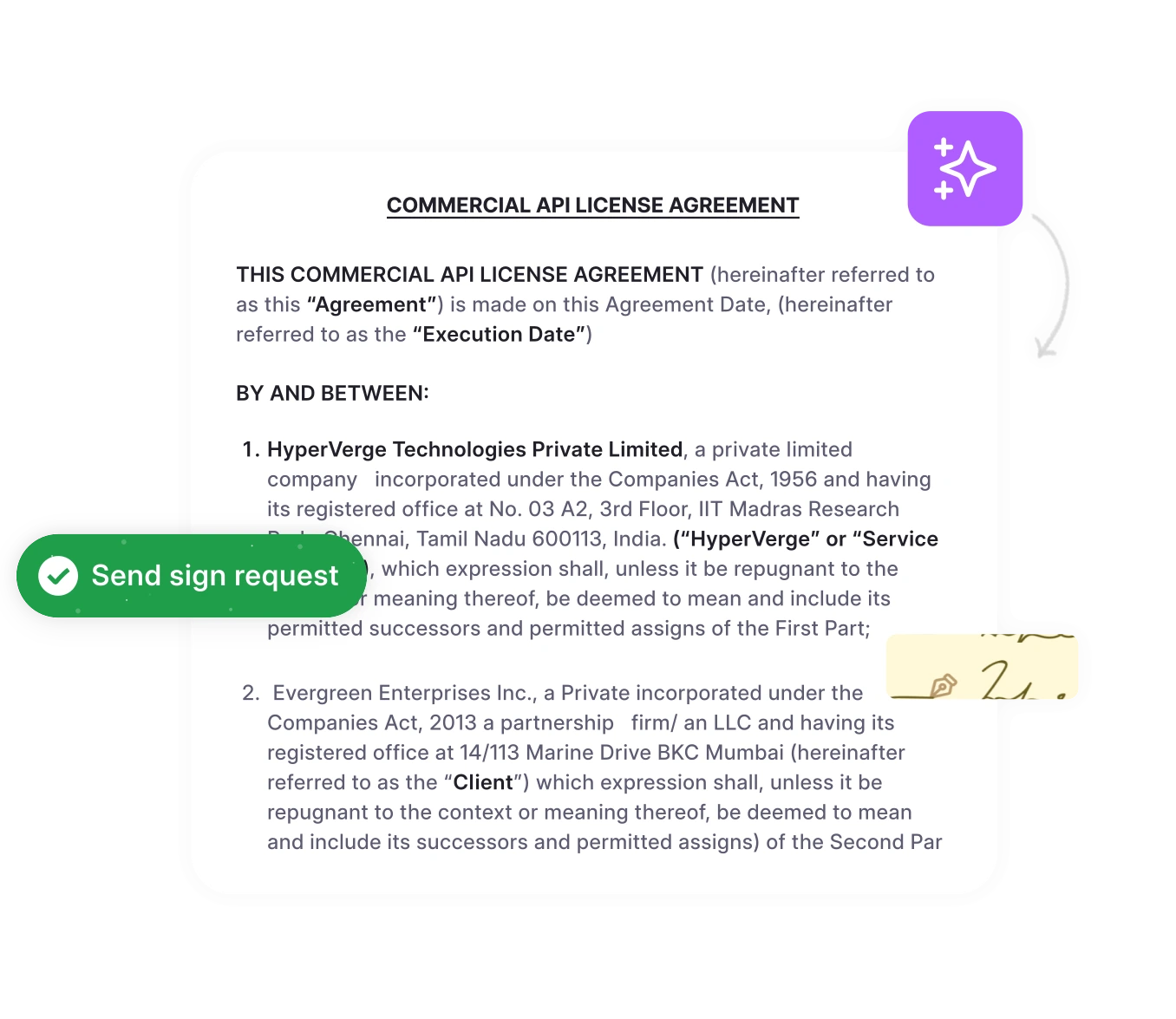
HyperStart bridges that gap. It’s not just a drafting assistant; it’s a full Contract Lifecycle Management (CLM) platform that handles everything from first draft to renewal tracking in a single environment.
Key Features of HyperStart CLM
- AI Redlining: AI Playbooks with your rules, Snippets for precedent clauses, and Chat for legal research with codified institutional language in a browser-based Word add-in.
- Intake Forms: Legal front door to streamline contract requests from across departments and apps.
- Contract Repository and Charts: Surface contract intelligence in seconds.
Pros of HyperStart CLM
- One single source of truth for drafting, storage, and renewals — no context switching between Word, email, and a separate CLM
- Agentic AI handles complex, multi-document scenarios that Word plugins can’t touch.
- Deep Microsoft 365 ecosystem integration
Cons of HyperStart CLM
- Requires more initial setup than a simple plugin to map existing contract data
- Not the right fit if all you need is a lightweight drafting assistant
Ready to see the future of legal AI?
Stop settling for simple drafting and redlines. Experience how Hyperstart automates the entire contract lifecycle. Book a demo today →
Book a Demo3. Gavel Exec
Gavel has evolved significantly. What started as a document automation tool for intake forms has become a high-precision transactional platform. In 2026, Gavel launched Gavel Exec for Web, allowing lawyers to run batch analysis across hundreds of files simultaneously, turning a folder of contracts into an interactive spreadsheet of extracted terms, according to National Law Review’s 2026 coverage.
Key Features of Gavel Exec
- Hybrid search technology: Combines semantic search(concept-level) with full-text search(exact language match) for 93% extraction accuracy
- Data-driven negotiation: Compares your redlines against market-standard clause positions
- Batch analysis: Process entire deal rooms, not just individual files
Pros of Gavel Exec
- Deeply stable Word integration; supports long-form drafting grounded in real precedent banks.
- Strong choice for transactional and commercial practice groups
Cons of Gavel Exec
- Market-average redlining means less control for teams with strict playbooks.
4. Ivo
If your firm has a very specific way of doing things — and the whole point of your playbook is that it never gets overridden — Ivo is built for you. It’s the choice for teams that value strict rule enforcement over creative AI suggestions.
What makes Ivo different is its deterministic logic. Unlike generative AI, which can introduce variation even within guardrails, Ivo features ensure consistency across every agreement it touches, according to Spellbook Briefs’ 2026 analysis.
Key Features of Ivo
- Managed playbooks: Ivo’s internal legal team actually builds and maintains your playbooks for you — this is a significant service differentiator
- Zero hallucination risk: Rule-based logic means no surprises
- High-volume standardized agreements: NDAs, SaaS MSAs, vendor agreements — the stuff legal teams process in bulk
Pros of Ivo
- Ideal for high-volume, standardized agreement workflows
- No risk of the “creative” suggestions that frustrate teams trying to enforce consistent language
Cons of Ivo
- Rigid by design — lacks the market benchmarking and creative drafting found in Gavel Exec or Spellbook.
- Less useful for complex, bespoke transactions that require contextual judgment
5. Ironclad
Ironclad is an enterprise CLM that It belongs on this list because for large enterprise legal teams, the biggest Spellbook alternative isn’t another AI assistant. It’s an entirely different category of software that treats contracts as operational data.
Key Features of Ironclad
- Jurist AI: A generative AI assistant built into the Ironclad ecosystem for summarization and redlining
- Salesforce native: Two-way data sync lets Sales teams launch and track contracts without ever leaving their CRM
- Complex approval chains: Multi-stakeholder workflows with conditional routing
Pros of Ironclad
- The gold standard for enterprise legal ops; handles massive complexity
- Deep integrations across the revenue stack(Salesforce, NetSuite, ServiceNow)
Cons of Ironclad
- $30k–$150k+ per year — budget typically requires CFO sign-off
- Implementation can take months; not a plug-and-play solution
Read: Ironclad Competitors & Alternatives, Ironclad Pricing, and Ironclad Reviews
How to choose: an evaluation framework for legal AI
Not all AI contract tools are created equal. Here’s what actually matters when you’re comparing options.
LLM transparency and hallucination checks
Ask every vendor: what’s your hallucination index? Modern evaluation frameworks like DeepEval allow teams to measure two things independently — Faithfulness (how closely the AI sticks to the source document) and Answer Relevancy (whether the response actually addresses what was asked). If a vendor can’t give you a straight answer on this, that’s a red flag.
The distinction matters especially for legal AI. A tool that’s 95% accurate on general text can still get a party name, a governing law clause, or a liability cap wrong — and that’s where accuracy gaps become litigation risks.
Playbook-based vs. market-average redlining
This is one of the most important strategic decisions in your evaluation:
- Playbook-based redlining(Hyperstart, Ivo): High consistency. The tool follows your specific negotiation rules. Ideal for teams with mature playbooks or strict compliance requirements.
- Market-average redlining(Spellbook, Gavel Exec): High context. The tool tells you what’s “standard” in the industry, useful for teams benchmarking against market norms or entering new contract categories.
Neither is objectively better — the right choice depends on your team’s maturity and workflow.
Security tier requirements
| GDPR / data residency | LegalFly (local anonymization) |
| SOC 2 Type II, full CLM | Hyperstart |
| Enterprise-wide process automation | Ironclad |
| Strict playbook enforcement | Ivo |
| High-volume transactional review | Gavel Exec |
What next?
Spellbook does what it says on the tin. It’s a capable drafting assistant for lawyers working in Microsoft Word. But “good at drafting” isn’t the ceiling legal teams are shooting for anymore.
If you need hallucination mitigation, multi-document intelligence, post-signature lifecycle management, or enterprise-grade security, you need a Spellbook alternative that was built for those requirements from the start.
For privacy-first requirements, LegalFly is in a class of its own. For strict playbook enforcement at scale, Ivo has few rivals. For most in-house and legal ops teams, Hyperstart covers the widest range of contract management use cases — from intake to auto-redlining grounded in corpus-level analysis across deal rooms.
The AI legal assistant market has matured fast in 2026. Switching to the right contract automation software now isn’t just a workflow upgrade; it’s a competitive advantage.
Ready to move beyond drafting?
See how Hyperstart’s agentic AI handles the full contract lifecycle, from first draft to renewal.
Book a Demo