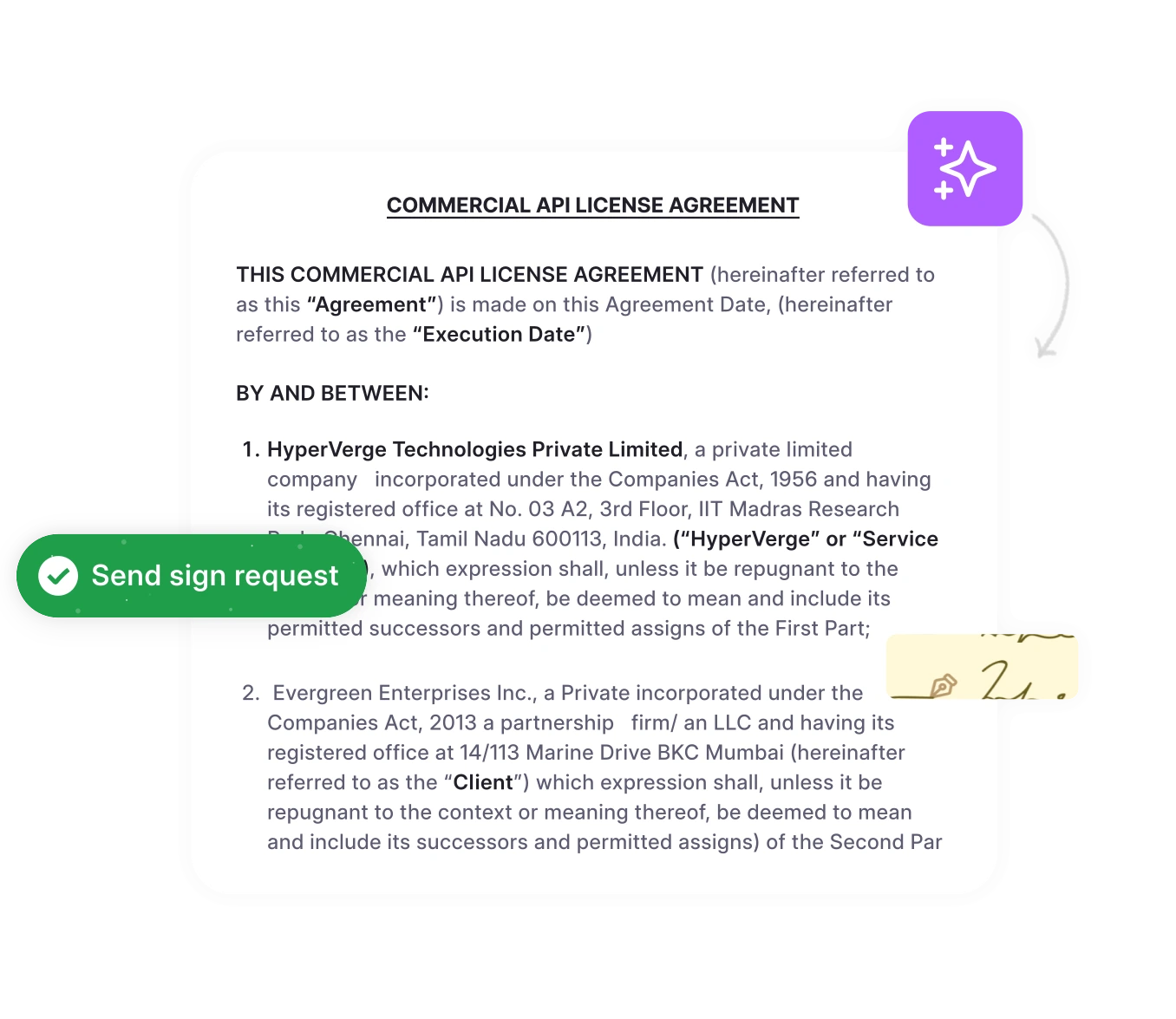




- A contract playbook is a structured guide that captures your legal team’s preferred positions, fallback clauses, and escalation rules — so every negotiator works from the same playbook, not personal judgment.
- Playbooks are most valuable for high-volume contract types: NDAs, MSAs, SaaS agreements, vendor contracts, and procurement deals.
- A strong playbook includes standard positions, fallback clauses, walk-away triggers, approval workflows, and clause-level guidance — not just template language.
- Static PDFs break down at scale. CLM software like HyperStart enforces playbook rules inside the contract workflow, reducing legal review time and ensuring compliance at every stage of the contract lifecycle.
Most contract negotiations stall not because of difficult counterparties, but because teams lack clear direction on what to agree to, what to escalate, and where to draw the line. These are the contract management challenges a contract playbook is designed to solve.
The consequences are delays in drafting, weak negotiations, disorganized workflows, and revenue loss. As per World Commerce and Contracting, poor contract management costs companies 9% of their annual revenue.
A contract playbook turns your legal team’s judgment into a reusable system. Instead of every negotiation starting from scratch, your team has pre-approved language, fallback positions, and escalation rules they can follow without waiting for legal sign-off on every clause.
What is a contract playbook?
A contract playbook is a structured reference document that standardizes how contracts are drafted, reviewed, negotiated, and approved within an organization. It captures your legal team’s preferred positions, acceptable fallback clauses, deal-breakers, and escalation protocols, so that judgments made once can be applied consistently at scale.
For example, a SaaS company might maintain a separate playbook for each contract type: one for NDAs, one for MSAs, and one for vendor agreements. Each playbook tells sales ops, procurement, and junior legal staff exactly how to handle common negotiation scenarios without escalating every decision to general counsel.
Key elements every contract playbook covers:
- Standard positions: Your preferred, pre-approved contract language for each clause type
- Fallback clauses: Pre-approved alternative language when the other party pushes back
- Walk-away triggers: Non-negotiable terms where no concession is acceptable
- Approval matrix: Who signs off on deviations and at what threshold
- Escalation paths: When and how to loop in legal or senior leadership
- Rationale statements: Plain-English explanations of why each clause position exists
Note the distinction: a clause library is a collection of approved language. A playbook is the decision logic around that language; it tells your team which clause to use, when to accept an alternative, and when to walk away.
What types of contracts need a playbook?
Build a playbook wherever volume, complexity, and risk overlap. The contract types that most consistently benefit from a dedicated playbook are:
- NDAs: High volume, often negotiated by non-legal staff. The most common starting point because the clause set is narrow and decisions are repeatable.
- Master service agreements (MSAs): Govern long-term service relationships. Complex enough to warrant detailed fallback guidance on liability, IP, and termination.
- Sales contracts and order forms: Negotiated frequently by sales reps under time pressure. A playbook gives sales clear guardrails on payment terms, SLAs, and liability caps without legal involvement in every deal.
- Vendor and supplier agreements: Procurement needs structured guidance on indemnification, IP ownership, data security, and exit rights.
- Data processing agreements (DPAs): Mandatory for organizations handling personal data under GDPR. The playbook ensures every DPA meets compliance requirements without a legal review for each one.
- SaaS agreements: Sales and customer success teams need clear guidance on what they can offer and what requires legal sign-off.
- Employment and contractor agreements: HR negotiates these repeatedly. A playbook for compensation terms, non-compete language, and IP assignment prevents inconsistency across hires.
Start with the contract type that causes the most internal friction. Build that playbook first, prove the value, then expand.
Who uses a contract playbook?
Contract playbooks are not just for lawyers. Every department that touches contracts benefits from one — but in different ways.
- Legal teams use playbooks to scale their judgment without scaling headcount. Senior attorneys can focus on complex, high-stakes matters instead of answering the same clause questions repeatedly.
- Sales teams use playbooks to close deals faster. A sales-facing playbook — sometimes called a contract negotiation playbook — tells reps exactly what they can agree to without legal review, what requires manager approval, and what is off the table.
- Procurement teams use playbooks to standardize vendor onboarding and ensure supplier contracts align with internal risk policies on payment terms, delivery obligations, and exit rights.
- Finance teams rely on playbooks to ensure every contract aligns with budget and forecasting requirements — particularly around payment structures, revenue recognition triggers, and penalty clauses.
- Compliance teams use playbooks to ensure regulatory language, data protection clauses, and reporting obligations are embedded in every contract by default — not added during a post-signature audit.
- HR teams use playbooks for employment contracts and contractor agreements to prevent inconsistency across hires in different regions or roles.
- Operations and IT benefit from playbook guidance on data processing terms, SLA definitions, and software licensing restrictions — clause types that have grown significantly more important as businesses digitize.
When do you need a contract playbook?
Ask yourself whether any of the following apply to your organization:
- Your legal team spends significant time reviewing contracts non-lawyers could handle with proper guidance
- Contracts consistently take longer than expected to finalize, and the delay is internal rather than from the counterparty
- Teams are relying on outdated templates or making unauthorized clause changes
- The same clause questions recur across deals, and the answers live in someone’s head rather than a shared document
- Contract non-compliance — missed obligations, inconsistent terms, unenforced rights — is increasing
- Your organization is growing and the ad hoc approach that worked at 20 people is breaking down at 200
If two or more apply, you are ready to build a playbook. A focused effort on one contract type can produce a usable first playbook in two to four weeks. The three factors that determine how comprehensive it needs to be are volume, complexity, and risk. High overlap across all three means a detailed playbook is worth the investment. Low overlap means a simple one-page reference may be enough.
What does a contract management playbook include?
Here are the core components every contract management playbook should contain:
1. Standard clause positions with rationale
For each key clause, document your organization’s preferred, pre-approved language — and the business reason behind it. When non-legal team members understand why a clause is written the way it is, they negotiate more effectively and escalate only when it genuinely matters. This is the core of the playbook.
2. Pre-approved fallback positions
A fallback position is the pre-approved alternative clause your team can accept when the counterparty rejects your standard language. Every key clause should have at least one fallback, and preferably two. Here is a real example of how to structure a Payment Terms clause:
| Position | Clause language | Approval required |
|---|---|---|
| Standard | Net 30 days from invoice date | None |
| Fallback 1 | Net 45 days from invoice date | Sales Manager |
| Fallback 2 | Net 60 days from invoice date | VP Finance |
| Walk-away | Beyond Net 60 | CFO only |
This structure gives your sales team clear guardrails. They can agree to Net 45 without looping in legal. Anything beyond Net 60 is a walk-away — full stop.
3. Contract templates by agreement type
Pre-approved templates reduce drafting time and ensure every new contract begins from a compliant baseline. Your playbook should reference where each template lives, who owns it, and when it was last reviewed. A template not updated in three years is a liability, not an asset.
4. Roles, responsibilities, and approval matrix
Define who drafts, who reviews, who negotiates, and who has final approval authority for each contract type. Map every deviation to the correct approver, threshold, and timeframe. “Any change to the liability cap requires VP Legal approval within 48 hours” is useful. “Major changes need senior approval” is not. Publishing the approval matrix as a standalone one-page reference directly builds contract management skills across the organization.
5. Counterparty paper checklist
When reviewing a contract drafted by the other party, the playbook should include a checklist of clauses your team must verify — unlimited liability exposure, automatic renewal without notice, unilateral amendment rights, and IP ownership language that could affect your product roadmap.
6. Compliance requirements and escalation triggers
Reference the internal policies and external regulations that govern each contract type. For healthcare, finance, or government contracting, embed specific compliance requirements directly into clause positions and walk-away triggers — so your team knows exactly when a clause triggers a mandatory legal review.
7. Amendment process, training guidance, and language index
Define the process for requesting, reviewing, and approving post-signature amendments. Add a short navigation guide and a language index that defines key legal terms and acronyms so non-legal team members can apply guidance without misinterpretation.
Ready to optimize your contract management?
Book a demo with HyperStart today and take your contract playbook to the next level.
How to structure your contract playbook for clarity and impact
A contract playbook must strike a balance between being comprehensive and being easy to use. Too much detail overwhelms users. Too little leaves critical gaps. In either case, the playbook goes unused.
- Write for non-lawyers, not lawyers: Use plain language and short sentences. Avoid legal jargon unless you define it immediately. Resist the temptation to write a playbook that reads like a contract or a whitepaper.
- Use a digital, searchable format: Static PDFs and physical binders are the wrong format for live negotiations. The playbook should be electronically accessible and searchable by contract type and clause. For scale, embedding it inside your CLM platform is the most effective approach.
- Organize by contract type, then by clause: Users need to find answers in seconds during live negotiations. Structure by contract type at the top level (NDA, MSA, vendor agreement) and by clause type within each section (payment terms, liability, IP, termination).
- Use examples, not just abstractions: For every clause position, include at least one concrete example. The Payment Terms table above is the model to follow for every key clause in your playbook.
- Build in a continuous update process: Track which fallback positions are accepted most frequently. Schedule formal review cycles and assign a named owner. A playbook that is not maintained becomes a risk within a year of publication.
See how CLM embeds your playbook into every contract negotiation
HyperStart CLM surfaces approved clauses, flags deviations, and routes approvals automatically, so your playbook enforces itself without manual checks.
Book a DemoWhat are the benefits of a contract negotiation playbook?
To fully capture the benefits of contract management, a playbook is one of the most underused tools available. The five core benefits are consistency, clarity, collaboration, compliance, and competence.
1. Consistency across every deal
A playbook creates a single source of truth for every deal, regardless of who is negotiating. It is one of the most direct ways to improve contract management quality at scale, eliminating the ad hoc judgment calls that produce inconsistent outcomes across teams and territories.
2. Clarity for non-legal teams
Clear guidelines reduce the ambiguity that causes back-and-forth in negotiations. Non-lawyers can participate meaningfully in contract discussions without requiring legal engagement for routine decisions, which is often where the most time is lost.
3. Collaboration across departments
Defined roles and predetermined negotiation protocols bring legal, sales, procurement, and finance into alignment. According to the Aberdeen Group, contract automation supported by a digital playbook can reduce average contract cycle time by up to 50%.
4. Compliance built into every contract
Standardized contract terms aligned with current regulatory requirements reduce compliance risk across every deal. When everyone follows the same playbook, compliance becomes a built-in output of the contracting process rather than a post-signature audit.
5. Competence that scales with your team
Better-informed stakeholders advocate more effectively. Legal focuses on substantive responsibilities instead of answering routine clause questions. This builds contract management skills across the entire organization, a clear indicator of a mature legal operations function.
A contract playbook acts as a lawyer’s reference guide. It contains approved clauses, templates, and legal language. This way, using a playbook helps ensure consistency in legal drafting, where all of the organization’s contracts are legally sound and fulfill business interests.
How do contract playbooks ensure compliance with company standards?
Compliance in contracting fails in two ways: teams agree to non-compliant terms because they don’t know what is allowed, or they use outdated language because no one updated the template. A contract playbook addresses both.
The playbook documents approved language for every clause, including which regulatory requirements that language satisfies. When your data processing clause must align with GDPR, the playbook flags that constraint explicitly, it doesn’t live in someone’s inbox or memory.
Walk-away triggers handle the second failure mode. If a counterparty insists on removing a mandatory compliance clause, the playbook tells your negotiator this is a deal-breaker requiring legal review, not a fallback scenario.
When embedded in a CLM platform, compliance checking becomes automatic. The system flags any contract language that deviates from playbook standards before signature, preventing compliance gaps from slipping through during high-volume periods when manual review is most likely to miss something.
How can digital playbooks ensure negotiators stick to approved language?
A PDF playbook tells your team what the approved language is. A digital playbook embedded in your CLM system enforces it in real time, without relying on anyone to remember to check a document.
- In-line clause surfacing: Approved language appears directly in the drafting environment when a negotiator opens a contract to redline. No tab-switching between documents.
- Deviation detection: Language that differs from the approved position is flagged instantly, with the approved alternative and the reason the deviation triggers a review.
- Automated approval routing: Flagged deviations are routed to the correct approver based on the escalation matrix, no manual email chains.
- Counterparty benchmarking: For third-party paper, incoming clauses are automatically benchmarked against playbook positions and non-standard language is highlighted before your team begins their review.
Compliance happens at the point of negotiation, not in a post-signature audit. Deals move faster because approved decisions are already built into the workflow.
So far, we have covered what goes into a contract lifecycle management playbook and why it is needed. Now, let’s find out how to create and use a contract playbook.
CLM turns your contract playbook into an automated enforcement engine
HyperStart CLM deploys in 4 weeks and embeds your playbook standards directly into drafting, redlining, and approval workflows. Every deviation is flagged. Every approval is routed. Every contract follows your rules.
Book a DemoHow do in-house legal teams create a contract playbook?
Here are the six steps in-house legal teams use to build a contract playbook that actually gets adopted.
Step 1: Plan the scope and align stakeholders
Choose your highest-volume or highest-risk contract type and build the playbook for that first. Assemble a cross-functional working group covering legal, sales or procurement, finance, and any relevant compliance stakeholders. Align the effort with your broader contract management strategy and assign a single owner for the final document.
Step 2: Audit existing contracts for patterns
Pull 20 to 30 executed contracts of the target type. Identify which clauses were most frequently negotiated, what the final agreed terms were, and where the biggest inconsistencies exist across deals. Also review any existing templates and internal guides.
Step 3: Define positions, fallbacks, and walk-aways
For each key clause, define three tiers: the standard position, one or two fallbacks with their approval thresholds, and the walk-away. Write a brief rationale statement for each so non-legal team members can negotiate confidently.
Step 4: Build the escalation and approval matrix
Map every deviation type to the correct approver, threshold, and timeframe. If you are deploying a CLM platform, treat this matrix as part of your CLM implementation, the approval logic becomes an automated workflow. This also supports agile contract management by making thresholds easy to update as business priorities shift.
Step 5: Pilot with active users, then finalize
Test draft sections with two or three people currently negotiating live deals. Real-world negotiations expose gaps no internal review will catch. Revise based on feedback before publishing to the full team.
Step 6: Launch, train, and maintain
Launch with a structured training session for every team that will use the playbook. Set up review cycles, quarterly for fast-moving contract types, semi-annually for stable ones. Assign a named owner. Track which fallback positions are used most frequently, if the same clause is deviated from in 70% of deals, your standard position needs recalibration.
What are the best practices for creating and implementing contract playbooks in CLM?
Collaborate across functions from the start. A playbook built solely by legal is destined to fail. Sales, procurement, and finance must co-own the content for it to reflect real negotiation scenarios. Cross-functional ownership is the single biggest driver of adoption.
Write for the non-lawyer, not the lawyer. Use plain language, short sentences, and intuitive navigation. Avoid legalese unless you define it immediately. The best playbooks read more like operating guides than legal documents.
Organize by contract type, then by clause. Users need to find guidance in seconds during a live negotiation. Structure by contract type at the top level and by clause type within each section, this mirrors how negotiations actually unfold.
Integrate with your CLM system to make adoption automatic. Link your playbook to your contract lifecycle management (CLM) platform to automate usage, approvals, and clause selection. When the playbook is embedded in the tool your team uses to draft and negotiate, adoption is the default, not a discipline that requires enforcement. This mirrors how the broader CLM process works at its best.
Track deviations and update regularly. Monitor how frequently fallback positions are accepted and analyze when escalations occur. Schedule formal review cycles. Version history is non-negotiable for audit readiness. See our guide to contract management best practices for the governance structure to support this.
From static document to strategic asset: how CLM implements and enforces contract playbooks
A contract playbook built in Word or stored as a PDF is a starting point. To fully capture the benefits of contract lifecycle management, the playbook needs to be embedded inside the system your team uses to draft, negotiate, and sign contracts.
Static playbooks fail in a predictable way: teams reference them during onboarding and then quietly ignore them as the pace of deal-making pushes them back to asking legal directly. The playbook is not where the work happens, so it does not influence where decisions are made.
Dynamic CLM-embedded playbooks work differently. Here is what enforcement looks like across the CLM process:
- During drafting: Contracts are pre-populated with standard clause positions. Negotiators start from approved language, not a blank template.
- During redlining: Any clause change is measured against the playbook. Approved fallbacks surface automatically. Unapproved deviations trigger alerts and route to the correct approver.
- During third-party review: Incoming clauses are benchmarked against playbook positions automatically, so non-standard language is flagged before your team starts reading.
- After signature: Obligation tracking rules from the playbook feed into post-execution monitoring. Renewal dates, notice periods, and performance obligations are flagged automatically when action is required.
When evaluating CLM platforms, look for contract management software features that support playbook enforcement directly: in-line clause surfacing, real-time deviation detection, automated approval routing, and version-controlled fallback libraries.
Organizations building a business case for a CLM system consistently find that playbook ROI is the clearest justification for investment. This is what the future of contract management looks like: playbook intelligence embedded at every stage rather than stored in a folder no one opens.
Contract management software like HyperStart deploys in 4 weeks and embeds your playbook logic directly into drafting, redlining, and approval workflows. Teams report contract cycle times reduced by up to 80% and legal review time cut by 70%.



![How to Negotiate SaaS Contracts [A Guide]](https://www.hyperstart.com/wp-content/uploads/2025/02/Blog-60-purple-scaled.webp)