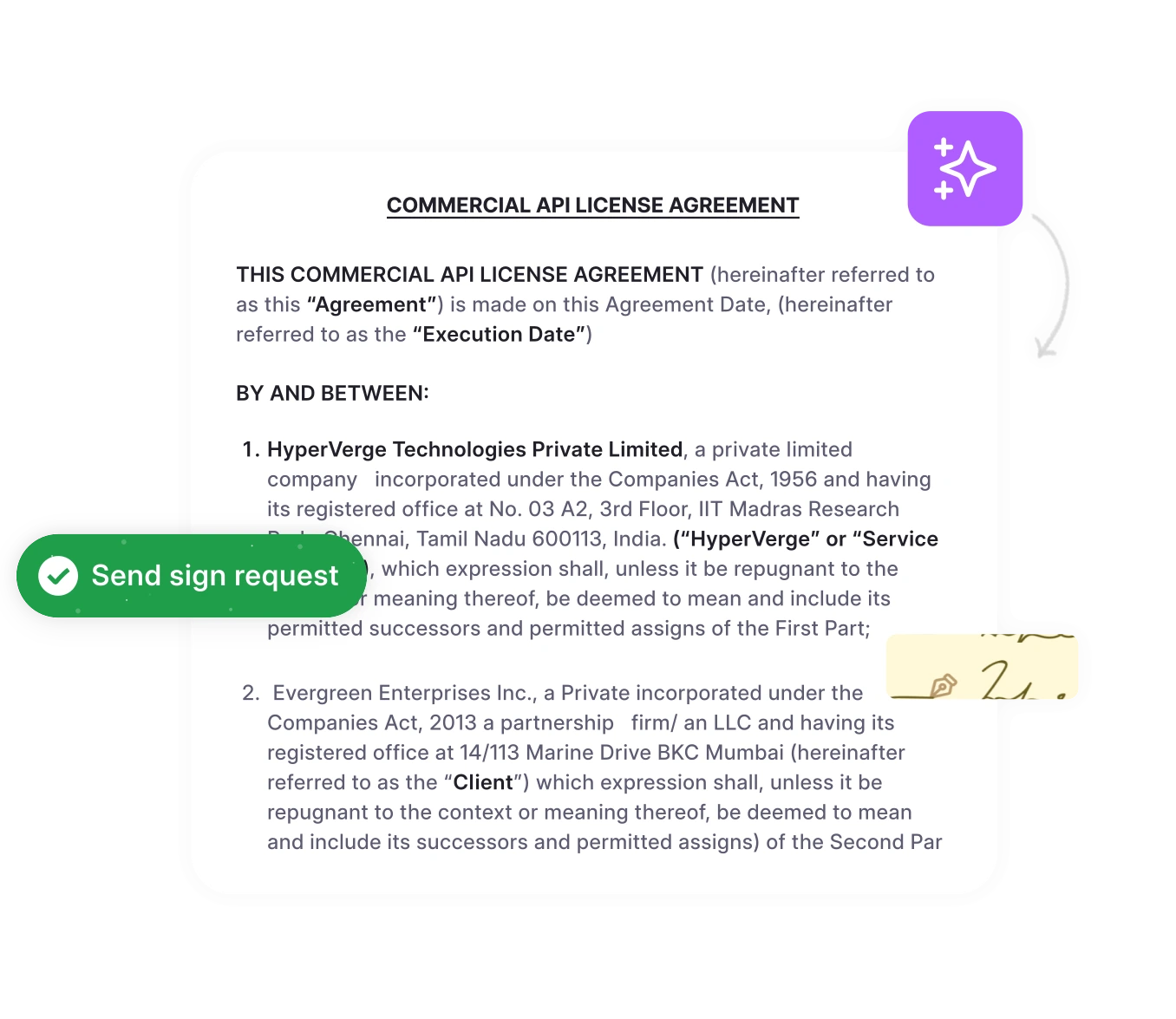




Download our free partnership agreement template in PDF or Word format to get started quickly. This business partnership agreement template is also a useful sample partnership agreement for understanding standard clause structure.
General Partnership Agreement Template
Download our free partnership agreement template in PDF or Word format. It covers all key elements for any business structure.
The ideal partnership aims to express the vision, aspirations, and hoped-for results from the perspective of both the partners as individuals and as a collective. A good partnership agreement template serves a three-fold purpose:
- How appropriation concerns are protected
- How roles and responsibilities are coordinated
- What to do during uncertainty
This comprehensive guide explores the four types of partnership structures, why they exist, the roles they play, and provides a step-by-step framework for creating your own agreement.
For an overview of how contract management software supports agreement workflows from drafting through renewal, explore HyperStart.
Let’s dive in.
What is a business partnership agreement?
A partnership agreement is a legally binding document that outlines the interest of business partners, the split of ownership, capital contributions, management responsibilities, and profit and loss distribution.
Unlike informal handshake agreements, a written and signed partnership contract is clear, enforceable, and reduces the chance of costly litigation. Without a legal partnership agreement, most states default to the Uniform Partnership Act (UPA) or the Revised Uniform Partnership Act (RUPA), which may impose terms that do not reflect the partners’ actual intentions. In fact, according to How to Contract, legal teams are increasingly encouraged to focus on practical, risk-stratified agreements that measure and anticipate plausible scenarios.
The four types of business partnership agreement structures
In many U.S. jurisdictions, a limited partnership might be able to act only through a general partner, in which case a signature block for the limited partnership might need to include the general partner’s name. And the general partner of a limited partnership might very well be a corporation or LLC; in that case, the signature block would be something like the following:
On the other hand, in some jurisdictions, a limited partnership might be able to act through its own officers; for example, Delaware’s limited-partnership statute gives general partners the power “to delegate to agents, officers and employees of the general partner or the limited partnership ….”
1. General Partnership (GP)
A general partnership agreement establishes a structure where all partners share equal management authority and assume unlimited personal liability for business debts and obligations. This means creditors can pursue partners’ personal assets to satisfy business debts.
Key characteristics:
- Shared management responsibilities among partners
- Unlimited personal liability for all partners
- Pass-through taxation(profits and losses flow to partners’ personal returns)
- Simple formation process with minimal regulatory requirements
This structure works well for small businesses that want equal decision-making power among partners. For a broader look at business agreement structures, see our guide on elements of a contract. The unlimited liability exposure, however, makes it risky for businesses with significant debt or legal exposure potential.
2. Limited Partnership (LP)
Limited partnerships create a two-tier structure between general partners who manage operations and limited partners who invest in capital. Management and unlimited personal liability remains in the purview of general partners. Limited partners enjoy liability protection limited without the responsibilities of management decisions.
Key characteristics:
- General partners: unlimited liability, full management authority
- Limited partners: liability capped at investment, no management role
- Pass-through taxation structure
- Requires formal registration with state authorities
LPs prove particularly valuable for real estate investments and venture capital structures where passive investors want liability protection while active partners handle operations. This way, businesses raise capital without diluting management control.
3. Limited Liability Partnership (LLP)
Limited Liability Partnerships protect partners from bearing liabilities while maintaining partnership taxation benefits, making LLPs attractive for professional service firms.
Key characteristics:
- Limited liability protection for all partners
- Flexible management structure(shared or delegated)
- Pass-through taxation advantages
- Professional licensing requirements in many states
For partnerships managing high volumes of agreements across multiple practice areas, a centralized contract management approach simplifies oversight.
4. Limited Liability Limited Partnership (LLLP)
LLLPs combine LP structure with enhanced liability protection, shielding even general partners from personal liability beyond their investment. This structure offers maximum liability protection while preserving management flexibility and investment advantages.
Key characteristics:
- Extended liability protection for general partners beyond their investment
- General partners retain full management authority without personal liability exposure
- Limited partners remain passive investors with capped liability
- Pass-through taxation structure
- Available in select states only; requires formal registration and additional regulatory compliance
LLLPs suit sophisticated investment structures and high-risk businesses where maximum liability protection justifies additional regulatory complexity.
Comparing the 4 types of partnerships
| Agreement Type | Personal Liability | Management Role | Taxation | Best For… |
| GP | Unlimited (all partners) | Shared equally | Pass-through | Small businesses, early-stage startups |
| LP | General partners: unlimited Limited partners: limited to investment | General partners manage | Pass-through | Real estate, investment funds |
| LLP | Limited (all partners) | Shared equally or delegated | Pass-through | Professional services firms |
| LLLP | Limited (all partners including general partners) | General partners manage, limited partners passive | Pass-through | High-risk businesses, sophisticated investment structures |
For more contract types, see our guide on types of contracts.
Advantages and disadvantages of a business partnership
Understanding the trade-offs helps you decide whether a small business partnership agreement or a more complex structure is right for your goals.
Advantages
- Easy formation. A business partnership contract requires minimal regulatory filings and no federal paperwork to get started.
- Pass-through taxation. Tax obligations flow directly to individual partners, simplifying annual filings.
- Shared financial burden. Partners split startup costs and ongoing expenses, reducing individual risk.
- Combined expertise. Each partner brings unique skills that strengthen the business beyond what any one person could build alone.
Disadvantages
- Personal liability exposure. In a general partnership, creditors can pursue partners’ personal assets to satisfy business debts.
- Mutual liability. One partner’s decisions can create legal exposure for all partners in the partnership business agreement.
- Slower decision-making. A company partnership agreement typically requires consensus or majority agreement, which can slow operations.
- Profit splitting. Earnings must be divided according to the agreed terms, reducing individual income compared to sole ownership.
Weighing these factors before drafting your agreement helps you choose the right structure and include the right protections.
Still managing partnership contracts through email chains and shared drives?
Growing partnerships mean more contracts to track, update, and monitor. HyperStart is an AI-powered CLM built for mid-market companies, delivering 70% faster contract turnaround with 94% AI accuracy — deploy in just 4 weeks.
Book a DemoThe anatomy of a strong partnership agreement
A comprehensive partnership agreement form requires careful attention to multiple interconnected elements. Whether you are working from a partnership agreement contract template or building your own, the right partnership agreement format covers the same core provisions. Each component serves specific purposes while supporting the overall partnership structure.
The following sections detail essential provisions that create robust, enforceable agreements.
1. Partnership name, purpose, and duration
State clearly the partnership’s primary purpose, the official business name, and how long the partnership will last. Does the partnership have a fixed end date, or will it continue indefinitely until the partners agree to dissolve it?
2. Capital contributions and distribution accounts
Detail each partner’s initial contribution in cash, property, or services. Also, detail how contribution, ownership structures, strategic direction, and distribution accounts will be maintained This helps avoid disputes over who invested what and how profits or losses are allocated. Tracking these contributions accurately from day one is essential for contract compliance.
3. Profit and loss distribution
Specify how net profits and losses will be shared among partners. Will profits be split equally, according to capital contributions, or another formula? Clear profit sharing and loss distribution clauses prevent misunderstandings.
4. Management roles and partners authority
Define each partner’s management roles and decision-making authority. Do decisions require unanimous and written consent, a majority vote, or delegated authority? Clarify how partners exercise authority and how standard operating procedures for the business to run smoothly. Include a deadlock clause that specifies a resolution mechanism, such as mediation, a neutral third-party tiebreaker, or a structured buyout trigger. This prevents operational paralysis when partners cannot reach consensus on critical decisions.
5. Planning for change: Partner withdrawal, removal, retirement, and death
Include terms for when a partner withdraws, retires, or passes away. Outline buyout terms, including how ownership interests are valued (using an outside firm’s valuation if needed) and how payouts will be made. This section helps avoid future disputes and ensures continuity.
6. Adding and removing partners
Also address how the partnership agreement itself can be amended. Most agreements require unanimous written consent to modify terms, and a formal contract amendment should document every change.
7. Dispute resolution and legal provisions
Include mechanisms to resolve disputes through arbitration, mediation, and litigation and specify jurisdiction. A contract review checklist can help ensure all dispute resolution provisions are complete before signing. Also cover other legal provisions, such as confidentiality and compliance with applicable laws.
Early on, I thought it was my responsibility to root out and eliminate all contractual risks. In part, because I knew the “worst-case” scenario all too well – litigating it out in court. I learned that risk stratification and guidance must be practical in order to be useful, and the worst-case scenarios are simply that (i.e., unlikely to occur).
Legal is not supposed to be the place where “yes goes to die,” so I kindly suggest adjusting your approach (if you are more inclined to say “no”) so that you can more efficiently get to the “acceptable yes” or the “yes, and…” instead. Having a better understanding of your organization’s business helps, as does asking your business partners to share their own concerns about a deal (after all, they are the ones working with the client or vendor day-to-day and have great insight that is likely not visible to Legal).
8. Signatures and execution
Proper execution procedures create legally binding obligations. All partners must sign and date the agreement, with signatures serving as formal acknowledgment of each partner’s commitment to the terms and conditions outlined in the document. Signatures in Global and National Commerce Act (ESIGN) and state Uniform Electronic Transactions Acts. Digital signature platforms provide secure authentication, audit trails, and timestamping that often exceed traditional paper-based security measures.
For a deeper look at digital execution options, see our guide on electronic contract signing.
9. Dissolution
Comprehensive dissolution clauses outline what triggers partnership termination and the procedures for winding up business affairs. Using a contract tracking system helps ensure no obligations are overlooked during wind-down. These provisions address voluntary dissolution by partner agreement, involuntary dissolution due to partner misconduct or incapacity, and automatic dissolution triggers like bankruptcy or death.
10. Partnership tax elections
Partnership agreements should address key tax elections that affect how the partnership and individual partners report income, losses, and distributions. This includes Section 754 elections for stepped-up basis adjustments, cash method elections for qualifying partnerships, and special allocation provisions for partners with different contribution types.
11. Death or disability
Partnership agreements must address partner death or disability scenarios that could otherwise trigger automatic partnership dissolution. These provisions typically include buy-sell arrangements funded by life insurance policies, disability insurance coverage, and predetermined valuation methods for deceased or disabled partners’ interests.
Together, these elements answer crucial questions:
- Who are the partners?
- What is the nature of the problem and why do we partner?
- What does the partnership want to accomplish?
- When will the partnership do what?
- How will the partnership be implemented?
- How will the partnership communicate?
- What if something does not go as planned?
Research into business alliances shows that addressing these questions systematically increases the chances of success.
Use it as your starting point to avoid missing critical clauses. For even simpler structures, check out our resource on simple contracts.
How to write a partnership agreement
Once you understand the key elements, you can create a partnership agreement using a step-by-step approach. Here is how to write a partnership agreement that protects all parties involved.
Step 1: Choose your partnership structure
Decide whether a general partnership, limited partnership, LLP, or LLLP best fits your business model and risk tolerance. This choice determines liability exposure and management rights for each partner.
Step 2: Define partner contributions and ownership
Document what each partner contributes, whether cash, property, or services, and how those contributions translate into ownership percentages. Include provisions for future capital calls.
Step 3: Establish profit and loss distribution
Specify how net profits and losses will be split. Partners can allocate these equally, proportionally to contributions, or through a custom formula.
Step 4: Set management and decision-making rules
Assign day-to-day management responsibilities and define how major decisions are made. Specify voting thresholds, deadlock resolution mechanisms, and which actions require unanimous consent.
Step 5: Draft exit, dissolution, and dispute provisions
Include withdrawal terms, buyout valuation methods, dissolution triggers, and dispute resolution procedures such as arbitration or mediation.
Step 6: Address tax elections and compliance
Cover Section 754 elections, fiscal year selection, and reporting responsibilities. Consult a tax professional for jurisdiction-specific requirements.
Step 7: Review, sign, and store securely
Have all partners and, ideally, an attorney review the final document. Execute with proper signatures, and store the signed agreement in a secure, centralized contract repository.
A simple partnership agreement can follow this same framework with fewer provisions, while complex multi-party arrangements will require more detailed clauses at each step.
What are the common partnership agreement mistakes to avoid?
Even well-intentioned partners make errors when drafting a business partner agreement. Avoiding these common mistakes strengthens your agreement and reduces the risk of disputes.
1. Skipping an exit strategy
Many partners focus on launching the business without planning for departures. Your agreement should address what happens when a partner wants to leave, how ownership interests are valued, and whether remaining partners have the right of first refusal.
How to avoid it: Include detailed withdrawal, buyout, and dissolution clauses from the start. Define a valuation method, such as book value or independent appraisal, so departures do not trigger protracted negotiations.
2. Choosing the wrong partnership structure
Without deliberate selection, a partnership defaults to a general partnership under state law, exposing all partners to unlimited personal liability.
How to avoid it: Evaluate whether an LP, LLP, or LLLP better fits your risk profile before signing. Consult a legal or tax professional to understand the liability and tax implications of each structure in your state.
3. Leaving profit and loss terms vague
Ambiguous language about financial distribution is one of the most common sources of partnership disputes.
How to avoid it: Specify exact percentages, timing of distributions, and conditions for reinvestment. Put formulas in writing rather than relying on verbal agreements.
4. Ignoring deadlock scenarios
Equal partnerships often reach impasses on critical decisions. Without a deadlock resolution clause, operations can stall.
How to avoid it: Include a clear tiebreaker mechanism such as mediation, a neutral third-party advisor, or a structured buyout trigger for unresolvable disputes.
5. Treating the agreement as permanent
Business conditions change, and a legally binding partnership agreement should anticipate that.How to avoid it: Include amendment procedures that allow partners to update terms with unanimous written consent. Schedule annual reviews to reassess whether the agreement still reflects the partnership’s needs.
Checklist: What to include in your partnership agreement template
For deeper guidance, see our resource on contract drafting.
Whether you need a simple partnership agreement template for a two-person venture, a basic template for straightforward arrangements, or a detailed partnership agreement example for a multi-partner enterprise, you can download this partnership agreement template word document for free. It acts as a foundation that you can customize based on your needs.
Want to partner up with a startup? Our file can act as a startup partnership agreement template. It can also work as a sample partnership agreement template for established firms. Customize each section to match your specific partnership agreement format and business requirements.
How long would it take to find every active contract in your partnership?
HyperStart eliminates 93% of contract admin costs with complete portfolio visibility. Set up in 4 weeks.
Book a DemoWrapping up
A well-drafted business partnership agreement serves as essential business infrastructure, providing clarity, protection, and procedures that enable successful long-term partnerships.
Whether you choose a general partnership structure for its simplicity, a limited partnership for investment flexibility, or an LLP for liability protection, the key lies in creating a thorough partnership agreement contract that addresses your specific business needs and partner relationships. Use a partnership contract template as your starting point, then customize every clause.
Remember that partnership agreements are living documents that should evolve with your business. When you create a partnership agreement, plan for regular reviews and updates to ensure it continues serving your partnership’s changing needs while maintaining the legal protection and operational clarity that supports long-term success.