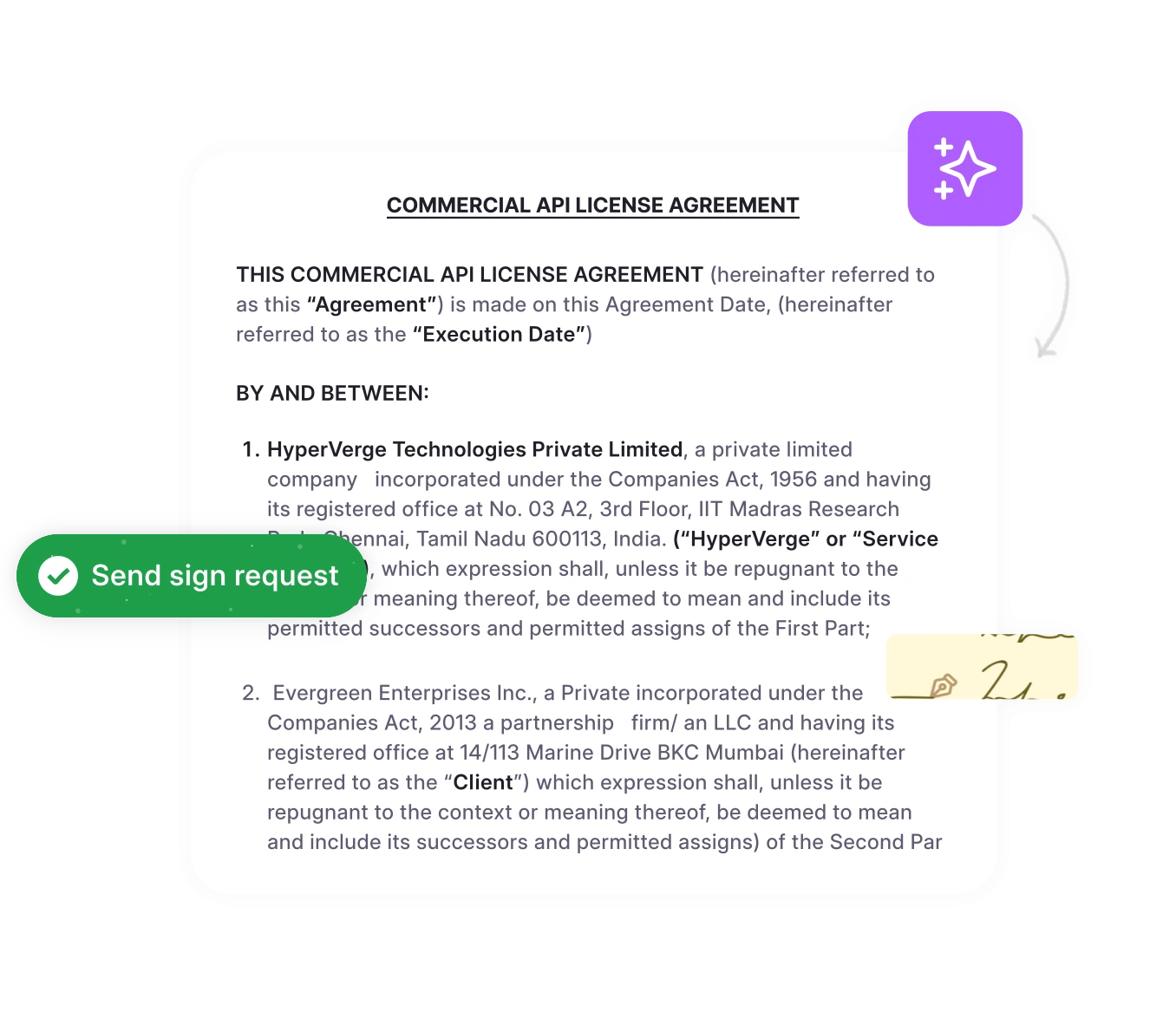

- An enforceable contract is an agreement enforceable by law, meaning courts will uphold it and provide remedies if breached. It must satisfy five essential elements: offer and acceptance, consideration, legal capacity, legality of purpose, and compliance with legal formalities.
- A valid and enforceable contract is not the same thing. A contract can be technically valid yet still unenforceable due to procedural failures, such as missing signatures or noncompliance with the Statute of Frauds.
- Common enforceability threats include lack of capacity, absence of genuine consent, unconscionable terms, illegal subject matter, and unclear contract language. Legal teams can reduce these risks using AI-powered contract review and automated compliance checks.
When a major business deal falls through because the contract isn’t legally binding, the consequences ripple throughout the entire organization. Legal teams scramble to understand what went wrong, while business leaders wonder how such a critical oversight occurred.
An enforceable contract forms the foundation of every successful business relationship, yet many organizations struggle with understanding what makes their agreements legally binding. Whether you’re a general counsel reviewing partnership agreements or a legal operations manager streamlining contract management processes, knowing the essential elements of enforceability protects your organization from costly disputes and failed deals.
This comprehensive guide covers the contract law basics every legal professional needs: the enforceable contract meaning, the five essential elements of a valid contract, practical examples across different industries, and how modern contract management enhances legal compliance and enforceability.
What is an enforceable contract?
An enforceable contract is a legally binding agreement that courts will uphold and provide remedies for if breached. The enforceable meaning in law is straightforward: it describes an agreement that creates clear legal obligations parties must fulfill, unlike informal promises that carry no legal weight. This enforceable contract definition applies regardless of whether the agreement is written, verbal, or digital.
A contract may be valid yet still unenforceable if it fails to meet procedural requirements, jurisdictional rules, or documentation standards. When legal professionals ask what is enforceable by law, they are asking whether a specific agreement meets every requirement for a court to recognize and uphold it. For example, a verbal agreement for services can be valid but hard to enforce without written proof.
To ensure enforceability, contracts must meet both the essential elements of contract law and the required legal formalities. With electronic signatures, cross-border deals, and digital execution now common, legal teams must pay close attention to enforceability requirements.
Enforceability in contract law depends on whether a court will compel performance or award damages when a party fails to honor its obligations. This requires satisfying both substantive requirements (the five elements below) and procedural requirements such as proper execution and jurisdictional compliance.
Understanding these foundational principles helps legal professionals draft stronger agreements and avoid common pitfalls that render otherwise valid contracts unenforceable in practice.
What are the 5 essential elements of an enforceable contract?
Creating a legally enforceable contract requires five fundamental elements working together. Often called the essential ingredients for the enforceability of a contract, these elements of an enforceable contract are non-negotiable: missing any single one can render the entire agreement unenforceable, regardless of the parties’ intentions or the deal’s complexity.
1. Offer and acceptance
A valid contract begins with a clear offer and an unambiguous acceptance. The offer must state definite terms, and acceptance must show agreement to those exact terms without further negotiation. In business, this often happens through emails, digital platforms, or signed documents. Counteroffers, expired offers, or unclear acceptance methods commonly create disputes, making it important to set clear protocols for when offers become binding.
2. Consideration (value exchange)
Contracts must involve an exchange of value between parties. Consideration can be money, goods, services, or promises to act—or even to refrain from acting. It doesn’t need to be equal, but must have legal value. Past performance, existing legal duties, or vague promises don’t count as valid consideration. Legal teams should ensure each party provides something of real value to make the contract enforceable.
3. Legal capacity of parties
All parties must have the legal contractual capacity to enter into a contract, meaning they understand the agreement and have the authority to commit. Capacity issues often arise with minors, mentally incapacitated individuals, or unauthorized company representatives. Businesses should verify signatory authority through corporate resolutions, partnership agreements, or powers of attorney, especially in cross-border deals where requirements vary. Maintaining a centralized contract repository makes it easier to track signatory records and authorization documents.
4. Legality of purpose
A contract must serve a lawful purpose and comply with applicable laws and public policies. Agreements that involve illegal activities or violate regulations are automatically unenforceable. Industry-specific laws, like HIPAA for healthcare contracts or banking compliance for financial contracts, must also be considered. Since laws evolve, long-term contracts should be reviewed regularly to ensure ongoing legality.
5. Compliance with legal formalities
Some contracts must follow specific formalities, such as being in writing, signed, or notarized. The Statute of Frauds is a legal doctrine that requires certain types of contracts to be in writing to be enforceable. These typically include real estate transactions, agreements that cannot be completed within one year, contracts for the sale of goods above a specified value (often $500 under the Uniform Commercial Code), and guarantees to pay another party’s debt. Failing to meet this written requirement can render an otherwise valid agreement unenforceable in court.
Today, electronic signatures hold the same legal weight as handwritten ones if they meet authentication standards. Using the best contract management software helps ensure compliance with execution requirements.
In summary, what makes a contract enforceable is the presence of all five elements working together, supported by proper execution and compliance with applicable legal formalities. Now let’s examine how enforceable contracts differ from their unenforceable counterparts and what causes this critical distinction.
Valid vs. enforceable contracts: Key differences
Many people assume that a valid contract is automatically enforceable, but that’s not always the case. Understanding the distinction between an enforceable and unenforceable contract helps businesses avoid agreements that appear sound on paper but offer no real legal protection when a dispute arises.
| Aspect | Valid Contract | Enforceable Contract |
| Definition | A contract that fulfills the five essential elements of contract law: offer, acceptance, consideration, capacity, and legality. | A valid contract that also satisfies all required legal formalities and can be upheld in court if breached. |
| Legal Formalities | May not comply with additional requirements such as written documentation, signatures, or notarization. | Meets all statutory and procedural requirements, such as the Statute of Frauds or electronic signature laws. |
| Court Recognition | Recognized as a legal agreement, but it may not always give remedies in case of a breach. | Fully recognized and actionable in court, allowing parties to seek remedies for non-performance. |
| Scope | A broader category: every enforceable contract is valid, but not every valid contract is enforceable. | A narrower category: only those valid contracts that courts will enforce. |
| Examples | A verbal agreement to sell real estate (valid in principle but unenforceable because property sales require written contracts). | A written and signed employment contract with clear terms and compliance with labor laws (valid and enforceable). |
Still relying on manual reviews to catch enforceability gaps?
HyperStart’s AI flags missing elements, ambiguous clauses, and compliance risks before signature, with 94% accuracy and deployment in just 4 weeks.
Book a DemoWith this foundation established, let’s explore the major reasons that make a contract unenforceable and hamper an organization’s productivity.
What makes a contract unenforceable?
Certain factors can make an otherwise valid agreement unenforceable in the eyes of the law. These issues typically arise from how the contract was formed, the nature of its terms, or external legal limitations.
Here are the top 4 reasons that end up making a contract unenforceable for organizations.
1. Lack of capacity
A contract becomes unenforceable if one or more parties lack the legal ability to enter into it. This includes minors, individuals declared mentally incompetent, or parties acting without proper authority. For instance, if an employee without signing rights commits a company to a deal, the contract may be deemed unenforceable.
2. Absence of proper consent
Contracts require genuine, informed agreement from all parties. If a contract is signed under duress, fraud, misrepresentation, or undue influence, it loses enforceability. Proper contract negotiation practices and documented workflows help ensure genuine consent from all parties. Courts prioritize fairness and free will, so any agreement obtained through coercion or deception is unlikely to stand.
3. Illegal subject matter
An agreement that involves unlawful activities—such as contracts for criminal services, unlicensed work, or terms that violate statutory law—cannot be enforced. Even if all other contract elements exist, courts will refuse to uphold an agreement based on an illegal purpose.
4. Unclear or indefinite terms
For a contract to be enforceable, its terms must be specific enough for courts to interpret and enforce. If the agreement is too vague—such as stating “services will be provided as needed” without defining scope, price, or timeline—it risks being declared unenforceable due to uncertainty.
According to Harvard Law research the presence of unenforceable terms in contracts often shifts burdens and financial risk disproportionately. In experimental studies with tenants, it was found that unenforceable terms caused parties to bear costs or take actions they would not have had the contracts been clear and enforceable.
5. Violation of legal formalities
Certain contracts must meet specific formal requirements to be enforceable, such as being in writing, signed, notarized, or witnessed. For example, real estate contracts often require written documentation to hold up in court. Failing to meet these statutory requirements can render a contract unenforceable.
6. Unconscionable terms
A contract may also be deemed unenforceable if its terms are so one-sided and unfair that they “shock the conscience” of the court. This is known as unconscionability. Courts evaluate both procedural unconscionability (how the contract was formed, such as a “take it or leave it” scenario with no negotiation opportunity) and substantive unconscionability (whether the terms themselves are excessively harsh). Even if all other elements are met, an unconscionable contract, or specific clauses within it, will not be enforced.
After understanding the causes of unenforceable contracts, it is time to have a look at the practical examples of enforceable contracts across different business contexts to illustrate these principles in action.
Real-world enforceable contract examples across industries
Seeing how courts uphold contracts in real situations helps businesses understand enforceability beyond theory. These examples show how contracts become legally binding when essential elements and formalities align.
1. Technology and e-commerce
In Feldman v. Google, Inc. (2007), the court enforced Google’s clickwrap agreement in its AdWords program. The decision confirmed that users who have the chance to review terms and then click “I agree” enter into enforceable contracts. This case highlights how digital agreements, when properly presented, hold the same weight as traditional paper contracts.
2. Software licensing
The landmark case ProCD, Inc. v. Zeidenberg (1996) established that shrinkwrap licenses—terms included inside software packaging—can be enforceable. Since the buyer had the opportunity to return the software if they didn’t agree, the court upheld the contract. This example shows how enforceability applies to modern licensing methods, provided users are given clear choices.
3. Agriculture and sales
In Goldkist, Inc. v. Brownlee (1987), a farmer orally agreed to deliver soybeans to a cooperative. The cooperative sent a written confirmation, and the farmer did not object within ten days. Under the Uniform Commercial Code (UCC), this silence created an enforceable contract. This case demonstrates how even oral agreements can become enforceable when followed by proper confirmations.
How quickly can you prove a contract breach with documented evidence?
HyperStart tracks every obligation, edit, and approval with tamper-proof audit trails, so your legal team is enforcement-ready from day one.
Book a DemoEach example demonstrates how proper attention to enforceability elements protects business interests and provides legal remedies when problems arise. However, even well-drafted contracts face common challenges that can affect enforcement.
What is the difference between void, voidable, and unenforceable contracts?
Not all invalid contracts are the same. Understanding the meaning of enforceable by law, and how it differs from void and voidable contracts, helps legal teams assess risk and determine the right course of action when issues arise.
1. Void contracts
A void contract was never legally valid from the start. It lacks one or more essential elements, most commonly the legality of purpose. For example, a contract to commit fraud is void from inception. Neither party can enforce it, and courts treat it as though it never existed.
2. Voidable contracts
A voidable contract is valid and enforceable unless the party with grounds to cancel chooses to do so. This typically arises when one party lacked capacity (such as a minor), was subject to fraud or misrepresentation, or signed under duress. The affected party can choose to either enforce the contract or void it. If they take no action, the contract remains binding.
3. Unenforceable contracts
An unenforceable contract may have been valid at formation but cannot be upheld by a court due to a legal defense or procedural deficiency. Common examples include contracts that violate the Statute of Frauds (such as a verbal real estate agreement) or contracts where the statute of limitations for filing a claim has expired.The practical difference matters for contract compliance: void contracts offer no legal protection from the outset, voidable contracts create risk if the affected party exercises their right to cancel, and unenforceable contracts leave obligations and contract terms without legal remedy even when a breach occurs.
What are the Common enforceability challenges and how to avoid them?
Even contracts that appear to meet all essential elements can face enforceability challenges in practice. Understanding these common issues helps legal teams draft stronger agreements and avoid costly disputes.
1. Ambiguous terms and unclear language
Ambiguity in contract wording creates frequent enforceability problems. Courts often interpret unclear language against the drafting party, which can lead to unexpected obligations or limited remedies.
How to tackle it:
Use precise language with specific performance standards, measurable deliverables, and defined technical terms. Avoid vague expressions like “reasonable efforts” or “commercially acceptable”. A legal review focused on clarity ensures that contracts leave little room for misinterpretation.
2. Missing signatures or improper execution
Even perfectly drafted agreements can fail if they lack valid signatures or are improperly executed. Common mistakes include unsigned copies, unauthorized signatories, or non-compliance with e-signature requirements.
How to tackle it:
Implement electronic contract signing platforms to streamline execution and track completion. Verify signatory authority through corporate resolutions, powers of attorney, or signature cards. Establish clear internal processes to ensure every executed contract is legally binding.
3. Capacity issues and authority problems
Contracts often face enforceability challenges when one or more parties lack the legal capacity or authority to sign. For instance, an employee without signing rights may bind an organization to terms that later become disputable.
How to tackle it:
Conduct due diligence to confirm authority. This includes verifying corporate standing, reviewing partnership agreements, and confirming signatory rights. For international contracts, check applicable foreign laws to ensure valid execution.
4. Legal compliance gaps
Contracts that fail to meet industry-specific regulations, licensing requirements, or jurisdictional laws risk being voided despite technical validity. This is particularly relevant in highly regulated industries like healthcare, finance, or construction.
How to tackle it:
Review applicable laws and regulations during contract drafting. Conduct regular contract compliance audits and legal updates to identify changes that may affect enforceability. Embedding compliance checks into the contract lifecycle helps avoid costly disputes.
Modern contract management technology addresses many of these challenges through automated compliance checking, signature workflow management, and centralized contract repositories that maintain enforceability documentation.
What happens when an enforceable contract is breached?
When a party breaches an enforceable contract, the non-breaching party can pursue several legal remedies to recover losses or compel performance. Effective contract enforcement requires both a legally sound agreement and documented evidence that a breach occurred. Here are the most common remedies courts provide for the enforcement of contract obligations.
1. Compensatory damages
Compensatory damages are the most common remedy. Courts award monetary compensation to put the injured party in the position they would have been in had the contract been performed as agreed.
2. Specific performance
Specific performance is an equitable remedy where the court orders the breaching party to fulfill their contractual obligations. This is typically reserved for situations involving unique goods or real estate, where monetary damages alone cannot adequately compensate the injured party.
3. Rescission
Rescission cancels the contract entirely and restores both parties to their original positions before the agreement was formed. Courts may order rescission when there was fraud, misrepresentation, or mutual mistake at the time of formation.
4. Restitution
Restitution requires the breaching party to return any benefits they unfairly received under the contract. This prevents unjust enrichment and ensures neither party profits from a failed agreement.
5. Liquidated damages
Liquidated damages are pre-agreed amounts specified in the contract itself, outlining what compensation is owed if a breach of contract occurs. Courts generally enforce these provisions as long as the amount is reasonable and not punitive.
Modern obligation management platforms help legal teams track performance against contractual obligations, creating an evidence trail that strengthens enforcement efforts if a dispute arises.
How does modern contract management enhance enforceability?
As digital-era contract law reshapes how agreements are formed and executed, switching from manual, paper-heavy workflows to modern contract management meaningfully improves how organizations create enforceable business contracts and preserve their legal enforceability over time. Here are the top 4 ways it helps:
1. Identify enforceability gaps before signature
AI-powered contract review tools analyze agreements for missing legal elements, ambiguous wording, and clauses that might reduce enforceability. With HyperStart, this process goes a step further—its AI compares clauses against legal precedents and industry-specific rules, flagging terms that could fail in court. By identifying issues such as vague payment terms, unclear acceptance methods, or compliance gaps before execution, businesses strengthen their contracts and reduce the risk of unenforceable provisions.
2. Ensure valid execution with e-signatures and audit trails
Modern e-signature platforms provide more than just convenience—they create enforceable evidence. Digital workflows authenticate signers, capture precise timestamps, and generate tamper-proof audit trails. Courts recognize these records as proof of valid consent and execution, making the resulting agreement a legally enforceable contract. Combined with proper authentication and timestamping, electronic contract signing ensures that digitally executed agreements are as legally enforceable as their paper counterparts.
3. Maintain continuous compliance as laws change
Regulatory updates can quickly make a valid contract unenforceable if the language no longer meets legal standards. Automated compliance monitoring helps legal teams track these changes and flag contracts that may require updates. HyperStart enhances this by sending real-time alerts when regulations shift and mapping them against existing contract clauses. This ensures that businesses don’t just comply at the time of signing but maintain enforceability throughout the contract lifecycle.
4. Integrate controls with core business systems
By connecting contracts with platforms like CRM, ERP, and HR systems, organizations create enforceability safeguards within daily operations. For example, contracts can auto-route for additional approval if they exceed financial thresholds, or flag risk if a signatory’s role changes. These integrations prevent unauthorized signings, ensure obligations are tracked, and maintain enforceability through ongoing performance monitoring.
These technological advances don’t replace legal expertise but enhance it, giving legal teams powerful tools to ensure their contracts remain enforceable throughout their lifecycle.
Contracts are more than just legal safeguards; in many situations, they should be dynamic tools that support collaboration, mitigate risk, and create value.
Tired of discovering enforceability gaps after the contract is signed?
HyperStart’s AI reviews every clause for legal enforceability before execution, helping legal teams achieve 70% faster contract turnaround with 94% AI accuracy.
Book a DemoKeep every contract enforceable with HyperStart
Understanding what makes contracts enforceable protects your organization from costly disputes and failed business relationships. The relationship between obligations and contracts is fundamental: legally enforceable contracts create binding obligations that courts will uphold, while unenforceable agreements leave parties without legal recourse. Modern legal teams benefit from combining traditional contract law principles with advanced contract lifecycle management technology.
AI-powered review systems, electronic signature platforms, and automated compliance monitoring help ensure your agreements remain enforceable throughout their lifecycle.
Whether you’re drafting partnership agreements, employment contracts, or complex commercial deals, focusing on enforceability from the start saves time, reduces risk, and strengthens your legal position. Transform your contract chaos into organized operations with HyperStart’s AI-powered contract management software.
Ready to ensure your contracts are always enforceable? Schedule a demo with HyperStart today and discover how legal teams achieve 70% faster contract turnaround while maintaining complete legal compliance.