


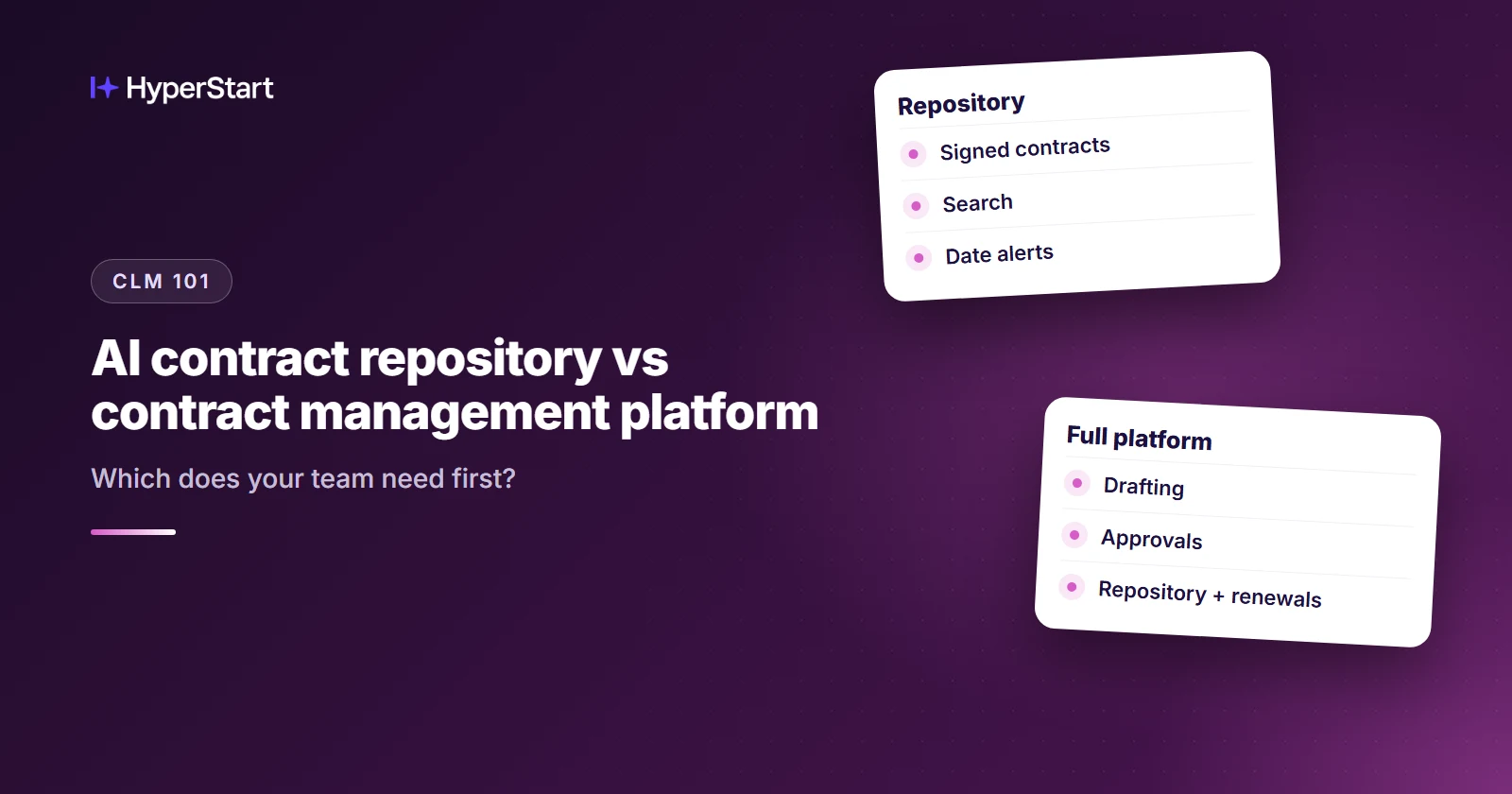
Signature is the dividing line: an AI contract repository is a centralized, searchable store that uses OCR and NLP to index signed and legacy contracts, extracting dates, parties, renewal terms and clauses. A contract management platform, or contract lifecycle management (CLM) system, also runs the work before signature: request, drafting, redlining, approval and signing, then post-signature tracking.
HyperStart is contract lifecycle management (CLM) software for mid-market legal and operations teams. It covers the whole contract lifecycle in one product and goes live in weeks, with no implementation partner.
Its searchable repository is part of the same product, so a team on a shared drive and Word templates does not have to pick one now and migrate again later.
- An AI contract repository stores signed and legacy contracts and uses AI to extract dates, parties, renewal terms and clauses.
- A contract management platform, or CLM, also runs the work before signature: request, drafting, redlining and approval.
- Choose a repository if your problem is finding and tracking signed contracts, and a platform if new contracts take too long.
- If you have both problems, start with the signed contracts in a product that can take on new contracts later.
- HyperStart is a CLM with a built-in repository, so a team can start with signed contracts and add drafting and approvals without a second migration.
What is an AI contract repository?
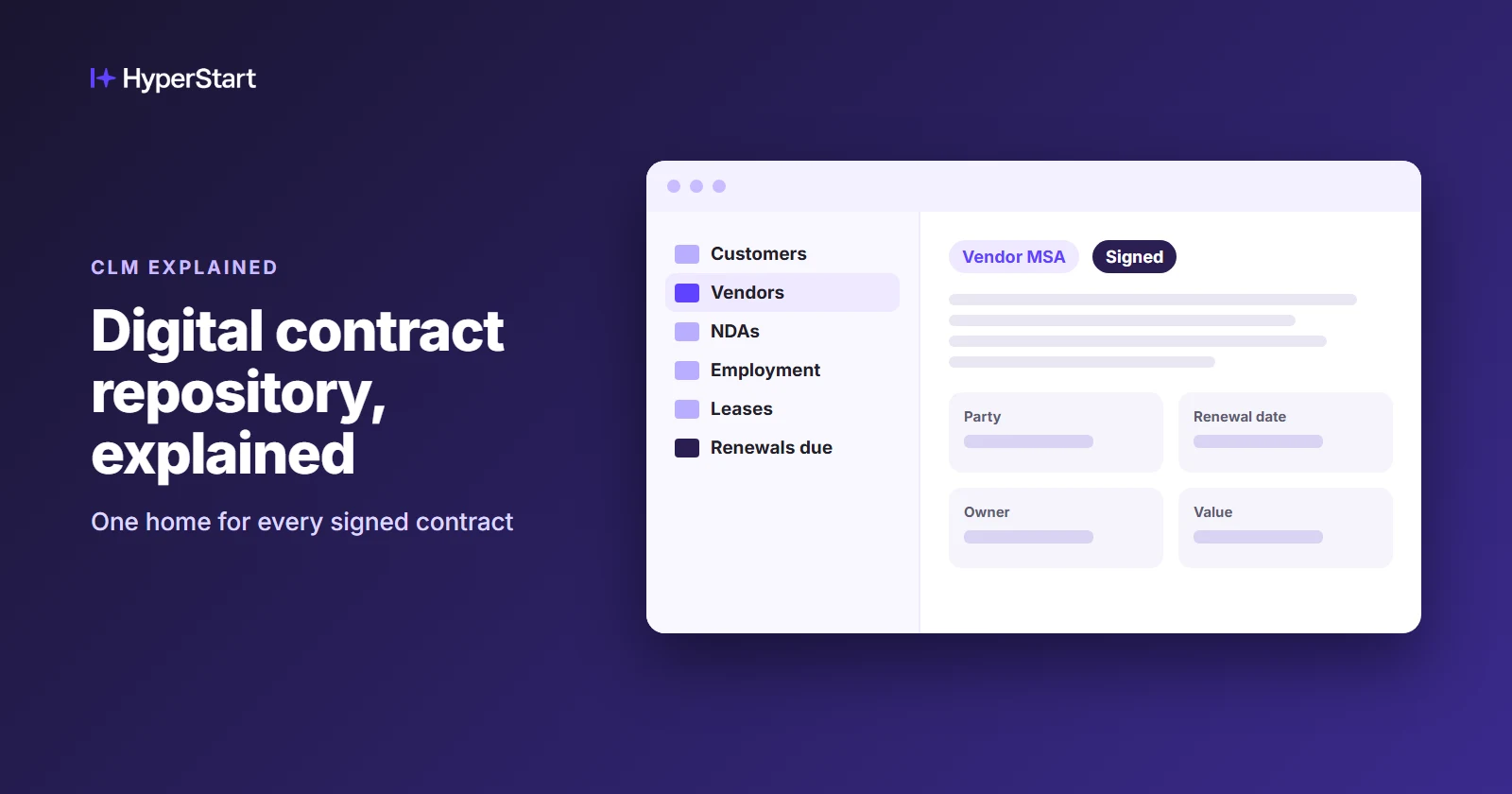
An AI contract repository gives a team a single source of truth for signed paper: AI reads each signed or legacy contract, records its metadata, and lets anyone search the full set for a clause, date or party.
- What it does: It imports legacy contracts in bulk from email, drives or a CRM, tags digital and scanned contracts using OCR, and sorts them by renewal date, liability and governing law.
- How AI is used: OCR turns scans into text. NLP then captures parties, dates, renewal terms and clauses such as indemnification, force majeure and liability caps as searchable metadata.
- Best for: Teams whose first question is “where is that contract, and when does it renew?”
- Limitation: It is passive. It organizes the contracts you already have and does nothing for the next one.
What is a contract management platform (CLM)?
A contract management platform, also called a CLM, runs each contract as a working process: request, drafting from an approved template, redlining and negotiation, approval workflow, signing, then renewal and obligation tracking, usually with a repository built in.
- What it does: Moves a contract from first request to signature, then keeps tracking it through the end of the lifecycle.
- How AI is used: Compares drafts with a playbook and suggests redlines. Some platforms also match contract terms against spend, ERP, CRM or purchase-order data to detect value leakage.
- Best for: Teams whose first question is “why does every new contract take so long?”
- Limitation: It usually costs more than a repository alone, takes more implementation work, and only pays back if the team adopts it.
Core differences
The core difference is when the contract enters the system. A repository receives it after signature, while a contract management platform handles it from the first request.
| What to compare | Repository only | Contract management platform | How HyperStart handles it |
| When the contract enters the system | After signature, as a signed or legacy file | At the request, before a draft exists | At intake, or by import if already signed |
| What the AI does | Reads, tags, extracts and searches | Also supports review and redlining | Extraction, review and redlining |
| Drafting from templates | No | Yes | Templates the business self-serves |
| Approval workflow | No | Yes | Drawn visually, and you change it yourself |
| Redlining in Word | No | Varies by platform | In Word, inside the platform |
| Signing | No | Built in or integrated | Through DocuSign, Adobe Acrobat Sign or Zoho Sign, which you keep |
| Contract family and amendment linking | Varies by tool | Varies by platform | Parent-child linking with metadata rollup |
| Renewal and obligation tracking | Extracted dates and terms | Tracking tied to the live contract | Reminders and escalations that chase on their own |
| Setup and time to go live | Lighter rollout, no change to how you draft | More complex implementation | Live in weeks, with no implementation partner |
What a repository can’t do
A repository can tell you that a renewal is coming, but it can’t produce or move the paper that follows. Those steps stay on email and Word unless another tool handles them.
A repository on its own does not:
- Draft a new contract from a template
- Route an approval workflow
- Support redlining or negotiation
- Send a contract for signature
See HyperStart CLM on your own contracts
Bring a few of your own contracts, and we’ll run them through HyperStart with you in a live demo.
Book a DemoChoose a repository or a contract management platform?
Choose based on where the work gets stuck. A repository fits when the trouble is finding and tracking contracts you already hold. A contract management platform fits when the trouble is creating, negotiating and approving new ones.
Choose a repository if
- You can’t say when a given SOW expires without opening files.
- Auto-renewal dates keep surprising you.
- An audit or due diligence request means hunting through folders.
Choose a contract management platform if
- Someone rebuilds the same NDA from an old Word file.
- Approvals depend on someone chasing people by email.
- Redlines bounce around as attachments, and nobody is sure which version is current.
If you have both problems
Start with the signed contracts, because that gives you answers quickly. Pick a product that can take on new contracts later on the same record.
Starting from a shared drive and Word templates
A team inheriting a shared drive and Word templates can import its signed contracts first, then bring new contract work onto the same record in stages. This path suits a mid-market legal or operations team that needs a searchable repository now and an approval workflow later, without a second migration.
What order should you add things in?
- Import the legacy contracts into the repository. AI metadata extraction gives you renewal dates and key terms you can search.
- Add templates. Start with the agreements your team drafts most often.
- Add the approval workflow and redlining in Word. New contracts now stay in one system through negotiation.
- Turn on renewal tracking. Dates and reminders sit on the same record as the contract and its amendments.
What does it cost, and how long does it take?
With HyperStart, the four stages above come under one quote, so you can price the whole path before you start:
- Time: Importing the legacy contracts and getting the repository searchable takes weeks, and HyperStart needs no implementation partner to do it.
- License: One custom quote, priced either on users or on contract volume, and paid as an annual plan.
- Implementation: Included for every stage, from migrating the signed contracts to building workflows and integrations later.
If you are sure you will never draft or negotiate your own paper, a standalone repository may be all you need. The second migration only becomes a cost if your needs grow.
How HyperStart covers both
HyperStart covers both because its searchable repository and its contract workflow are one product.
HyperStart: best for mid-market legal and operations teams that want the whole contract lifecycle in one product, live in weeks, with no implementation partner and implementation included in the quote.
In practice, you can start on the repository side: import the signed paper, link amendments into contract families and switch on renewal tracking. When new contracts become the bottleneck, the templates and approval routing are already there to switch on. You work with the HyperVerge people who build it at both stages.
What does each team get from it?
- General Counsel: The first stage answers questions about signed paper. The next moves routine drafting onto templates, so legal time goes to risky contracts.
- Legal operations: Once the workflow stage is live, an in-flight dashboard shows each contract with its stage, owner and age.
- Sales: Once templates are added, reps send standard agreements themselves and can see where each one stands.
- Procurement: From the first import, vendor notice dates are searchable and each amendment sits in its contract family.
- Finance: Contracted value rolls up across each family, so the renewal calendar shows what the company is actually committed to.
Book a demo and run HyperStart on ten of your own contracts.
Other contract management platforms you may compare
Teams making this choice often also compare Ironclad, DocuSign CLM and Sirion. All four, including HyperStart, are sold by custom quote rather than a public price list:
| Platform | Pricing | G2 rating |
| HyperStart | Custom quote based on users or contract volume, with implementation included (pricing page, as of Nov 2026) | 4.5/5 on G2 (9 reviews, as of Nov 2026) |
| Ironclad | No public price; custom quote, no free trial (pricing page, as of Nov 2026). Vendr reports a median of $40,875 a year, with implementation at $10,000 to $75,000+ on top (as of Nov 2026) | 4.4/5 on G2 (332 reviews, as of Nov 2026) |
| DocuSign CLM | Sold by quote. DocuSign’s published IAM plans are a separate product (as of Nov 2026) | 4.3/5 on G2 (503 reviews, as of Nov 2026) |
| Sirion | Sold by quote; no public price list (as of Nov 2026) | 4.5/5 on G2 (65 reviews, as of Nov 2026) |
Ask every vendor to show license and implementation as separate lines. A quote that leaves out implementation is not the number you will end up paying.
Two questions to settle it
How many contracts do you handle? And which is the bigger bottleneck: finding old contracts or approving new ones?
If the answer is both, book a demo and see the repository and the approval workflow run on ten of your own contracts.
Try HyperStart CLM before you decide
The whole contract lifecycle in one product, live in weeks, with implementation included in the quote and no implementation partner.
Book a Demo