


TL;DR
- AI in legal operations automates routine tasks like intake routing, contract drafting, and compliance monitoring—freeing in-house lawyers to focus on high-judgment work.
- Teams using AI see contract turnaround drop from days to under an hour and cut legal research time from hours to minutes.
- Start small with a high-volume, low-risk use case (like NDAs), pick tools that integrate with your existing workflow, and scale deliberately.
AI in legal operations has moved from experiment to operational standard. For in-house legal teams, the workload isn’t slowing down. Contract volumes are up. Compliance obligations keep expanding. Headcount stays flat. And somewhere between the NDA requests coming in via Slack, the vendor agreements sitting in someone’s inbox, and the quarterly compliance review that’s already two weeks overdue, there’s a legal team being asked to do more without any additional resources to do it with.
AI is changing that equation by automating the work that shouldn’t require a lawyer in the first place. Intake routing. Standard contract generation. Clause flagging. Document review. Compliance monitoring. These are tasks that eat legal bandwidth every day, and they’re exactly what AI handles well.
This guide covers the full picture: what AI in legal operations actually means, the use cases that are delivering real value right now, how to evaluate tools, and a practical roadmap for getting started.
What Does AI in Legal Operations Actually Mean?
“AI in legal operations” covers the full spectrum of legal process automation — from routing intake requests to generating first-draft NDAs to flagging contract risk before a human ever opens the document.
The main types of AI powering legal ops tools today:
In practice, most modern legal AI tools combine several of these. The result is a legal tech stack that can handle an increasing share of the operational workload — without increasing headcount.
See Contract AI in Action?
Hyperstart helps in-house legal teams automate intake, contracts, and workflows — without the heavy implementation lift.
Book a DemoWhere AI Is Making the Biggest Difference in Legal Teams
1. Legal Intake & Triage
Legal intake is one of the highest-volume, lowest-value uses of lawyer time. AI chatbots and intake forms auto-capture requests from Slack, email, or web portals — then route them to the right person or workflow without any human intervention required.
The downstream effect is significant. Teams using AI-powered legal intake and triage report major reductions in back-and-forth, missed requests, and the general chaos of managing work that arrives through five different channels simultaneously.
→ Further reading: What is legal intake management
2. Contract Drafting & Review
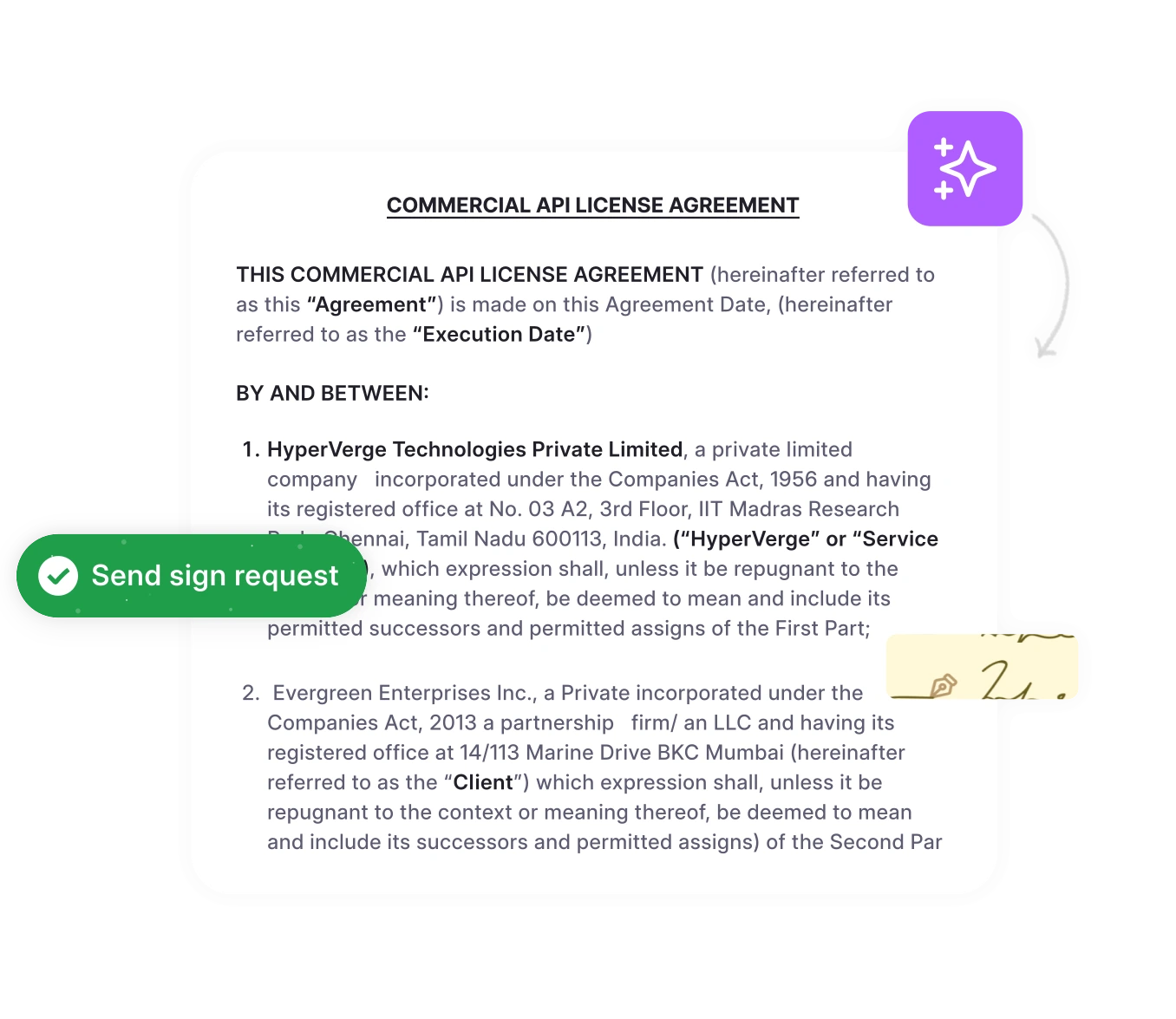
Generative AI can produce a standard NDA in seconds based on a few inputs — counterparty name, governing law, permitted use. On the review side, AI flags risky clauses, non-standard terms, and compliance gaps across long documents in minutes rather than hours.
For in-house legal teams handling high volumes of routine contracts, contract review AI alone can reclaim meaningful attorney hours every week.
→ Further reading: AI contract review: How it works
3. Contract Lifecycle Management (CLM)
AI-powered CLM tools track contracts from initial request through to renewal, flag upcoming deadlines, and surface insights from your contract portfolio — including obligations, SLA performance, and value trends. No more spreadsheets. No more missed auto-renewals.
This is also where legal process automation connects directly to business outcomes: procurement teams get renewal alerts in time to renegotiate, finance teams see billing alignment issues before they become disputes.
→ Further reading: How to choose a CLM platform
4. Legal Research
NLP-powered search tools let lawyers query case law, statutes, and internal precedent in plain English. Instead of running Boolean searches across multiple databases, you ask: “What cases support force majeure in software contracts?” and get contextual, summarized results.
AI-driven legal research cuts hours-per-query to minutes and surfaces relevant material that manual searches regularly miss.
5. eDiscovery & Document Review
AI processes thousands of documents simultaneously, identifies relevant evidence, flags duplicates, and applies technology-assisted review (TAR) for privilege — cutting eDiscovery costs dramatically while improving accuracy and consistency. What previously took a team days of manual review can now be handled in hours.
6. Compliance Monitoring
AI continuously monitors regulatory changes, flags risks in existing contracts, and generates compliance alerts — keeping legal teams ahead of obligations without the periodic manual audits that used to be the only option. For organizations operating across multiple jurisdictions, compliance monitoring automation is quickly becoming non-negotiable.
Real-World Examples: How Teams Are Using AI Today
It helps to see this in concrete terms rather than categories. Here’s what legal workflow automation looks like in practice.
Example 1: Automated Contract Generation
A business unit submits an NDA request via Slack. AI generates a first draft in under 60 seconds, routes it for approval, and tracks the executed document in the CLM — no lawyer required for standard requests. The legal team only touches it if the other party redlines.
Example 2: AI-Powered Legal Chatbot
An internal AI legal chatbot answers common employee questions (“Do I need legal approval for this vendor contract?”) instantly, 24/7. Teams using this approach report reductions in ad hoc legal request volume of 30–40%, freeing attorneys to focus on high-value legal work that actually requires their judgment.
Example 3: Intelligent Workflow Routing
Incoming legal requests are auto-categorized by matter type, urgency, and jurisdiction — then assigned to the right attorney or escalated based on predefined rules. Zero manual triage. Every request is tracked in real time. Nothing falls into an inbox and disappears.
The Real Benefits: Speed, Cost, and Strategic Focus
The ROI case for AI in legal operations comes down to three things: faster turnaround, lower costs, and freeing your lawyers to focus on work that actually requires a lawyer.
| Benefit | Without AI | With AI |
| Contract turnaround | 3–5 days | Under 1 hour for standard templates |
| Legal intake processing | Manual triage, delays | Instant routing, real-time tracking |
| Document review (eDiscovery) | Days of manual review | Hours with AI-assisted review |
| Compliance monitoring | Reactive, periodic audits | Continuous, real-time alerts |
| Legal research | Hours per query | Minutes with NLP-powered search |
Beyond the time savings, there’s a legal ops maturity argument here too. Teams that automate the operational layer build a fundamentally more scalable legal department — one that can handle increasing contract volumes, more jurisdictions, and growing compliance obligations without a proportional increase in headcount or legal spend management burden.
→ Further reading: Legal operations KPIs and metrics
What to Look for in an AI Legal Operations Tool
The market for legal AI tools has grown quickly, and the quality varies significantly. Here’s what actually matters when evaluating platforms for your legal tech stack:
✓ No-code configurability — can your team build workflows and intake forms without involving engineering? If the answer is no, adoption will be slow and expensive.
✓ Integration fit — does it connect with Slack, Teams, Salesforce, or your existing CLM? Tools that require your team to change how they work will get abandoned.
✓ Intake-to-resolution visibility — can you see every request’s status in one place? A real-time dashboard is non-negotiable for any team managing meaningful request volumes.
✓ Generative AI capabilities — can it draft, summarize, and respond — not just search? Pure search tools solve a narrow problem. You want end-to-end AI contract drafting and response capability.
✓ Security and compliance — SOC 2, GDPR, and a full audit trail are the floor, not the ceiling. Legal data is sensitive. Don’t compromise here.
✓ Scalability — does the platform work for a 5-person team and a 500-person department? Your needs will grow. Make sure the tool grows with you.
The best AI legal operations tools aren’t the ones with the most features — they’re the ones your team will actually use. Prioritize integration fit and configurability over feature lists.
How to Start: A Practical 5-Step AI Integration Roadmap
Getting started with AI in legal operations doesn’t require an enterprise rollout. The teams that make the most progress start small, prove value fast, and expand deliberately.
Step 1: Start with a High-Volume, Low-Risk Use Case
Pick something that happens a lot and doesn’t need senior legal judgment to handle — NDA requests, legal FAQ responses, or standard vendor agreement intake. These are quick wins that build confidence and buy-in across the team.
Step 2: Choose Tools That Fit How Your Team Already Works
Don’t ask your team to log into a new platform every morning. Prioritize tools that plug into Slack, email, or Teams so adoption is frictionless from day one. The best no-code legal workflow builder in the world won’t deliver ROI if no one uses it.
Step 3: Make Sure You Have Visibility Into Every Request
One of the most persistent legal ops problems is lack of visibility — work that lands in inboxes and quietly disappears. Your AI tools should surface a real-time view of all requests, statuses, and bottlenecks, so nothing falls through the cracks.
Step 4: Build in Feedback Loops
AI tools improve with use — but only if you configure the mechanisms to capture that feedback. Make sure your platform lets you flag incorrect AI outputs, adjust routing rules, and improve accuracy over time. Treat it as a living system, not a one-time deployment.
Step 5: Educate and Empower Your Team
AI doesn’t replace legal judgment — it informs it. Run short training sessions so your team understands what the AI handles, what it doesn’t, and when to override it. Legal ops professionals who know how to work alongside AI tools become measurably more valuable.
What’s Coming: AI in Legal Operations Beyond 2026
The current generation of legal AI tools is largely focused on making existing processes faster. What’s coming in the next few years is more fundamental.
Agentic AI for legal operations: rather than responding to a single input, agentic AI handles multi-step autonomous workflows — initiating contract reviews, routing approvals, following up on outstanding obligations, and escalating exceptions, all without human prompting at each step.
Predictive contract analytics: moving beyond flagging known risks to predicting outcomes. Which contracts are most likely to result in disputes? Which vendor relationships are showing early signs of SLA deterioration? Predictive analytics legal tools will answer these questions.
Sovereign AI and data privacy compliance: as data residency requirements tighten globally, AI tools built for legal departments will need to offer sovereign deployment options — processing data within specific jurisdictions to meet compliance obligations.
Democratized legal analytics for non-lawyers: AI “copilots” that let business stakeholders query complex contract data and legal risk in plain English — without needing to involve legal for every question. This is what general counsel (GC) AI strategy will increasingly look like: legal intelligence available across the organisation, not just inside the legal team.
Conclusion: From Automation to Strategic Enablement
The legal teams winning right now are the ones building their AI in legal operations foundation today — not waiting for perfect tools or perfect conditions.
AI won’t solve every legal ops challenge overnight. But it will handle the volume of routine work that’s currently consuming your team’s capacity, and it will do it faster, more consistently, and at a fraction of the cost of scaling headcount. The teams that make this shift aren’t just saving time — they’re building a fundamentally more strategic legal function.
The path forward is clear: start with a high-impact use case, prove value quickly, and expand deliberately. The technology is there. The question is whether your team moves first or watches competitors move ahead.