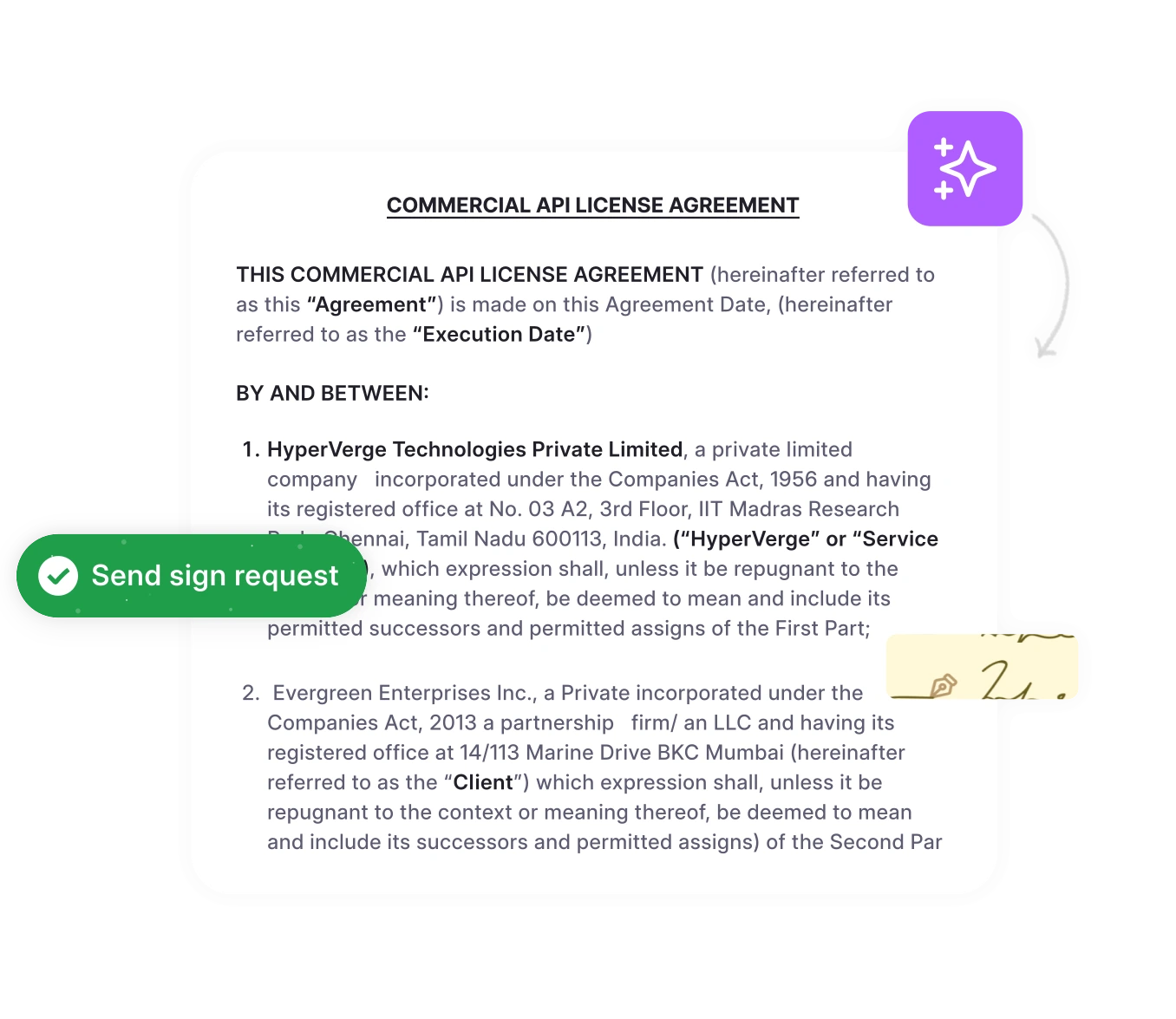




Your contract is ready in Microsoft Word, and now it needs a signature. You don’t have to print, sign, and scan it. You can electronically sign a Word doc in minutes. This guide shows how to e-sign a Word document with an e-signature tool, how to add a certificate-based digital signature in Word, and which method your document needs.
Key Takeaways
- Electronic and digital signatures are different things. An electronic signature shows that the signer intended to sign. A digital signature adds a certificate and encryption that prove who signed and that the file hasn’t changed since.
- Word has no built-in way to collect signatures from other people. Most people electronically sign a Word doc through an e-signature platform or add-in.
- Word’s own digital signatures need a certificate and only work in Word for Windows.
- Finish editing before anyone signs. Any change to a digitally signed Word file removes the signature.
- Most U.S. business documents can be signed electronically. The ESIGN Act and state UETA laws make those signatures legally binding, with exceptions such as wills and court orders.
Quick Answer
To e-sign a Word document, open it in an e-signature tool, add the signers, place the signature fields, sign, and download the signed copy. To add a certificate-based digital signature instead, go to Insert > Signature Line in Word for Windows, double-click the line, choose your digital certificate, and click Sign.
What Is an Electronic Signature?
An electronic signature (e-signature) is an electronic sound, symbol, or process that a person attaches to a record with the intent to sign it. A typed name, a signature drawn with a mouse, an uploaded signature image, or a click on a “Sign” button can all count.
What makes an e-signature hold up is the evidence behind it: the signer’s intent, proof of who signed, and an intact record. That’s why e-signature platforms keep an audit trail with email verification, timestamps, and IP addresses. For more detail, see our guide to legal signatures.
What Is a Digital Signature?
A digital signature is a type of electronic signature that uses public key infrastructure (PKI). When you sign a document with a digital signature, your private key creates an encrypted fingerprint of the file. That fingerprint is tied to a digital certificate issued by a certificate authority (CA) or by your organization.
This confirms who signed and whether the document changed afterward. If anyone edits the file, the signature becomes invalid. Digital signatures are common in government, healthcare, and finance.
Electronic Signature vs. Digital Signature
| Feature | Electronic Signature | Digital Signature |
| What it is | Any electronic mark that shows intent to sign | A certificate-based, encrypted e-signature |
| Identity check | Email, access code, SMS code, or none | Digital certificate from a CA or organization |
| Tamper evidence | Audit trail and sealed PDF (depends on the platform) | Built in. Edits invalidate the signature |
| Setup | Little to none | Requires a certificate |
| Typical use | Contracts, NDAs, HR forms | Government filings, regulated documents |
Every digital signature is an electronic signature, but not every electronic signature is a digital signature.
How to E-Sign a Word Document: Step by Step Guide
How do you sign a Word document electronically when other people need to sign too? Use an e-signature solution: a standalone tool, a Word add-in, or a contract management platform with built-in signing.
- Prepare and review your Word document: Finalize names, dates, and amounts, accept all tracked changes, and delete comments.
- Upload or open the document in an electronic signing solution: Upload the .docx or open it through the tool’s Word add-in. Most tools convert it to PDF so the layout stays fixed.
- Add the required signer(s): Enter each signer’s name and email, and set a signing order if one is needed.
- Place the signature field: Drag signature, initial, and date fields onto the page and assign each one to a signer.
- Add your electronic signature: Type, draw, or upload your signature, or reuse a saved one.
- Review the completed document: Check that every required field is filled and nothing shifted during conversion.
- Complete the signing process: Click Finish or Send. Other signers get an email link, and the platform locks the file once everyone has signed.
- Download or share the signed document: Save the signed PDF and its audit trail somewhere easy to find, such as your contract repository.
Microsoft 365 users can also electronically sign a Word doc without leaving Word, using SharePoint eSignature. This requires Word for desktop, a file stored on a SharePoint site where eSignature is turned on, and setup by an admin.
| Method | Best for | Ease of use | Security |
| E-signature platform or add-in | Contracts with outside or multiple signers | High | High (authentication and audit trail) |
| Microsoft 365 SharePoint eSignature | Microsoft 365 organizations | Moderate (needs admin setup) | Moderate to high |
| Signature image or Draw tab | Informal, single-person sign-offs | High | Low |
Need multiple people to sign the same contract?
HyperStart lets you add every signer, set a signing order, and track who’s completed their part — all without leaving your contract workflow.
Book a DemoHow to Digitally Sign a Word Document
Here’s how to digitally sign a Word document using Word’s built-in tools in Word for Windows:
- Open the Word document: Use the final .docx saved on your computer. Convert older .doc files first.
- Add a Signature Line: Go to Insert > Signature Line > Microsoft Office Signature Line and enter the signer’s name, title, and email.
- Select the signing option: Double-click the signature line, or right-click it and choose Sign. For an invisible signature, go to File > Info > Protect Document > Add a Digital Signature instead.
- Select or obtain a digital certificate: Check the Signing as field and click Change if it shows the wrong certificate. If you don’t have a certificate, get one from a CA or your IT team.
- Enter the required information: Type your name next to the X, or select an image of your signature.
- Apply the digital signature: Click Sign. If you use a smart card, such as a PIV or CAC card, enter your PIN.
- Save the document: Word marks the file as final. Keep an unsigned copy for edits, because changing the signed file removes the signature.
- Verify the signature: Open File > Info > View Signatures to see who signed, when, and whether the signature is still valid.
| Method | Best for | Ease of use | Security |
| Visible signature line | Documents where readers should see who signed | Moderate | High with a CA-issued certificate |
| Invisible signature (File > Info) | Filings that only need proof the file is unchanged | Moderate | High with a CA-issued certificate |
| Smart card (PIV/CAC) | Government and enterprise use | Moderate | Very high |
On a Mac? Word for Mac offers little or no support for certificate-based signatures. Use a Windows PC or an e-signature platform that supports digital signatures.
How to Create a Digital Signature in Word
To create a digital signature in Word, you first need a digital certificate. There are three ways to get one:
- Buy one from a certificate authority. This is best for external documents, because recipients’ computers will trust it.
- Get one from your organization, often stored on a smart card.
- Create a self-signed certificate with Office’s SelfCert tool. Only your own computer trusts it, so use it for testing only.
Once the certificate is installed, Word lists it in the Signing as field when you sign.
If you only want your handwritten signature to appear in the document, scan it, save it as a PNG, and add it with Insert > Pictures. You can also draw one on the Draw tab. Keep in mind that an image carries no certificate or tamper protection.
How to E-Sign a Word Document Without Printing
How do you sign a Word document electronically without a printer or scanner? Follow these steps:
- Upload the Word document to an e-signature platform: The platform creates a fixed-layout copy, so every signer sees the same thing.
- Add signature fields: Place signature, date, and name fields, and assign each one to the right person.
- Sign electronically: Type, draw, or adopt a signature. Signers open an email link on any device and don’t need to install anything.
- Send the completed document: Route it to the remaining signers, either in sequence or all at once.
- Track the signing process: Watch the status, send reminders, and download the final copy with its audit trail.
| Method | Best for | Ease of use | Security |
| E-signature platform | Multi-party agreements | High | High |
| Word digital signature line | Internal sign-offs in Word for Windows | Moderate | High with a trusted certificate |
| Convert to PDF and sign | One-off personal documents | High | Low to moderate |
This is the simplest way to sign a doc electronically from any device. For contract-specific tips, see our guide to electronic contract signing.
Are Electronic Signatures Legally Binding in the U.S.?
Yes, for most business and consumer transactions. The federal ESIGN Act (2000) says a signature can’t be denied legal effect just because it’s electronic. The Uniform Electronic Transactions Act (UETA), adopted by 49 states and Washington, D.C., does the same at the state level. New York is the exception and has its own Electronic Signatures and Records Act.
An enforceable e-signature generally shows the signer’s intent, consent to do business electronically, attribution to the signer, and an accurately stored record.
Exceptions include wills and testamentary trusts, many family-law documents, court orders, and certain notices, such as utility shutoffs, foreclosures, and insurance cancellations. This is general information, not legal advice. To see who can sign for a company, read our guide to authorized signatories.
Electronic vs. Digital Signatures: Which Should You Use?
| Use Case | Recommended Approach |
| Sales contracts, NDAs, vendor agreements | E-signature or contract management platform with an audit trail |
| HR offer letters and onboarding | E-signature platform with templates and a signing order |
| Internal approvals | Word digital signature, if everyone uses Word for Windows |
| Government or agency filings | Digital signature with the agency’s required certificate (e.g., PIV/CAC) |
| Regulated documents (healthcare, finance) | Digital signature, or a platform that supports certificate-based signing |
| High-volume contracts across teams | Contract management platform with built-in signing |
Choose an e-signature when speed and ease matter most. Sign a document with a digital signature when you need to prove it hasn’t changed since signing.
Common Issues When Signing a Word Document Electronically or Digitally
- The signature disappeared after an edit. Word removes digital signatures whenever the file changes. Make edits on an unsigned copy, then sign again.
- Signature Line is grayed out. The file may be a .doc, open in Protected View, or open in Word for the web or Mac. Save it as .docx, click Enable Editing, and use Word for Windows.
- No certificate appears, or it shows as invalid. Install a certificate from a CA or your IT team. An invalid certificate is usually expired or self-signed.
- The formatting shifts after upload. Export the document to PDF yourself first, or review every page before you send it.
- Adding a signer breaks earlier signatures. In Word, add every signature line before the first person signs. E-signature platforms avoid this problem by routing a locked copy.
Conclusion
For contracts with other people, the fastest way to e-sign a Word document is an e-signature platform. You upload the file, place the fields, sign, and track progress without printing. When you need certificate-backed proof of identity and integrity, digitally sign the Word document with a trusted certificate. Either way, finalize the document before anyone signs, and keep the signed copy with its audit trail.
Ready to Sign Documents Without the Back-and-Forth?
Signing is only one step. You also route approvals, chase signers, and track down final versions. HyperStart’s contract signing software combines these steps into one workflow, with drag-and-drop signatories, sequential or parallel signing, automatic reminders, and an audit trail for every contract. It also integrates with DocuSign and Adobe Sign.
Book a Demo