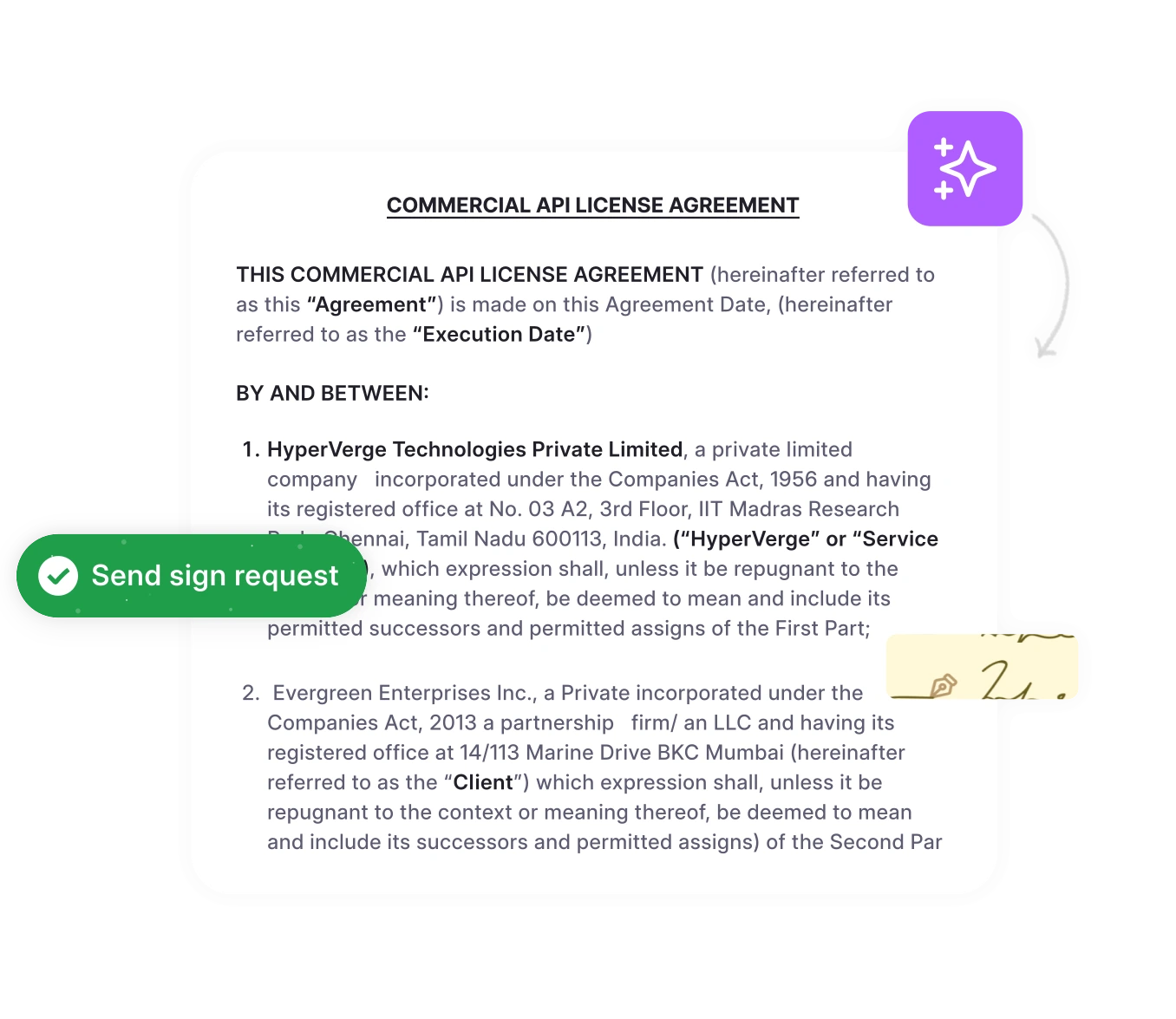




- The purpose of a contract is to create a legally binding agreement that documents the rights, obligations, and expectations of all parties involved, making private promises enforceable through courts or arbitration.
- Contracts serve 10 critical business functions: documenting obligations, creating legal enforceability, formalizing relationships, guaranteeing payment, optimizing revenue, preventing disputes, protecting confidentiality, enabling collaboration, building trust, and improving operational efficiency.
The purpose of a contract is to formalize an agreement between two or more parties, making each party’s rights, obligations, and expectations legally enforceable. Contracts transform verbal promises into documented commitments that courts and arbitration bodies recognize.
Without a written contract, businesses face disputes over payment terms, delivery timelines, confidentiality obligations, and liability. Organizations that manage contracts poorly lose an average of 9.2% of annual revenue, according to World Commerce & Contracting. This guide covers the 10 key reasons contracts are critical for business, the essential elements every contract needs, and how contract management software reduces risk.
What is the purpose of a contract?
The purpose of a contract is to create a legally binding agreement that documents the rights, obligations, and expectations of all parties involved. A contract transforms private promises into enforceable commitments that courts recognize. The three fundamental functions of any contract are documentation of commitments in permanent written form, legal enforceability through courts and arbitration, and formal structuring of business relationships with clear communication protocols.
A contract is a formal, legally binding agreement between two parties. This agreement creates mutual obligations that are enforceable by law.
Read
Contracts serve three fundamental functions that benefit both parties. First, they document commitments in permanent written form that can be referenced throughout the business relationship. Second, they make private promises legally enforceable through courts and dispute resolution mechanisms. The purpose of contract documentation comes down to three fundamental functions that benefit both parties. First, they document commitments in permanent written form that can be referenced throughout the business relationship.
According to the International Chamber of Commerce (ICC), 95% of commercial contracts in 2024 included a choice-of-law clause, highlighting the growing importance of legal clarity in international agreements. Third, they create formal structure for contractual relationships by establishing communication protocols, approval processes, and change management procedures.
The table below summarizes the core purposes:
| Core Purpose | What It Accomplishes | Business Impact |
| Legal enforceability | Makes agreements binding under law | Provides recourse if terms are violated |
| Risk management | Anticipates problems and allocates responsibility | Reduces exposure to disputes |
| Business structure | Defines roles, timelines, and deliverables | Improves operational efficiency |
Understanding the purpose of a contract goes beyond legal compliance. Contracts serve as strategic tools that protect revenue, enable collaboration, and create opportunities for business growth when managed effectively. Modern businesses managing multiple agreements benefit from systematic approaches to contract dispute prevention and resolution.
Businesses that ask “what is the purpose of a contract” often discover the answer goes beyond legal compliance. Contracts serve as strategic tools that protect revenue, enable collaboration, and create opportunities for business growth when managed effectively.
Ready to transform your contract lifecycle?
AI-powered contract lifecycle management platforms eliminate manual workflows while maintaining complete visibility across your entire contract portfolio.
Book a DemoWhy are contracts important for business?
Contracts are important for business because they provide legal enforceability, protect revenue, prevent disputes, and create accountability between parties. Organizations without proper contract management lose an average of 9.2% of annual revenue, according to World Commerce & Contracting. Contracts serve at least 10 distinct business functions, from documenting obligations and guaranteeing payment to enabling formal collaboration and building trust.
The purpose of contracts extends beyond their foundational legal role. They deliver tangible benefits that protect businesses and enable them to grow. Here are 10 crucial reasons every business needs comprehensive contract management.
1. Contracts document rights, obligations, and responsibilities
Contracts create a permanent written record of who does what, when, and how. This documentation eliminates the “he said, she said” disputes that plague verbal agreements. A SaaS provider and an enterprise client might verbally agree on implementation timelines, but without written specifications, both parties may recall the conversation differently when deadlines approach.
Comprehensive contracts outline deliverables with specificity: data migration completed by March 15, training sessions delivered within 30 days of go-live, and support response times measured in hours. These details serve as the single source of truth throughout the relationship lifecycle. When questions arise months or years after signing, parties reference the contract rather than relying on fading memories.
A software vendor and client disputed whether certain features were included in the project scope. The signed contract’s detailed deliverables list resolved the disagreement immediately, saving both parties weeks of negotiation and preserving the business relationship.
2. Contracts transform private promises into legal commitments
The importance of contracts becomes clear when informal agreements fail to hold up. A handshake deal carries no legal weight when one party decides the terms no longer suit their interests. Contracts shift these informal promises into enforceable obligations recognized by courts and arbitration bodies.
When a vendor fails to deliver promised services, the contract provides legal recourse. The affected party can seek compensation for damages, require specific performance of obligations, or terminate the agreement with appropriate remedies. This legal backing fundamentally changes the risk profile of business relationships by ensuring consequences exist for breach of contract situations.
3. Contracts formalize business relationships between parties
Official partnerships, vendor relationships, and strategic alliances begin with contracts that establish professional frameworks. A partnership agreement template defines equity splits, decision-making authority, profit distribution, and exit scenarios before conflicts arise. This formalization sets expectations and demonstrates commitment from all parties.
Vendor agreements transform casual supplier relationships into structured engagements with defined service levels, quality standards, and accountability measures. The process of negotiating and signing contracts signals that all parties take the relationship seriously and have invested time in establishing clear terms.
4. Contracts guarantee payment and protect revenue
Payment terms, amounts, and schedules clearly defined in service agreements protect both buyers and sellers. Net-30 payment terms with a 2% late fee after 45 days provide service providers with recourse against non-payment. Construction contracts tie payments to milestone completions: 30% upon foundation completion, 40% after framing, and the final 30% upon passing inspections.
These structured payment provisions ensure service providers receive compensation for delivered work while guaranteeing buyers only pay for completed deliverables. A consulting firm that completes a six-month engagement without a signed contract faces collection challenges that consume time and legal resources. Why are contracts important in business? They eliminate payment ambiguity that otherwise stalls cash flow and damages working capital.
Include specific payment milestones tied to deliverables and outline late payment penalties to ensure timely compensation and maintain healthy cash flow.
5. Contracts create opportunities for revenue optimization
Contracts aren’t just protective documents; they’re strategic growth tools. Businesses leverage agreements to increase value and accelerate deal cycles through two primary approaches. World Commerce & Contracting estimates that poor contract management erodes up to 40% of a contract’s total value through missed terms, unclaimed discounts, and unenforced penalty clauses.
A. Negotiating contract terms to increase value
Volume discounts, annual prepayments, and expanded scopes have a direct impact on revenue. A software company that negotiates annual rather than monthly pricing captures 12 months of revenue upfront, offering clients a 15% discount. Contract optimization identifies opportunities to restructure pricing models, expand services, and incorporate automatic renewals to prevent revenue churn.
Contracts are not just about legal protection—they are the foundation of trust, order, and predictability in business relationships, both conventional and digital.
Read
B. Making the contract process more efficient
Time spent in legal review represents deals that are stuck in limbo rather than being closed and generating revenue. Contract automation software reduces contract cycle times from two weeks to two days by standardizing templates, automating approvals, and eliminating manual bottlenecks. Faster deal cycles mean sales teams close more business per quarter, directly impacting top-line growth.
Are your contracts bottlenecked?
Streamline creation, negotiation, and approval workflows to close deals 80% faster with AI-powered contract automation.
Book a Demo6. Contracts prevent disputes and mitigate business risks
Well-drafted contracts anticipate potential problems and establish resolution mechanisms before conflicts arise. Arbitration clauses require parties to attempt mediation before pursuing litigation, saving thousands in legal fees. Contract disputes cost small businesses a median of $91,000 per case, according to business litigation data. Clear contract language reduces the likelihood of reaching that point. Warranty provisions allocate risk between buyers and sellers, offering a three-year warranty for manufacturing defects versus a 90-day warranty for consumable components. The World Bank Group notes that efficient contract enforcement is crucial for economic development, as it reduces transactional uncertainty and enhances investor confidence.
Contract risk management software helps organizations identify exposure across their entire contract portfolio. Companies discover unfavorable auto-renewal clauses, missing liability caps, and expiring insurance requirements before they become problems. Risk allocation through contracts transforms uncertainty into manageable, quantified exposure.
A manufacturing contract included an arbitration clause requiring mediation before litigation. When a delivery dispute arose, both parties resolved the issue through a mediator in two weeks, saving over $50,000 in legal fees and preserving their ongoing relationship.
7. Contracts ensure confidentiality and protect sensitive information
Confidentiality contracts and non-disclosure agreements embedded within broader business contracts protect trade secrets, proprietary information, and customer data. Technology companies licensing software to third-party vendors include provisions preventing reverse engineering, unauthorized disclosure of source code, and sharing of customer lists.
These confidentiality provisions carry legal consequences for breaches. A marketing agency with access to a client’s product launch strategy faces damage if information leaks to competitors. The contract meaning extends beyond basic service terms to encompass protective clauses that safeguard competitive advantages in information-sensitive industries.
8. Contracts enable formal collaboration across teams and organizations
Multi-party projects require frameworks that define roles, responsibilities, and communication protocols. Contract collaboration software facilitates coordination between legal, finance, sales, and operations teams during negotiation and execution. Joint venture agreements between two companies typically specify which party is responsible for regulatory compliance, who owns the intellectual property, and how profits are distributed.
MSA agreements streamline ongoing partnerships by establishing base terms once, then using simpler statements of work for individual projects. This approach reduces negotiation time for subsequent engagements while maintaining necessary legal protections. Clear contractual frameworks reduce internal confusion about who has approval authority and eliminate external finger-pointing when deliverables span multiple organizations.
Master Service Agreements (MSAs) streamline collaboration by establishing base terms once, then using simpler statements of work for individual projects, cutting negotiation time by 60%.
9. Contracts build trust and demonstrate commitment
The willingness to formalize an agreement signals seriousness about the relationship. When both sides understand the purpose of the contract from the start, negotiations move faster. A startup pursuing an enterprise client demonstrates credibility by offering a comprehensive contract that addresses security requirements, liability limitations, and service level commitments.
Understanding contract clauses helps businesses negotiate terms that foster trust rather than erode it. Fair limitation of liability clauses, reasonable termination provisions, and balanced intellectual property ownership demonstrate good faith. Companies that invest effort in creating clear, fair contracts lay the foundations for partnerships that extend beyond single transactions.
10. Contracts improve operational and business efficiency
Clear roles and timelines in contracts minimize back-and-forth communication, which saves time. Procurement contracts with pre-approved payment terms, standard quality specifications, and automatic renewal provisions accelerate vendor onboarding from weeks to days. This standardization enables procurement teams to focus on strategic supplier relationships rather than repeatedly negotiating basic terms.
Digital contracting platforms enable e-signatures, automated workflow routing, and real-time status tracking. What was once a manual process requiring printed documents, physical signatures, and filing cabinets has become a streamlined digital workflow. Time saved on contract administration redirects resources toward revenue-generating activities and strategic initiatives.
A mid-size technology company reduced contract approval time from 14 days to 3 days using standardized templates and automated workflows, enabling the sales team to close 40% more deals per quarter and significantly accelerate revenue growth.
What are the essential elements of a valid contract?
A valid contract requires five essential elements: offer, acceptance, consideration (something of value exchanged), capacity (both parties must be legally competent), and legal purpose (the contract cannot involve illegal activities). If any one of these elements is missing, the agreement may be unenforceable in court.
An offer is a clear proposal from one party to another, stating specific terms. Acceptance occurs when the other party agrees to those exact terms without modification. If the accepting party changes any terms, that response becomes a counteroffer rather than an acceptance.
Consideration is the exchange of value that makes a contract binding. Each party must give something (money, services, goods, or a promise to act or refrain from acting). A one-sided promise without consideration is generally not enforceable as a contract.
What are the objectives of a contract in business?
The objectives of a contract in business are to establish clarity about deliverables and timelines, create legal enforceability for all obligations, mitigate risk through defined liability and indemnity provisions, and protect the financial value of the agreement for both parties. Each objective serves a specific function in reducing uncertainty and building accountability.
Clarity is the first objective because ambiguous terms cause disputes. The American Arbitration Association reports that contract disputes cost a median of $91,000 for small businesses and significantly more for enterprise organizations. Well-drafted contracts reduce this risk by specifying exact deliverables, deadlines, payment amounts, and consequences for non-performance.
Streamline contract management with HyperStart
Contracts are foundational to business success, serving both protective and strategic functions. They transform promises into enforceable commitments, prevent costly disputes, and create opportunities for revenue growth. Modern businesses managing multiple agreements across departments need systematic approaches to maintain compliance, capture value, and accelerate deal cycles.
HyperStart, an AI-powered contract lifecycle management platform, addresses every purpose outlined above. Our automated contract creation eliminates manual drafting while maintaining consistent quality. Intelligent clause extraction and AI-powered contract review identify risks before agreements are signed. Comprehensive contract tracking provides complete visibility across your portfolio, ensuring no renewal deadline or obligation goes unnoticed. See how leading companies streamline their contract workflows and close deals 80% faster.