



- AI contract management uses natural language processing and machine learning to automate contract drafting, review, obligation tracking, and renewal workflows across the entire contract lifecycle.
- Organizations using AI-powered CLM platforms report measurable results including faster contract review (from hours to minutes), lower error rates, and reduced contract administration costs.
AI contract management is the use of artificial intelligence, including natural language processing and machine learning, to automate and optimize every stage of the contract lifecycle. AI-powered contract management systems handle drafting, clause review, risk analysis, obligation tracking, and renewal workflows that traditionally require hours of manual legal work.
Nearly half of legal teams now use generative AI weekly for drafting and reviewing contracts. As adoption accelerates, understanding how AI transforms contract management, and what to look for in an AI CLM platform, is critical for legal, procurement, and operations teams managing high contract volumes.
What is AI contract management, and how does it work?
AI contract management is the application of artificial intelligence technologies, including natural language processing, machine learning, and generative AI, to automate contract drafting, review, analysis, and lifecycle tracking. AI-powered contract management software extract key terms, flag risk clauses, track obligations, and route approvals without manual intervention. Organizations using AI contract management report contract review times dropping from an average of 92 minutes per document to under 10 minutes. The AI contract management market was valued at $589.1 million in 2024 and is projected to grow at a 26.5% CAGR to reach $3862.7 M by 2033, reflecting rapid enterprise adoption across legal, procurement, and finance teams (Global Growth Insights, 2025).
AI contracting software replaces conventional CLM tools for better automation and minimal contractual effort. Let’s understand AI-based contract management with the help of an example. This example is of LeadSquared, which used AI featured by HyperStart CLM.
LeadSquared has a monthly contract load of 180-250+ agreements which it used to manage manually, taking 30% of their legal time. Implementing HyperStart CLM helped LeadSquared automate tasks like contract drafting and review with AI. The result? 6+ hours saved in contract review and 60% slash-off in contract creation time.
The scope and potential of AI technology in contracting processes are clear. However, what are the benefits of using AI for managing contracts? Let’s find out.
What are the benefits of AI contract management?
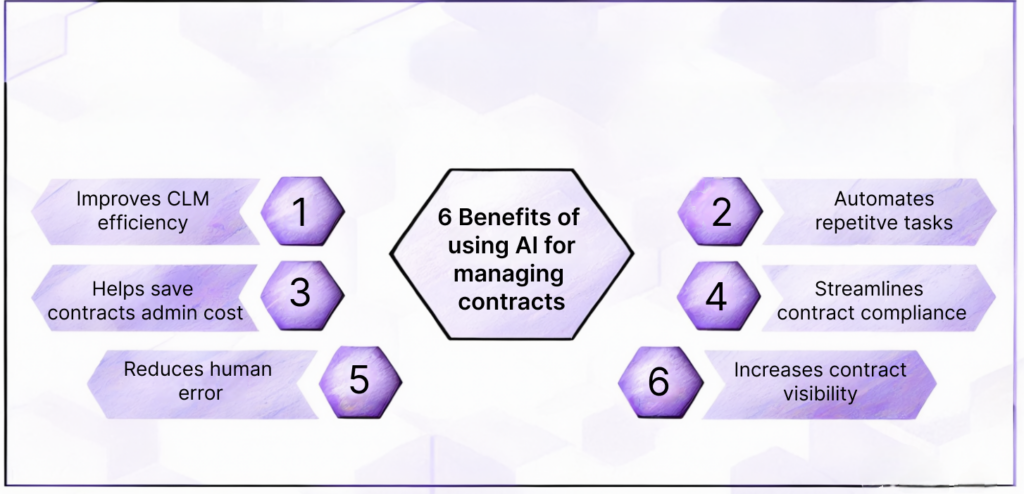
The primary benefits of AI contract management are faster contract cycles, lower error rates, reduced administration costs, stronger compliance, and better visibility into contract obligations. Legal teams using AI-powered CLM tools report cutting contract turnaround from weeks to days. According to Juro’s 2026 research, 44% of legal teams now use generative AI daily or weekly for contract-related tasks, up from single digits just two years ago.
1. Improves contracting speed and efficiency
According to a report by the University of Texas at San Antonio, executing a non-standard agreement with high risk can take as much as 3 to 4 months. This duration encompasses the time it takes from contract request generation to final signing.
AI-based CLM tools help shrink the contract TAT from months to days. Strategic and automated workflows self-orchestrate contract journeys, ensuring that contracts move automatically across your organization without any bottlenecks or delays. Human-led contract reviews average 92 minutes per document. AI-powered review reduces first-pass analysis to under 10 minutes, a time savings that compounds across organizations managing hundreds or thousands of contracts annually.
2. Automates repetitive tasks
Contract management involves many repetitive activities such as creation, review, approvals, redlining, and tracking. Legal teams spend time extensively on these processes, reducing their efficiency and productivity.
AI contract management solutions help automate monotonous tasks throughout the contract lifecycle. With AI, business teams can automatically generate contracts, track contract status, redline contract clauses, and get approvals. This gives legal staff more bandwidth for other, more important activities.
3. Helps save contract admin costs
According to Salary.com, the cost of hiring a contract administrator can range from USD 58,008 to USD 76,511. The contract administrator manages the contractual processes to ensure all contracts flow smoothly. Poor contract management costs organizations up to 9% of annual revenue through missed renewals, unfavorable auto-renewals, and compliance failures (World Commerce & Contracting).
Using AI for contract management helps reduce contract admin costs by automating routine contract tasks. With AI-powered contract management software, all contractual processes can be automatically administered with minimal human intervention, saving contract admin time and costs.
4. Enhances contract compliance
Legal compliance and risk management are important for effective contract administration. Regarding contract management, compliance means adhering to the agreed terms and commitments such as payment dates, payout amounts, and milestones. Manual tracking often results in contract negligence and non-compliance. 42% of organizations are currently implementing AI in their contracting processes, with compliance automation cited as a primary driver (World Commerce & Contracting, “2025 AI in Contracting Report,” based on a survey of 374 organizations).
Using AI for contract management helps streamline compliance by automating contract obligation tracking. AI algorithms ensure all contract obligations are tracked, reported, and visible to avoid non-compliance-related penalties.
5. Reduces human errors
Manual contract management is prone to human errors. Mismanaged contract requests, negligence in redlining, missed signatures, and unorganized contracts are a few instances where manual errors result in chaotic contract management.
Using an AI contract management system helps eliminate human errors in the contract lifecycle. Artificial intelligence models like HyperStart CLM work with 99% accuracy, balancing efficiency and precision.
6. Improves contract data tracking and visibility
Contract visibility is crucial for contracting professionals to understand and manage CLM performance. Visibility helps locate contracts, track agreements, streamline legal strategies, and nurture strong contract analytics for data-driven decisions.
AI-driven contract management processes help increase contract visibility by automatically processing large datasets into legal insights. Legal teams can leverage AI to track contracts throughout the organization and gain data-driven insights.
Manage Contracts 80% Faster With AI
Switch to HyperStart CLM and create, review, approve, store, track, and analyze contracts through AI.
These are the benefits of using artificial intelligence in contract lifecycle management. Claiming these benefits requires selecting the right CLM software with the right AI capabilities. The coming section talks about factors to consider when choosing a contract intelligence solution.
How do you choose the right AI contract management software?
Choosing the right AI contract management software requires evaluating four factors: output accuracy (look for 94% or higher), data security and compliance certifications, integration with existing systems (CRM, ERP, e-signature tools), and implementation complexity based on your contract volume and standardization level. Over 51% of businesses still lack dedicated contract management software, meaning most teams are selecting their first platform rather than replacing an existing one.
Output accuracy: Using untrained or less-trained natural language processing models may result in inaccurate output. Moreover, non-contract AI models often lack the contextual understanding of contracts and legal processes.
Data privacy and security: Using AI to manage contracts without proper cybersecurity mechanisms can compromise data security. The leakage of critical contract data increases business risk and is an important consideration clause.
Integration: AI contract management features work well when integrated with external systems like CRMs, HRMs, finance systems, etc. Consider your AI contract management solution’s configurability with other systems for holistic CLM efficiency.
Implementation: Implementing CLM software for managing complex contract workflows requires customizing the AI model. Standardized contracts, on the other hand, require less implementation effort.
These considerations help ensure the smooth implementation of AI technology in contract management processes. Apart from these factors, there are certain tips to help you get started with AI-based contracting and implement a CLM tool for contract management.
Auto-pilot Routine Contracting Tasks
Accelerate contracting speed and value with HyperStart CLM’s powerful AI. Focus on what matters and automate the rest.
Book a DemoHow do you implement AI contract management successfully?
Successful AI contract management implementation follows five steps: start with a pilot on your highest-volume contract type, configure AI models for your specific clause library, integrate with existing workflows (CRM, ERP, e-signature), validate AI outputs against legal review standards, and train users with structured onboarding. Implementation timelines vary, but platforms like HyperStart deploy in 4 weeks, while 72% of CLM implementations take 2 months or longer.
Integrating artificial intelligence technology into your existing contractual processes can be tricky, but it’s key to the future of contract management. Here are a few tips to help you ease the process:
1. Start small with selected use cases
- Identify the most time-consuming tasks in your CLM, such as contract review or data entry, and choose one area to pilot AI.
- Set clear goals for the pilot project, like reducing contract processing time by a certain percentage.
- Use the pilot to gather metrics (e.g., time saved, error reduction) that can demonstrate AI’s impact before expanding to more areas.
2. Choose a scalable solution
- Evaluate AI-based CLM platforms that offer flexibility and support growth, so you can add more features as your needs expand.
- Check the integration capabilities of the solution with your current tech stack to avoid complex adjustments later.
- Ensure the vendor provides support for upgrades and scalability without significant disruptions or extra costs.
3. Focus on automating routine tasks
- List repetitive tasks (e.g., data extraction, contract generation) and identify which can be automated for time savings.
- Implement AI to handle these routine processes first, freeing up time for higher-value contract management tasks.
- Track the time saved and accuracy improvements from automation to assess its impact on overall efficiency.
4. Check generative AI’s output
- Establish a review process for AI-generated content, having team members validate accuracy and compliance with company standards. AI contract negotiations can further refine the process by ensuring AI-assisted clause adjustments and optimizing contract terms based on historical data and legal best practices.
- Set parameters for AI use, specifying where human oversight is required, especially in high-risk or sensitive contracts.
- Encourage feedback from users to refine AI prompts and instructions, improving the relevance and accuracy of outputs.
5. Train your team and seek routine feedback
- Schedule hands-on training sessions to familiarize your team with the AI features and address any questions or concerns.
- Create a feedback loop where team members can share their experiences and suggest adjustments based on day-to-day use.
- Regularly review feedback to adjust workflows, update training, and optimize AI settings to better meet team needs.
Follow these tips for the best results while automating contracts with AI. All you need now is reliable and efficient AI-based contract management software.
What is the difference between AI contract management and traditional CLM?
Traditional contract lifecycle management (CLM) software digitizes contract storage, automates basic workflows, and provides a central repository. AI contract management builds on traditional CLM by adding intelligent capabilities: automated clause extraction, risk scoring, obligation tracking, and predictive analytics. The difference is that traditional CLM requires humans to read, interpret, and act on contracts, while AI CLM handles these tasks automatically with 94% or higher accuracy.
The shift from traditional CLM to AI-powered contract management is accelerating. The CLM market grew from $1.24 billion in 2025 to a projected $1.84 billion, with AI-native platforms capturing an increasing share of new implementations (GM Insights, Fortune Business Insights). Organizations evaluating contract management solutions should consider whether they need basic workflow automation or full AI-powered lifecycle intelligence.
| Capability | Traditional CLM | AI contract management |
|---|---|---|
| Contract drafting | Templates with manual field population | AI generates drafts from deal parameters and clause libraries |
| Contract review | Manual clause-by-clause legal review (avg 92 min) | AI flags risks and deviations in minutes |
| Data extraction | Manual reading and tagging of key terms | NLP extracts dates, obligations, and financial terms automatically |
| Obligation tracking | Calendar reminders set manually | AI monitors obligations and triggers alerts proactively |
| Risk assessment | Depends on reviewer experience | AI scores risk based on clause analysis and historical patterns |
| Renewal management | Spreadsheet tracking with manual follow-up | Automated renewal workflows with deadline alerts |
| Search and retrieval | Keyword search across stored documents | Semantic search understands intent (retrieval in 2 seconds) |
| Accuracy | Varies by reviewer fatigue and experience | 94% or higher accuracy with continuous model improvement |
| Implementation time | 3 to 6 months typical | 4 weeks (HyperStart) to 2+ months (industry average) |
What industries benefit most from AI contract management?
AI contract management delivers the highest impact in industries with large contract volumes, complex compliance requirements, and multi-party agreements. Sales teams, procurement departments, finance organizations, and legal teams each use AI contract management differently depending on their workflow priorities and risk profiles.
Sales and revenue operations
Sales teams use AI contract management to accelerate deal cycles by auto-generating contracts from CRM data, inserting pre-approved clauses, and routing approvals in parallel rather than sequentially. AI-powered contract tools reduce sales contract turnaround from an average of 3 to 4 weeks to under one week, which directly impacts revenue recognition timelines.
Procurement and vendor management
Procurement teams manage hundreds of vendor contracts with overlapping renewal dates, compliance requirements, and pricing tiers. AI contract management flags upcoming renewals, benchmarks pricing against historical data, and identifies non-standard terms that introduce supply chain risk. Organizations with automated procurement workflows report 5% to 15% annual contract cost reductions through better renewal tracking (Freqens, 2024).
Finance and accounting
Finance teams rely on AI contract management for revenue recognition compliance (ASC 606), payment obligation tracking, and audit preparation. AI extracts financial terms, payment schedules, and penalty clauses across thousands of contracts, replacing manual spreadsheet tracking that introduces errors and delays quarterly close processes.
Legal and compliance teams
Legal departments use AI contract management to review incoming contracts against playbooks, flag deviations from approved language, and maintain audit trails for regulatory compliance. Human-led contract reviews average 92 minutes per document (Juro, 2026). AI reduces first-pass review to minutes, allowing lawyers to focus on negotiations and exceptions rather than clause-by-clause reading.
How can AI automate routine contract tasks?
AI automates routine contract tasks by handling drafting, clause insertion, risk flagging, obligation extraction, approval routing, and renewal tracking without manual effort. Contract management consumes up to 50% of legal department capacity according to Gartner. AI automation targets exactly these repetitive workflows, freeing legal professionals to focus on negotiation, strategy, and exception handling rather than document processing.
Implementing Artificial intelligence in contract management requires choosing the right vendor with an advanced AI model. HyperStart CLM offers end-to-end solutions for automated, streamlined, and optimized contract management. Here’s how HyperStart CLM’s AI transforms contract management:
80% contract turnaround time
2-second retrieval for past contracts
2 minutes to create a new contract
75% reduction in contract negotiation time
10x faster contract reviews
$20 saved on each contract
With a 99% accurate AI model and a record of handling over 1 billion contracts, HyperStart CLM is the right AI solution for all your contract management requirements. Book a demo today to learn more about how HyperStart’s CLM can help you streamline contract management.
With HyperStart’s intelligent contract management platform, your legal and procurement teams gain full control over the contracting lifecycle — from creation to compliance — with speed, accuracy, and clarity.