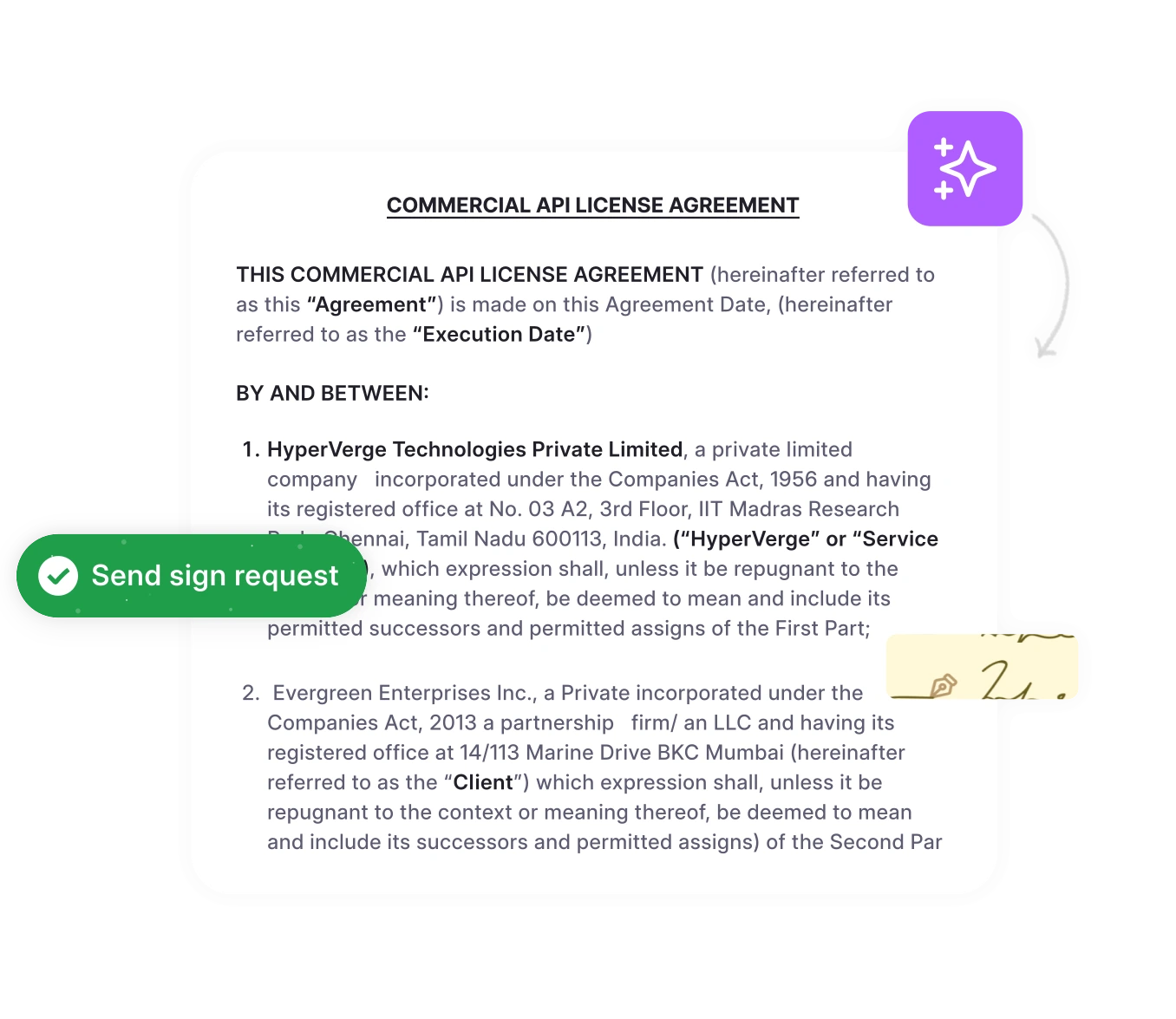




- Every contract is an agreement, but not every agreement is a contract. An agreement becomes a contract only when it satisfies all legal requirements, including consideration, capacity, legality, and mutual assent.
- The core difference is enforceability. If one party breaks an agreement, legal remedies may not be available. If one party breaches a contract, the affected party can seek damages or enforcement through a court of law.
- For business dealings, always use a contract. Informal agreements work for casual, low-risk situations. But for employment, real estate, vendor relationships, or any transaction involving money, a formal contractual agreement is essential to protect your interests.
People use “agreement” and “contract” interchangeably all the time, but legally, they are not the same thing. Understanding the contract vs agreement distinction matters whether you are signing a vendor agreement, negotiating a lease, or onboarding a new employee. The difference between agreement and contract comes down to one thing: legal enforceability.
An agreement is simply a mutual understanding between two or more parties. A contract is a specific type of agreement that the law recognizes and enforces. In other words, all agreements start as mutual understandings, but only those that meet specific legal requirements become enforceable. This guide breaks down the contract vs agreement difference in plain language, covering what each term means, the legal elements that separate them, how different types of legal agreements compare, and when you should use one over the other.
What is the difference between an agreement and a contract?
An agreement is a mutual understanding between parties, while a contract is a legally binding agreement that courts will enforce. The simplest way to remember it: all contracts are agreements, but not all agreements are contracts. So what makes a contract different from an agreement? A contract becomes enforceable only when it includes specific legal elements beyond just offer and acceptance, namely consideration, capacity, legality, and mutual assent.
Here is a side-by-side comparison of the contract vs agreement difference:
| Aspect | Agreement | Contract |
| Definition | A mutual understanding or arrangement between two or more parties. | A legally binding agreement that is enforceable by law. |
| Legal Enforceability | May or may not be enforceable in a court of law. | Always enforceable in a court of law if validly formed. |
| Required Elements | Requires only offer and acceptance, reflecting mutual consent. | Requires offer, acceptance, consideration, legal capacity, lawful object, and intention to create legal relations. |
| Formality | Can be verbal, written, or implied and is often informal. | Usually formal and documented, although some verbal contracts may also be legally valid. |
| Legal Obligation | Does not necessarily create legal obligations between the parties. | Creates legally enforceable rights and obligations for all parties involved. |
| Consequence of Breach | Generally provides limited or no legal remedy if breached. | The aggrieved party can seek remedies such as damages, compensation, or specific performance. |
| Purpose | Primarily records a mutual understanding or promise between parties. | Establishes a legally recognized relationship with enforceable duties. |
| Example | Two friends agree to meet for dinner. | A company signs a service agreement with a vendor for business services. |
Understanding the contract vs agreement in business law is especially important because businesses routinely use documents labeled “agreement” (NDAs, MSAs, SLAs) that are, in fact, legally enforceable contracts. The label does not determine enforceability; the substance does.
What is an agreement?
So what is agreement in legal terms? An agreement is an agreement between two parties (or more) where one person makes an offer, and another accepts it. It is the “manifestation of mutual assent” or a “meeting of the minds” where all parties share a common intention about what each will do.
Agreements can take many forms. They can be verbal, written, or even implied through behavior. A handshake deal, a casual promise, or an informal email exchange can all constitute agreements. The defining characteristic is mutual consent: both parties understand and accept the terms.
However, an agreement alone does not carry the weight of law. If one party fails to follow through, the other party generally has no legal recourse. For example, if a friend promises to help you move next weekend and does not show up, you cannot sue them. The promise was an agreement, not a contract.
Common examples of agreements:
- A neighbor agrees to water your plants while you are on vacation
- Two business partners verbally agree to explore a joint venture
- Friends agree to split the cost of a trip
- A memorandum of understanding outlining preliminary terms before a formal contract deal
What is a contract?
A contract is a specific type of contractual agreement that meets all the legal requirements necessary to be enforceable in a court of law. When an agreement includes consideration (something of value exchanged), involves parties with legal capacity, has a lawful purpose, and reflects genuine mutual assent, it becomes a contract. Every contract agreement is built on the foundation of an agreement, but not every agreement reaches this threshold.
Under contract law, if one party fails to meet their obligations under a contract, the other party can pursue legal remedies. These include suing for damages, seeking specific performance (forcing the other party to fulfill the contract), or terminating the contractual relationship. This legal enforceability is what sets contracts apart from informal legal agreements.
Contracts can be verbal or written, though written contracts are strongly recommended for anything of significance. Certain types of contracts, such as real estate transactions and agreements that cannot be performed within one year, are legally required to be in writing under the Statute of Frauds.
Common examples of contracts:
- An employment contract between a company and an employee
- A non-disclosure agreement (NDA) between business partners
- A lease agreement between a landlord and tenant
- A master service agreement between a client and a service provider
- A vendor agreement for the supply of goods or services
What are the essential elements of a valid contract?
For an agreement to become a legally enforceable contract, it must satisfy six essential elements. These are the elements of a contract that courts look for when determining enforceability, and they are exactly what makes a contract different from an agreement:
1. Offer
One party must make a clear, definite proposal to another party. The offer must be specific enough that the terms can be understood and acted upon. Vague statements or invitations to negotiate do not qualify as offers.
2. Acceptance
The other party must accept the offer in its entirety, without modifications. If the accepting party changes any terms, it becomes a counter-offer rather than an acceptance. Acceptance can be communicated through words, writing, or conduct.
3. Consideration
Consideration in a contract refers to something of value that each party exchanges. This is the critical element that separates a contract from a simple agreement. Consideration can be money, goods, services, or even a promise to do (or not do) something. Without consideration, there is no contract agreement.
4. Capacity
All parties must have the legal contractual capacity to enter into a contract. This means they must be of legal age (18 in most jurisdictions), of sound mind, and not under duress, undue influence, or intoxication. Contracts signed by minors or individuals deemed mentally incompetent may be voidable.
5. Legality
The purpose of a contract must be lawful. A contractual agreement to perform an illegal act is void and unenforceable from the start. The subject matter, terms, and contract conditions must all comply with applicable laws.
6. Mutual assent
All parties must genuinely and willingly agree to the terms without coercion, fraud, misrepresentation, or mistake. This “meeting of the minds” is sometimes called “free consent.” If consent is obtained through deception or force, the agreement in a contract may be voidable.
Is an agreement a contract?
Not necessarily. An agreement is a broader concept that may or may not carry legal consequences. A contract is a specific type of agreement that the law recognizes and enforces. The relationship between the two follows a well-known legal principle: every contract is an agreement, but not every agreement is a contract.
The distinction depends entirely on whether all six essential elements are present. An agreement between two parties to meet for coffee has offer and acceptance but lacks consideration and legal intent, so it remains just an agreement. A signed contractual agreement between a company and a freelancer, with defined deliverables, payment terms, and a termination clause, is a contract.
Under U.S. contract law, the distinction is grounded in two primary frameworks:
- The Restatement (Second) of Contracts, Section 1 defines a contract as “a promise or a set of promises for the breach of which the law gives a remedy, or the performance of which the law in some way recognizes as a duty.”
- The Uniform Commercial Code (UCC), Article 2 governs contracts for the sale of goods and requires the same core elements: offer, acceptance, consideration, and mutual assent. Under UCC Section 2-201 (the Statute of Frauds), contracts for the sale of goods valued at $500 or more must be in writing to be enforceable.
The golden rule: Offer + Acceptance = Agreement. Agreement + Consideration + Capacity + Legality + Mutual Assent = Contract.
It is also worth noting the concept of contract-to-contract variation, where the enforceability and terms of each contract depend on its own specific facts and circumstances. Even within the same business relationship, one document may be a non-binding agreement while another is a fully enforceable contract.
How do different types of agreements compare to contracts?
Many legal agreements carry the word “agreement” in their title but function as legally binding contracts. Others are genuinely non-binding. Here is how common types stack up in the contract vs agreement spectrum:
- Letter of agreement vs contract: A letter of agreement vs contract comparison often confuses people because the two overlap. A letter of agreement is a simplified document outlining basic deal terms in plain language. If it includes all essential contract elements, it is enforceable as a contract regardless of format. Letters of agreement are common in freelance work, consulting, and simple contracts.
- Service agreement vs contract: The service agreement vs contract distinction is largely semantic. A service agreement that defines scope of work, payment terms, timelines, and liability is a contract in every meaningful sense. Businesses should treat every service agreement as a binding contract agreement and include proper contract clauses.
- Master service agreement vs contract: When evaluating a master service agreement vs contract, the answer is straightforward: a master service agreement (MSA) is a contract. It establishes overarching terms for an ongoing business relationship, including payment, IP rights, limitation of liability, and dispute resolution.
- Employment agreement vs contract: The employment agreement vs contract comparison follows the same pattern. An employment contract defines salary, role, benefits, non-compete obligations, and termination conditions. Despite the “agreement” label, it is fully enforceable because it includes consideration (salary in exchange for work), capacity, and mutual assent.
- Cooperative agreement vs contract: A cooperative agreement vs contract distinction is relevant in government and nonprofit contexts. Cooperative agreements involve substantial government involvement in the funded activity, while contracts are used when the government purchases specific goods or services. Both can be legally binding.
- Memorandum of agreement vs contract: A memorandum of agreement vs contract outlines terms that parties have agreed to in principle. It may or may not be binding depending on whether all essential contract elements are present. Often it serves as a precursor to a formal contract, but if consideration and legal intent exist, courts may treat it as a binding contractual agreement.
- Sales contract vs purchase agreement: The sales contract vs purchase agreement distinction is mostly terminology. Both refer to a legally binding agreement defining terms, price, and conditions for transferring ownership. A purchase agreement vs contract comparison is essentially identical, as both describe an enforceable contract for the sale of goods or assets.
What are real-world examples of agreements vs contracts?
Understanding the difference between agreement and contract becomes clearer with practical examples:
Agreement (not a contract)
Your colleague promises to cover your shift next Friday. You agree. There is mutual consent (offer + acceptance), but there is no consideration (nothing of value is exchanged), and there is no intention to create a legally binding agreement. If your colleague backs out, you have no legal remedy. This is an agreement.
Contract
You hire a moving company to transport your furniture for a fixed price. Both parties agree to the terms, a payment amount is set (consideration), both parties have legal capacity, the service is lawful, and both parties sign. If the company fails to show up, legal remedies are available, including suing for breach of contract or material breach. This is a contract.
Documents labeled “agreement” that are actually contracts
Many business contract carry the word “agreement” in their title but are fully enforceable agreement contracts. These include:
- Non-disclosure agreement (NDA): Despite the name, an NDA contains consideration, mutual obligations, and legal consequences for breach, making it a contract.
- Master service agreement (MSA): Establishes the terms for an ongoing commercial relationship, including payment terms, liability, and termination clauses.
- Service level agreement (SLA): Defines performance expectations and penalties, functioning as a contract agreement when signed.
- Employment agreement: Sets out salary, role, responsibilities, and termination terms, making it a legally binding employment contract.
what makes something a contract is its substance (the presence of all essential legal elements), not the label on the document. This is a fundamental principle of contract vs agreement in business law.
Why does the agreement vs contract distinction matter in business?
Understanding the difference between agreement and contract is not just an academic exercise. In a business context, confusing the two can expose your organization to real financial and operational risk. Here is why this distinction matters:
1. Risk management: Relying on a mere agreement for significant matters is risky. If the other party does not follow through on an informal understanding, you may have no legal recourse. A contractual agreement provides a framework for accountability. Consider scenarios like hiring an employee, engaging a supplier for critical components, or licensing intellectual property. In each case, an informal agreement leaves your business unprotected, while a contract gives you enforceable rights.
2. Clarity and certainty: Contracts force parties to clearly define terms, responsibilities, deliverables, timelines, and expectations upfront. This reduces misunderstandings and prevents disputes down the line. Poor contract management often stems from ambiguities that could have been resolved with a more formal contractual process during contract drafting.
3. Legal recourse: If a contract is breached, the non-breaching party can seek remedies through the legal system, including compensatory damages, specific performance (forcing the other party to fulfill their obligations), or contract termination. This protection is generally not available with non-contractual agreements. Without a legally binding agreement, a broken promise remains just that, a broken promise.
4. Stronger business relationships: Formal contracts may seem overly cautious, but they actually lay the foundation for stronger, more transparent business relationships. By ensuring everyone is on the same page from the start, contracts reduce friction and build trust between parties. A clear contractual relationship protects both sides and sets the stage for long-term collaboration.
What are the advantages of an agreement and a contract?
Both agreements and contracts serve important purposes. The right choice depends on the situation.
Advantages of an agreement:
The primary benefit of a non-binding agreement is its inherent informality and flexibility. Where the parties have a longstanding relationship and share a considerable degree of trust, using an agreement rather than a formal contract can save time, reduce legal costs, and allow more flexibility in how obligations are fulfilled. Agreements are also practical in situations where drafting a full contract would be disproportionately burdensome relative to the stakes involved. For example, an agreement between two parties to collaborate on an exploratory project, with no money changing hands, does not need the formality of a full contract.
Advantages of a contract:
The main advantage of a contract is that it spells out the specific terms that all parties have agreed upon, and in the event of a breack, it serves as a guide for a court of law to determine the proper remedy for the injured party. Even where parties have a good relationship and trust one another, a contract agreement provides an extra layer of assurance that obligations will be fulfilled as intended. Contracts are generally advisable over informal agreements in any official business or commercial matter due to the added legal protection they provide.
How do you turn an agreement into a contract?
Taking an informal agreement and upgrading it into an enforceable contract requires adding the missing legal elements. In practice, especially in business, five additional components make a contract comprehensive:
- Add boilerplate clauses: Include standardized language like severability, governing law, and force majeure. These boilerplate clauses adhere to state or federal statutes and appear in nearly every formal business contract.
- Define remedies for breach: Specify what happens if one party fails to perform. Common remedies for breach of contract include compensatory damages, liquidated damages, specific performance, and contract termination.
- Specify jurisdiction: If parties are in different states or countries, include a governing law clause to define which jurisdiction’s laws apply and whether arbitration or litigation will be used for disputes.
- Fold in related agreements: A modern contract often merges several smaller legal agreements into one, such as terms and conditions, NDAs, and data processing addenda. These are routinely bundled into larger agreement contracts.
- Use CLM software: Modern clm platforms like HyperStart automate clause inclusion, route contracts through approval workflows, and ensure nothing is missed when formalizing an agreement into a contract.
When should you use an agreement vs a contract?
Choosing between an agreement and a contract depends on the risk, value, and formality of the arrangement.
Use an agreement when:
- You are in early-stage discussions and nothing is final yet
- The arrangement is casual and low-risk (splitting a dinner bill, informal collaboration)
- You want to record intent without creating legal obligations, such as a memorandum of understanding
- The parties share a high degree of trust and the stakes are minimal
Use a contract when:
- Money, assets, or valuable services are being exchanged in a contract deal
- You are entering a long-term business contract or partnership
- Legal protection is needed in case something goes wrong
- The transaction involves employment, real estate, intellectual property, or regulated industries
- You need enforceable obligations around confidentiality, non-compete, or indemnification
For any situation involving financial risk or legal exposure, always opt for a formal, written contractual agreement. A well-drafted contract protects both parties by clearly defining rights, responsibilities, timelines, payment terms, and remedies in case of breach.
How does contract management software help manage agreements and contracts?
As businesses scale, managing dozens or hundreds of legal agreements and contracts across legal, procurement, sales, HR, and finance teams becomes complex. Tracking which agreements are legally binding, which contracts are nearing renewal, and which terms need renegotiation requires a system beyond spreadsheets and shared drives.
This is where contract lifecycle management (CLM) software comes in. A CLM platform like HyperStart helps teams manage the entire journey of a contract agreement, from contract creation and drafting to negotiation, signing, storage, tracking, and renewal.
With HyperStart CLM, your team can:
- Draft contracts from templates using pre-approved contract clauses and boilerplate language, ensuring every agreement in a contract includes all essential legal elements.
- Automate approval workflows so contracts move through contract review and sign-off without manual follow-ups.
- Track key dates and obligations with automated reminders for contract renewals, expirations, and compliance deadlines.
- Extract metadata with AI to identify and tag critical terms across your entire contract portfolio with 94% accuracy.
- Store everything in a centralized repository so every signed contract and contractual agreement is searchable, organized, and accessible.
Whether you are managing simple contracts or complex enterprise agreements, HyperStart CLM ensures nothing falls through the cracks. Book a free demo to see how it works for your team.