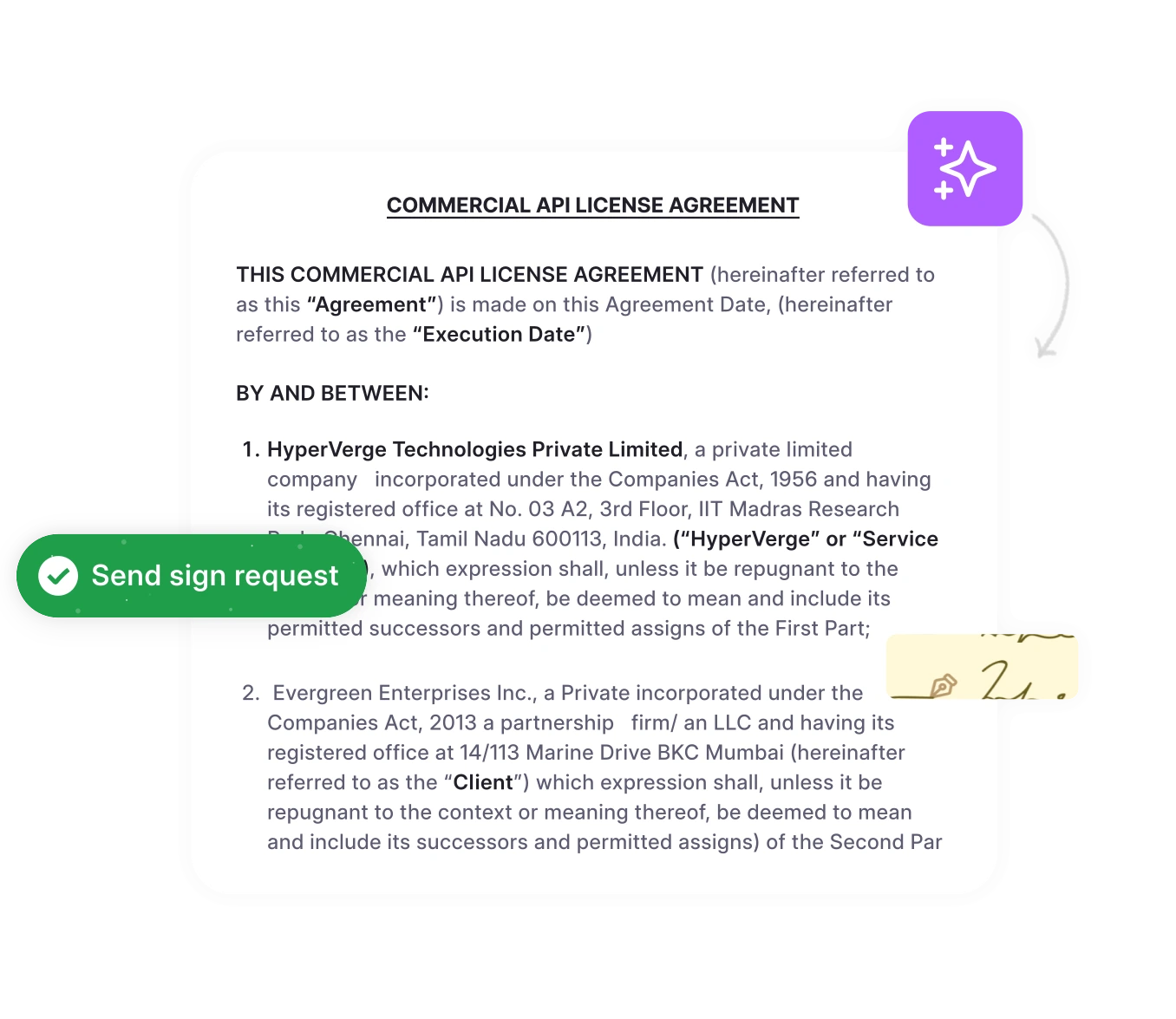




- A contractual obligation is a legally binding duty that a party must fulfill under the terms of a contract. Failure to meet it can result in a breach of contract and legal consequences.
- Common types include payment, delivery, performance, confidentiality, and non-compete obligations. Each defines who must do what, when, and how within a contractual agreement.
- Proactive obligation management reduces risk. Tracking contract obligations manually leads to missed deadlines and revenue leakage. CLM software like HyperStart automates reminders, compliance tracking, and reporting.
What is a contractual obligation?
A contractual obligation is a legally binding duty that a party is required to fulfill as outlined in a contract. It represents the specific actions, responsibilities, or restrictions that each party agrees to when they enter into a contractual agreement. These obligations transform business promises into enforceable commitments under contract law.
In simpler terms, every enforceable contract creates two things: rights and legal duties. The party entitled to receive a benefit is called the obligee. The party required to perform the duty is called the obligor. Together, these roles define the contractual responsibility each side carries.
It is worth noting that a contractual obligation is distinct from a general legal obligation. A contractual obligation arises specifically from a contract that parties have voluntarily entered into. A legal obligation, on the other hand, can arise from statutes, regulations, or court orders regardless of whether a contract exists.
For example, paying taxes is a legal obligation imposed by law; paying a vendor invoice is a contractual responsibility arising from agreed contract terms.
| Aspect | Details |
| Definition | A legal duty that a party must fulfill according to the terms of a contract. |
| Also Known As | Contractual duty, contractual responsibility, legal obligation. |
| Created By | A valid and enforceable contract containing offer, acceptance, consideration, capacity, legality, and mutual assent. |
| Binding Nature | Legally enforceable; failure to fulfill the obligation may result in a breach of contract. |
| Applies To | Both parties involved in the contract, as obligations are typically mutual. |
| Enforced By | Courts, arbitration, or other dispute resolution mechanisms specified in the contract. |
Contractual obligations can broadly fall into two categories:
- Obligations to act: A promise to do something, such as delivering goods, providing services, or making a payment by a specific date.
- Obligations to refrain: A promise not to do something, such as not disclosing confidential information or not competing in a specific market.
What are the types of contractual obligations?
Contractual obligations vary depending on the nature of the agreement, but most commercial contracts include some combination of these common types:
- Payment obligations: The most fundamental contractual duty in most business agreements. Payment obligations define how much is owed, the payment due date, acceptable payment methods, and penalties for late payment. These are central to every vendor agreement, service agreement, and payment agreement.
- Delivery obligations: These specify what must be delivered, in what condition, by what deadline, and to what location. Delivery obligations are critical in supply chain contracts, procurement agreements, and any contract involving physical goods.
- Performance obligations: Performance obligations define the quality standards, milestones, and outcomes that a party must achieve. In a master service agreement, for example, the service provider’s contract performance is measured against agreed KPIs and service levels.
- Confidentiality obligations: These require parties to protect sensitive information shared during the business relationship. Confidentiality obligations are typically formalized through a non-disclosure agreement (NDA) or a confidentiality contract clause embedded within a larger agreement.
- Non-compete obligations: A non-compete clause is one of the most common contract restrictions in business agreements. It restricts a party from engaging in similar business activities or competing in a specified geographic area for a defined period. These are common in employment contracts and partnership agreements.
- Indemnification obligations: An indemnification clause requires one party to compensate the other for losses, damages, or liabilities arising from specific events or breaches. This shifts risk between parties and is standard in most contractual agreements.
- Compliance obligations: These require parties to adhere to applicable laws, regulations, and industry standards throughout the contract term. A contractual compliance agreement may reference data protection laws (GDPR, CCPA), industry regulations, or internal policies that both parties must follow.
- Reporting obligations: Some contracts require regular reporting on progress, financials, or compliance status. Contract management reporting obligations ensure transparency and give both parties visibility into how the contract is performing.
What is the difference between obligor and obligee?
The obligor is the party required to perform a specific duty under the contract. The obligee is the party entitled to receive the benefit of that performance. In most contractual agreements, both parties are simultaneously obligors and obligees because obligations are mutual.
| Role | Definition | Example |
| Obligor | The party who must perform a duty | A vendor who must deliver goods by a deadline |
| Obligee | The party who receives the benefit | The buyer who receives the goods |
For example, in a software development contract, the development company (obligor) must deliver a working product by the agreed deadline. The client (obligee) must pay the agreed fee. But the client is also an obligor for payment, and the development company is an obligee for that payment. This mutual structure of contractual responsibility is what makes contracts bilateral in nature.
What are real-world examples of contractual obligations?
Here are practical contractual obligation examples across common business scenarios:
- Employment contract: An employer agrees to pay a salary of $80,000/year, provide health benefits, and maintain a safe workplace. The employee agrees to perform their role, protect company IP, and comply with a non-compete clause for 12 months after departure.
- SaaS subscription agreement: A software vendor agrees to maintain 99.9% uptime, provide monthly security patches, and respond to support tickets within 4 hours. The client agrees to pay the subscription fee monthly and comply with acceptable use terms.
- Vendor supply contract: A supplier agrees to deliver 10,000 units of raw material by the 15th of each month to specified quality standards. The buyer agrees to pay within 30 days of delivery and provide reasonable storage access.
- NDA (confidentiality agreement): Both parties agree not to disclose proprietary information shared during a partnership evaluation. The obligation survives the end of the agreement, typically for 2 to 5 years.
- Real estate lease: The landlord agrees to maintain the property in habitable condition and provide essential services. The tenant agrees to pay rent on time, not damage the property, and comply with building rules.
- Construction contract: The contractor agrees to complete a building project by a specific date and to meet defined quality and safety standards. The property owner agrees to make staged payments tied to milestones and provide site access.
- Healthcare EOB (Explanation of Benefits): In the healthcare industry, a contractual obligation appears on an EOB as the pre-negotiated rate between a healthcare provider and an insurance company. The provider is contractually obliged to accept the discounted rate and cannot bill the patient for the difference between the billed amount and the contracted rate. This is a specific application of contractual obligation enforcement in regulated industries.
In each example, the contractual duty of one party directly corresponds to the right of the other. When either side fails to fulfill their obligation, it may constitute a breach.
Contractual obligations can sometimes be transferred to another party through assignment (transferring rights) or delegation (transferring duties), depending on the contract terms. However, many contracts include contract restrictions that prohibit assignment without the other party’s written consent. High-trust obligations, such as personal service contracts, are generally not transferable because the identity of the performing party matters to the obligee.
What happens when a contractual obligation is breached?
A breach of a contractual obligation occurs when one party fails to fulfill their duty as defined in the contract without a valid legal excuse. Under contract law, a breach can trigger legal consequences and entitle the non-breaching party to remedies.
There are four common types of breach:
- Minor breach (partial breach): The obligor substantially performs but fails to meet a specific condition. For example, a vendor delivers goods one day late but in perfect condition. The non-breaching party may seek compensation for damages caused by the delay but cannot cancel the entire contract.
- Material breach: A material breach occurs when the failure is significant enough to undermine the entire purpose of the contract. For example, a contractor uses substandard materials that compromise building safety. The non-breaching party can terminate the contract and seek full damages.
- Anticipatory breach: One party communicates (explicitly or through conduct) that they will not fulfill their obligation before the deadline arrives. The non-breaching party can treat the contract as breached immediately and seek remedies without waiting for the deadline to pass.
- Actual breach: The obligor simply fails to perform on the due date. This is the most straightforward type of breach and triggers the remedies specified in the contract clauses.
Common remedies for breach include:
Contractual obligation enforcement depends on the remedies and dispute resolution mechanisms (litigation, arbitration, or mediation) specified in the contract. Including clear enforcement provisions during contract drafting is essential for protecting both parties.
Struggling to track obligations across dozens of contracts?
HyperStart CLM automates obligation tracking, sends deadline reminders, and flags compliance risks before they become breaches.
Book a DemoWhy are contractual obligations important in business?
Contractual obligations are not just legal formalities. They are the operational backbone of every business relationship. Here is why they matter:
- Risk management: Clearly defined contractual obligations allocate risk between parties. When each side knows exactly what they owe and what they are owed, surprises and disputes decrease. Effective contract risk management starts with well-defined obligations.
- Compliance and governance: Obligations related to data protection, industry regulations, and reporting requirements ensure that both parties remain compliant throughout the contract term. A solid contract governance framework depends on clear obligation tracking.
- Financial protection: Payment terms, penalties for late delivery, and limitation of liability clauses protect your organization’s financial interests. Missed obligations can lead to revenue leakage and unplanned costs.
- Relationship preservation: Consistently fulfilling contractual responsibilities builds your reputation as a reliable partner. Conversely, repeated failures erode trust and damage long-term business relationships.
- Legal enforceability: Without clear obligations, contracts lose their teeth. Well-drafted obligations give you legal recourse if the other party fails to perform, and they give the other party the same assurance about your commitments.
How to manage and track contractual obligations
Contract obligation management is the process of identifying, tracking, and ensuring fulfillment of every duty defined across your contract portfolio. For small teams managing a handful of contracts, spreadsheets may suffice. But as volume grows, manual tracking of contract obligations becomes a major risk.
Here are the core steps for effective contract obligations management:
- Extract and catalog obligations: During contract review, identify every obligation each party must fulfill, including deadlines, conditions, and deliverables. Tag each obligation by type (payment, delivery, compliance, reporting).
- Assign ownership: Every obligation needs a clear owner, whether that is an individual, team, or department. Without ownership, obligations fall through the cracks.
- Set automated reminders: Use a contract monitoring system to trigger reminders well before deadlines. This prevents last-minute scrambles and reduces the risk of unintentional breach.
- Track fulfillment status: Maintain a real-time view of which obligations are fulfilled, pending, overdue, or at risk. A contract monitoring checklist can help standardize this process.
- Audit and report: Regular contract compliance audits verify that obligations are being met across your portfolio. Use contract management KPIs to measure performance and identify gaps.
- Escalate proactively: When an obligation is at risk, escalate early. Addressing issues before they become breaches protects the relationship and gives both parties time to negotiate amendments or extensions.
How does contract management software help with obligation tracking?
Manual tracking of contract obligations across spreadsheets and shared drives is one of the most common contract management challenges businesses face. As contract volume grows, the risk of missed deadlines, overlooked contract conditions, and compliance failures increases.
This is where a contract automation platform like contract management software transforms contract obligation management from a reactive, manual process into a proactive, automated one.
With HyperStart CLM, your team can:
- Extract obligations automatically: HyperStart’s AI identifies and tags contractual obligations across your contract portfolio with 94% accuracy, eliminating the need for manual review of every clause.
- Track deadlines and milestones: Automated reminders ensure that payment dates, delivery deadlines, contract renewals, and compliance milestones are never missed.
- Monitor compliance in real time: Dashboards provide a centralized view of obligation status (fulfilled, pending, overdue, at risk) across all active contracts, supporting contract compliance
at scale. - Assign and route obligations: Every obligation is assigned to a clear owner with automated workflows that escalate at-risk items before they become breaches.
- Generate audit-ready reports: Contract management reporting tools produce compliance and obligation fulfillment reports for internal audits, regulatory reviews, and executive dashboards.
- Store everything in one place: All contracts, obligations, and supporting documentation live in a centralized, searchable repository, following contract management best practices.
Whether you are managing contractual agreements across procurement, legal, HR, or finance, HyperStart CLM ensures every obligation is tracked, every deadline is met, and every compliance requirement is documented. Book a free demo to see how it works for your team.