


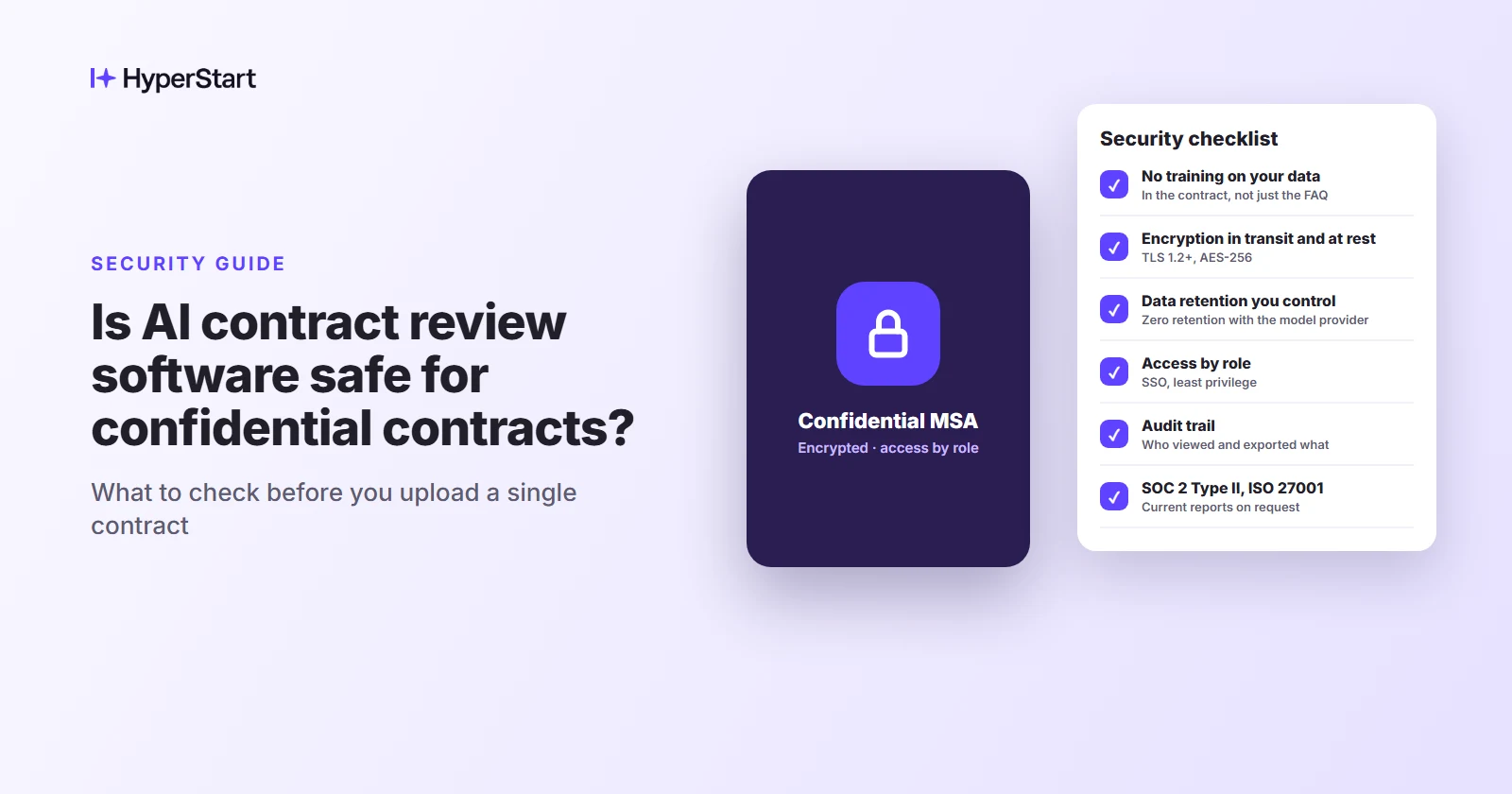
Yes, AI contract review software can be safe for confidential contracts, under three conditions. The tool is built for contract work, its data terms are in writing, and a person still reviews the output. A free consumer chatbot is a different case, because it may keep what you paste and use it to train future models.
Before you upload anything, also check whether the contract itself allows you to share it with a service provider. That restriction applies whatever tool you use, so it belongs in your process, not only in the vendor review.
- Safety depends on the tool’s tier and written terms more than on whether it uses AI.
- Ask separately about training, retention and sub-processors, and get each answer in the contract or DPA.
- Ask for the SOC 2 and ISO 27001 reports themselves, not just the logos on a website.
- Check the contract’s own confidentiality clause before you upload counterparty paper.
- On a shared drive, uncontrolled copies are often a bigger risk than the AI itself.
How do consumer chatbots, business-tier tools and purpose-built contract software compare?
The tool’s tier matters more than whether it uses AI. A consumer chatbot runs on click-through terms that you cannot negotiate. A business-tier tool, sometimes sold as an enterprise plan, usually comes with written data terms.
Purpose-built contract software should add security terms written for contract data. Within each tier, the actual terms vary by vendor.
| What to check | Consumer chatbot | Business-tier AI tool | Purpose-built contract software | HyperStart |
| May train on your inputs | Possibly, depending on the plan and settings | Usually not, if the agreement says so | Should not. Confirm it in writing | Set by the customer agreement |
| Retention terms | Prompts and logs may be kept | Set by the agreement, and they vary | Set by the DPA. Ask about deletion and logs | Set by the customer agreement |
| Who else handles your data | Not disclosed in a way you control | Varies by vendor | A current sub-processor list | Publishes its sub-processor list |
| Certifications | Not built for your security review | Varies by vendor | Expect SOC 2 Type II and ISO 27001, with reports on request | SOC 2 Type 2 and ISO 27001 certified, and HIPAA compliant |
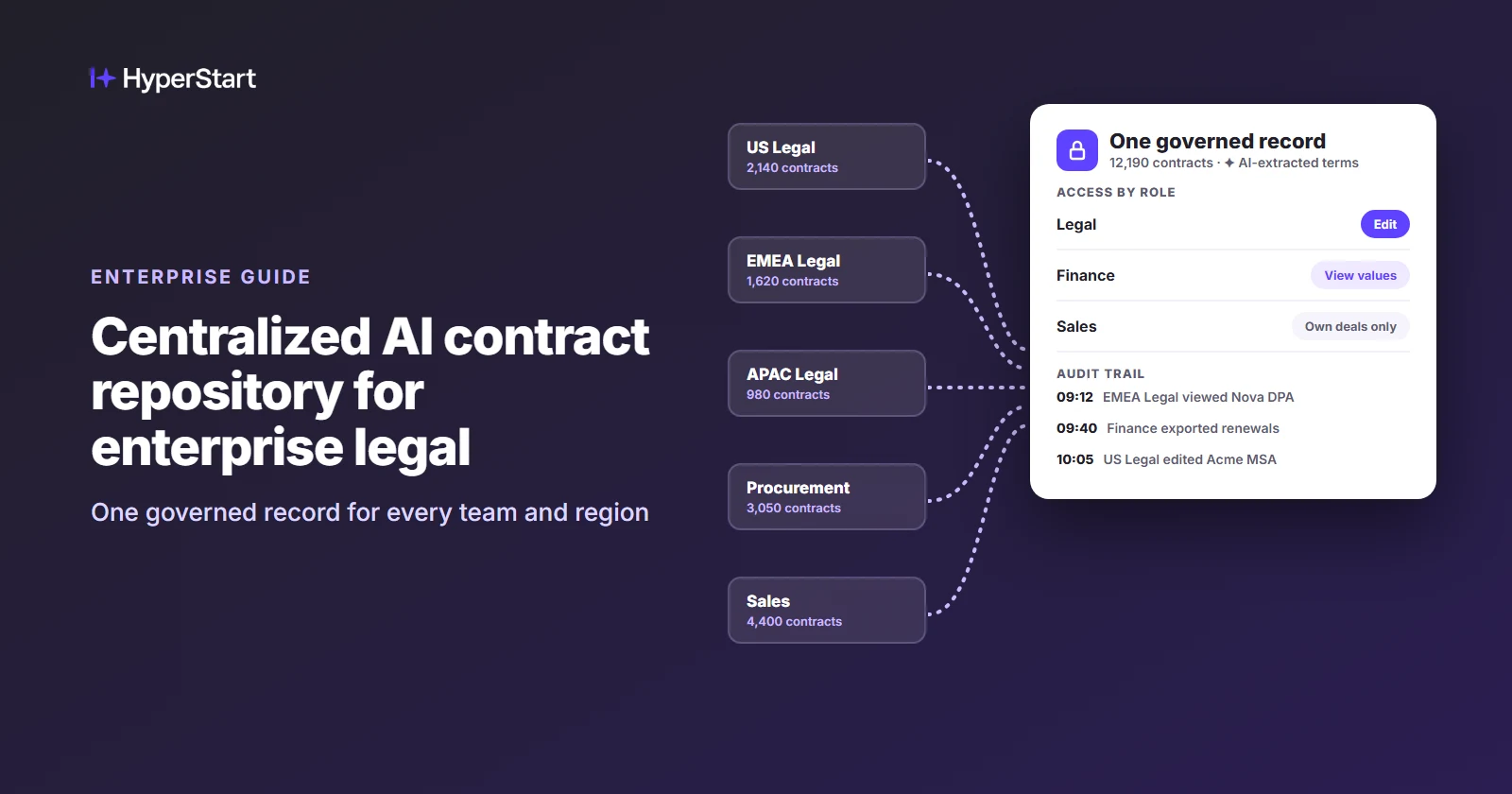
| Access and audit trail | None you control | Varies | Should record who viewed, edited and approved each contract | Role-based access control at every step, encryption and audit trails |
What four things should you confirm before you upload a contract?
Run these four checks before a confidential contract goes into any AI tool. Each one is explained in its own section below.
- The contract permits it: its confidentiality clause allows disclosure to a service provider.
- The data terms are in writing: the vendor commits on training, retention and sub-processors.
- The certifications are real: you have the SOC 2 Type II and ISO 27001 reports themselves, not just the logos.
- A named person signs off: someone qualified owns the final read of anything that carries risk.
What makes AI contract review unsafe?
AI contract review becomes unsafe when the tool’s terms let your data leave your control, or when its output is trusted without a check. The tool and the process both matter.
- Training on inputs: Consumer tools may use submitted text to train future models, so confidential terms could shape outputs other people see.
- Retention: Text you paste may be stored in prompt or output logs long after your session ends.
- Privilege risk: Sharing privileged material with a third-party tool that lacks confidentiality protections can put attorney-client privilege at risk.
- Discovery exposure: Stored prompts and outputs may be reachable in discovery or by subpoena.
- Counterparty breach: Uploading another party’s contract can breach the NDA or confidentiality clause you signed with them.
- Confident errors: AI can misread a clause, or report one that isn’t there, in fluent and convincing language.
What should a safe tool commit to in writing?
A safe vendor makes three separate written commitments, not one. Vendors often fold them into a single “zero data retention / no training” promise. A vendor can honestly make one of the three and not the others.
Ask about each one on its own, and get each answer in the contract or the DPA.
Does the vendor promise not to train on your contracts?
- Scope: The promise should cover uploads, prompts, outputs and extracted metadata, not only “documents.”
- Location: It belongs in the Data Processing Agreement or master terms. A marketing page that can change without notice is not enough.
How long is your data kept, and how is it deleted?
- Retention period: Ask how long contracts, prompts and outputs are stored, and what triggers deletion.
- Abuse-monitoring logs: Ask whether any copy is held for abuse monitoring, by whom, and for how long. “No training” says nothing about this.
- Exit: Ask what happens to your data when you cancel, and whether you get written confirmation that it was deleted.
Who else touches your data?
Most AI contract tools send text to an underlying model provider and rely on other sub-processors. A vendor’s zero data retention (ZDR) promise only holds if every provider behind it has signed the same commitment. Ask this exact question:
“Which of your model providers have you signed zero data retention agreements with, and can you show them?”
- Sub-processor list: Ask for the current list and how you will be told about changes.
- Deployment: Ask whether your data sits in a shared environment or in a single-tenant or isolated one.
- Limits: ZDR lowers your exposure but does not remove it, which is why the human review and counterparty checks below still apply.
See HyperStart CLM on your own contracts
Bring a few of your own contracts, and we’ll run them through HyperStart with you in a live demo.
Book a DemoWhich certifications matter for confidential contracts?
Certifications show that an auditor has checked the vendor’s controls. They don’t replace the written data terms above, but they are the fastest filter during a security review. Ask for the reports themselves, read the scope, and check the dates.
- SOC 2 Type II: An independent audit of how security controls operated over a period of time, not just on a single day.
- ISO 27001: A certified information security management system.
- HIPAA: Relevant when contracts or attachments contain protected health information. Look for a vendor that is HIPAA compliant and will sign the agreements your counsel requires.
- Encryption: Ask how contracts are encrypted in transit and at rest, and which standards the vendor uses.
- Access controls and audit trail: Role-based permissions, and a log of who opened, edited or approved each contract.
Can you upload a counterparty’s contract at all?
Not always. The contract you want reviewed may restrict who can see it. The terms of a contract can themselves be confidential, so even uploading a summary may count as disclosure.
- Read the confidentiality clause: Check whether disclosure to contractors, advisers or “service providers” is allowed, and on what conditions.
- Check the NDA behind it: A separate NDA with the counterparty may be stricter than the main agreement.
- Redact when unsure: Remove names, pricing and personal data before upload, or keep the contract out of AI review entirely.
- Record the decision: Note who approved the upload and why, so the call can be checked later.
What should a person still check after AI review?
AI contract review works best as a first pass that flags where a contract departs from your playbook. A qualified person still decides what those flags mean. The AI speeds up triage, but the reviewer remains responsible for the result.
- Risk-carrying terms: A lawyer reads indemnities, liability caps, data-protection terms and termination rights in full.
- Flagged deviations: Every flag is checked against the source text before anyone acts on it.
- Missing clauses: A reviewer confirms what should be in the contract but isn’t. AI doesn’t reliably flag what is absent.
- Routine paper: Standard NDAs on your own templates can get a lighter check, but someone still signs off.
How far to trust the output for each task is a question of accuracy, not safety. Test that separately on your own contracts.
What should you do first when your contracts live on a shared drive?
On a shared drive, the biggest confidentiality risk is usually the number of uncontrolled copies, not the AI. Before choosing any tool, find out where contracts actually live and set one rule for AI use.
- Find the copies: List every folder, inbox and personal drive that holds signed contracts or drafts.
- Sort the paper: Separate your own templates from third-party paper, and flag every contract with a confidentiality clause that limits disclosure.
- Set an interim rule: No contract goes into a free chatbot. Legal, sales, finance and HR need to hear this, because they’re the ones most likely to paste in a clause for a quick answer.
- Pick one system of record: Move to a single repository with access controls and an audit trail, so every confidential contract has one owner and one current version.
- Keep negotiation inside it: Some CLM tools run redlining in Word inside the system, so fewer copies of a confidential contract circulate by email.
Questions to settle with IT first
Before any vendor demo, agree three answers with your security team:
- Which certifications and reports do we require, and who reads them? Decide whether SOC 2 Type II, ISO 27001 and HIPAA are must-haves for your contracts.
- What must the written terms say about training, retention and sub-processors? Write the clauses you need, so every vendor answers the same test.
- Which contracts may go into the tool, and who approves exceptions? Counterparty paper with strict confidentiality clauses may need redaction or a no.
HyperStart is SOC 2 Type 2 and ISO 27001 certified, and HIPAA compliant. It also publishes its sub-processor list, so the first question and part of the second have written answers before the first call. Book a demo and bring your security questionnaire.
Try HyperStart CLM before you decide
The whole contract lifecycle in one product, live in weeks, with implementation included in the quote and no implementation partner.
Book a Demo