


- Sirion is a powerful enterprise CLM with agentic AI and Gartner Magic Quadrant Leader status, but its 6-12 month implementation, steep learning curve, and $50K-$200K+ annual pricing make it impractical for mid-market teams.
- The best Sirion alternatives for 2026 are Ironclad, HyperStart CLM, Icertis, Agiloft, DocuSign CLM, Juro, ContractPodAi, LinkSquares, CobbleStone, and SpotDraft, each serving different team sizes, budgets, and use cases.
Sirion is a Gartner Magic Quadrant Leader with strong agentic AI capabilities. But when implementation stretches to 6-12 months, annual costs land between $50K and $200K+, and G2 reviewers keep flagging a steep learning curve, mid-market teams start asking whether the investment is worth it.
Sirion holds a 4.5/5 rating on G2, yet recurring complaints about slow onboarding, limited customization, and opaque pricing tell you where the platform struggles to keep up with what growing teams actually need.
The best Sirion alternatives in 2026 are Ironclad, HyperStart CLM, Icertis, Agiloft, DocuSign CLM, Juro, ContractPodAi, LinkSquares, CobbleStone, and SpotDraft. Each one closes a different gap depending on your team size, budget, and deployment timeline.
What does Sirion do well?
Sirion is not on this list because it is a weak platform. It earned Gartner Magic Quadrant Leader status four years running for a reason.
Sirion’s agentic AI is its biggest differentiator. The platform goes beyond basic contract review and actively monitors obligations, tracks performance against agreed terms, and flags deviations in real time. For enterprise legal and procurement teams managing thousands of supplier contracts, that level of automation is hard to find elsewhere.
Multi-language support covers 100+ languages natively, which makes Sirion a genuine option for global enterprises managing contracts across jurisdictions. The platform handles the full contract lifecycle from authoring and negotiation through execution, obligation tracking, and renewal management.
Sirion also brings strong supplier performance management. Teams can track vendor compliance against contractual SLAs and KPIs, giving procurement a data-backed view of supplier health rather than relying on quarterly reviews.
For Fortune 500 enterprises with complex supplier ecosystems, dedicated legal ops teams, and the budget to support a 6-12 month rollout, Sirion delivers. The friction starts when mid-market teams try to fit into that enterprise mould.
Why teams look for Sirion alternatives
Sirion earned a 4.5/5 rating on G2 and recognition as a Gartner Magic Quadrant Leader four years running. Its agentic AI capabilities and multi-language support are impressive. But several patterns emerge across G2 reviews.
Implementation takes 6-12 months. One G2 reviewer noted that “the initial setup and configuration can be time-consuming.”
The learning curve is steep. One user shared: “The tool has a steep learning curve, especially for new users who are not familiar with contract management systems.”
Pricing is opaque and premium. Sirion does not publish pricing. Industry estimates place annual costs between $50K and $200K+.
Customization has limits. G2 reviewers flag that “some customization options are limited.”
Multi-domain support is lacking. Organizations managing contracts across multiple brands or legal entities report that Sirion’s multi-logo and multi-domain capabilities fall short.
How do the top Sirion alternatives compare?
| Platform | Best for | Deployment time | Starting price | G2 rating |
| Ironclad | Workflow automation at enterprise scale | ~3 months | $30K-$150K/yr | 4.5/5 |
| HyperStart CLM | Mid-market teams needing fast deployment | 4 weeks | Custom, unlimited users | 4.6/5 |
| Icertis | Fortune 500 with global compliance needs | 6-12 months | $150K-$500K+/yr | 4.2/5 |
| Agiloft | No-code customization | 2-4 months | $6K-$60K/yr | 4.5/5 |
| DocuSign CLM | DocuSign ecosystem extension | 3-6 months | $25K-$100K+/yr | 4.3/5 |
| Juro | Speed and simplicity | 3-4 weeks | ~$15K-$60K/yr | 4.6/5 |
| ContractPodAi | Conversational AI in CLM | 8-12 weeks | $50K-$100K+/yr | 4.4/5 |
| LinkSquares | Post-signature contract intelligence | 6-10 weeks | ~$31K/yr median | 4.7/5 |
| CobbleStone | CLM + procurement in one platform | 2-3 months | Custom | 4.7/5 |
| SpotDraft | Scaling legal teams on a budget | 2-4 weeks | $10K-$30K/yr | 4.5/5 |
Note: G2 ratings and pricing estimates are based on publicly available data as of April 2026. Contact vendors for current pricing.
1. Ironclad
Best for: Enterprise legal teams that need deeply configurable workflow automation
G2 rating: 4.5/5
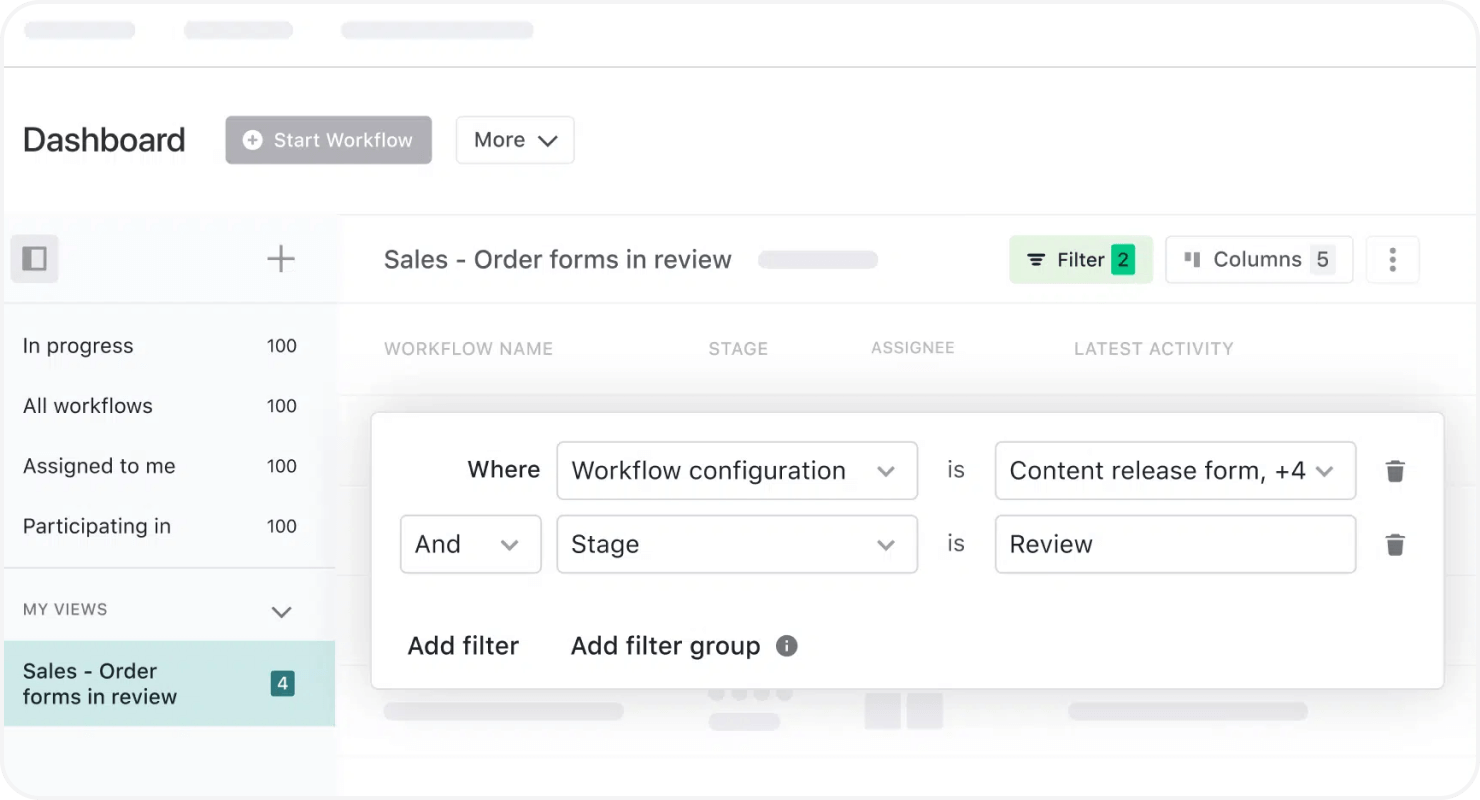
Ironclad’s core strength is conditional workflow logic. You can build approval chains that route differently based on contract value, risk level, department, or geography. Its Salesforce integration is the deepest in the CLM space.
The platform also offers Ironclad AI, which automates contract review, metadata extraction, and clause identification. Pricing starts at $30K and can reach $150K annually. Implementation takes roughly 3 months.
Key features of Ironclad
- Conditional workflow builder with multi-level approvals and parallel routing
- Deepest native Salesforce integration among CLM platforms
- AI-powered contract review and metadata extraction
- Self-service template editor with clause library
- Workflow analytics and bottleneck identification
- Repository search with smart filters and tagging
How Ironclad compares to Sirion
Ironclad solves Sirion’s customization complaint with conditional workflow logic that handles different routing by contract value, risk, department, or geography. Salesforce integration is also significantly deeper than Sirion’s, and the Ironclad Editor reduces the Word dependency Sirion users complain about.
But it does not solve the accessibility issues. Pricing is in the same enterprise band ($30K-$150K vs. Sirion’s $50K-$200K+), and implementation is roughly 3 months — better than Sirion’s 6-12, but still long for mid-market teams. The learning curve is also non-trivial for non-legal users.
Ironclad fits enterprise legal teams with complex multi-department workflows and the budget to match. For mid-market teams that want lifecycle coverage without enterprise overhead, HyperStart CLM is a stronger fit. For more, see our guide to Ironclad competitors.
Pricing of Ironclad
Ironclad does not publish pricing publicly. Industry estimates place annual costs between $30K and $150K, depending on contract volume and modules.
2. HyperStart CLM
Best for: Mid-market teams needing fast deployment without enterprise pricing
G2 rating: 4.6/5
HyperStart CLM is the alternative to Sirion. Where Sirion takes 6-12 months to deploy, HyperStart goes live in 4 weeks. Where Sirion pricing starts at $50K, HyperStart offers custom pricing with unlimited users included.
HyperStart is built by HyperVerge, a company with 13+ years of AI expertise and 1 billion+ documents processed. That AI foundation translates into 94% accuracy in metadata extraction, 2-second contract retrieval, and automated risk identification during AI contract review.
The platform covers the full contract lifecycle. For teams migrating from Sirion, the deployment includes one-click smart import with automated AI metadata tagging into a centralized contract repository.
| Feature | Sirion | HyperStart CLM |
| Deployment time | 6-12 months | 4 weeks |
| AI accuracy | Not published | 94% |
| Contract retrieval | Not published | 2 seconds |
| User pricing | Per-user licensing | Unlimited users included |
| Learning curve | Steep (G2 reviews) | Intuitive, minimal training |
| Implementation success rate | Not published | 100% |
Key features of HyperStart CLM
| Feature | Description | Why it matters for your team |
| AI-powered metadata extraction (94% accuracy) | Automatically extracts key contract data (clauses, dates, obligations, parties) using AI trained on 1B+ documents. | Reduces manual data entry, minimizes errors, and ensures faster contract analysis at scale. |
| 2-second contract retrieval with AI search | An intelligent search engine lets you find contracts, clauses, or specific terms within seconds. | Saves time for legal and business teams, especially when managing large contract repositories. |
| End-to-end contract lifecycle management | Covers the entire lifecycle—from contract drafting and negotiation to execution, obligation tracking, and renewals. | Eliminates the need for multiple tools and ensures complete visibility across all contract stages. |
| Built-in and integrated e-signature support | Includes native e-signature capabilities and integrates with tools like DocuSign, Adobe Acrobat Sign, and Zoho Sign. | Speeds up contract execution and allows teams to continue using their preferred signing tools. |
| Self-service template builder with clause library | Enables teams to create reusable templates and standardized clause libraries with dynamic conditions. | Ensures consistency, reduces legal dependency for routine contracts, and speeds up drafting. |
| Drag-and-drop workflow builder | Visual workflow builder with conditional routing based on contract value, risk, or department. | Automates approvals and reduces bottlenecks without requiring technical expertise. |
| One-click legacy contract import with AI tagging | Bulk import existing contracts into a centralized |
How HyperStart CLM compares to Sirion
HyperStart solves Sirion’s two biggest blockers: deployment timeline and pricing. Where Sirion takes 6-12 months to go live, HyperStart deploys in 4 weeks with a 100% implementation success rate. Where Sirion starts at $50K and climbs past $200K, HyperStart offers custom mid-market pricing with unlimited users included.
It also addresses the learning curve and customization complaints. The interface is intuitive enough that non-legal users adopt it without weeks of training, and the self-service template builder, drag-and-drop workflow designer, and clause library handle the customization Sirion users find limited.
HyperStart fits mid-market teams that need agentic-AI-grade contract management without an enterprise rollout. For Fortune 500 teams with global compliance complexity, Icertis or Sirion itself may still fit better. See the broader landscape in our guide to the best contract management software.
Pricing of HyperStart CLM
HyperStart offers custom pricing with unlimited users included. Unlike Sirion’s $50K-$200K+ annual cost, HyperStart is designed for mid-market budgets. Book a demo to get a tailored quote.
Ready to replace Sirion without the 6-month wait?
Most teams switch from Sirion because they cannot afford to wait 6-12 months for a CLM to go live. HyperStart deploys in 4 weeks with 94% AI accuracy, unlimited users, and a 100% implementation success rate.
Book a Demo3. Icertis
Best for: Fortune 500 teams with global compliance needs
G2 rating: 4.2/5
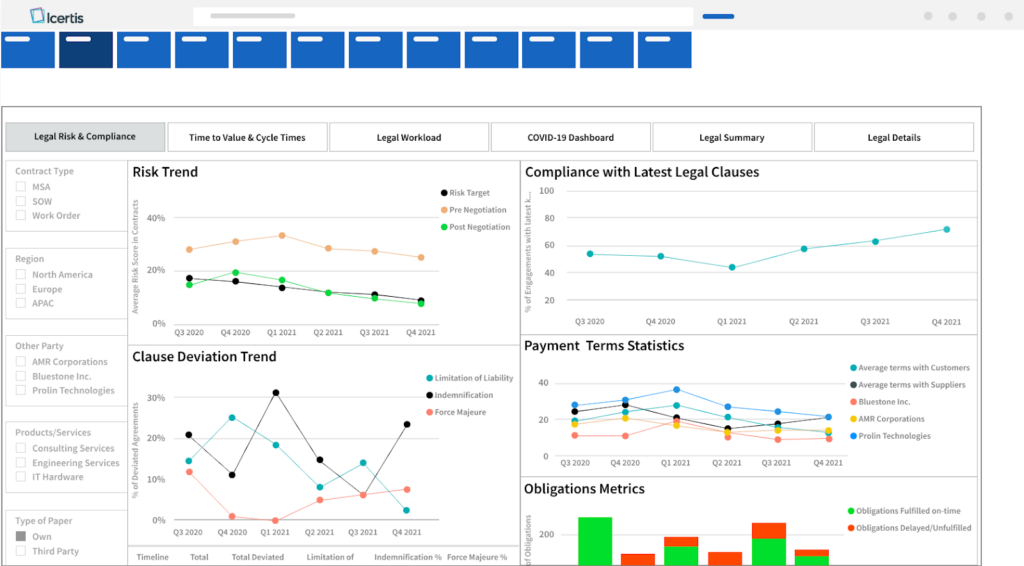
Icertis is the enterprise CLM closest to Sirion in scope and ambition. Icertis excels in global compliance scenarios: multi-language contracts, multi-currency handling, and jurisdiction-specific regulatory compliance. ObligationsAI automatically tracks and manages contractual obligations.
However, Icertis is even more expensive than Sirion. Annual pricing starts at $150K and can exceed $500K. Implementation timelines mirror Sirion’s 6-12 month range.
Key features of Icertis
- ObligationsAI for automated contractual obligation tracking
- Multi-language, multi-currency, and multi-jurisdiction support
- Native SAP and Salesforce integration for enterprise workflows
- AI-powered risk scoring and compliance monitoring
- Supplier management with performance tracking
- Advanced analytics and reporting dashboards
How Icertis compares to Sirion
Icertis solves Sirion’s multi-domain and global compliance complaints better than any other CLM on this list. ObligationsAI tracks contractual commitments at scale, multi-currency, and multi-jurisdiction handling beats Sirion in Fortune 500 scenarios, and SAP integration is deeper.
But it does not solve the accessibility problems and makes them worse. Pricing starts at $150K and can exceed $500K — well above Sirion’s $50K-$200K+. Implementation timelines are the same, 6-12 months. Customization complaints carry over, too.
Icertis fits Fortune 500 enterprises that need global compliance scale and have the budget Sirion users could not justify. For mid-market teams, neither Sirion nor Icertis is a fit — HyperStart, Juro, or SpotDraft are better starting points. See our guide to Icertis competitors.
Pricing of Icertis
Icertis pricing starts at approximately $150K annually and can exceed $500K for large-scale enterprise deployments.
4. Agiloft
Best for: Teams that need extreme no-code configurability
G2 rating: 4.5/5
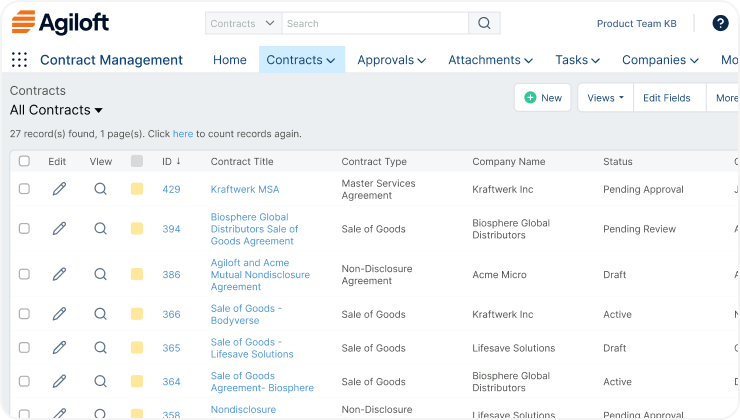
Where Sirion’s customization options are limited, Agiloft goes in the opposite direction. Everything is configurable. You can build custom contract types, unique approval workflows for each department, and automated notifications based on any contract field.
Agiloft also holds a unique position on pricing. Annual costs range from $6K to $60K, making it accessible to mid-market teams.
Key features of Agiloft
- No-code platform with complete workflow and field customization
- Custom contract types and department-specific approval chains
- AI-assisted contract review and clause extraction
- Built-in reporting and contract management dashboard
- Flexible deployment options (cloud, on-premise, hybrid)
- Open API for custom integrations
How Agiloft compares to Sirion
Agiloft solves Sirion’s customization complaint head-on. Where Sirion users say “some customization options are limited,” Agiloft is the opposite — every workflow, field, and approval chain can be configured without code. Pricing also drops dramatically: $6K-$60K/year vs. Sirion’s $50K-$200K+.
But it does not solve the learning curve. Agiloft’s no-code power comes with a real configuration burden. Implementation runs 2-4 months, faster than Sirion but still significant. Teams that hoped to escape Sirion’s training overhead may find Agiloft’s setup challenging, too.
Agiloft fits compliance-heavy industries that need deep customization at mid-market pricing. For teams that want speed and simplicity over configurability, HyperStart deploys in 4 weeks with minimal training. See our HyperStart vs Agiloft comparison.
Pricing of Agiloft
Agiloft pricing ranges from approximately $6K to $60K annually, depending on users and modules.
5. DocuSign CLM
Best for: Organizations already using DocuSign for e-signatures
G2 rating: 4.3/5
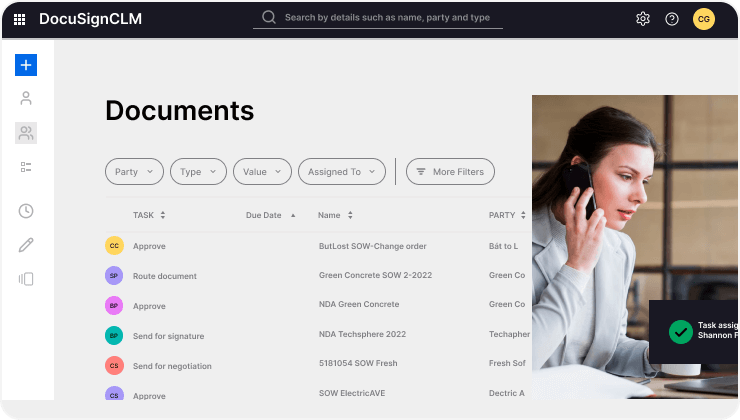
If your team is embedded in the DocuSign ecosystem and wants to extend into full lifecycle contract management software, the native integration eliminates the need for third-party connectors. The platform offers 400+ pre-built integrations. Implementation is the weak spot: DocuSign CLM deployments typically take 3-6 months.
Key features of DocuSign CLM
- Native DocuSign e-signature integration with seamless signing workflow
- 400+ pre-built integrations with CRM, ERP, and HR systems
- AI-powered contract analytics and clause detection
- Template management with conditional logic
- Workflow automation with multi-step approvals
- Reporting dashboard with contract status tracking
How DocuSign CLM compares to Sirion
DocuSign CLM solves Sirion’s integration depth complaint with 400+ pre-built connectors and native eSignature on a platform that signers already trust. For teams already on DocuSign eSignature, the CLM extension also avoids adding a new vendor.
But it does not solve the implementation or pricing pain. Deployments still take 3-6 months, G2 reviewers consistently flag setup as more complex than promised, and pricing ($25K-$100K+) is roughly the same band as Sirion’s lower tiers. The interface also feels outdated compared to purpose-built CLMs.
DocuSign CLM fits enterprises already committed to the DocuSign ecosystem. For mid-market teams without that lock-in, HyperStart ships faster, modernizes the UX, and includes unlimited users. See our guide to DocuSign alternatives.
Pricing of DocuSign CLM
Pricing ranges from $25K to over $100K annually, depending on contract volume and feature requirements.
6. Juro
Best for: Legal and business teams that prioritize speed, usability, and modern UX
G2 rating: 4.6/5
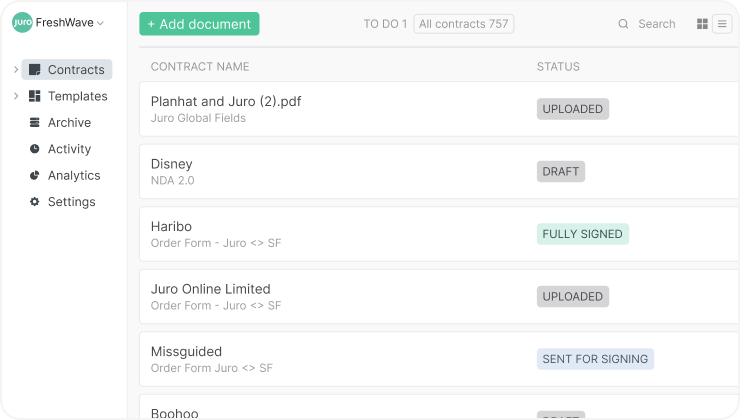
Juro’s standout feature is its in-browser contract editor. Unlike Sirion and most enterprise CLMs that rely on Word-based editing, Juro lets teams draft, negotiate, and approve contracts entirely within the browser using purpose-built contract collaboration software.
The platform includes unlimited users. Deployment in 3-4 weeks makes it one of the fastest CLMs to implement.
Key features of Juro
- Browser-native contract editor (no Microsoft Word required)
- Unlimited users included in pricing
- 18-21 day deployment timeline
- Automated contract workflows with approval routing
- Real-time collaboration for legal and business teams
- Contract analytics with renewal and expiry tracking
How Juro compares to Sirion
Juro solves Sirion’s deployment timeline and learning curve in one move. The browser-native editor removes Word dependency, deployment runs 3-4 weeks (vs. Sirion’s 6-12 months), and unlimited users are included in pricing. Non-legal stakeholders adopt Juro without the training Sirion demands.
But it does not solve enterprise procurement complexity. Teams managing large vendor portfolios with multi-tier approval chains may find Juro lightweight compared to Sirion’s depth. Pricing also remains custom ($15K-$60K), not published.
Juro fits legal and business teams that prioritize speed, usability, and a modern UX. For teams that need Juro’s UX plus deeper AI accuracy and stronger procurement workflows, HyperStart is the stronger fit. See our HyperStart vs Juro comparison.
Pricing of Juro
Juro pricing ranges from approximately $15K to $60K annually. Unlimited users are included.
Skip the enterprise overhead and get your CLM live in weeks
If Sirion’s 6-12 month implementation is holding your team back, HyperStart delivers full lifecycle contract management with 94% AI accuracy, 2-second retrieval, and deployment in 4 weeks.
Book a Demo7. ContractPodAi
Best for: Teams that want conversational AI inside their CLM
G2 rating: 4.4/5
ContractPodAi stands out for its conversational AI assistant, Leah. Users ask Leah questions in natural language: “Show me all vendor contracts expiring in the next 90 days” or “What is our liability cap with Acme Corp?”
The platform supports modular adoption. Teams can start with repository and search, then add drafting, approval workflows, and analytics as they grow.
Key features of ContractPodAi
- Leah AI assistant for natural language contract queries
- Modular adoption (start small, scale up)
- AI-powered contract review and risk identification
- Template management with clause library
- Integration with Microsoft 365, Salesforce, and SAP
- Obligation tracking with automated contract reminders
How ContractPodAi compares to Sirion
ContractPodAi solves Sirion’s learning curve directly. Leah, the conversational AI assistant, lets non-legal users query contract data in natural language instead of navigating menus and filters. Modular adoption also reduces the all-at-once implementation risk Sirion forces.
But it does not solve pricing or performance. Annual costs ($50K-$100K+) sit in the same band as Sirion’s lower tiers. G2 reviewers also report performance slowdowns during bulk uploads, which matters when migrating a large legacy portfolio off Sirion.
ContractPodAi fits enterprise teams that want conversational AI access for non-legal stakeholders and can stage deployment by module. For mid-market teams that want strong AI accuracy at a lower price point with faster deployment, HyperStart is the better fit. See our guide to ContractPodAi competitors.
Pricing of ContractPodAi
Pricing starts at approximately $50K and can exceed $100K annually for enterprise deployments.
8. LinkSquares
Best for: Post-signature contract intelligence across existing portfolios
G2 rating: 4.7/5
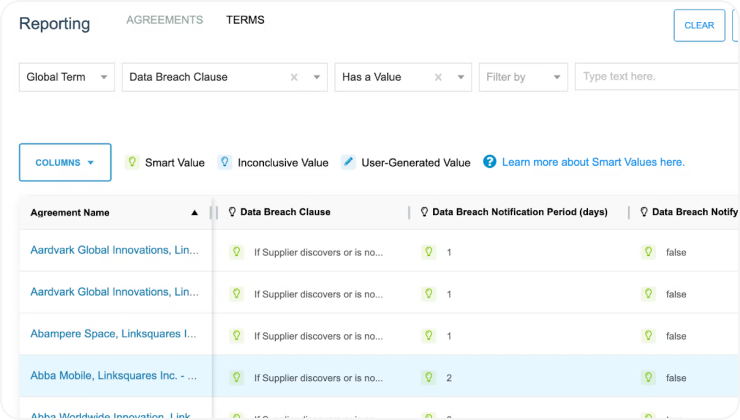
Where Sirion focuses on end-to-end lifecycle management, LinkSquares excels specifically in post-signature analytics. The platform’s AI scans executed contracts to extract key terms, obligations, renewal dates, and risk indicators across 120+ data points. AI risk scoring helps legal teams prioritize which contracts need attention.
One important note on pricing: implementation fees are reported to equal 100% of the first-year license cost.
Key features of LinkSquares
- AI extraction across 120+ data points from executed contracts
- AI risk scoring and contract health assessment
- Automated obligation and renewal tracking
- Pre-signature module (Finalize) for drafting and approvals
- Custom reporting and contract management KPIs
- Integration with Salesforce, Slack, and cloud storage platforms
How LinkSquares compares to Sirion
LinkSquares solves Sirion’s post-signature analytics gap with AI extraction of 120+ data points and risk scoring across executed contracts. For teams that want deep portfolio intelligence on their existing Sirion data, the Analyze module delivers visibility that Sirion does not match.
But it does not solve pricing or scope. Implementation fees match 100% of the first-year license, bringing year-one costs to roughly $62K. LinkSquares also is not a full Sirion replacement — Analyze is post-signature only, and you need Finalize for drafting workflows, doubling the scope.
LinkSquares fits teams that already have a drafting workflow and want best-in-class post-signature analytics. For full lifecycle replacement of Sirion at mid-market pricing, HyperStart is the better unified fit. See our guide to LinkSquares competitors.
Pricing of LinkSquares
The median annual license is approximately $31K. Implementation fees can equal 100% of the first-year license, bringing year-one costs to roughly $62K.
9. CobbleStone
Best for: Organizations that want CLM + procurement in one platform
G2 rating: 4.7/5
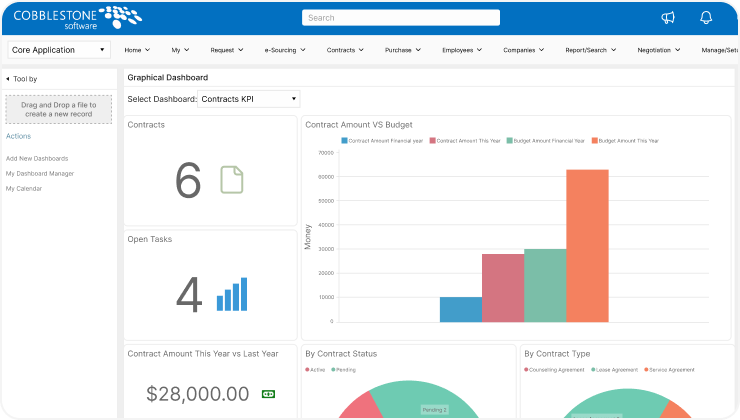
CobbleStone combines contract lifecycle management with a full procurement suite. For organizations that need vendor management, purchase order tracking, and contract management in a single platform, CobbleStone eliminates the need for separate tools. Visdom AI handles contract analysis, risk identification, and clause extraction.
Key features of CobbleStone
- Visdom AI for contract analysis and risk identification
- Integrated procurement suite with vendor management
- Purchase order tracking and sourcing workflows
- Contract authoring with template library
- Obligation and milestone tracking with automated alerts
- On-premise and cloud deployment options
How CobbleStone compares to Sirion
CobbleStone solves Sirion’s procurement complaint by combining CLM with a full procurement suite — vendor management, purchase order tracking, and contract authoring in one platform. For teams that ran procurement separately alongside Sirion, CobbleStone consolidates the stack.
But it does not solve the modern UX expectation. G2 reviewers consistently flag CobbleStone’s interface as dated, and performance can slow with large databases. Pricing is also custom only, repeating the opacity that frustrates Sirion users.
CobbleStone fits organizations where procurement and legal collaborate closely and need a unified platform with both cloud and on-premise deployment options. For modern UX with strong AI and faster deployment, HyperStart is the lighter, faster alternative. See our guide to the best contract management software.
Pricing of CobbleStone
CobbleStone offers custom pricing based on deployment type, users, and modules.
10. SpotDraft
Best for: Scaling legal teams on a budget
G2 rating: 4.5/5
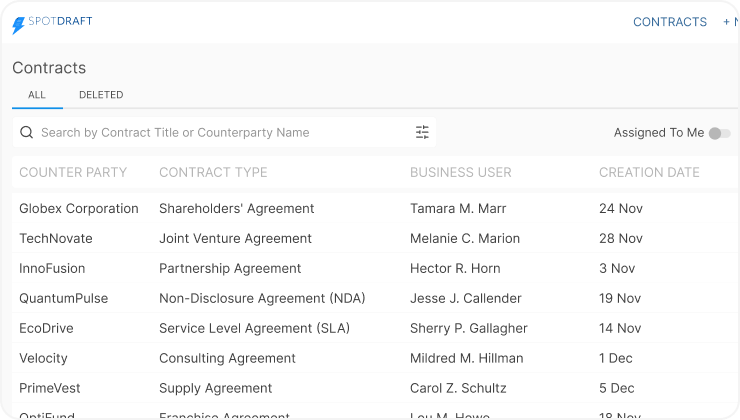
SpotDraft targets growing legal teams that need a capable CLM without the enterprise price tag. SpotDraft’s VerifAI handles contract review by analyzing agreements against your playbook. Implementation is included in pricing.
Key features of SpotDraft
- VerifAI for contract review and obligation extraction
- Template management with clause playbook enforcement
- Approval workflows with conditional routing
- Contract repository with search and filtering
- Implementation included in pricing (no separate setup fees)
- Integration with Slack, Salesforce, and HubSpot
How SpotDraft compares to Sirion
SpotDraft solves Sirion’s pricing and deployment problems decisively. At $10K-$30K/year with implementation included, SpotDraft is a fraction of Sirion’s cost. Deployment also runs 2-4 weeks vs. Sirion’s 6-12 months. VerifAI playbook review handles core legal workflows without Sirion’s complexity.
But it does not solve the autonomy concern that often motivates Sirion switches. SpotDraft manages templates on the customers’ behalf, so every clause update goes through SpotDraft’s team. Teams that wanted to escape Sirion’s vendor dependency may find SpotDraft frustrating in the same way.
SpotDraft fits scaling legal teams on a budget that can live with vendor-managed templates. For teams that want fast deployment plus full self-service control over templates and clauses, HyperStart is the better fit. See the broader landscape in our guide to the best contract management software.
Pricing of SpotDraft
SpotDraft pricing ranges from approximately $10K to $30K annually. Implementation is included.
How to choose the right Sirion alternative
- Deployment speed. HyperStart (4 weeks), Juro (3-4 weeks), and SpotDraft (2-4 weeks) are the fastest. Icertis and DocuSign CLM take 3-6+ months.
- Total cost of ownership. Factor in implementation fees (LinkSquares charges 100%), per-user costs, and module add-ons. HyperStart and Juro include unlimited users.
- AI capabilities. Ask vendors for specific metrics on metadata extraction accuracy, clause identification, and contract reminder software automation. HyperStart publishes 94% accuracy.
- Supplier and vendor management. CobbleStone, Icertis, and Sirion itself are strongest here.
- Customization vs. simplicity. Agiloft offers the deepest customization. Juro prioritizes simplicity. Track the right contract management KPIs.
- Integration requirements. DocuSign CLM is strongest for DocuSign users. Ironclad has the deepest Salesforce integration. HyperStart integrates with Salesforce, HubSpot, Pipedrive, Microsoft Teams, and Slack.
Choosing your next CLM after Sirion
If you’re evaluating alternatives to Sirion, the next step is to get clarity on what actually matters for your team — not what looks good in feature lists.
Start by identifying your top priorities. For most teams, this usually comes down to a combination of deployment speed, pricing, AI capabilities, and how easily the platform fits into existing workflows. If your team cannot afford long implementation cycles, solutions with faster go-live timelines should immediately move to the top of your shortlist. If cost predictability matters, look closely at pricing models, including hidden implementation or per-user fees.
Once your priorities are clear, narrow down your options accordingly. Enterprise-grade platforms like Icertis or Ironclad make sense if you need deep compliance and complex workflows. If flexibility and customization are critical, platforms like Agiloft offer more control. For teams looking for faster deployment, better usability, and mid-market pricing, options like HyperStart, Juro, or SpotDraft are more practical starting points.
Before making a decision, evaluate how each platform handles migration. Look for capabilities like bulk contract import, automated metadata extraction, and minimal disruption to ongoing operations. Most modern CLMs offer migration support, but the ease and speed can vary significantly.
Finally, move beyond comparisons and see the product in action. Book demos, involve key stakeholders (legal, procurement, ops), and test real workflows instead of relying only on feature lists. The right choice is the one your team can actually adopt and use effectively — not just the one with the most features.