


Does this sound familiar? You need to check the renewal date on a vendor agreement. You open the contract. It is 47 pages long. Twenty minutes later you are still searching. Meanwhile, three other contracts have auto-renewed on terms nobody reviewed, a compliance deadline was missed because the obligation was buried in an appendix, and your legal team is spending 80% of their time on tasks that should take minutes.
You are not alone. 80% of corporate legal professionals say they expect greater use of technology to improve productivity (Brightleaf). Organizations with poor contract management lose up to 9% of annual revenue to value erosion, according to WorldCC’s analysis of contracting performance. Contract abstraction addresses the root cause: unstructured data locked inside documents that no one can search, filter, or report on
That is what contract abstraction solves. It is the process of extracting key data points from contracts into a structured, standardized format, making every agreement searchable, comparable, and actionable. This is one of the most common contract management challenges teams face when scaling their operations, and it is the one that creates the most downstream risk when left unaddressed.
Manual abstraction takes 3-4 hours per contract, making it unsustainable for organizations with 500+ contracts. A team of three paralegals abstracting full-time can process roughly 6-8 contracts per day.
This guide covers the full contract abstraction process, gives you a template of 25+ data points to extract, compares manual vs. AI-powered approaches, and shows you exactly which teams and industries benefit most so you can decide what works for your organization.
In this guide, you will learn:
What contract abstraction is and how it differs from contract review and summarization
Four signs your organization needs contract abstraction now
The 5-step abstraction process from template definition to CLM integration
A 25+ field extraction template you can use today
How AI-powered abstraction works and where human review still matters
Which departments and industries use contract abstraction and for what purpose
When your organization needs contract abstraction most
What is contract abstraction?
Contract abstraction takes a 30-page vendor agreement and reduces it to a structured summary with the 15 to 20 data points that matter most. These data points drive decision-making, compliance tracking, and risk management across your organization.
For example, a legal ops team abstracting a vendor agreement would extract the counterparty name, contract value, payment terms, auto-renewal clause, termination notice period, liability cap, and governing law into standardized fields. That abstract becomes searchable in the CLM, so when someone asks “which vendor contracts auto-renew in Q3?”, the answer takes seconds instead of hours of manual searching. This is the foundation of effective contract visibility across your organization.
A contract abstract is not a rewrite, a legal opinion, or a narrative summary. It is a structured data card for each contract. Think of it as a standardized profile that captures the who, what, when, how much, and what happens next for every agreement in your portfolio.
Also known as: contract metadata extraction, contract data abstraction, legal contract abstraction. These terms are used interchangeably across legal ops and procurement teams, and all refer to the same fundamental process of extracting structured data from unstructured contract documents.
Who performs contract abstraction? Paralegals, legal ops specialists, contract management professionals, outsourced legal process organizations (LPOs), or increasingly, AI-powered CLM platforms. The role depends on your organization’s volume, budget, and technology maturity.
Contract abstraction typically happens during CLM migration, M&A due diligence, compliance audits, or as part of ongoing contract intake when new agreements are executed. Organizations also use it to tackle legacy contract portfolios that have never been digitized or indexed.
How does contract abstraction differ from contract review and contract summarization?
Teams frequently confuse abstraction, review, and summarization. This leads to misaligned expectations and wasted effort. A business stakeholder asking for a “contract review” may actually want an abstract or summary. The table below clarifies the distinction.
| Dimension | Contract abstraction | Contract review | Contract summarization |
| Purpose | Extract structured data points (parties, dates, values, obligations) into a standardized format for storage and retrieval. The goal is to make contracts searchable and comparable at scale. | Assess the legal quality, risk level, and compliance of a contract. The goal is to identify problematic terms, flag risks, and recommend changes before execution.. | Create a plain-language narrative overview of what the contract covers. The goal is to help non-legal stakeholders understand the key terms quickly. |
| Output | Standardized data fields organized by category (dates, financials, parties, risk clauses). Typically stored in a CLM system or database. | Marked-up contract with redlines, risk flags, compliance notes, and reviewer comments. May include a risk score or assessment report. | A 1 to 2 page narrative summary in plain language. Reads more like a memo or briefing document. |
| Who uses it | Legal ops, procurement, finance, contract managers. Used for portfolio-level visibility and reporting. | Legal counsel, compliance teams. Used during contract negotiation and execution. | Business stakeholders, executives, project managers. Used for quick understanding without reading the full contract. |
| Automation potential | Highly automatable with AI. Structured data extraction is one of AI’s strongest capabilities. | Partially automatable. AI can flag risks, but human judgment is needed for complex legal analysis. | Partially automatable. AI can generate summaries, but nuance and context require human review. |
| When it happens | During CLM migration, M&A, compliance audits, or ongoing intake. Often performed on existing and legacy contracts. | During contract negotiation before execution. Happens on new or amended contracts. | On demand. When someone needs a quick understanding of a specific contract. |
Clarifying these distinctions upfront saves time and sets the right expectations across legal, procurement, and business teams.
Four signs your organization needs contract abstraction now
Before exploring the process in depth, it is worth checking whether your organization is already experiencing the symptoms that make abstraction urgent. Here are four diagnostic signs that indicate you need to act.
Sign 1: Your teams work in silos with no contract visibility
The larger the company, the more divisions operate independently and the more contracts fall through the gaps between them. Procurement signs vendor agreements. Legal handles employment contracts. IT manages software licenses. Nobody has a complete picture. This creates missed deadlines, duplicate vendor relationships, and an inability to leverage existing contract terms across departments. If someone asks “do we already have a contract with this vendor?”, and the answer takes days to find, you are in this category.
Sign 2: Contract review is consuming your legal team’s capacity
If your legal team spends most of their time manually reading through contracts to find specific clauses, dates, or obligations, they are operating as a search engine rather than a legal function. Manual abstraction of more than a few hundred contracts demands planning, oversight, and constant error checking. If your legal team cannot take on higher-value work because routine contract administration is consuming their bandwidth, abstraction is the fix.
Sign 3: You are missing renewal deadlines and contract milestones
If contracts have expired without your team noticing, if auto-renewals have triggered on unfavorable terms, or if compliance deadlines have passed unaddressed, your contract data is not visible enough to manage proactively. Every missed deadline is a direct consequence of unabstracted contract data.
Sign 4: You are experiencing revenue leakage from unnoticed term changes
If a changed renewal term, a missed price escalation clause, or an untracked payment milestone has cost your organization money, you are experiencing contract leakage. This is one of the most common and most expensive consequences of poor abstraction practices, and it compounds across every unmanaged contract in your portfolio.
Why is contract abstraction critical for your organization?
Contract abstraction is not just a data management exercise. It is the operational foundation that determines whether your legal, procurement, and finance teams can do their jobs efficiently, stay compliant, and avoid costly surprises. Here is why it matters across every dimension of contract management.
Visibility
You cannot manage what you cannot find. Contract abstraction is the foundation of contract visibility because it transforms unstructured legal text into searchable, structured contract metadata.
Risk reduction
Manual abstraction errors carry serious financial and legal consequences. One misplaced decimal, one incorrect renewal date, or one wrong party name can cost thousands. A missed auto-renewal clause on a $500K vendor contract can lock your organization into unfavorable terms for another year.
Speed
AI generates contract abstracts in minutes compared to 3 to 4 hours manually. For organizations managing 1,000+ contracts, this is the difference between months of work and days.
Cost
Abstracting 500 contracts manually at 3 hours each equals 1,500 hours of legal team time. AI-powered abstraction reduces this to a fraction of the effort, with staff time focused on validating edge cases rather than extracting routine data points.
Scale
Organizations managing 1,000+ contracts cannot afford manual abstraction. The backlog of legacy contracts that have never been abstracted grows every quarter, creating compounding visibility and compliance gaps.
Compliance and audit readiness
Regulators and auditors expect organizations to answer specific questions about their contractual obligations. What are your data processing terms? What is your total liability exposure? Which contracts expire this quarter? Without abstracted data, these questions take days or weeks to answer instead of seconds. A strong contract audit practice depends on abstracted data being available immediately.
What does the contract abstraction process look like step by step?
The contract abstraction process follows five stages. Each stage builds on the previous one. Skipping steps leads to incomplete data, inconsistent abstracts, and wasted rework.
Step 1: Define what data points to extract
Before abstracting a single contract, define your extraction template. Determine which data points matter most for your organization, industry, and compliance requirements.
Start with the comprehensive template in the next section, then customize for your specific contract types. A SaaS company will prioritize auto-renewal clauses and data processing terms. A construction firm will prioritize milestone deliverables and change order procedures. Involve legal, procurement, finance, and compliance stakeholders in defining the template so the abstracted data serves all teams.
Step 2: Gather and organize contracts for abstraction
Collect all contracts that need abstraction. This may include legacy contracts scattered across email, shared drives, and filing cabinets, as well as newly executed agreements. For a structured approach to bringing legacy contracts into your system, see our guide on contract digitization.
Organize contracts by type, department, or priority level. For CLM migration projects, prioritize active contracts with upcoming renewal or expiration dates. For M&A due diligence, prioritize contracts with the highest financial value or risk.
Step 3: Review and extract key data points
Work through each contract systematically, extracting the defined data points into your standardized template or CLM system. Do not skip sections. Key data often appears in appendices, schedules, amendments, and side letters, not just the main body.
Maintain consistent formatting throughout (date formats, naming conventions, currency notation). Flag any ambiguous terms or missing information for legal review rather than interpreting them.
Step 4: Code, categorize, and quality assure
Once data is extracted, assign standardized codes and tags to different clause types (indemnification, confidentiality, termination, force majeure) so they can be searched and sorted consistently across your entire contract portfolio. Apply these codes consistently across all similar contracts to maintain an organized system.
A second reviewer or AI validation step then checks every abstract for accuracy, completeness, and consistency. Cross-reference extracted data against the source document.
Common QA checks include: are all required fields populated? Do dates match the contract? Are financial figures accurate (currency, decimals, totals)? Are party names consistent with legal entity names?
Step 5: Store, integrate, and maintain
Import the abstracted data into your contract repository or CLM platform, feeding it directly into contract data dashboards and reports. This is where abstraction delivers its real value: searchable, filterable, reportable contract intelligence.
A strong contract management workflow connects abstraction directly to renewal tracking,obligation management, and compliance monitoring.
Ongoing maintenance is equally important. Whenever a contract is modified or amended, update the abstract or create a new version reflecting the current terms. Schedule regular audits of your contract repository to identify missing or incorrectly coded abstracts. CLM platforms with version control handle this automatically by updating abstracts when amendments are processed. See our guide to contract amendment management for more detail on how this works in practice.
Automate contract abstraction in seconds
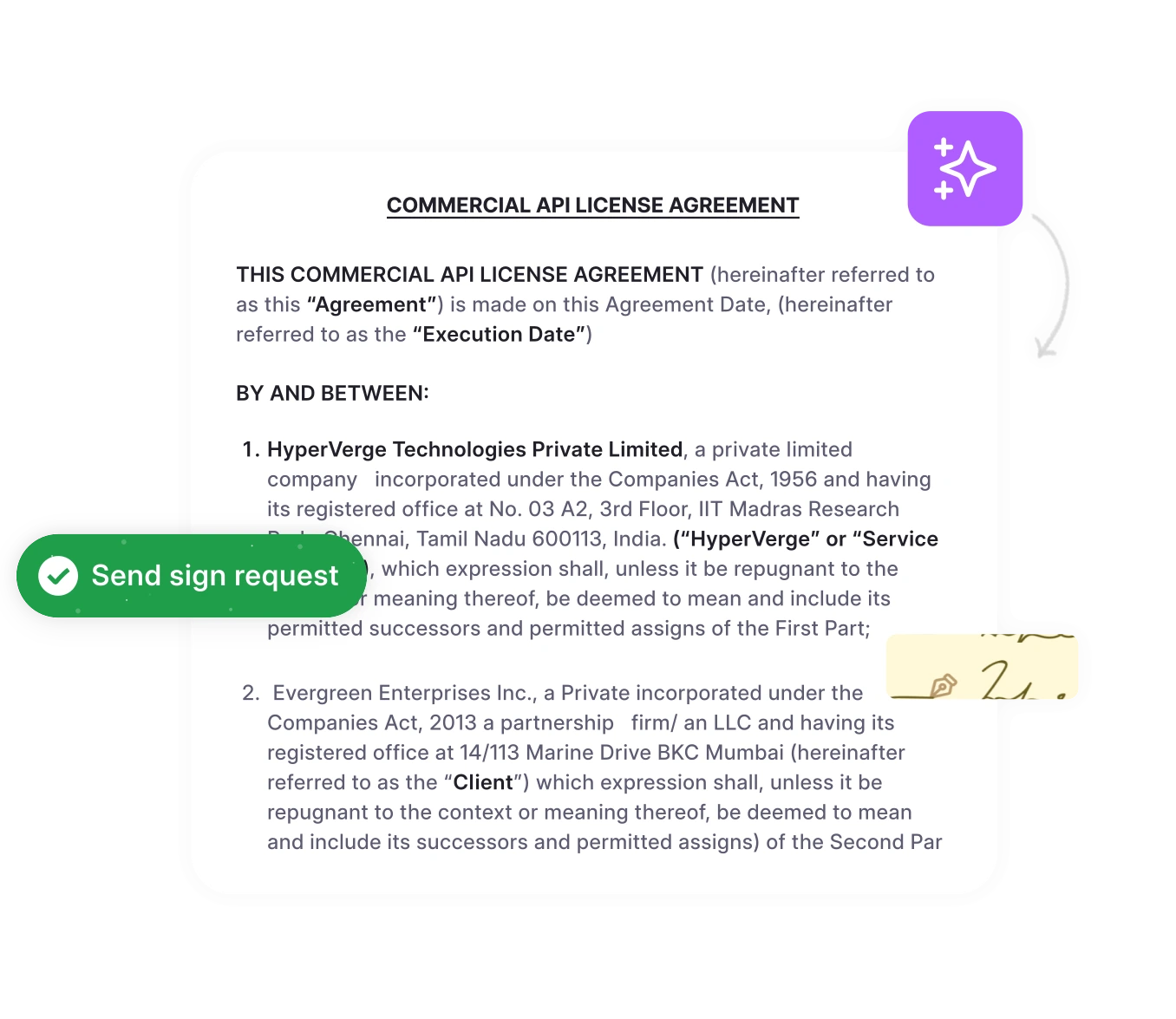
HyperStart CLM uses AI built on 1B+ processed documents to extract metadata from your contracts with 94% accuracy. Import your existing contracts with one click, and the AI automatically abstracts key data points: parties, dates, obligations, financial terms, and renewal conditions. No manual spreadsheets. No months of paralegal time.
Book a DemoWhat should you include in a contract abstract? (template)
No two organizations abstract the same data points. But the 25+ fields below cover the most critical information across contract types. This template applies across all major contract types including NDAs, MSAs, vendor agreements, and employment contracts. Use this as your starting template and customize for your industry.
Party and counterparty information
Full legal names of all parties (as they appear in the contract)
Registered addresses and jurisdictions of incorporation
Authorized signatories (names, titles)
Parent company or subsidiary relationships (especially for guarantees)
Primary contact person for contract management
Key dates and milestones
Effective date / execution date
Expiration date / end date
Renewal date and renewal type (auto-renewal vs. manual renewal)
Notice period for termination or non-renewal (days/months required)
Key milestone dates (deliverable deadlines, review dates, performance checkpoints)
Amendment dates (if the contract has been modified since execution)
Financial terms and obligations
Total contract value / total consideration
Payment terms and schedule (net 30, net 60, milestone-based)
Pricing structure (fixed, variable, tiered, usage-based)
Penalties, late fees, or interest clauses
Currency and exchange rate provisions
Price escalation or adjustment mechanismsPrice escalation or adjustment mechanisms
Insurance requirements and minimum coverage amounts
Risk and liability clauses
Indemnification terms (mutual or one-way, scope, carve-outs)
Limitation of liability (cap amount, exclusions)
Force majeure provisions
Governing law and jurisdiction
Dispute resolution mechanism (arbitration vs. litigation, venue)Confidentiality and non-disclosure obligations
Dispute resolution mechanism (arbitration vs. litigation, venue)
Data privacy and data processing terms (especially for GDPR, CCPA compliance)
Change of control provisions
How the contract is affected if one party undergoes a merger, acquisition, or change in ownership
Assignment restrictions and consent requirements
Termination rights triggered by change of control eventsssignment restrictions and consent requirements
This field is especially critical for enterprise and M&A contexts. Change of control clauses determine whether contracts survive an acquisition, require consent from the counterparty, or give either party the right to terminate. Missing this data point during due diligence is one of the most common and costly abstraction oversights.
Renewal and termination terms
Auto-renewal clause (yes/no, renewal period, renewal terms)
Termination for convenience (notice period, fees)
Termination for convenience clauses and associated costs
Post-termination obligations (data return, transition assistance, survival clauses)
Non-compete or exclusivity provisions
This 25+ field template is the single most actionable output in this guide. Bookmark it, share it with your team, and adapt it to your specific contract types and compliance requirements.
How abstracted data translates into stakeholder reports
Once data is abstracted and stored, it should feed into tailored reports for different stakeholders rather than a single generic output:
Legal teams: compliance status, risk flags, clause-level obligation tracking, audit trail documentation
Finance teams: payment schedules, penalty clauses, total contract value, revenue recognition triggers
Procurement teams: vendor performance terms, SLA obligations, renewal windows, pricing structures
Senior management: total contractual commitments, upcoming renewals, aggregate liability exposure, strategic risk summary
Configuring your CLM to generate these stakeholder-specific views is what turns abstraction from a data exercise into a decision-making tool.
What are the common challenges with manual contract abstraction, and how do you solve them?
Manual contract abstraction is one of the highest-impact processes to automate, yet most organizations continue to rely on it long after it has stopped being viable. The challenges below are not edge cases. They are the daily reality for any legal or contract team managing more than a few hundred agreements without dedicated tooling.
Challenge 1 – Reducing abstraction time from hours to minutes
Manual abstraction takes 3 to 4 hours per contract, making it unsustainable for organizations with 500+ contracts. A team of three paralegals abstracting full-time can process roughly 6 to 8 contracts per day.
Solution: AI-powered abstraction reduces processing time to minutes per contract. Prioritize AI for high-volume, standardized contract types and reserve manual abstraction for complex, non-standard agreements.
Challenge 2- Eliminating inconsistency across abstractors
Without standardized processes, every abstractor develops their own style. One person captures 15 data points. Another captures 10. Date formats vary. Party names are recorded differently across abstracts.
Solution: Define a standardized extraction template (use the one in this guide as a starting point). Implement QA checks where a second reviewer validates every abstract against the template. In a CLM system like HyperStart, mandatory fields enforce consistency automatically.
Challenge 3 – Catching human errors before they become costly
One misplaced decimal, one incorrect renewal date, or one wrong party name can cost thousands in missed obligations or unfavorable renewals.
Solution: Implement a dual-review process (abstractor plus validator). AI tools can cross-reference extracted data against the source document to flag discrepancies. For financial terms, automated validation checks catch common errors like totals that do not add up or dates that are logically inconsistent.
Challenge 4 – Scaling abstraction beyond a few hundred contracts
Manual abstraction does not scale beyond a few hundred contracts. Organizations with legacy portfolios of 5,000+ contracts face years of backlog.
Solution: Use AI to bulk-process legacy contracts. One-click smart import features in CLM platforms can abstract thousands of contracts in days, not years. HyperStart’s AI, built on 1B+ processed documents, handles this at scale with 94% accuracy.
Challenge 5 – Keeping abstracts current as contracts change
Contracts get amended, renewed, and modified over time. An abstract created at execution becomes outdated if amendments are not reflected.
Solution: CLM platforms with version control automatically update abstracts when amendments are processed. AI can re-abstract updated contracts and flag changes to previously extracted data points. Schedule regular repository audits to catch any abstracts that have fallen out of sync with the current contract version.
How does AI-powered contract abstraction work?
AI has transformed contract abstraction from a manual, labor-intensive process into a scalable operation. Here is how the technology works.
How NLP and machine learning extract contract data
AI-powered contract abstraction relies on four technologies working together:
OCR (Optical Character Recognition): Converts scanned paper contracts, PDFs, and image-based documents into machine-readable text. This is the first step for any legacy contract portfolio that includes physical documents or non-searchable PDFs.
NLP (Natural Language Processing): Analyzes the text to identify and classify entities (party names, addresses), dates (effective, expiration, renewal), financial terms (values, payment schedules), and clause types (indemnification, limitation of liability, force majeure). NLP understands context, so it can distinguish between a “party” as a contractual entity and the word “party” used in other contexts.
Machine learning models: Trained on millions of contracts to recognize patterns and improve accuracy over time. The more contracts the system processes, the better it gets at handling variations in language, formatting, and structure across different contract types and industries.
Field mapping: The system maps extracted data to standardized fields in your CLM or database. Dates go into date fields, financial values into currency fields, and party names into entity fields. This ensures the abstracted data is immediately searchable and reportable.
Accuracy and the role of human review
AI accuracy for key data points typically ranges from 94 to 99% depending on contract complexity. For standardized contract types (NDAs, MSAs, vendor agreements), accuracy is at the higher end. For complex, non-standard agreements, accuracy may be lower and human review becomes more important.
Human-in-the-loop review remains essential. The most effective approach is AI abstraction combined with human validation, where AI does the heavy lifting and humans verify, correct, and handle edge cases. AI flags ambiguous terms for human attention rather than guessing. Over time, human corrections feed back into the AI model, improving accuracy for future contracts of the same type.
HyperStart contract management software is built on HyperVerge’s 1B+ document processing platform, delivering 94% accuracy in contract data extraction. For a deeper look at the data extraction side, see our guide on AI contract management.
Extract contract data with 94% AI accuracy
HyperStart’s AI is built on 1B+ processed documents. It extracts parties, dates, financial terms, obligations, and renewal conditions automatically, turning months of manual work into minutes. Import your entire contract portfolio with one click.
Book a DemoWho uses contract abstraction? Applications across departments and industries
Contract abstraction is not a niche legal function. It has broad applications across departments and industries, and the value it delivers depends on what each team extracts and how they use that data.
By department
Legal departments
Legal teams use abstracted data for quick access to key terms, risk assessment, compliance monitoring, litigation support, and managing contractual obligations. Abstraction allows legal to move from reactive fire-fighting to proactive contract risk management.
Procurement and sourcing teams
Procurement relies on abstracted data to understand supplier obligations, pricing terms, renewal dates for vendor contracts, and SLA commitments. This helps in negotiating better deals, managing supplier performance, and ensuring continuity of supply.
Sales and commercial teams
Sales teams use abstracted customer contract data to track entitlements, renewal opportunities, and compliance with agreed terms. For more on managing this, see our guide to sales contract management.
Finance and accounting departments
Abstracted financial terms including payment schedules, revenue recognition triggers, and penalty clauses are critical for accurate budgeting, forecasting, billing, and compliance with financial reporting standards.
By industry
Healthcare and life sciences
Clinical trial agreements, licensing deals, supplier contracts, and BAA (Business Associate Agreement) terms contain complex regulatory, IP, and payment obligations that must be tracked at the clause level. Abstraction in healthcare is not optional in highly regulated environments. For more, see our guide to healthcare contract management.
Financial services and banking
Loan agreements, investment contracts, and compliance documents contain terms where a single misread clause can create regulatory exposure. Abstraction is essential for contract risk management in this sector. For more, see our guide to contract management software for banks.
Technology and SaaS
SaaS agreements, licensing contracts, and IP-related documents benefit from abstraction to manage subscriptions, royalties, auto-renewal terms, and data processing obligations. For more on managing this in a tech environment, see our guide to IT contract management.
Real estate and lease management
Managing numerous lease agreements with varying terms, renewal dates, CAM charges, and maintenance obligations becomes far simpler with abstraction. Lease abstraction is a specialized form of contract abstraction focused specifically on real estate agreements, with extraction templates tailored to lease-specific data points like rent escalation schedules, renewal options, and tenant improvement allowances.
Manufacturing and construction
Construction contract management involves complex obligation tracking across change orders, milestone deliverables, SLA performance, and warranty terms. Abstraction gives procurement and legal teams visibility into post-signature obligations that would otherwise require manual contract re-reading.
When does your organization need contract abstraction?
Contract abstraction is not a one-time project. It is an ongoing operational capability. But certain events make it urgent.
M&A due diligence
Acquiring a company means inheriting hundreds or thousands of contracts with unknown obligations, risks, and financial commitments. Contract abstraction gives the deal team structured visibility into liabilities, change-of-control clauses, assignment restrictions, and financial obligations within days instead of weeks. See our full guide to merger and acquisition contract considerations for more detail.
CLM migration
Moving from spreadsheets, shared drives, or an old CLM to a new platform requires structured data. Abstraction ensures legacy contracts are imported with complete, structured metadata rather than as unorganized PDF files. For a step-by-step approach, see our guide to CLM implementation.
Compliance audits
Regulators and auditors ask specific questions about your contractual obligations. What are your data processing terms? Which contracts include arbitration clauses? What is your total liability exposure? Abstracted data provides instant answers and feeds directly into contract management reporting.
Growing contract portfolio
When your organization’s active contract volume exceeds 500+, manual tracking breaks down. Renewals are missed through inadequate contract tracking. Obligations go untracked, increasing contract risk. Abstraction is the foundation for scalable contract management.
For more on the technical side of pulling data from contracts, see our guide on contract data extraction.
Turn your contract backlog into structured data with HyperStart
Contract abstraction turns unstructured legal documents into actionable, structured data that your organization can search, track, and manage at scale. Without it, critical information stays buried in PDFs and filing cabinets where it cannot drive decisions.
Manual abstraction is slow (3 to 4 hours per contract), inconsistent, and does not scale. AI-powered abstraction delivers the same output in minutes with 94%+ accuracy, making it the only viable path for organizations managing hundreds or thousands of contracts.
Start with the 25+ field template in this guide to define your extraction standard. Then explore how a CLM platform automates the entire process from extraction to storage to reporting.
HyperStart CLM automates contract abstraction with AI-powered metadata extraction built on 1B+ processed documents. One-click smart import abstracts your entire contract portfolio, and every data point feeds directly into renewal alerts,obligation tracking, and compliance dashboards. The platform deploys in 4 weeks with a 100% implementation success rate.
For more on building a complete contract analysis practice, explore our guides to contract analysis and contract management best practices.